There is a particular kind of exhaustion that comes from chasing success the wrong way. You work hard, you check the boxes, you sacrifice sleep and weekends and quiet mornings — and somewhere along the line, the thing you were chasing stops feeling like it was worth chasing. You hit your goal and feel hollow. You miss it and feel worse.
The corrective isn’t to want less. It’s to build differently.
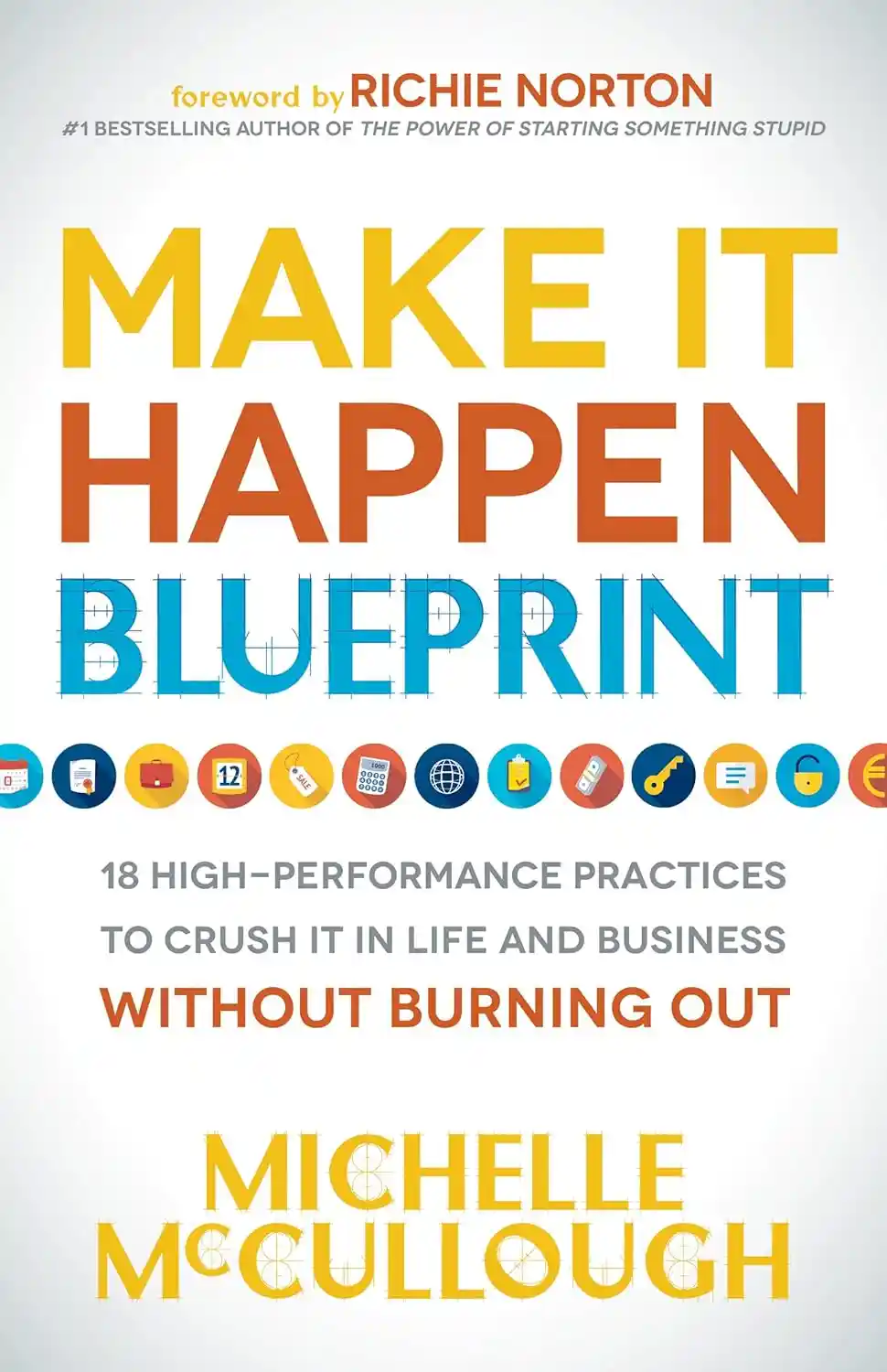
In Make It Happen Blueprint: 18 High-Performance Practices to Crush It in Life and Business Without Burning Out, Michelle McCullough — entrepreneur, speaker, and longtime business coach — offers a refreshingly grounded answer. After years of working with thousands of clients, building three companies of her own, and raising two young kids, she distilled what she’d learned into eighteen practices. Not eighteen shortcuts. Not eighteen hacks. Eighteen habits that, taken together, form the quiet architecture of a high-performing life.
What’s striking about her list is how unglamorous most of it is. There’s no breakthrough productivity app. No proprietary five-step system. Just a clear-eyed reminder that the people who consistently make things happen tend to do a small set of ordinary things with uncommon discipline.
This article is a tour through all eighteen practices, organized into the five clusters they naturally fall into: how you think, how you plan, how you work, how you relate, and how you live. Use it as a map. Then go deeper into the practices that meet you where you are.
Cluster 1: How You Think (The Inner Foundation)
McCullough is unambiguous about where high performance starts: it starts in the mind. Before you can build a calendar that works or a business that scales, you have to clear out the mental clutter that quietly sabotages everything you try.
Lesson 1. Possibility. This is the practice of seeing beyond your usual ceiling. McCullough describes a year she chose the word “limitless” — and watched her business quadruple, her relationships deepen, and her first book get picked up by a major publisher in two years instead of five. The mechanism wasn’t magic. It was the simple act of noticing the limitations she’d placed on herself and choosing to test them. Vision boards, “word of the year” exercises, and morning pages all serve the same purpose: making the desire visible enough that you stop pretending it isn’t there.
Lesson 2. Pledge. Owning your life means refusing to be a passenger in it. McCullough uses the metaphor of being given a free luxury car only to be told the dealer drives. Most of us live that way — letting circumstances, employers, or family dynamics dictate our route. The pledge is simple: “I choose to own my life. From this point forward I choose to create a future and a life I love.” It’s the prerequisite for everything else.
3. Permission. The most paralyzing thought in your way is some version of I don’t deserve this. McCullough confesses this was her single biggest deterrent to her own goals for years — until she realized she was waiting for an engraved invitation that was never coming. Permission, in her framing, is something you give yourself. The world rarely will.
4. Purpose. Knowing your “why” — the deeper motivation underneath what you do — is what carries you through the hard middle of any project. McCullough’s own purpose is to help people choose happiness in every stage of life. Yours might be smaller or larger, professional or personal. The point isn’t grandiosity. The point is alignment.
Cluster 2: How You Plan (Turning Vision Into Schedule)
A vision without a plan is a daydream. McCullough is direct about this, and offers two of her most distinctive tools in this cluster.
5. Planning. “Plan” is the four-letter word for success, McCullough says, and high performers find power in it rather than resistance. Her go-to tool is the Time Map — a weekly schedule built around blocks of time dedicated to specific roles and tasks (marketing time on Monday afternoons, family time in the evenings, content creation Tuesday mornings). She also offers the SMARTY goal framework — Specific, Measurable, Attainable, Realistic, Timely, plus Your Why — arguing that without the why, even well-structured goals collapse under pressure.
6. Productivity. Planning tells you what to do. Productivity is doing it. McCullough identifies four time traps that drain most people’s days: failure to plan, distraction, the misdirection of multitasking, and failure to delegate. Her remedies are practical and immediate — checking email three times a day instead of constantly, batching similar tasks, posting “office hours” even if you work from home, treating focus as a skill rather than a personality trait.
7. Peace. This one surprises people. Peace as a high-performance practice? Yes — because the alternative is the chronic low-grade panic that erodes decision-making and depletes energy. McCullough recommends “inner voice appointments”: ten to thirty minutes mid-day, no phone, no agenda, just sitting and letting the mind catch up with itself. She also offers a three-question check-in for any area of life: What’s working? What’s not working? What needs to change?
8. Power Up and Power Down. The bookends of a high-performing day. The Power Up routine — done before email, before kids wake, before any external input — combines light movement, vision review, inspirational reading, and meditation. The Power Down mirrors it: gratitude journaling, scheduling a glance at tomorrow, reading something nourishing, ending tech-free. McCullough is candid: she doesn’t do these every day. Just the days she wants to be a high performer.
Cluster 3: How You Work (The Engine Room)
Even with a clear vision and a structured calendar, the doing itself takes a particular set of habits.
9. Persistence. Successful people fail. A lot. McCullough lists eight businesses she’s started — some clear failures, all of them teachers. Her favorite borrowed line: “Persistence trumps talent.” High performers see failure as feedback rather than verdict, and they keep going for one more attempt longer than the people who give up. The world rewards stamina more than it rewards genius.
10. Positivity. Not toxic positivity. Not pretending your problems aren’t real. Just the disciplined practice of looking for the good — through gratitude journaling (five things every day, however small), through choosing happiness as a daily decision rather than a future destination, through refusing to spread the drama. The bonus, McCullough notes from interviewing Danielle LaPorte: when you operate from joy, you actually become more productive and more useful to other people.
11. Plasticity. From the dictionary definition: the capacity for being molded and altered. High performers stay teachable. They subscribe to industry publications, attend conferences, take feedback as data rather than insult. McCullough’s image: be a sieve, not a sponge or a rock. Take in everything, separate what’s valuable, let go of the rest.
Cluster 4: How You Relate (Because Nothing Big Gets Built Alone)
Four of the practices are explicitly about other people — and McCullough argues these are what make sustained high performance possible.
12.People-Centric. A debate coach once pointed at her and said, “I hope when people look at Michelle they don’t just see a good debater. I hope they see a nice person, too.” That moment, she writes, has shaped her career. No award, paycheck, or achievement is more important than how you treat people — and that includes strangers, grocery clerks, the rude driver, your tired spouse. Self-mastery is how you act when no one’s watching the scoreboard.
13. Power Team. McCullough’s pyramid has three levels: foundational support (people you delegate to), core friend support (the mutual relationships that sustain you), and mentor support (people who’ve walked the path ahead). Most of us neglect at least one level — usually the foundational, because we think we should do everything ourselves, or the mentor, because we feel we should already know.
14. Persuasion. The chapter she calls “Enrollment.” It’s a four-step formula for getting people on board with your goals: share the vision, commit to the goal, explain the plan and the specific support you need, then ask the question of support. McCullough uses it on her husband, her employees, and her young children — and is candid about the years she spent expecting people to read her mind instead.
15. Pride. Confidence, not arrogance. McCullough draws the distinction sharply: arrogance is rooted in believing you’re better than others; pride is rooted in satisfaction with a job well done. High performers take pride in their work without using it to diminish anyone else’s. They also know the inverse — that confidence is a practice, not a trophy.
Cluster 5: How You Live (The Body, The Joy, The Next Generation)
The final cluster is what makes the whole thing sustainable rather than a sprint to burnout.
16. Physical Health. McCullough’s framing: your body is the vehicle for your dreams. Eight habits run through her chapter — find an exercise you actually enjoy, schedule it like an appointment, drink water, eat real food, don’t skip breakfast, keep a healthy mindset, take vitamins your doctor recommends, and sleep more than you think you need. Nothing exotic. Just non-negotiable.
17. Play. The chapter that demolishes the “life balance” myth. Balance assumes equal distribution, McCullough argues, and that’s neither realistic nor desirable. The better goal is prioritization — knowing what matters most this season and protecting it. She recommends two play lists: a Free Play List (twenty-five things you can do for fun cheaply) and a Wish Play List (twenty-five bigger dreams that motivate you). Without play, work eats everything.
18. Raising Up Little High Performers. The final practice extends the framework to the next generation. McCullough offers “anchor points” — positivity, gratitude, future-thinking, traditions, family themes, individual goals, goal parties — that help kids absorb high-performance habits early. The deepest message of the chapter: no goal or practice will substitute for huge doses of love and presence. Kids who know they’re loved can absorb almost anything. Kids who don’t won’t be helped by any framework you give them.
How to Actually Use This
Eighteen practices is too many to start at once. McCullough’s suggestion — and it’s a good one — is to read through, notice which one or two land hardest in your gut, and start there. Maybe it’s permission. Maybe it’s the Power Up routine. Maybe it’s the realization that you’ve been spending your whole life waiting for someone else to drive.
The practices are mutually reinforcing. Possibility opens space for purpose. Purpose anchors planning. Planning enables productivity. Productivity creates room for peace. Peace makes you a better person to be around, which strengthens your power team, which carries you through the inevitable failures of persistence. The whole system tightens around itself.
What ties it together is McCullough’s central conviction: high performance isn’t a personality. It’s a practice. Anyone willing to do the unglamorous work of building these habits — slowly, imperfectly, with grace for the days they fall apart — can build a life that crushes it without crushing them.
Pick one. Start tomorrow morning. The currency, as McCullough puts it, is work. And the work is worth it.
This article is based on the book Make It Happen Blueprint: 18 High-Performance Practices to Crush It in Life and Business Without Burning Out by Michelle McCullough (Morgan James Publishing, 2017).
Related posts:
 How to Raise High-Performing Kids: 6 Anchor Points That Work
 How to Create a Vision Board That Actually Works (And Why Most People Fail)
 The Power Team Pyramid: Who You Need Around You to Reach Big Goals
 The Life Balance Myth: Why High Performers Choose Priorities Over Balance
 Your Body Is the Vehicle for Your Dreams: 8 Healthy Habits of Successful People