There’s a particular trap people fall into when life gets hard. The mind, trying to protect us, becomes a relentless scanner for what’s wrong. Every interaction gets parsed for insult. Every news cycle reinforces the sense that things are bad and getting worse. Every accomplishment is immediately measured against what’s still missing. And we walk through our days vaguely heavier than we should be, often without quite knowing why.
The most common advice — be more positive! — is useless. You can’t decide to be positive any more than you can decide to be hungry. Positivity isn’t a switch. It’s a byproduct of where you’ve trained your attention.
In Make It Happen Blueprint, business coach Michelle McCullough shares a simple practice that’s done more for her outlook than any amount of optimism-talk: a daily gratitude journal. Five things, every night, that you were grateful for that day. That’s the whole instruction.
The practice sounds almost too modest to matter. McCullough tells the story of how she resisted it during one of the darkest periods of her own life, and how it transformed her experience anyway. This article walks through why it works, how to start, and what people get wrong about gratitude as a practice.
The Practice in One Paragraph
Get a small notebook. Keep it by your bed. Every night, before you turn out the light, write down five things from the day you were grateful for. Specific things. Not “my health” but “the way the sun hit the kitchen at 4 PM” or “my coworker checked in on the project without me having to ask.” Five items. Three to five minutes. Then put the notebook away and sleep.
That’s it. That’s the entire practice. McCullough has been doing some version of it for years, after first encountering the idea in Sarah Ban Breathnach’s Simple Abundance.
What makes it work isn’t anything mystical. It’s that the practice gradually retrains where your attention goes during the day. Knowing you’ll be looking for five things to write down at night, your mind starts noticing them as they happen. The noticing changes everything.
When She Almost Didn’t Start
The honest part of McCullough’s story is that she nearly didn’t try the practice. When she first read about gratitude journaling, she was twenty-one, freshly divorced from a marriage that had collapsed faster than she could have imagined. The book recommended five gratitudes a day. McCullough remembers thinking that if the author knew what was actually going on in her life, she would understand it wasn’t the right time.
After reading about it in nearly every chapter, she eventually consented — partly out of stubbornness, almost in an attempt to prove the author wrong.
The early entries were surface-level. Grateful for my health, a roof, a car, dinner, my paycheck even though it’s a poor college-student paycheck. Performative gratitude, basically. The kind people write when they’re going through the motions.
But something shifted as the days went on. The act of looking, even reluctantly, started revealing things she’d been missing. Friends who called at exactly the right moment. Mysterious neighbors leaving laundry soap and postage stamps on her porch. Teachers and coworkers showing up with kindness she hadn’t registered in real time. The miracles, as she puts it, had been happening all along. She’d been so caught in her own woes that she hadn’t been able to see them.
This is the secret of the practice: it doesn’t manufacture gratitude. It surfaces what was already there.

Why Gratitude Journal Works
The mechanism is well-understood at this point.
The brain has a strong negativity bias — an evolutionary feature that helped our ancestors survive but doesn’t serve us well in a world where most threats aren’t lions. Without intervention, the mind defaults to scanning for problems. Gratitude practice intervenes in that default. It deliberately directs attention toward the good.
Over time, this attention shift starts happening automatically. You begin noticing positive moments in real time, not just at the end of the day when you’re cataloging them. The practice rewires the scanner.
There’s also a simple compounding effect. McCullough puts it as plainly as possible: when you look for the good, you find it. When you look for the bad, you find that too. Whatever you’re scanning for is what your day will appear to be made of. The world contains both. Your attention picks the version you live in.
What Most People Get Wrong
Three mistakes kill most gratitude practices before they get going.
Going too abstract. “I’m grateful for my family” is true but useless as a journal entry. The brain processes it as a phrase, not an experience. Specificity is what makes the practice work. I’m grateful that my daughter laughed at my terrible joke at dinner. I’m grateful that the coffee shop got my order right today. I’m grateful for the clean sheets. The smaller and more specific, the more it reaches.
Treating it as a performance. Some people approach the journal as a place to demonstrate they’re a properly grateful person. The entries get rehearsed, sanitized, performance-quality. This kills the practice. The journal is for you. No one else will read it. Be honest about what actually felt like a small grace today, not what you think should have.
Giving up too soon. The first week or two often feels mechanical. The entries feel forced. You wonder if it’s doing anything. This is normal. The practice’s effects are cumulative — they show up around weeks three to six, not days three to six. Push through the early awkwardness.
What to Write When the Day Was Hard
The practice is easy on good days. The real test is the hard days — the days you’re tempted to skip the journal because you can’t think of anything good.
McCullough’s approach: do it anyway, especially then. The hard days are when the practice matters most.
If five things feel impossible, start with one. The cup of tea that warmed your hands. The fact that you got out of bed. A song that helped. A friend who texted. The mind that’s been busy cataloging everything that went wrong will fight the exercise. Push through. Find one. Then another. By the third or fourth, something usually shifts.
There’s a deeper principle here from McCullough’s interview with Danielle LaPorte, which she quotes in her chapter. LaPorte, asked what she’d say to someone who feels they can’t possibly be happy right now: don’t worry about getting out of your circumstances. Don’t worry about solving everything. Just get to the place where you can say I would prefer to feel calm. I would prefer to feel energetic. And then find one small thing tomorrow that helps you feel that way.
The gratitude journal is one of those one small things. On the worst days, it can be the only practice that’s still available.
Beyond the Journal: The Full Positivity Practice
The journal is the foundation, but McCullough’s full practice for positivity has a few other components worth knowing.
Refuse to spread the drama. McCullough quotes media expert Peter Shankman’s challenge: stop spreading drama. In your social media. In your conversations. At the water cooler. The ambient negativity we contribute to is also negativity we marinate in. Cutting your contribution to it changes what comes back.
Notice your “I’ll be happy when” sentences. The trap of conditional happiness — I’ll be happy when I get the promotion / lose the weight / find the partner / finish the project — is one of the most reliable ways to never be happy. Whatever fills in that blank, the mind moves the goalposts the moment you reach it. The cure is to find ways to be happier now, in actual current circumstances, regardless of whether the conditions are met.
Do the positivity science project. McCullough recommends one experiment: pick a day. Commit to being genuinely happy for the entire day — not faking, but actively choosing happiness as your default. Notice what changes. Notice how strangers respond. Notice how it affects work and relationships. Most people are surprised by how much one day reveals about how their default state has been costing them.
Reframe job dissatisfaction. If you don’t love your work, you have two real choices: change the job or change the outlook. Drifting in resentment isn’t a third option, it’s just suffering. McCullough’s example of Richard, the cheerful employee at her local discount store, shows what taking pride in what you do — regardless of the job itself — can look like. Same store, same shifts, completely different experience.
The Rich Are Not Always Grateful
One of the most striking moments in McCullough’s chapter is her account of going to Mexico at fourteen to do humanitarian work. Her family helped build a small addition onto a shack housing two parents and eleven children. The family had no electricity, no running water, dirt floors, an outhouse. Their last night together, the family made dinner and presented a program — one daughter sang an American hymn in Spanish.
The family was, as McCullough remembers, bright shining lights of joy. They were grateful for every little thing they had. They loved each other. Their gratitude and love made the small home ooze with happiness.
The point isn’t to romanticize poverty. Poverty is hard. The point is that the relationship between circumstances and gratitude is much weaker than we assume. People with very little can be deeply grateful. People with a great deal can be perpetually unsatisfied. The variable is the practice, not the situation.
This means the practice is genuinely available to everyone. Whatever your circumstances, the work of looking for what’s good is the same work.
Start Tonight
You don’t need a special journal. You don’t need a perfect setup. Tonight, before you sleep, find any piece of paper or open the notes app on your phone (yes, screens are okay for this if it’s the only way it’ll happen consistently).
Write down five things from today you were grateful for. Specific things. Small is fine.
Do it tomorrow night. And the next.
After two weeks, you’ll start to notice the shift. After two months, the people around you may notice. After a year, you’ll have a record of the small graces of an entire year of your life — and a brain trained to find them as they happen.
The practice doesn’t make hard things easy. It doesn’t fix what’s broken. What it does is restore your ability to see the good that’s always been there alongside the hard. That ability, McCullough has come to believe, is one of the foundational practices of high performance — because nothing sustainable gets built on a steady diet of dissatisfaction.
The good is there. The practice is just learning to look.
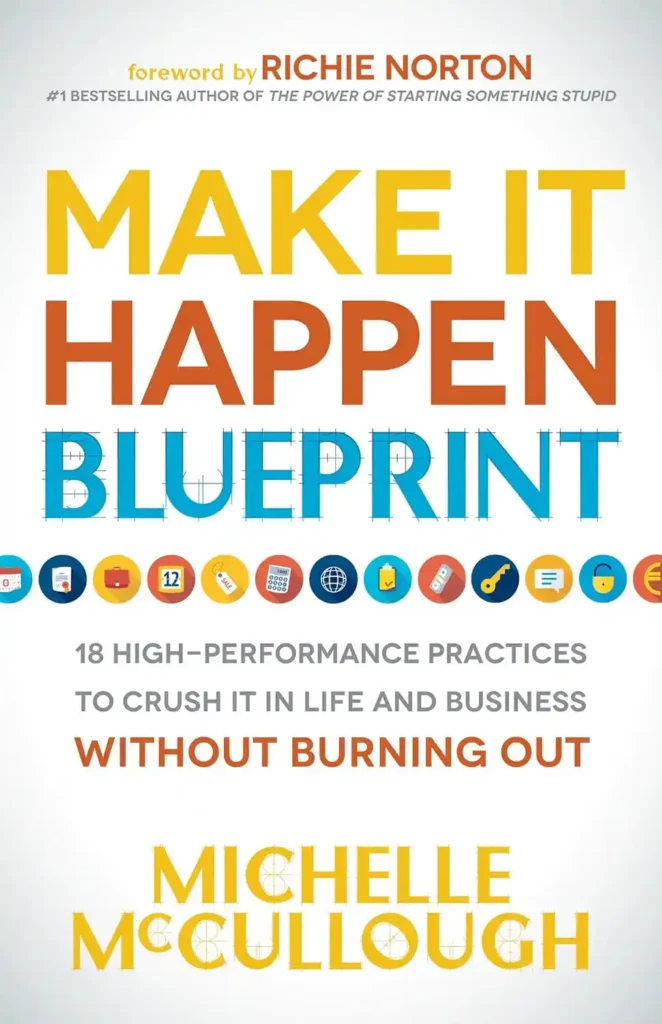
This article is inspired by the chapter on Positivity in Make It Happen Blueprint: 18 High-Performance Practices to Crush It in Life and Business Without Burning Out by Michelle McCullough (Morgan James Publishing, 2017).
Related posts:
 The Neuroscience of Gratitude: How to Rewire Your Negativity Bias
 Make It Happen Blueprint: 18 High-Performance Practices to Crush It in Life and Business Without Burning Out (Full Summary & Course)
 How to Raise High-Performing Kids: 6 Anchor Points That Work
 The Morning and Evening Routines That Set High Performers Apart
 How to Create a Vision Board That Actually Works (And Why Most People Fail)