There’s a tired narrative floating around about success that goes something like this: to get ahead, you have to be ruthless. Nice people get walked on. The corner office belongs to the sharp-elbowed ones. If you want to win, learn to play the game without sentimentality.
This story sells books and TV shows. It also produces a lot of unhappy, isolated people who climbed the ladder only to discover the view at the top wasn’t worth what they gave up to get there.
In Make It Happen Blueprint, business coach Michelle McCullough makes the opposite case with the directness it deserves: kindness isn’t a soft skill. It’s a foundational success skill. And how you treat people — including the people who can do nothing for you — is one of the most reliable predictors of how far and how sustainably you’ll actually go.
This article is about why this is true, what people-centric high performance actually looks like, and how to practice it without becoming a doormat.
The Moment That Shaped a Career
McCullough opens her chapter on people-centric living with a story from high school debate camp. She’d worked hard, won her share of trophies, and arrived at camp feeling, in her words, like pretty hot stuff. The director, Dennis Edmunds, was retiring and gave a final lecture that included life and success principles beyond debate tactics.
Then he pointed directly at her.
“I hope when people look at Michelle, they don’t just see a good debater,” he said. “I hope they see a nice person, too.”
She was a teenager at the time. Twenty years later, she still hears those words on a regular basis. The question they planted — am I a nice person now? — has shaped her career.
What strikes about this story isn’t the recognition that kindness matters. Most of us would say we believe that. What strikes is how rarely we measure ourselves by it. We track our wins, our paychecks, our titles, our followers. We track our productivity and our progress. We very rarely sit down at the end of a day and ask: was I kind today? To whom? Where did I fall short?
McCullough’s argument is that high performers do ask this question, and that the asking is part of what makes them high performers in the first place.
The Quiet Mathematics
There’s a practical reason kindness pays, beyond just being morally correct.
Your career, your business, and your personal life are all built on relationships. People remember how you made them feel. They remember whether you treated them like a human being or a transaction. The clerk you snapped at, the colleague you took for granted, the contact you only reached out to when you needed something — they all remember. And the world is much smaller than people realize.
McCullough’s wise friend Monty: Life is just a long test in interpersonal relationships.
The people who reach high levels and stay there tend to be people who built genuine goodwill on the way up. The people who leveraged others ruthlessly often hit a ceiling — sometimes high, but never as high as they could have gone — and they often fall hard when they hit it. The math is unsentimental. People who have been treated well show up for you when it counts. People who have been used don’t.
This isn’t an argument for being calculating about kindness. The moment kindness becomes strategic, it becomes manipulation, and people can tell. The argument is simpler: genuine kindness is an investment in a kind of capital that compounds over decades.
What Counts as Kindness
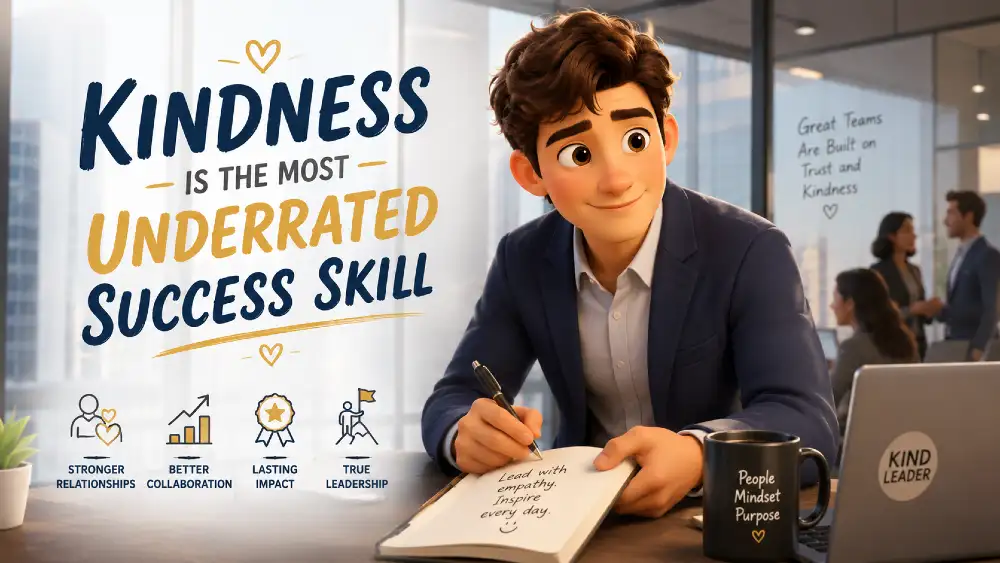
McCullough’s key insight is that kindness isn’t selective. It’s not how you treat people who can help you, or people who are watching, or people in your in-group. It’s how you treat everyone.
You can’t be nice to your boss and rude to the grocery clerk. You can’t be sweet to your best clients and dismissive to the entry-level person who answers their email. You can’t be charming at networking events and mean to the customer service rep who put you on hold. Or rather, you can — many people do — but it’s not kindness. It’s performance. And the gap between your performance and your character shows up eventually.
True kindness is what you’re like when nothing’s at stake. When the person can do nothing for you. When no one is watching. When you’re tired and traffic is bad and your day didn’t go your way.
This is what self-mastery actually looks like. Not perfect emotional control, but the basic discipline of not making your bad day someone else’s problem.
The Question That Cuts Through
McCullough offers a question that’s worth carrying around: What is it costing me to be right?
Almost everyone has had a relationship that eroded because they cared more about being right than preserving the connection. The argument that lasted longer than it should have. The point you made that landed harder than it needed to. The grudge you held instead of letting it go.
Each of these moments has a cost. The cost is paid in connection, in trust, in the texture of a relationship over time. Sometimes the cost is small. Sometimes it’s enormous — a marriage, a friendship, a working partnership.
The question doesn’t mean you should never assert yourself or stand your ground. It means you should know what the choice is costing. If the cost is acceptable, fine. If it isn’t, the prize of being right may be more expensive than it looks.
Standing Up Without Putting Down
Worth being clear: kindness isn’t passivity. McCullough is direct that being people-centric doesn’t mean letting yourself be treated badly. You shouldn’t allow people to treat you poorly.
The skill is responding without harming. There’s a way to share your views, push back, set a boundary, or correct a misunderstanding that doesn’t demean the other person. The difference is in the energy: are you trying to be heard, or are you trying to wound?
McCullough offers an example of opening dialogue when a relationship has gone sideways: I know in the past we’ve communicated in a way that wasn’t good for either of us. I’m sorry. I’d like to stop that and move forward with a healthier way of communicating. The opening doesn’t put the other person on trial. It owns your part. It invites repair.
People who can do this — assert without attacking, push back without poisoning, repair without grovelling — have an enormous advantage in any relational context, professional or personal. The skill is rarer than it should be.
The Code of Ethics for High Performers
McCullough offers a kind of code in her chapter — a set of principles that describes how high performers tend to relate to others. A condensed version:
High performers don’t just understand the value of a person — they understand the value of every person.
They don’t seek success at the expense of others. They know there’s no better success than making a difference in the life of one person.
They listen well. They practice Stephen Covey’s principle: seek first to understand, then to be understood.
They put customers first and value meeting needs over making sales. They understand it’s not about the transaction — it’s about creating customers for life.
They provide value even when there’s no sale at the end.
They see friendship as a two-way street. They give more than they take.
They take romantic relationships seriously and protect them.
They use their knowledge for the good of others. They mentor.
Their circle of influence extends beyond home and office. They smile at strangers, help passers-by, try to leave everyone they meet a little better.
They never belittle, demean, or put down anyone — regardless of station, class, or circumstances.
They don’t bully and they don’t tolerate bullying when they see it.
They compete to be their best selves, not to defeat others.
This isn’t a checklist to perform. It’s a description of how genuinely people-centric people tend to operate. The point isn’t to memorize the list. The point is to recognize the pattern and start practicing one or two pieces that resonate.
The Repair Conversation
McCullough tells a story worth pausing on. She had a relationship with a family member that needed to change. It was a hard conversation — sincere apology, real commitment to new ways, then actually doing them.
The result surprised her. The person who had been putting blocks in her way became one of her biggest supporters. Where there had been friction, there was suddenly partnership. The family member is now someone she says she couldn’t do her work without.
This is one of the underrated moves in life. Most of us have at least one relationship — sometimes more — that’s been quietly damaged and that we’ve concluded can’t be repaired. We avoid the person. We work around them. We pay the ongoing cost of the unresolved conflict.
But many of these relationships can be repaired, often with surprisingly simple ingredients: an honest apology for your part, a genuine commitment to new behavior, and the willingness to follow through. Not all of them. Some people aren’t safe or willing. But more than people assume.
If there’s a relationship you’ve been avoiding, consider whether the move that could change everything is just an honest conversation. Often it is.
What This Looks Like in a Workday
People-centric living isn’t a separate practice from your work. It’s how you do the work.
It’s the email that takes thirty seconds longer to write because you actually wished the person well. It’s the meeting where you let the quietest person speak. It’s the moment of patience with the customer who’s struggling to articulate their problem. It’s the choice not to fire off the snippy reply, even though you could justify it. It’s the genuine question — how are you, really? — instead of the reflexive good, you?
None of these are big gestures. They’re small ones, scattered through a day, that together build a reputation. Over years, that reputation becomes a kind of moat around your career. People want to work with you. They recommend you. They show up when you need them. Doors that wouldn’t open for someone equally talented but less kind open easily for you.
The Honest Difficulty
It’s worth acknowledging: this practice is harder than it sounds. We all have bad days. We all have people who push our buttons. We all snap sometimes, hold grudges sometimes, prioritize being right over being kind sometimes.
The point isn’t perfection. It’s direction. Are you, on average, becoming kinder, or harder? Are you treating people, on the whole, more or less generously than you did five years ago? Are the small choices accumulating in the right direction?
McCullough is candid that this is a practice she’s still working on, decades into her career. Her debate coach’s words still run through her mind. She still asks the question. The asking matters more than ever achieving a finished state of kindness.
Start Today
If you want to practice people-centric living, the entry point is small.
Today, smile at strangers. Make eye contact. Acknowledge people. Notice how it shifts the tone of brief interactions.
Today, in any conversation that matters, listen more than you talk. Ask one more question than you would have. Let the other person finish.
Today, if there’s a small grievance you’ve been carrying — a slight, a frustration, a stored-up resentment — consider whether holding onto it is actually serving you, or just costing you energy you could use elsewhere.
Today, if there’s someone you owe a kindness — a thank you, an apology, a check-in — do it before the day ends.
Kindness, McCullough writes, is the practice of remembering that the people in your life are the actual point. Not the goal. Not the paycheck. Not the milestone. The people. Treat them like it, and the rest of your life tends to organize itself around something worth building.
This article is inspired by the chapter on People-Centric in Make It Happen Blueprint: 18 High-Performance Practices to Crush It in Life and Business Without Burning Out by Michelle McCullough (Morgan James Publishing, 2017).
Related posts:
 Make It Happen Blueprint: 18 High-Performance Practices to Crush It in Life and Business Without Burning Out (Full Summary & Course)
 The Power Team Pyramid: Who You Need Around You to Reach Big Goals
 Why Boundaries Are Essential for Healthy Relationships and Self-Respect
 Why a Gratitude Journal Actually Works (And How to Start One Tonight)
 How to Raise High-Performing Kids: 6 Anchor Points That Work