We tend to mythologize talent. The athlete who was born to run, the musician who could play by age four, the entrepreneur who saw a gap nobody else could see. These stories make for good reading. They also quietly do damage to the rest of us, because they suggest success belongs to people with some innate spark we either have or don’t.
The data and the lived experience say otherwise. The people who consistently succeed across long timelines aren’t usually the most talented in any given room. They’re the ones who were still showing up when the more talented people quit.
In Make It Happen Blueprint, business coach Michelle McCullough makes this case with the directness it deserves. Quoting her friend and former coach Tiffany Peterson, she puts it plainly: persistence trumps talent. Calvin Coolidge said something similar a century earlier — that nothing in the world can take the place of persistence, that talent and genius and education don’t, that the slogan “Press On!” has always solved the problems of the human race.
This article is about why this is true, what persistence actually looks like in practice, and how to build it when you weren’t born with thick skin.
What Persistence Actually Is
Persistence isn’t grit-as-performance. It isn’t the white-knuckled refusal to ever feel discouraged. It isn’t pretending the setbacks don’t sting.
Persistence, more honestly, is the willingness to take the next reasonable action after the previous one didn’t work.
That’s it. The next call after the rejection. The next attempt after the failed launch. The next manuscript after the rejection letter. The next mile after the painful one. The next day of showing up after the day that broke your heart.
McCullough tells the story of a half-marathon she trained for despite calling herself a “recovering sedentariest” — someone whose favorite things were movies, popcorn, chocolate, and her couch. She announced the race on Facebook (“because everyone knows there’s no turning back once you post something on Facebook”) and committed to the training. Then, on a long training run, she accidentally maced herself in the face. She spent twenty minutes in a gas station bathroom flushing her eyes out with soap and water.
The lesson she draws isn’t that she’s tough. It’s that the moment was a “trial of fate” — one of the predictable little tests that show up to see whether your conviction is real. Most people would have taken the mace incident as confirmation that they weren’t meant to run. McCullough finished the training. She ran the race.
Persistence is what happens when you refuse to interpret obstacles as verdicts.
Why Talented People Often Lose
Talent has a hidden curse: when things come easily, you don’t develop the muscle for handling things that don’t.
The talented kid who never had to study struggles in college when the material gets hard. The natural athlete who didn’t need to practice fundamentals struggles when the competition catches up. The entrepreneur whose first business succeeded effortlessly is unprepared when the second one demands actual grit.
Coolidge’s phrase that McCullough cites — “unrewarded genius is almost a proverb” — points at exactly this. The world is full of unusually capable people who never built the persistence required to translate capability into results. Talent without persistence is potential energy that never converts to kinetic.
Meanwhile, people of more modest talent who happen to have built persistence keep showing up. They take the rejection. They iterate. They learn. They get incrementally better. Over time, the persistence person passes the talent person on the road, often without either of them quite noticing when it happened.
This isn’t a moral judgment. It’s just how compounding works. Small consistent effort over long timelines beats large inconsistent effort almost every time.
The Failures That Built Success
McCullough is candid about her own track record. In fifteen years, she’d started, sold, and grown more than eight businesses. Some of them, she says without hedging, were clear failures. Her three current businesses thrive because of what she learned from the failures, not despite them.
This is the pattern in almost every honest success story. The polished version on stage tells you about the wins. The honest version, told over coffee, tells you about the bankruptcies, the divorces, the broken partnerships, the products nobody bought, the manuscripts that went nowhere, the years that felt wasted at the time.
McCullough cites pastor Steve Furtick: “One of the reasons we struggle with insecurity is that we compare our ‘behind the scenes’ to other people’s highlight reel.” The highlight reel is what’s visible. The behind-the-scenes — the failure, the mess, the doubt — is what builds the person who eventually appears on the highlight reel.
If you’re in the messy middle of something right now, that’s worth holding onto. The middle is where persistence is built. Not in the moments of success. In the moments when success seems unlikely and you keep going anyway.
Reframing Failure as Teacher
McCullough draws a sharp distinction in her chapter: high performers see failure as a teacher and seek to learn from it, but they don’t dwell on it or internalize it as a character flaw.
That distinction is worth slowing down on. There are essentially two ways to relate to a failure.
The first is to take it as a verdict on you. I failed, therefore I’m a failure. I’m not cut out for this. The evidence is now in. This interpretation is paralyzing. It also has the effect of making you avoid the next attempt, because the next attempt risks producing more evidence in the same direction.
The second is to take it as data. That didn’t work. What can I learn from why it didn’t work? What would I do differently? This interpretation is generative. It also has the effect of making you more capable each time you do it, because you accumulate actual lessons rather than just accumulating evidence of inadequacy.
The shift from interpretation one to interpretation two isn’t easy, especially if you grew up in environments where failure was met with criticism rather than curiosity. But it can be practiced. The next time something doesn’t work for you, try this: instead of asking what does this say about me?, ask what does this teach me? Notice how different the body feels when you ask the second question.
Common Excuses That Mask Avoidance
McCullough lists a few of the assumptions persistence-deficient people use to opt out:
Other people can do this better than I can, so I shouldn’t even try.
My parents grew up in poverty. I grew up in poverty. I’m not meant to earn more than this.
It’s not meant to be.
I don’t have what it takes.
These statements feel like analysis. They aren’t. They’re exits. They give you permission to stop trying without having to face the discomfort of either failure or persistence.
McCullough’s response, drawing on Kelly King Anderson’s line, is direct: “You have every gift, talent, and ability that you need to succeed.” This sounds like a slogan, but it’s pointing at something real: you don’t actually know what you’re capable of yet, because you haven’t pushed all the way through enough of the obstacles to find out. Conclusions about your limits, drawn while you’re still in the early discomfort of trying, aren’t reliable.
The choices you make from this point forward determine your future, not the past. The past is data. The future is yours to build.
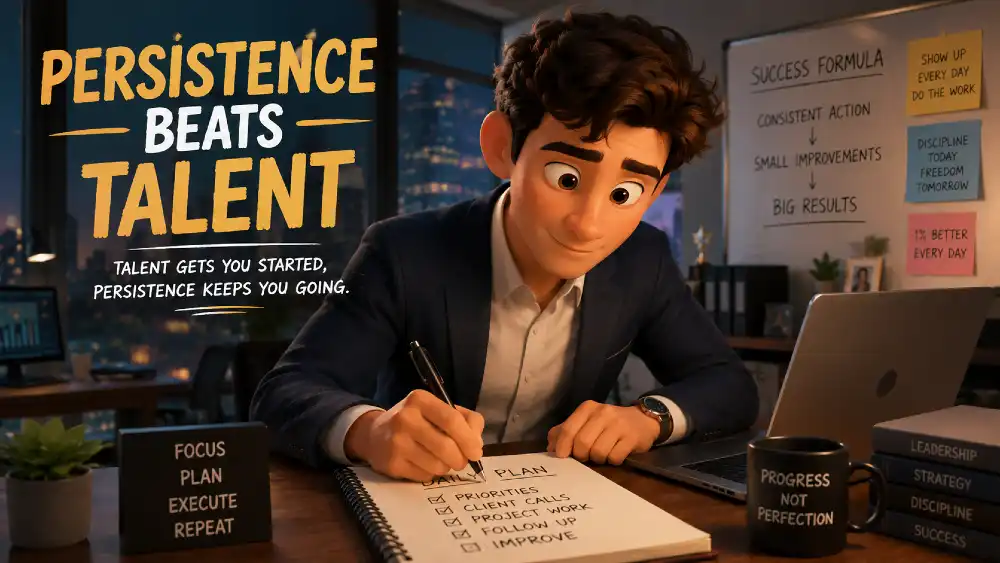
How to Build Persistence
Persistence isn’t a personality trait you either have or don’t. It’s a muscle. Like any muscle, it builds through use.
Start with small reps. Pick one thing this month that you’ve been on the verge of quitting and commit to one more attempt past where you were going to stop. The exercise routine you were about to abandon — one more week. The project you were going to shelve — one more iteration. The conversation you were going to give up on — one more honest attempt. Each rep makes the next one easier.
Decouple your identity from individual outcomes. Failure of an attempt is not failure of you. The pitch didn’t land. The application got rejected. The product didn’t sell. None of these are statements about your worth. They’re statements about what didn’t work this time. Practice the language: that attempt didn’t work, not I failed.
Build a feedback habit. After every meaningful attempt — successful or not — ask yourself: what worked? what didn’t? what would I do differently next time? The reflection turns the attempt into education. Without reflection, ten attempts produce ten random data points. With reflection, ten attempts produce a learning curve.
Find the right kind of company. Persistence is contagious. So is its opposite. McCullough has an entire chapter on the “power team” you build around yourself. The people you spend time with shape your default settings on whether to push through obstacles or look for exits. Choose accordingly.
Track your trail. Keep some kind of record of what you’ve actually overcome. The setbacks you survived. The rejections you absorbed. The moments you wanted to quit and didn’t. On hard days, look at the record. The evidence that you’ve persisted before is the strongest argument that you can persist again.
When to Quit
It’s worth being honest: not every project deserves persistence. Sometimes the right move is to stop. Knowing the difference is part of wisdom.
A few markers help. Persistence is appropriate when the obstacles are external (the market, the timing, the difficulty of the work) and when the underlying goal still matters to you. Quitting is appropriate when the underlying goal no longer aligns with who you are or what you actually want — when you’re persisting only out of stubbornness, sunk cost, or fear of looking like you gave up.
The honest question to ask yourself periodically: if I were starting from zero today, would I choose this path? If the answer is yes, persist. If the answer is no, you may not be quitting. You may be evolving.
McCullough is clear that persistence isn’t about staying on every road you’ve ever started. It’s about not letting small obstacles, hard moments, or temporary discouragement be the reason you abandon roads that still belong to you.
The Long View
The reason persistence beats talent is structural, not motivational. Compounding favors duration. Small consistent effort over decades produces results that no amount of brilliant short bursts can match.
The person who writes a thousand words a day for ten years has written more than the gifted writer who waited for inspiration. The person who builds the relationship through hundreds of small unglamorous interactions has more depth than the charismatic one who wins people fast and loses them just as fast. The person who shows up to the work every day, on the days they feel inspired and on the days they don’t, builds something the more talented quitters never can.
This is the deeper invitation in McCullough’s chapter on persistence: stop measuring yourself against the highlight reels and start measuring yourself against your own capacity to keep going. The race isn’t to be the most talented person at the start. The race is to still be running at the end.
Show up tomorrow. Then the day after. Then the day after that.
That’s it. That’s the whole secret.
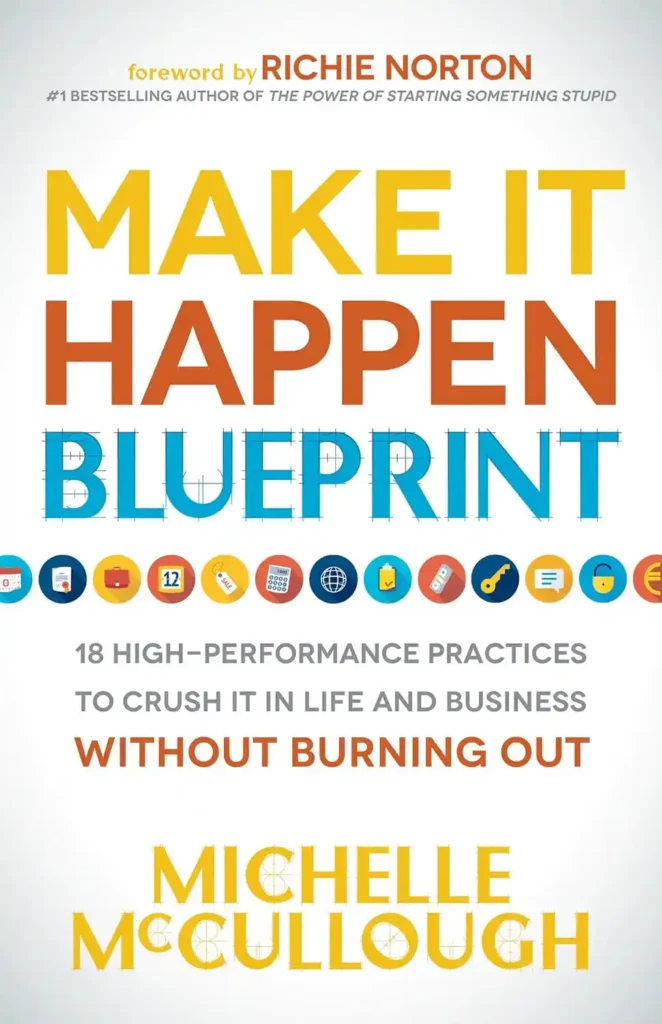
This article is inspired by the chapter on Persistence in Make It Happen Blueprint: 18 High-Performance Practices to Crush It in Life and Business Without Burning Out by Michelle McCullough (Morgan James Publishing, 2017).
Related posts:
 Self Discipline and Persistence: Why Winners Never Quit
 The Obstacle Is the Way Summary: Ryan Holiday’s Complete Framework
 Stoicism in Modern Life: How Ancient Wisdom Solves Modern Problems
 The Real Stories Behind Stoic Philosophy: People Who Transformed Devastating Setbacks Into Victory
Why Action Is the Heart of Stoicism: Lessons From The Obstacle Is the Way
The Real Stories Behind Stoic Philosophy: People Who Transformed Devastating Setbacks Into Victory
Why Action Is the Heart of Stoicism: Lessons From The Obstacle Is the Way