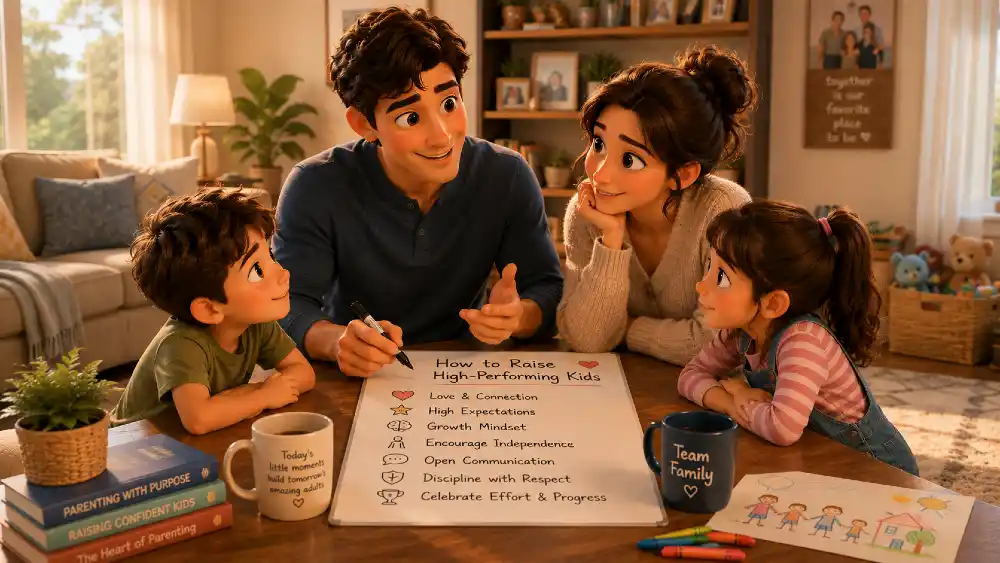
Every parent has had some version of the same wish: I want my kids to have the tools I didn’t, so they don’t have to wait until they’re 30 or 40 to figure out how to live well.
This is one of the deepest motivations in parenting. Not to push our kids toward specific outcomes, but to give them the underlying capacities — the resilience, the optimism, the self-awareness, the ability to set and pursue goals — that quietly make a good life possible.
In Make It Happen Blueprint, business coach Michelle McCullough turns the eighteen practices of her book toward the next generation. Her chapter on raising high performers isn’t about training overachievers or driving kids toward conventional success. It’s about installing the foundations — what she calls anchor points — that help children navigate whatever life brings them with steadiness and intention.
This article walks through the six anchor points McCullough offers and why the simplest one is also the most important.
The One That Comes Before All Six
Before anything else, McCullough makes one point unambiguously: no goal, no amount of preparation, and no tradition will do more to raise good kids than huge doses of love and presence.
This is the foundation under every other practice. You can do every anchor point perfectly, and if your child doesn’t feel deeply loved and genuinely seen, none of it will land. Conversely, kids who know they’re loved can absorb almost any framework you teach them — and they can survive your inevitable parenting mistakes, of which there will be many.
What presence means in practice: putting away the phone when they’re talking to you. Listening when they share something, even if it sounds small. Keeping the commitments you make. Showing up to their things. Being interruptible.
Everything that follows builds on this foundation. Without it, the techniques are just techniques.
Anchor Point 1: Positivity
McCullough’s first anchor point starts with the parent, not the child. The most direct path to raising positive kids is being a positive parent.
This doesn’t mean toxic cheerfulness or pretending problems don’t exist. It means watching what you broadcast about the world in front of your kids. The constant complaints about your boss. The doom-loop about politics. The frustrations about money expressed without filtering. Kids absorb the emotional tone of the home, and if the tone is mostly negative, that becomes their default orientation.
McCullough suggests two practical questions to ask kids at bedtime or dinner: What was the best thing that happened today? and, for the gold-medal version, What did you do to make someone else happy today?
The first question trains them to scan their day for what was good. The second trains them to notice their own ability to influence other people’s happiness — a quietly profound skill.
She also mentions reframing. When kids approach you with negative commentary — about themselves, their bodies, their friends — help them find an alternative angle. Over time they learn to do this for themselves. Some families create a special word or phrase (“reframe!”) as a gentle trigger to redirect negative talk.
The deeper teaching: happiness is a choice, even at six years old. McCullough remembers sitting down with her young children and explaining this. Now when they’re being ornery or upset about a denied request, she says simply, “Choose to be happy.” It’s a reminder that mood isn’t entirely something that happens to you.
Anchor Point 2: Gratitude
A close cousin of positivity, with its own specific practice. McCullough asks her kids every night for two things they’re grateful for. For young kids who can’t write, she suggests having them draw pictures of what they appreciate.
The point of the practice isn’t performance. It’s training the same scanner-for-good muscle in kids that gratitude journaling builds in adults. Over time, kids who do this become naturally more aware of what’s working in their lives, less prone to entitlement, more able to find perspective when something doesn’t go their way.
McCullough also has real conversations with her kids about the fact that other kids don’t have what they have. Not in a guilt-inducing way, but in a perspective-giving way. Kids who think their circumstances are “normal” can struggle when normal turns out to be uncommonly fortunate. Honest conversations about how other people live help children develop a wider awareness.
(A small story she tells: her husband told the kids about cultures and historical periods where bathrooms were outside. Of all the gratitude conversations they’ve had, this one stuck the hardest. Her son now thanks God for indoor toilets every night in his prayers.)
Anchor Point 3: Thinking About the Future
Kids thrive when they have things to look forward to. Future-orientation isn’t natural for young children — they live mostly in the present — but it can be cultivated.
McCullough offers a few practical ways to build this muscle:
Calendar and discuss future events. Put fun things on the calendar — a trip to the zoo, a vacation, ice cream after school on Friday — and talk about them as the date approaches. This builds anticipation, which is a real skill. Kids learn that endurance through current frustrations is rewarded.
Involve them in planning. She tells the story of a mom who, dreading the approaching summer vacation and the inevitable boredom complaints, sat down with her kids and built a summer vision board together. They cut out pictures of nearby parks they wanted to visit, listed friends to invite over, planned activities. The board became both a planning tool and a fun project that bonded them in the planning itself.
Play “Imagine if…” McCullough started this with her kids when they were two and four. After the bedtime routine, with the light out, she’d ask simple imagining questions: Imagine if we went to Disneyland — what ride would you want to go on first? Imagine if you could buy a new bike — what would you choose? Imagine if we could paint your room any color — what would you pick? The game gets kids thinking, dreaming, and wishing. It’s playful goal-setting practice at its earliest stage.
These exercises don’t require big budgets or elaborate plans. They require small, regular moments of inviting children to think beyond right now.
Anchor Point 4: Traditions
In an unstable world, kids crave comfort. Traditions are a powerful, low-cost way to provide it.
The obvious traditions — birthdays, holidays — matter. But McCullough makes the case that smaller, more frequent traditions often do even more.
She describes families with Friday pizza night, Taco Tuesday, Saturday breakfast with dad. Her own family has a Monday night routine: family time, a teaching moment, an activity, a treat, calendar coordination for the week — all with phones away. The kids ask for it every night.
A few principles for tradition design:
Repeatable is better than elaborate. A simple weekly thing the kids look forward to does more than a once-a-year extravaganza.
Phone-free time. The presence is what makes traditions land, not the activity. Take the phones out of the equation.
Side benefits compound. McCullough notes that her mother’s Family Home Evening practice, which included taking turns conducting and giving short lessons, accidentally trained all four kids to be comfortable speaking and presenting. Years later, all four enjoy public speaking. The tradition was for connection. The skill-building came along for free.
For adults without kids of their own, McCullough notes that traditions can be built with nieces, nephews, neighbor kids, or friends’ children. A monthly ice cream trip to find the best soft serve in town. A regular hiking outing. A board game night. The form doesn’t matter. The reliability does.
Anchor Point 5: Family Themes
McCullough is a fan of family mission statements (drawing from Stephen Covey), but she’s even more enthusiastic about something simpler: family themes.
A theme is a short statement — sometimes just a few words — that anchors a family in a value or goal for a defined period, usually a year. It’s lighter than a mission statement, more focused, easier for kids to remember.
She describes three criteria for a good family theme:
Simple and age-appropriate. Long themes don’t stick. Short ones do.
Memorable enough that everyone in the family can repeat it on demand.
Actionable — something that can come to mind in specific moments and shape behavior.
Her own family’s first theme, when her oldest started kindergarten, was: Be brave. Be smart. Be kind. Six words. Easy to remember. Connected to the actual challenges of being a five-year-old in a new school.
The first day, dropping her son off, he hopped out of the car and said to himself, under his breath: Be brave. Be smart. Be kind. He’d taken the theme inside himself and used it to overcome his first-day jitters.
She mentions another family whose theme was Work Hard. Play Hard. Simple. Memorable. Easy to apply to schoolwork, family time, and the broader rhythm of life.
A family theme isn’t preachy. It’s a shared shorthand that gives everyone — kids and adults — a touchstone in hard moments.
Anchor Point 6: Individual Goals and Themes
While family themes provide group identity, individual themes or goals serve a different purpose. They give each child their own focus, suited to their personality and current needs.
McCullough mentions a friend, Nicole Carpenter, who uses the SMARTY goal framework with her kids (Specific, Measurable, Attainable, Realistic, Timely, Your Why — the addition from McCullough’s chapter on Planning). The kids write down goals and use the framework to make sure they actually stick.
Goals don’t have to be year-long. They can be tied to a season, a school year, a sport. What matters is the practice of identifying something specific to work toward, writing it down, and placing it where it can be seen often.
She also shares the story of her friend Stacy’s son Ashton, a nine-year-old basketball-loving perfectionist. Ashton wrote himself a personal saying — almost a contract — to motivate himself when things felt dark. His mother had it etched onto a stone he hung in his room. Ashton wasn’t given the saying. He came up with it himself, with his mother’s quiet support and structure-providing.
The deepest lesson here isn’t the etched stone. It’s that Stacy noticed her son’s personality — perfectionist, easily discouraged, not receptive to pep talks in the moment — and helped him build a self-motivation system that fit him. The goal-setting was customized to who he actually was.
The Goal Party
One bonus practice McCullough mentions: her friend Kate grew up in a family of ten kids whose mother had them each set five goals every school year. One educational, one relational, one health-related, one spiritual, one personal.
At the end of the school year, the whole family — including parents, who also participated — sat around the table. Each person shared their goals and whether they’d achieved them. Successes were cheered. Failures were… booed. (McCullough laughs at this and says she probably wouldn’t implement the booing in her own home.)
The deeper point: there’s something powerful about a family ritual of acknowledging both wins and misses out loud. Kids learn that goals are normal, that success is celebrated, that misses are recoverable. The whole pattern of setting, pursuing, and reviewing goals becomes part of how they understand life.
You don’t have to use ten kids and booing. The principle adapts: a family ritual, once a year, where you acknowledge what you set out to do and what actually happened.
What This Adds Up To
McCullough explicitly says: don’t get overwhelmed. You don’t need a family theme, individual themes, vision boards, traditions, and goal parties all running at once. Pick two or three of these that fit your family. Use the rest as a springboard for ideas of your own.
The questions she suggests asking yourself:
How can I help the kids in my life be more positive?
What activities, games, and questions can I use to help them think about the future?
What themes or phrases would be good to focus on this coming year?
What are the individual goals and needs of each child? How can I help them progress toward what they want most?
The Final, Quiet Point
The last thing McCullough emphasizes in her chapter is also the most important: being an example of high performance matters more than pushing it on kids.
Have your own vision. Share it with them. Let them watch you tackle it. Let them see how you get back on course when you veer. Show them how you stick to things when it’s hard.
Kids absorb who you are. They mimic what you actually do, not what you tell them to do. If you want them to be people who pursue meaningful lives, the most powerful thing you can do is pursue one yourself — visibly, imperfectly, persistently — so they grow up with the assumption that this is what adults do.
Happiness, motivation, and high performance carry a ripple effect through families. When you live your best life, your kids will quietly absorb the patterns. You don’t have to push them. You just have to live the example.
The anchor points help. The love and presence are what make them stick.
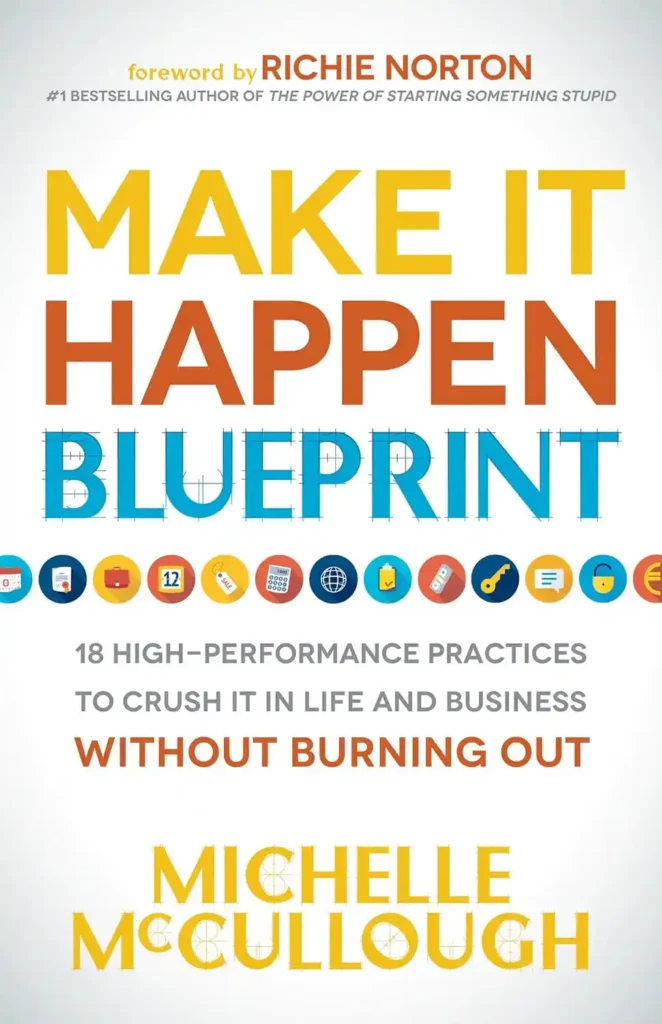
This article is inspired by the chapter on Raising Up Little High Performers in Make It Happen Blueprint: 18 High-Performance Practices to Crush It in Life and Business Without Burning Out by Michelle McCullough (Morgan James Publishing, 2017).
Related posts:
 Make It Happen Blueprint: 18 High-Performance Practices to Crush It in Life and Business Without Burning Out (Full Summary & Course)
 The Power Team Pyramid: Who You Need Around You to Reach Big Goals
 How to Set Anti-Goals by Defining What You Want to Avoid
 The Life Balance Myth: Why High Performers Choose Priorities Over Balance
 Your Body Is the Vehicle for Your Dreams: 8 Healthy Habits of Successful People