How you start your day decides more than you think. So does how you end it.
Most people stumble out of bed, reach for the phone before their feet hit the floor, scroll through emails and notifications and other people’s lives, and arrive at their first task already drained and reactive. They end the day the same way — phone in hand, scrolling until sleep takes over, brain still buzzing with input. Then they wonder why they wake up exhausted and the cycle starts again.
In Make It Happen Blueprint, business coach Michelle McCullough offers a simple and well-tested alternative: the Power Up and Power Down routine. Two short rituals — one in the morning, one at night — that bracket your day with intention rather than reactivity. McCullough is candid that she didn’t invent the concept; she’s combined elements of several frameworks (the “Power Hour,” Tiffany Peterson’s morning and evening rituals, the Franklin Planner approach) into something that’s worked for her through years of running businesses while raising young kids.
This article walks through what each routine includes, why both ends matter, and how to start one this week without overhauling your entire life.

Why Bookends Work
The principle is straightforward: you can’t fully control what happens during your day, but you can almost always control what happens at the very beginning and end of it. Those bookend windows have an outsized effect on what fills the middle.
Start your day in reactive mode and the day stays reactive. Start it intentionally and the intention carries.
End your day with overstimulation and unprocessed work and you sleep poorly, wake up tired, and start the next day from a deficit. End it with quiet integration and you wake up rested and ready.
McCullough draws an analogy from airline safety announcements: put on your own oxygen mask before assisting others. The Power Up and Power Down routines are the oxygen masks. They’re how you make sure you have something to give before you start giving it.
The Power Up: Starting the Day With You
The morning routine is built on one foundational rule: do it before any external input enters your day.
That means before you check email. Before you open social media. Before the kids wake up. Before the news, the messages, the notifications. The first content your brain consumes in the morning shapes the day. McCullough is firm: if your first inputs are other people’s drama, requests, and crises, you’ve handed your morning to them before it began.
Here’s what her own Power Up looks like, distilled:
Light physical activity. Not a full workout — just something to get the blood moving and the brain online. A walk around the house. Some jumping jacks. A few stretches while waiting for water to boil. McCullough usually does her actual workout later. The Power Up movement is just to wake the body up.
Review goals and vision. She looks at her vision board, listens to her recorded Ideal LifeVision (a tool from Ann Webb’s program), and flips through her “Why” cards. The whole point is to spend time, before anyone else’s agenda intrudes, reconnecting with her own.
Think about people you love. She thinks about her husband and kids individually — what’s going on with them, how she wants to show up for them today. This makes her presence with them later more intentional.
Read something inspirational. Five minutes with a book that nourishes the mind. Not news. Not work-related. Something that feeds.
Meditate and pray. Or whatever the contemplative equivalent is for your tradition. Quiet time before the noise begins.
The whole thing can be done in fifteen minutes if that’s all you have. McCullough learned this from her coach: it doesn’t have to be an hour. Most people fail at morning routines because they aim for ninety minutes and can’t sustain it. Start with fifteen.
The Power Down: Ending the Day With Care
The evening routine is the mirror. Where the Power Up sets the tone for the day, the Power Down releases the day so the next one can start fresh.
McCullough’s Power Down looks like this:
Five gratitudes in a journal. Not abstract. Specific. The conversation with her daughter at bedtime. The unexpected easy parking spot. The way the light hit the kitchen at 4 PM. The point isn’t to perform gratitude for an audience. It’s to train the mind to notice what was actually good about a day that, in real time, may have felt mostly hard.
Review tomorrow’s schedule. A quick glance at what the next day holds — meetings, appointments, commitments. This prevents the 11 PM mental panic of wait, what time is that thing tomorrow? The brain settles when it knows what’s coming.
Read for business and pleasure. Some learning, some enjoyment. Both serve a purpose. The learning continues professional growth. The pleasure provides the cognitive equivalent of a meal — something the mind can chew on that isn’t work.
Close with something inspirational. A few minutes of something that reconnects you to whatever larger sense of meaning you hold. For McCullough, that’s often spiritual reading. For others, it might be poetry, philosophy, or just a few quiet moments of reflection.
No screens. This is critical. McCullough is explicit: do all of this in a technology-free zone. Stop looking at the laptop and the phone before bed. The blue light, the constant input, the social comparison — all of it interferes with sleep and with the integration the brain needs to do overnight.
Why Both Ends Matter
People who try only the morning routine usually get partial results. The morning sets a good tone, but if the evening still ends in screens and overstimulation, sleep suffers and the morning starts from a depleted place. The two routines aren’t independent. They reinforce each other.
McCullough notes that her Power Down is the more reliable of the two — it almost always happens. The Power Up is more easily disrupted by vacations, late nights, or oversleeping. But she can always tell the difference in her day when she misses it. When she lets the phone or the kids’ agenda set her morning, she feels behind all day. When she protects the Power Up, she feels like she’s leading the day rather than chasing it.
A Realistic First Version
Don’t try to implement both routines in their full form starting tomorrow. You’ll fail and feel like a failure. Start small.
Week one: Add five minutes to the start of your morning. Before phone. Before email. Just five minutes — sit, breathe, drink water, look out a window. That’s it.
Week two: Add five minutes to the end of your night. Phone away. Three things you’re grateful for, written or just thought through.
Week three: Extend each to ten minutes. Add one element to each — maybe a few minutes of reading in the morning, a glance at tomorrow’s calendar at night.
Week four: Build out to the full routine, customized to what’s working. Some elements will land for you. Others won’t. Keep what serves you. Drop what doesn’t.
The goal isn’t to copy McCullough’s routine exactly. It’s to build a version that fits your life and that you’ll actually do.
What Tools Help
A few practical pieces help the routines stick.
A nightstand kit. McCullough keeps her gratitude journal, a day-to-day journal, scriptures, a motivational book, and pens within arm’s reach of her bed. This removes friction. You’re more likely to do the practice if everything you need is right there.
A morning corner. A specific spot for the Power Up — a chair, a desk, a window seat — set up with whatever you need (vision board, reading material, water, notepad). The space cues the practice.
A book on the bedside. Something you actually want to read. The unread book that’s been on your list for two years isn’t a Power Up book — it’s a book you’ve been avoiding. Pick something that pulls you in.
A device boundary. This one is non-negotiable. The phone has to stay out of the morning’s first thirty minutes and the evening’s last thirty. Most people can’t hold this with willpower alone; they need physical separation. Charge it in another room. Use a real alarm clock. Whatever it takes.
The Common Objection
The most predictable resistance: I don’t have time for this in the morning.
The honest response: you’ll likely have to get up earlier. McCullough doesn’t pretend otherwise. But she also notes that with a Power Down routine that helps you sleep better, you’ll wake more rested and the earlier hour will feel less brutal than it does when you’re going to bed wired and waking up groggy.
There’s also a math argument. If a fifteen-minute Power Up makes the next eight hours measurably more focused, less reactive, and more aligned with what matters to you, the trade is wildly favorable. You don’t lose fifteen minutes. You buy back hours.
The 90-Day Test
McCullough recommends committing to the routines — at whatever scale feels doable — for ninety days before evaluating whether they’re working. The reason: the benefits are cumulative. A single day of Power Up doesn’t transform anything. Ninety days starts to reshape patterns at a deeper level.
After a month, you’ll likely notice you’re a little more centered, a little less reactive. After two months, the people around you may notice. After three months, you’ll have built something durable enough that skipping a day feels off, the way skipping brushing your teeth would feel off.
The point of the 90-day commitment isn’t perfection. McCullough explicitly says you don’t have to do the full routine every day — just the days you want to be a high performer. The commitment is to the practice itself, not to flawless execution.
What Changes
People who maintain these routines for several months tend to report similar shifts.
Decision-making gets clearer because the day starts from intention rather than reaction. Energy stabilizes because sleep improves and the chronic morning overwhelm fades. Relationships improve because you arrive at conversations more present. Work output increases not because you’re working more hours but because the hours you’re working are higher quality. The chronic background anxiety quiets.
None of this happens through any single component of the routines. It happens through the combination — the bookending of the day with intentional time, repeated until it becomes the default.
Start Tomorrow Morning
Don’t wait for the perfect Monday. Don’t wait until the kids are older or the project is done or the season changes.
Tomorrow morning, before you reach for your phone, sit up. Drink water. Take five breaths. Think about one thing you want to do well today. That’s it. That’s your first Power Up.
Tomorrow night, before you scroll yourself to sleep, put the phone in another room. Write three things you were grateful for. That’s your first Power Down.
Do both for a week. See what you notice.
Then build from there. The architecture of a high-performing life isn’t built in dramatic moments. It’s built in the quiet bookends most people give away to other people’s noise.
Take yours back.
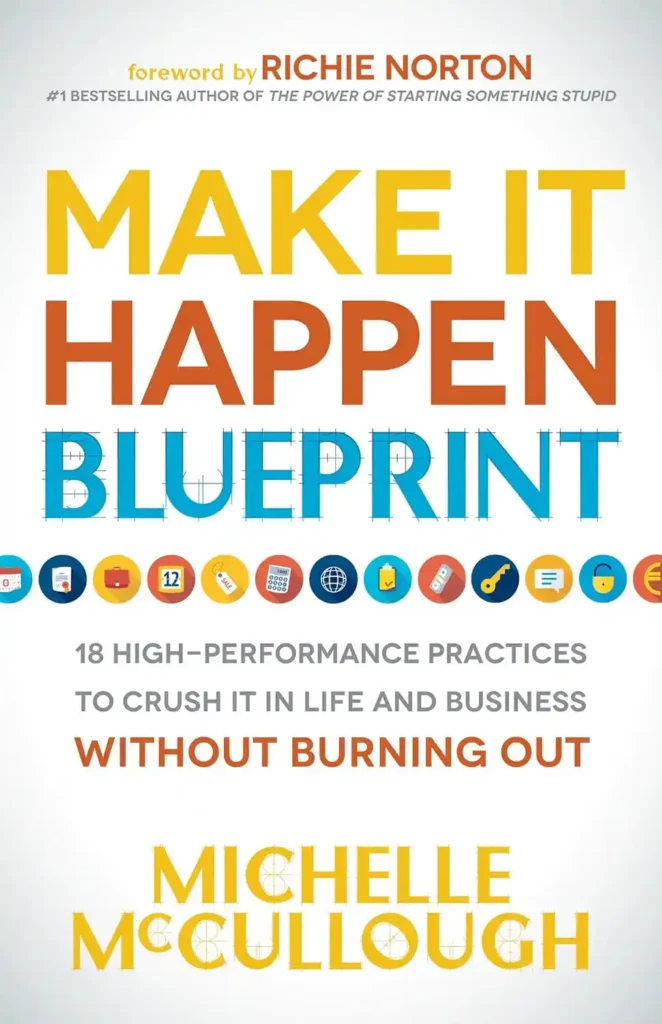
This article is inspired by the chapter on Power Up and Power Down in Make It Happen Blueprint: 18 High-Performance Practices to Crush It in Life and Business Without Burning Out by Michelle McCullough (Morgan James Publishing, 2017).
Related posts:
 The Importance of Sleep for Success (Why Discipline Depends on Rest)
 Can You Function on Bad Sleep? Why Your Belief Matters More Than Your Hours
 Hume Band Review: Does This Stress-Tracking Wearable Actually Work?
 Make It Happen Blueprint: 18 High-Performance Practices to Crush It in Life and Business Without Burning Out (Full Summary & Course)
 Early Morning Routine Benefits: How Rising Early Builds Discipline