There’s a particular kind of stuckness that has nothing to do with capability and everything to do with a quiet, unspoken belief: I’m not allowed. Not allowed to want this. Not allowed to be ambitious about it. Not allowed to take the space, the resources, the visibility that going after it would require.
You may not phrase it that way. You may not even know you’re carrying it. But if you’ve been holding back on something that matters to you for years — waiting for a clearer sign, a better moment, a more enthusiastic response from the people around you — there’s a good chance permission is what you’re really waiting for.
In Make It Happen Blueprint, business coach and speaker Michelle McCullough names this directly. The most paralyzing thought standing between most people and their goals, she writes, isn’t lack of skill or strategy. It’s some version of I don’t deserve it. And the cure isn’t waiting for someone to tell you that you do. It’s giving yourself permission anyway.
This article is about how that works.
The Engraved Invitation That Never Arrives
McCullough tells the story of her own decision to become a professional speaker. After years of doing it occasionally on the side, she finally hired a coach and declared the goal out loud: I see myself as a highly-paid, highly sought-after speaker. Doors began to open almost immediately. Invitations arrived. Resources became available.
And then, predictably, came the resistance — both from the inside (“you don’t have the talent for that”) and from people around her (“you can’t do that, you’re a mom”). She found herself, as she puts it, a recovering people pleaser ready to throw in the towel just to make someone else more comfortable.
Then a panelist at a women’s business event asked a question that stopped her: If everyone in your life agreed, what would you choose?
The clarity came instantly. Her dreams were hers. They didn’t need to be ratified. The validation she’d been waiting for was a permission slip that wasn’t going to arrive — and didn’t need to.
Most of us have some version of this experience. We tell ourselves we’d pursue the thing if only our partner believed in it more, if only our parents had supported it, if only a mentor confirmed it was a good idea. But the support rarely shows up the way we hope. As McCullough puts it, few people will fully understand your dreams, and even fewer will rise to be your constant cheerleaders. Not because they’re bad people. Because they’re caught up in their own dreams and battling their own self-doubt.
The permission slip you’ve been waiting for has been on your desk the whole time. You’re the one who has to sign it.
Where the Permission Block Comes From
It’s worth understanding why this gets so deeply lodged in us, because the patterns are usually older than we think.
Most of us were raised in environments where wanting too much, asking for too much, or claiming too much got subtle pushback — sometimes overt, often implicit. Don’t get too big for your britches. Don’t be greedy. Don’t show off. Don’t think you’re better than anyone. By the time we’re adults, these messages have hardened into an automatic editor that runs in the background of our ambitions, quietly downsizing them before they can be spoken.
There’s also social risk in declaring a big goal. If you say it out loud and it doesn’t happen, you’re exposed. Easier to keep wanting it privately, where failure stays invisible. The permission block is partly a defense against that exposure.
And there’s the deeper fear McCullough names directly: that if you actually got what you wanted, you’d become someone different. The version of you with the dream realized is a person you don’t yet know how to be. Some part of you is protecting your current identity by not letting that future arrive.
None of this means the desire is wrong. It means the resistance to it is doing a job — usually a job it learned long before you had a choice in the matter.
The Question That Cuts Through
Take a piece of paper and try McCullough’s exercise. Answer it honestly:
Whose permission am I waiting for so that I feel it’s okay to have what I want?
For some people, the answer is a parent — sometimes a parent who’s been gone for years. For some, it’s a spouse, a mentor, an old teacher. For others, it’s something more diffuse: the imagined judgment of a community, a culture, an industry, the internet.
Whoever it is, name them. Then ask the harder follow-up: Are they ever actually going to give it?
In most cases, the honest answer is no. The person you’re waiting on is either gone, doesn’t think this way, doesn’t have the relationship with you that would make their permission meaningful, or simply isn’t paying enough attention to weigh in. The vote you’re waiting for isn’t coming. The decision is yours alone.
This isn’t tragic. It’s clarifying. It returns the choice to its proper owner.
What Self-Permission Sounds Like
Permission isn’t a feeling you wait to have. It’s a sentence you say.
I’m allowed to want this.
I’m allowed to take this seriously.
I’m allowed to invest in this even if no one else thinks I should.
I’m allowed to take up the space this requires.
I’m allowed to be wrong about it and try anyway.
The sentences feel awkward at first because they’re naming permission you’ve been quietly denying yourself for years. They’re meant to feel that way. The discomfort is the work.
McCullough recommends writing one of these statements down — choose the one that lands hardest — and putting it somewhere you’ll see it daily. On the bathroom mirror. Inside your planner. As a phone wallpaper. The act of seeing it repeatedly does something. It loosens the old editor’s grip.
The Higher Power Question
McCullough is open about the role her faith plays in her own version of this practice. For her, permission was partly a matter of asking God whether she was allowed to pursue what she wanted — and noticing, when doors started opening, that the answer seemed to be yes, more than you wanted for yourself.
You don’t have to share her specific framework to take the underlying point. Whatever your relationship with the larger question of meaning — religious, secular, agnostic, ambivalent — there’s something useful about checking in beyond the level of your daily anxiety. Sit with the question. Let it breathe. Notice what comes up that isn’t just the editor.
For some people this looks like prayer. For others, meditation. For others, long walks, or journaling, or talking to a trusted friend. The form matters less than the willingness to ask. Most people find the answer is some version of yes, you’re allowed. They just hadn’t sat still long enough to hear it.
When Other People Push Back
Once you start giving yourself permission, you’ll notice something uncomfortable: the people around you may not all rise to celebrate. Some will be confused. Some will be threatened. Some will tell you to be realistic.
This is where many people retreat. The pushback feels like evidence that the permission was unauthorized after all.
It isn’t. The pushback is usually about them. McCullough quotes Marianne Williamson’s well-known passage on this: Our deepest fear is not that we are inadequate. Our deepest fear is that we are powerful beyond measure. It is our light, not our darkness, that most frightens us… your playing small does not serve the world. When you stop playing small, you implicitly invite others to do the same — and that invitation is uncomfortable for people who aren’t ready to accept it.
A few practical responses help here. First, be sparing about whom you share the dream with in its early, fragile stages. Not everyone has earned access to your most vulnerable goals. Second, learn to receive doubt without absorbing it. Thank you for your concern is a complete sentence. Third, take action — quiet, consistent, undramatic action. Results have a way of converting skeptics that explanations never will.
Permission for Smaller Things, Too
It’s tempting to apply this practice only to the big visible dreams — the business, the book, the career change. But the permission block shows up in smaller places too, and addressing those is often where the work actually lives.
Permission to take a real lunch break. Permission to say no to a request you don’t have capacity for. Permission to spend an evening doing nothing without earning it first. Permission to ask for a raise. Permission to not call your mother back today. Permission to take the longer route home because you like the trees on it.
These are small things. They’re also the daily texture of a life you’ve authorized rather than tolerated. The small permissions practice the same muscle as the large ones. And often, by the time you’re ready to grant yourself the big permission, you’ve built the strength on a hundred small ones.
The Practice, Not the Permission
Here’s what people miss: self-permission isn’t a one-time decision. It’s a practice. Old voices come back. Old editors reactivate. New situations bring new versions of the same old question.
Each time, the work is the same: notice the waiting, name the desire, sign the slip yourself, take the next action.
McCullough is candid that even years into her career — published author, in-demand speaker, successful business owner — she still has moments where the old permission block reactivates. The difference is she now recognizes it for what it is. The work hasn’t gone away. She’s just gotten faster at moving through it.
That’s the realistic outcome of this practice. Not freedom from self-doubt. Familiarity with it, and a clearer relationship to whose voice gets the deciding vote.
The Permission Slip You Sign Today
So here’s the practice. One time, for now, do it deliberately.
Pick something you’ve been waiting on. Write it as a sentence: I want to ___________.
Notice who you’ve been waiting to authorize it. Name them.
Then write the permission slip yourself, in your own handwriting, in your own words.
Sign it.
Take one small action toward the thing today. Not tomorrow. Today.
The world doesn’t owe you permission, McCullough writes throughout her chapter, but the truth is it doesn’t actually have the authority either. The authority is yours. It always was. The waiting was the only thing in the way.
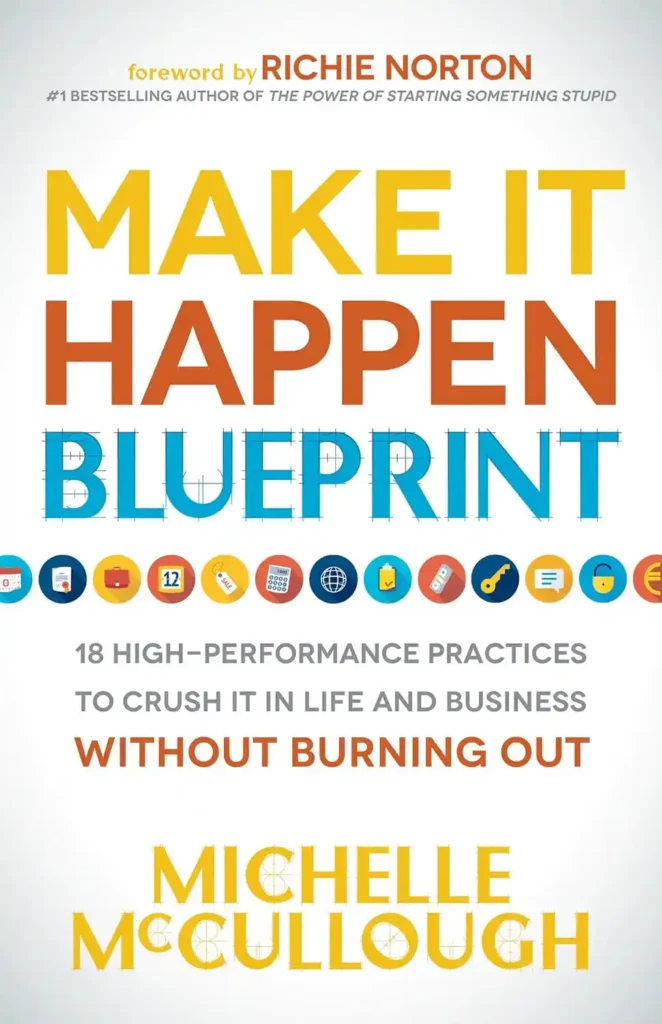
This article is inspired by the chapter on Permission in Make It Happen Blueprint: 18 High-Performance Practices to Crush It in Life and Business Without Burning Out by Michelle McCullough (Morgan James Publishing, 2017).

Related posts:
 Make It Happen Blueprint: 18 High-Performance Practices to Crush It in Life and Business Without Burning Out (Full Summary & Course)
 How to Take 100% Responsibility for Your Life (Without Beating Yourself Up)
 How to Create a Vision Board That Actually Works (And Why Most People Fail)
 Work-Life Balance for Entrepreneurs Through Integrated Wealth
 Personal Responsibility: The Skill That Determines Freedom, Power, and Success