If you’ve ever ended a week feeling exhausted and unsure where the hours went, you’re in good company. Most people are running their lives off some combination of a to-do list and a calendar that mostly contains other people’s appointments. The result is predictable: the urgent eats the important, the days fill with reactive work, and the things that actually matter — the strategic projects, the relationships, the personal goals — keep getting pushed to “next week.”
There’s a better way, and it’s been hiding in plain sight: time blocking, organized into what Michelle McCullough calls a Time Map. In Make It Happen Blueprint, she lays out a planning method she’s used to run three businesses while raising young kids from home — without sending them to daycare and without working herself into burnout.
This article walks through what a Time Map is, why it works when to-do lists don’t, and how to build one this weekend that will reshape your week.
The Problem With To-Do Lists
To-do lists are useful, but they have a fundamental flaw: they treat all tasks as equally available. They don’t distinguish between work that requires deep focus and work that can be done in five minutes between meetings. They don’t account for energy, attention, or the kind of mental state different tasks require. And they don’t protect time — anything on a to-do list can be displaced by anything else that comes up.
The result is the universal experience of looking at a list at the end of the day, seeing twelve unchecked items, and feeling vaguely guilty even though you worked hard. The list grew. The completion rate didn’t.
McCullough’s diagnosis is direct: don’t rule your day by your to-do list. Rule it by your schedule. The Time Map is the structure that makes this possible.
What a Time Map Is
A Time Map is a visual representation of your week, broken into blocks of time dedicated to specific activities or roles. It looks like a calendar, but it’s filled in proactively — not just with appointments, but with the categories of work you need to do regularly to keep your life and business moving.
The principle behind it is what McCullough calls block time: a specific chunk of time set aside for a certain task or activity. During a block, you do that one thing. You don’t answer the phone. You don’t check email. You don’t allow yourself to drift into something else. You honor the block.
Her own example: every Monday afternoon from 12:30 to 2:30 PM, she has a marketing block. During that time, she reviews her marketing plan, drafts social media posts, plans email launches, and handles whatever else marketing requires that week. Two hours, dedicated, undistracted. Then it’s done until next Monday.
Multiply this pattern across your major roles and responsibilities, and you have a Time Map.
Why It Works
The Time Map works for three reasons.
It protects what matters. Things that aren’t scheduled tend not to happen. Strategic work, deep thinking, time with loved ones, exercise, learning — these are the activities that get squeezed out by reactive demands. Putting them on the map gives them territory.
It batches similar work. Switching contexts is one of the most expensive things your brain does. A Time Map groups similar activities into single blocks, which dramatically reduces the cognitive overhead of constantly reorienting. Two hours of focused marketing produces more than four hours of marketing-while-multitasking.
It removes daily decision fatigue. Without a map, every morning starts with the same question: what should I work on first? The Time Map answers that question once, on the weekend, so you don’t have to answer it forty more times during the week. You just look at the schedule and do what’s next.
McCullough also notes a softer benefit: it changes the way you experience your week. Instead of feeling like time is slipping away from you, you feel like you’re driving it. The same hours feel different.
What Goes On a Time Map
The simple answer: every important role you play, plus the work that keeps each role functioning.
For an entrepreneur, blocks might include marketing, content creation, networking, administration, accounting, sales calls, client work, education, and product development. For a working parent, blocks might include focused work hours, school pickup, family dinner, kids’ activities, exercise, and personal time. For someone running a household, blocks might include meal planning, errands, deep cleaning, kid time, partner time, and personal projects.
Whatever your roles, the question is: what regular activities, if I don’t protect time for them, will keep getting displaced? Those are the blocks that need to go on first.
A few principles help here. Bigger tasks need bigger blocks. Two-hour blocks for substantial work, thirty-minute blocks for quick tasks, hour-long blocks for things in between. Match energy to work. If you do your best creative work in the morning, put creative blocks there and leave administrative work for after lunch. Build in transitions. Don’t schedule one block right against another — leave breathing room.
How to Build Your Time Map This Weekend
Here’s a simple build process, adapted from McCullough’s approach.
Step one: list your roles. Write down every role you play that requires recurring attention. Parent, partner, employee, business owner, friend, household manager, student — whatever applies to you. Most people have somewhere between five and ten.
Step two: list the recurring work for each role. Under each role, write the activities that need to happen weekly or more often. Don’t worry about one-off projects yet. Focus on the rhythm.
Step three: estimate time. For each activity, estimate honestly how much time per week it actually needs. Be realistic. People consistently underestimate how long things take and then feel like failures when their schedules don’t work.
Step four: lay it on the week. Open a blank weekly calendar (paper, digital, whatever you’ll actually use) and start placing blocks. Begin with non-negotiables — sleep, family meals, fixed appointments. Then add your highest-leverage work blocks. Then fill in the rest.
Step five: leave white space. A Time Map jammed with no margin will fail in week one. Leave at least 20% of your scheduled time unbooked, for the inevitable interruptions, overflow, and unplanned needs that come up.
Step six: review and adjust. McCullough recommends scheduling an evaluation block at the end of each week to ask what worked and what didn’t. The first version of your Time Map will be wrong in some way. The fifth version will be much better. Keep iterating.
The Tools That Don’t Matter (And the One That Does)
McCullough has tried nearly every planning tool — Franklin Day Planner, wall calendars, Palm Pilots (yes, really), Google Calendar, phone apps, paper notebooks. After all that, she landed on this: the best system is the one you’ll actually use.
Some people work best with paper. Others need everything synced across devices. Some thrive on color-coded digital calendars. Others need a single physical notebook they carry everywhere. The medium is genuinely irrelevant. What matters is consistency.
The one principle that does matter: have one system. Not seven sticky notes, three apps, two calendars, and a vague mental list. One place where the schedule lives. One place where you check it. One place where new commitments get added.
Common Objections (And Why They Don’t Hold)
“This is too rigid for my creative work.” McCullough hears this constantly, mostly from people who call themselves creative types. Her response: planning isn’t the enemy of creativity. The absence of structure is. Creative work needs protected time more than any other kind, because it’s the first thing displaced by urgent demands. Many of the most prolific creative people in history were ruthless about their schedules. The discipline is what made the freedom possible.
“My week is too unpredictable.” Most people who say this discover, when they actually track their time, that 60-70% of their week is more predictable than they thought. Even unpredictable weeks have patterns. Your Time Map can flex around those patterns. And the unpredictable parts become more manageable when the predictable parts are handled.
“I don’t want to live by a schedule.” A Time Map isn’t a prison. It’s a default. When something more important comes up, you move blocks. The map is a starting point, not a contract. The alternative — constant reactivity — is much more exhausting and much less freeing than people realize.
Pairing the Time Map With a Goal Map
McCullough also describes a complementary tool she calls the Goal Map: a step-by-step plan for moving from where you are to where you want to be on a specific goal. The Goal Map handles the what of a project. The Time Map handles the when.
The integration is critical. McCullough is direct that this is where the magic happens: schedule time in your calendar each week to work on your goals, your milestones, and your action lists. Execution is where you take a goal from idea to reality.
Without this integration, goals stay abstract. With it, every week contains protected time for the things you said mattered to you.

What Changes After 30 Days
McCullough says she can’t take credit for the basic concept — time blocking has been around for decades, and she learned it from a business associate. What she did was refine it, customize it, and stay with it long enough to see compound effects.
Most people who try the Time Map for thirty days report the same things. The week feels less reactive. Important work that had been getting deferred starts getting done. Energy stabilizes because you stop the constant context-switching that depletes it. Relationships get more attention because they’re protected, not residual. The vague background guilt of unfinished work quiets down because you can see what’s getting done and when.
You also start noticing what you’ve been doing that doesn’t fit. Activities that don’t earn a place on the map become suspect. You start eliminating, delegating, or redesigning the work that wasn’t actually serving you. The map clarifies more than just your schedule.
Start This Weekend
You don’t need a perfect Time Map. You need a first one.
This weekend, take an hour. List your roles. List the recurring work. Lay it on the week. Leave white space. Try it for seven days, knowing it will be imperfect. Then sit down the following weekend and adjust.
McCullough is candid that she’s been refining her own system for years and still tweaks it. The point isn’t perfection. The point is having a structure that makes your week more intentional than it would be otherwise.
The week is going to happen either way. The Time Map just decides whether you drive it or it drives you.
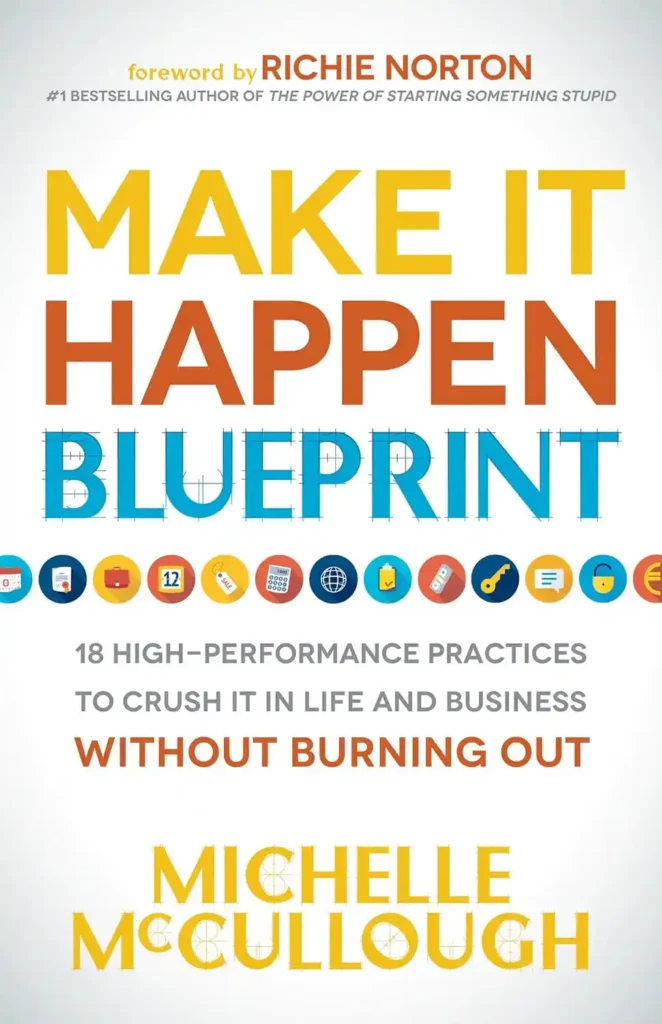
This article is inspired by the chapter on Planning in Make It Happen Blueprint: 18 High-Performance Practices to Crush It in Life and Business Without Burning Out by Michelle McCullough (Morgan James Publishing, 2017).
Related posts:
 Ridge Wallet Review (2026): Is the Minimalist Metal Wallet Actually Worth It?
 Hume Band Review: Does This Stress-Tracking Wearable Actually Work?
 10 Most Popular Gifts for Men in 2026 (That He’ll Actually Use)
 WHO IS JEFFREY PFEFFER: Stanford’s Revolutionary Power Expert & Organizational Behavior Pioneer
 The Four Ways to Meet Women in 2026: A Modern Dating Strategy for Men