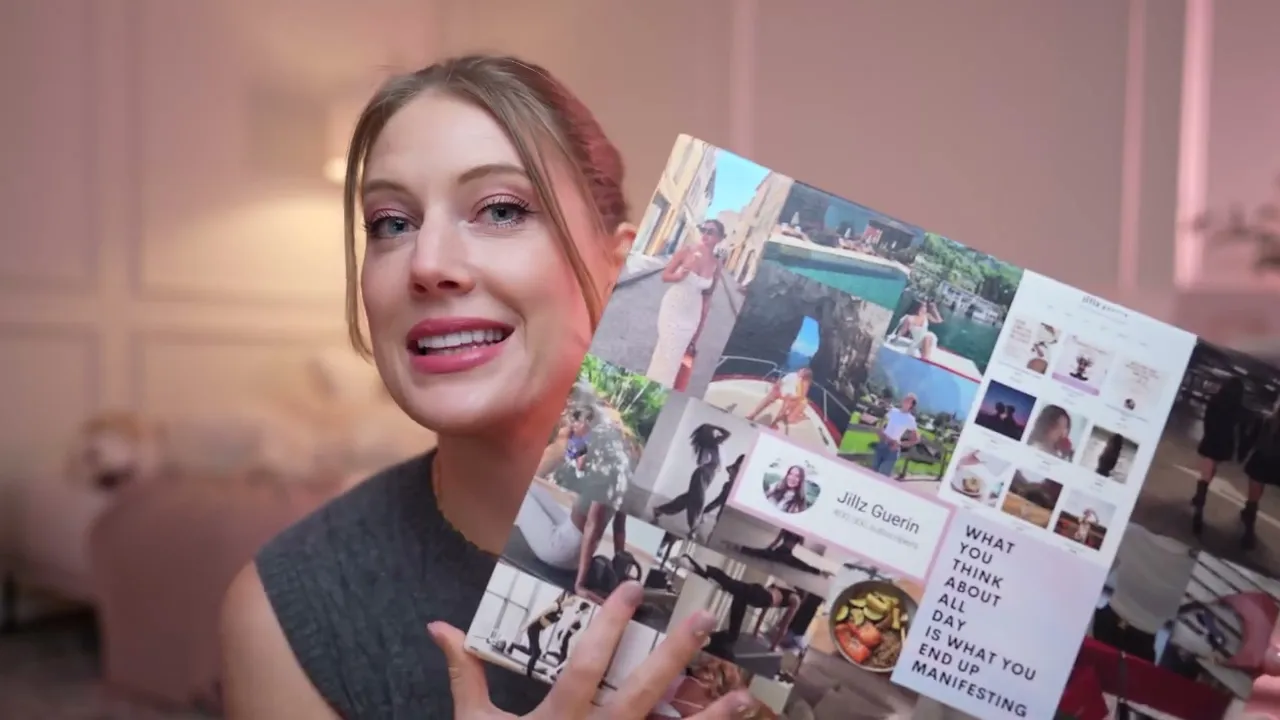
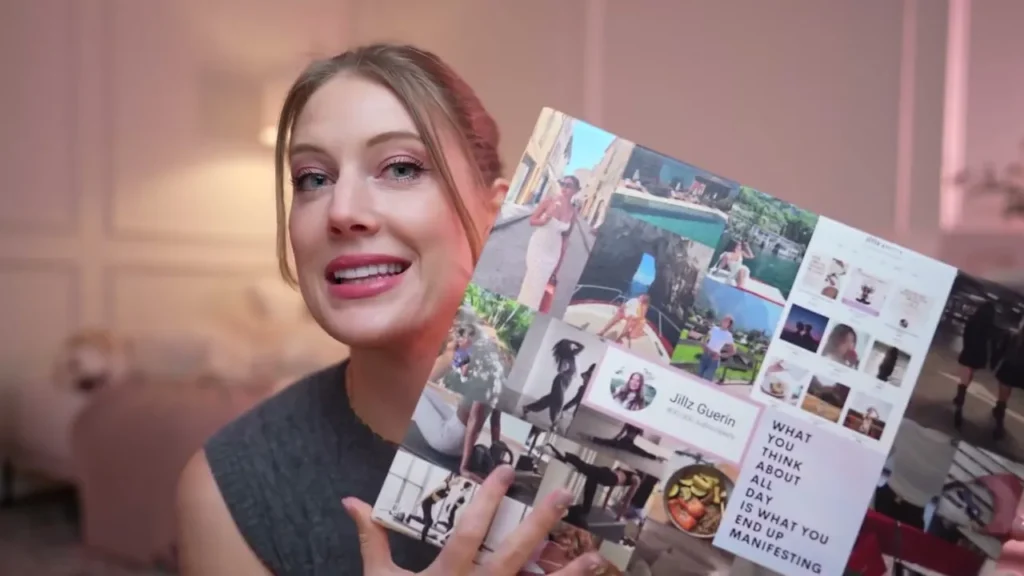
There’s an entire genre of self-help that promises the universe will deliver whatever you imagine clearly enough. For people who instinctively roll their eyes at this, the vision board has long looked like exhibit A — a craft project for adults pretending magazines and glue can substitute for work.
But there’s a quieter, more grounded version of vision boarding that actually works. Not because the universe is paying attention. Because you are.
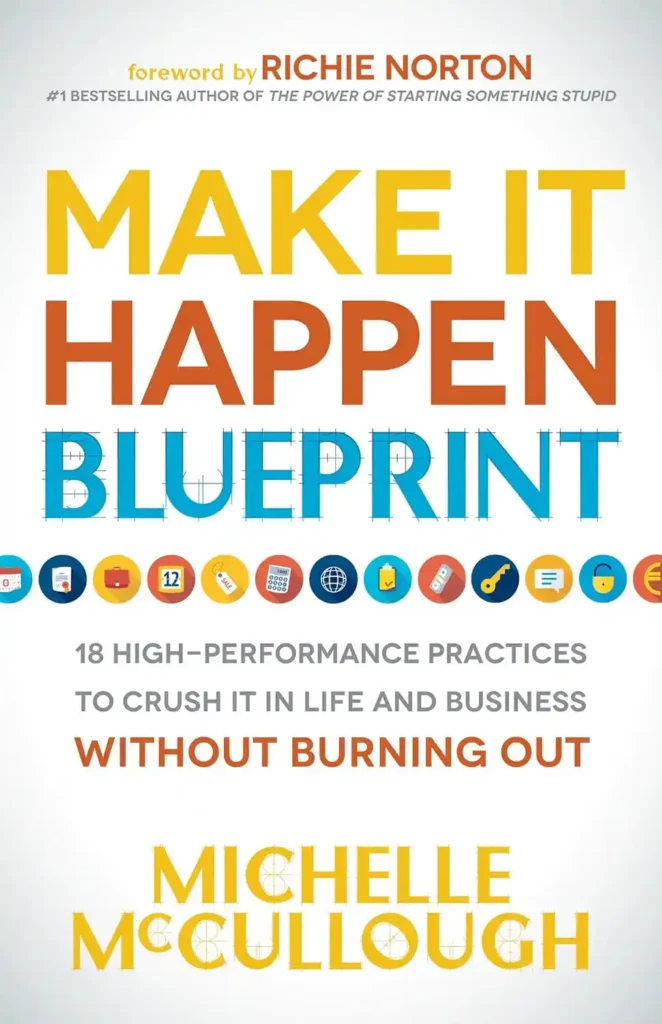
In Make It Happen Blueprint, entrepreneur and business coach Michelle McCullough — who once dismissed vision boards as “woo woo” before becoming a believer — offers one of the more honest accounts of why this practice matters and how to do it without losing your dignity. After running her own businesses for over a decade, working with thousands of clients, and seeing nearly every item on her first vision board come to fruition, she’s come to a clear-eyed conclusion: vision boards work because they make your goals visible enough that you actually act on them.
This article walks through what a vision board really does, why most people’s don’t work, and how to build one that earns its place on your wall.
Key takeaways:
- Vision boards work through documented psychological mechanisms — attention, motivation, and goal specificity — not magical thinking.
- Research on visualization is more nuanced than most vision-board content admits: pure fantasizing about success without also confronting obstacles can actually reduce motivation, according to psychologist Gabriele Oettingen’s research.
- The fix, and the one McCullough’s own approach already gets right, is pairing vision with concrete action — a board alone changes nothing without follow-through.
- Specificity matters more than aesthetics: vague images (“a beach”) don’t give your brain anything to organize around the way concrete ones do.
What a Vision Board Actually Is (And Isn’t)
Strip away the magical thinking and a vision board is a deceptively simple tool: a visual collection of the things you want, placed somewhere you’ll see it daily. That’s it.
Its real function is psychological, not metaphysical. The board makes your goals concrete in a way that wishes never are. It pulls them out of the vague back-of-the-mind space where they live and pins them where you have to look at them. And the things you look at every day are the things your brain quietly organizes itself around.
McCullough’s first vision board, made in 2008 at the suggestion of a friend, included a flatbed scanner, a particular house she wanted, a financial goal, a video camera for marketing, a magazine cover representing media opportunities, and a tropical vacation with her husband. Within months, friends were calling her to offer the scanner. The vacation got paid for by her husband’s company. The local business magazine selected her for a “40 Under 40” feature out of hundreds of nominations. With the exception of one item — a desk — every single thing on that first board came to pass.
She isn’t claiming sorcery. She’s pointing at something more interesting: when you make what you want visible, you start noticing opportunities that were already there, taking actions you wouldn’t have otherwise taken, and saying yes to things that move you toward those goals. The board isn’t doing the work. It’s keeping the work in front of you.
Does This Actually Hold Up, Psychologically?
Given the article’s own skepticism about “woo,” it’s worth being precise about what the research actually supports — because the honest answer is more interesting than either extreme (pure magic, or pure placebo).
Goal-setting research going back decades, most associated with psychologists Edwin Locke and Gary Latham, consistently finds that specific, vivid goals produce better outcomes than vague ones — which lines up exactly with why McCullough’s “flatbed scanner” beat a generic “more success” every time. Specificity gives the brain a concrete target to notice progress toward and opportunities related to.
Where it gets more interesting — and where a lot of vision-board content oversimplifies — is the research on visualization itself. Psychologist Gabriele Oettingen has spent years studying what happens when people vividly imagine a desired future. Her findings are counterintuitive: purely positive fantasizing about success, on its own, can actually lower motivation and effort, because the brain gets a small reward from imagining the outcome as if it’s already achieved. The piece that makes visualization actually work, in her research, is pairing the wish with an honest look at the obstacle in the way and a concrete plan for it — a method she calls mental contrasting.
This is, in effect, exactly what McCullough is describing when she insists the board only works alongside real action: “vision without action is decoration.” The research doesn’t contradict the vision-board practice — it explains precisely why the boards that fail (pure image, no plan) fail, and why the boards that work (image plus daily follow-through) work.
Why Most Vision Boards Fail
Most vision boards end up in a closet within six months. Here are the patterns that kill them.
They’re too vague. A picture of a beach doesn’t represent a goal. It represents a feeling. If you don’t know whether you want to retire there, vacation there, or just look at a beach occasionally, the board can’t help you. McCullough’s images were specific: a particular type of camera, a financial figure, an actual builder’s house design. Specificity gives the brain something to organize around.
They’re hidden. A vision board stuffed behind a bookshelf is a craft project, not a tool. The whole point is daily exposure. If yours isn’t somewhere you naturally look — an office wall, a bedroom mirror, a corkboard above your desk — it isn’t doing its job.
They’re built once and forgotten. Goals shift. So should boards. McCullough updates hers annually as part of her planning ritual, and at the end of the year takes down the items she achieved and puts them in what she calls a “Made It Happen” book. On hard days, she flips through it. The board isn’t a one-time exercise. It’s an ongoing conversation with yourself.
They’re built without belief. Here’s the harder part. If you make a board full of things you secretly think you don’t deserve, your subconscious knows. The board sits there as a reminder of how far you are from what you claim to want. McCullough is direct: at the heart of vision boarding are two principles — deciding what you want, and believing you can have it. Without the second, the first is just decoration.
They’re missing a plan for the obstacle. This is the piece the research adds that most vision-board guides skip entirely. A board full of outcomes with no thought given to what’s actually in the way of them tends to produce exactly the motivation dip Oettingen’s research predicts. The fix isn’t complicated: for your top two or three items, spend two minutes naming the single biggest obstacle and one concrete first step past it.
The Five-Step Vision Board That Actually Works
Here’s a stripped-down version of what McCullough recommends, refined into something a skeptic can do without cringing.
Step one: get clear on what you actually want. Before any pictures, sit with a notebook for an hour. Ask yourself the question McCullough returns to throughout her book: What are the deepest desires of my heart? Don’t filter for what’s “realistic.” Don’t pre-edit for what other people would approve of. Just write what comes up. Some of it will surprise you. Some of it will embarrass you. Both are useful. If you’re also trying to get clear on what you don’t want, pairing this with an anti-goals exercise can sharpen the picture from the other direction.
Step two: make the items concrete. Translate vague longings into specific images. “I want to be successful” becomes the magazine cover you want to be on, the income figure you want to hit, the title you want under your name. “I want to travel more” becomes a specific city, a specific lodge, a specific photograph that represents the trip you actually want to take. The brain is much better at navigating toward concrete targets than abstract ideals.
Step three: include why. McCullough always puts a picture of her family in the center of her board, because they’re the reason behind everything else. Your why grounds the board. Without it, ambition floats. With it, even hard days feel connected to something worth the effort.
Step four: place it where you’ll see it daily. Office wall. Bedroom mirror. Inside the closet door you open every morning. The board only works if you’re exposed to it without having to seek it out. Many high performers also take a phone photo of theirs and use it as a lock screen.
Step five: revisit regularly. Don’t just look — engage. McCullough integrates her board into her morning Power Up routine: she reviews it briefly, thinks about what each item represents, and lets it set the tone for the day. At the end of the year, the items that came true get celebrated. The ones that didn’t get evaluated — were they still wanted? Or had your life moved on?
Physical vs. Digital: Which Format Actually Works Better
There’s no strong research showing one format outperforms the other — the mechanism (daily visual exposure plus specificity) works whether it’s cardboard or pixels. What matters more is which format you’ll actually keep in front of you.
Physical boards (poster board, corkboard, magazine cutouts) tend to work well for people who want a tactile process and a fixed spot — a wall you walk past every day, not a file buried in a folder.
Digital boards (Canva, Pinterest, or a single composite image set as a phone lock screen or desktop wallpaper) tend to work better for people who check their phone constantly anyway — which, practically speaking, is most people. The daily-exposure mechanism is arguably easier to hit this way, since you don’t have to be in a specific room to see it.
Some people use both: a physical board for the annual, deeper reflection process, and a digital version — often just a photo of the physical board — as the daily touchpoint on their phone.
What to Put on a Vision Board (Beyond Beach Photos)
If your imagination is stuck in the standard sunset-and-luxury-car aesthetic, here are categories worth considering:
A specific goal in your work — the title you want, the project you want to launch, the income figure that would make you feel solidly resourced.
A relationship goal — not “find love” generally, but the kind of partnership you actually want; or for couples, a particular trip, ritual, or season together.
A health goal — the strength you want to build, the practice you want to maintain, the energy level you want to operate at.
A creative or learning goal — the book you want to write, the language you want to speak, the instrument you want to learn.
A contribution goal — the cause you want to fund, the people you want to help, the kind of impact you want your work to have.
A play goal — McCullough specifically recommends a “Wish Play List” of bigger dreams (a particular trip, a hobby you’ve always wanted to try, a celebration you want to throw) and putting images from that list on the board to remind you what the work is for.
The board doesn’t have to be one cluttered collage either. Some people build themed boards — one for the year ahead, one for a specific project, one for a longer-term life vision. If you want a more structured framework for organizing across life areas rather than a single freeform collage, the Bagua Vision Board approach maps your board to nine distinct life areas — wealth, relationships, health, and more — instead of one open canvas. Others use digital boards via Pinterest or a single image they keep on their desktop. The medium matters less than the consistency of contact.
The Honest Case for Belief
Here’s the part most articles skip. The reason vision boards make some people uncomfortable isn’t really the kitsch. It’s that they require admitting what you actually want. And admitting what you want exposes you to the possibility of not getting it.
McCullough names this directly when she describes her own resistance — the years she dismissed visioning tools as crazy before her own results changed her mind. The discomfort wasn’t about the boards. It was about the vulnerability of declaring a desire and watching to see whether life would meet it.
But this is also where the practice becomes valuable. The vision board is a small daily act of saying yes, I want this, and I’m willing to look at it. That alone shifts something. You start noticing the opportunities your busy mind was filtering out. You start having conversations with people who can help. You start saying yes to things that move you closer and no to things that don’t. The board doesn’t change reality. It changes what you notice in reality.
When the Board Doesn’t Work
Sometimes you’ll make a board and nothing happens. Before concluding the practice is broken, check three things.
Are you actually looking at it? Daily exposure is the entire mechanism. If the board has become wallpaper, move it.
Are the items still what you want? Sometimes a goal that felt true in January is no longer alive in June. That’s not failure — that’s growth. Take it down. Replace it with what’s true now.
Are you doing the work the board points at? Vision without action is decoration. McCullough is unambiguous about this throughout her book: the currency is work. The board makes the work visible. It doesn’t replace the work. If you’re consistently stuck at this step, it may be less about the board and more about setting audacious goals you’ll actually follow through on.
Frequently Asked Questions
Do vision boards actually work, or is it just the law of attraction? The evidence supports the psychological mechanism — specific, visible goals get more of your attention and shape what you notice and act on — not any metaphysical claim about the universe responding to thought. Research on goal-setting and visualization backs the practice when it’s paired with concrete action; on its own, pure visualization without a plan for obstacles has been shown to sometimes reduce motivation rather than build it.
How often should I update my vision board? Most practitioners, including McCullough, review and refresh annually as part of a broader planning process, while checking in more casually throughout the year. If an item no longer feels true to what you want, that’s a signal to update it rather than waiting for a fixed schedule.
Is a digital vision board as effective as a physical one? Yes, based on the same underlying mechanism — daily visual exposure and goal specificity matter more than the medium. Choose whichever format you’ll actually look at consistently; for many people that ends up being a phone lock screen rather than a printed board.
What’s the difference between a regular vision board and a Bagua vision board? A standard vision board is a freeform collage of whatever images resonate with you. A Bagua Vision Board borrows a structured, nine-area framework from Feng Shui — covering categories like wealth, relationships, career, and health — so you’re prompted to represent every major life area rather than only the ones that come to mind first.
The Quiet Power of Visible Goals
There’s nothing magical about a piece of cardboard with pictures on it. But there is something genuinely powerful about the daily act of looking at what you want, naming it without apology, and letting your brain quietly orient toward it.
McCullough’s whole approach to high performance rests on a deceptively simple insight: the things that consistently get built tend to be the things you’ve made impossible to ignore. A vision board is one way of doing that. It isn’t the only way. But for many people, it’s a more honest tool than they expected — provided they make it specific, place it where they’ll see it, and do the work the board reminds them of.
Try it for a year. At the end, take down what came true and put it somewhere you can revisit on hard days. You may find, as McCullough did, that the practice earns its place — not because the universe was listening, but because you finally were.
Do you want to try to make a Bagua Vision board?
This article is inspired by the chapter on Possibility in Make It Happen Blueprint: 18 High-Performance Practices to Crush It in Life and Business Without Burning Out by Michelle McCullough (Morgan James Publishing, 2017).
Do you want to try to make a Bagua Vision board?
Related posts:
 Make It Happen Blueprint: 18 High-Performance Practices to Crush It in Life and Business Without Burning Out (Full Summary & Course)
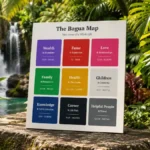 Bagua Vision Board: A Complete Guide to the 9 Life Areas
 How to Raise High-Performing Kids: 6 Anchor Points That Work
 The Power Team Pyramid: Who You Need Around You to Reach Big Goals
 The Life Balance Myth: Why High Performers Choose Priorities Over Balance