There’s a particular myth running through self-help culture that goes like this: if you’re truly driven, truly committed, truly determined, you can do it on your own. The lone-wolf entrepreneur. The self-made success. The grit-it-out-alone narrative.
It’s a beautiful story. It’s also, almost without exception, false.
Look closely at anyone who’s built something meaningful over years — a business, a body of work, a family, a recovery — and you’ll find a quiet network of people who held them up along the way. The mentors. The friends. The assistants. The contractors. The peers who got it. The mentor who gave the right advice at the right moment. The spouse who held things together during the hard years. The person who showed up with a casserole when no words would do.
In Make It Happen Blueprint, business coach Michelle McCullough quotes Jim Rohn’s famous line — “You are the average of the five people you spend the most time with” — and then offers a more useful framework: the Power Team pyramid, organized in three levels. Each level serves a specific purpose. Most people are weak in at least one. And the level you’re weakest in is usually the one quietly capping your growth.
This article walks through all three levels, helps you assess where your gaps are, and shows you how to start filling them.
The Pyramid
McCullough’s pyramid has three tiers. From bottom to top:
Foundational support — the people you delegate to.
Core friend support — the mutual relationships that sustain you.
Mentor support — the people who’ve walked the path ahead and can pull you forward.
Each tier has a different purpose. None of them is optional, though they look different at different stages of life. A college student’s foundational support might just be a study group. An entrepreneur’s might be virtual assistants, contractors, and a bookkeeper. A working parent’s might include childcare help, a house cleaner, and a meal service. The forms vary. The category stays consistent.
Let’s look at each.
Level 1: Foundational Support
The foundational tier is the base of the pyramid, and it’s the one most people undervalue.
This is where you offload tasks that don’t require you specifically. McCullough divides these into two types: lower-level tasks (things that should be handled by an assistant, contractor, or someone at a different pay level) and skill-based tasks (things above your expertise or outside your strengths that someone else can do better).
The principle she cites from Ken Blanchard: all monkeys must be handled at the lowest organizational level consistent with their welfare. In plain terms — the most appropriate person, usually not you, should be doing the task. This isn’t about hierarchy or status. It’s about leverage. Time you spend doing what others could do is time you can’t spend doing what only you can do.
McCullough tells the story of a graphic designer client who was spending one to two hours a week on bookkeeping she hated and wasn’t good at. At her hourly rate as a designer ($75-100), that’s $150-200 a week of opportunity cost — plus the emotional drain of dreading something she resisted every week. When McCullough pointed out the math, hiring a bookkeeper became obvious.
The objection she hears most: I can’t afford it. The honest reframe is usually: I can’t afford not to. The hours you free up at your real hourly rate often more than cover the cost of the help — provided you actually use those hours for higher-leverage work.
For people without budget, foundational support can take other forms. Trading services with a friend. Hiring a neighborhood teenager (McCullough started by paying neighborhood kids to put stickers on her promotional product catalogs). Negotiating with a partner about household division of labor. The underlying question is the same: what am I doing that doesn’t need to be done by me, and how do I get it off my plate?
The gap to watch for: people who pride themselves on doing everything themselves. They’re usually exhausted, often resentful, and growing more slowly than they could be. If this is you, the foundational level is where to start.
Level 2: Core Friend Support
The middle tier is for friends and family — the people who are sitting on the front row at your important events, by your side in hard moments, celebrating with you when things go well and holding space for you when they don’t.
This is the level most people naturally have something of, but the quality varies wildly.
The key distinction McCullough draws: unlike the foundational level (which can appropriately be one-sided — you pay them, they provide a service), the core friend level only works when it’s mutual. Trust, communication, support, and love have to flow both ways. You can’t have one-sided friendships indefinitely; they wear out the giver.
This means part of building strong core friend support is being a good core friend yourself. McCullough is direct about this: some of her clients discover their weakness in this category isn’t bad luck. It’s that they haven’t been showing up well for others. The relationships dried up over time because nothing was being deposited.
If your core friend support is weak, the first move isn’t to look for new people. It’s to ask whether you’ve been the kind of friend the people already in your life would want more of. If the honest answer is no, start there. Reach out. Show up. Send the text. Make the call. Be reliably present in small ways before you expect to be supported in big ones.
For people whose core friend support is genuinely thin — people who’ve moved cities, gone through major life transitions, or simply never built deep adult friendships — McCullough suggests a few practical moves:
Connect with like-minded individuals. Networking events, professional groups, chambers of commerce. Sports teams, hobby clubs, classes. Anywhere people with shared interests gather is a place where friendships can plausibly start.
Find online groups. Social media communities and online forums can connect you with like-minded people across the world. The relationships have limits compared to in-person friendship, but they’re not nothing — especially in a season of life when in-person friendship is hard to build.
Accept that the cast changes. McCullough notes that core friends come and go as life evolves. The friends from junior high mostly aren’t her current friends. The friends from her first business aren’t necessarily the friends from her current life. This isn’t tragic — it’s life. As you grow, some people grow with you and some don’t. That’s okay. New people enter when they’re needed.
The gap to watch for: people who have plenty of acquaintances but no one they’d call at 2 AM. The breadth of their network masks the absence of real depth in any single relationship. If this is you, choose two or three people you’d most want to deepen with — and invest in those relationships specifically rather than spreading thin across many.
Level 3: Mentor Support
The top tier is mentor support — the people who’ve already done what you’re trying to do, or know what you want to know.
McCullough describes mentors as being “above” her — not in moral terms, but positionally. They’ve walked the path ahead. They can pull you forward in ways your peers can’t, because they’ve already been where you’re going.
This level is the one most people skip entirely, often because of a few quiet assumptions: I should figure this out on my own. I don’t want to bother anyone. I’m not far enough along to deserve a mentor’s attention. I can’t afford a coach.
These assumptions usually cost more than they save.
McCullough is candid that she has paid for coaches throughout her career — even after becoming a successful coach herself. She still pays for coaching now. The reason: a good coach or mentor compresses the learning curve dramatically. Five years of figuring something out alone can become six months with the right guide. The investment usually pays for itself many times over, even putting aside the emotional benefit of having someone in your corner.
Not all mentor relationships require payment. McCullough has also benefited from free mentors, mastermind groups, and accountability partners. The key is having someone in this tier — a person whose experience you can borrow, whose perspective is broader than yours, who can tell you when you’re missing something obvious.
How to find mentors:
Look for people one or two steps ahead, not ten. A mentor who’s a few years further along your path is usually more useful than a celebrity in your field. They remember what your stage felt like. Their advice is relevant.
Be specific about what you’re asking for. “Will you be my mentor?” is a big ask that usually gets a polite no. “Could I buy you coffee and ask you three specific questions about how you handled X?” is a smaller, more answerable ask.
Be generous before you ask. Most successful people are happy to help — within reason — but they’re tired of being treated like vending machines. Build a real relationship first. Be useful to them in whatever small ways you can. Then ask.
Pay where appropriate. If a coach or consultant has built a business around their expertise, hire them when you can afford it. Not everyone wants to be a free mentor, and that’s fair.
The gap to watch for: people who have plenty of friends but no one further along the path. Their growth is bounded by their peer group. Adding even one mentor relationship to the mix often opens doors that years of grinding alone couldn’t.
On Family
McCullough places family specifically in the core friend tier — which is worth pausing on, because for many people, family is their most important power team relationship.
The principle: just because family is family doesn’t mean the relationship sustains itself. McCullough makes time for her husband and kids every day and every week. Date night happens once a week, 97% of the time. The relationship gets calendar space, not just leftover time.
For people whose family relationships are strong, this is a reminder to keep investing — not to take the strength for granted. For people whose family relationships are strained, McCullough’s stance is grounded: tend what you can tend, and accept that some relationships in your life of origin may not be available as power team relationships in the way you’d hope. The good news is core friend support isn’t dependent on biology. Chosen family counts.
On Naysayers
One of the most useful sections of McCullough’s chapter is on dealing with people who don’t get it — the friends, family members, or acquaintances who tell you your goals are crazy, your dreams are unrealistic, your plans won’t work.
Three principles she offers:
Always be kind. Don’t fight people for the support they’re not able to give. Thank you for your feedback is a complete sentence. Change the subject.
Remember that results quiet naysayers. Talk doesn’t usually convince skeptics. Action sometimes does. Take action, build traction, let the results speak. Many of the people who doubted you will quietly come around once they see something working.
Have a better conversation when needed. Sometimes the issue isn’t the naysayer — it’s that you haven’t actually told them how they could support you. (This is what McCullough’s chapter on Persuasion addresses in depth.) People often want to support but don’t know how. Make it easy for them.

Auditing Your Power Team Pyramid
A quick exercise. Take a piece of paper. Write the three levels: Foundational, Core Friend, Mentor. Under each, list the people in your life currently filling that role.
Where are the gaps?
If foundational is empty, what’s one thing you could outsource or delegate this month?
If core friend is thin, who are two or three relationships you could deepen?
If mentor is empty, what’s the small step toward finding one — a paid coach, a mastermind, a senior person in your field you could ask to coffee?
You don’t have to fill every gap immediately. But naming the gaps is the start.
You Were Never Supposed to Do This Alone
The deepest insight in McCullough’s chapter on the Power Team is the implicit one: high performance is a team sport, not a solo act. The people who go furthest and stay happiest along the way are usually the ones who got serious about who they had around them.
This isn’t weakness. It’s structural intelligence. You’re not designed to be the entire system. Build the system.
Then tend it well. Quality time, expressed gratitude, reliable presence — these are the deposits that keep the power team strong. McCullough writes physical letters to people in her life regularly. She schedules check-ins with her team. She makes the small investments that keep relationships alive.
Big lives are built on small consistent investments in the people who help you live them. Start auditing yours today.
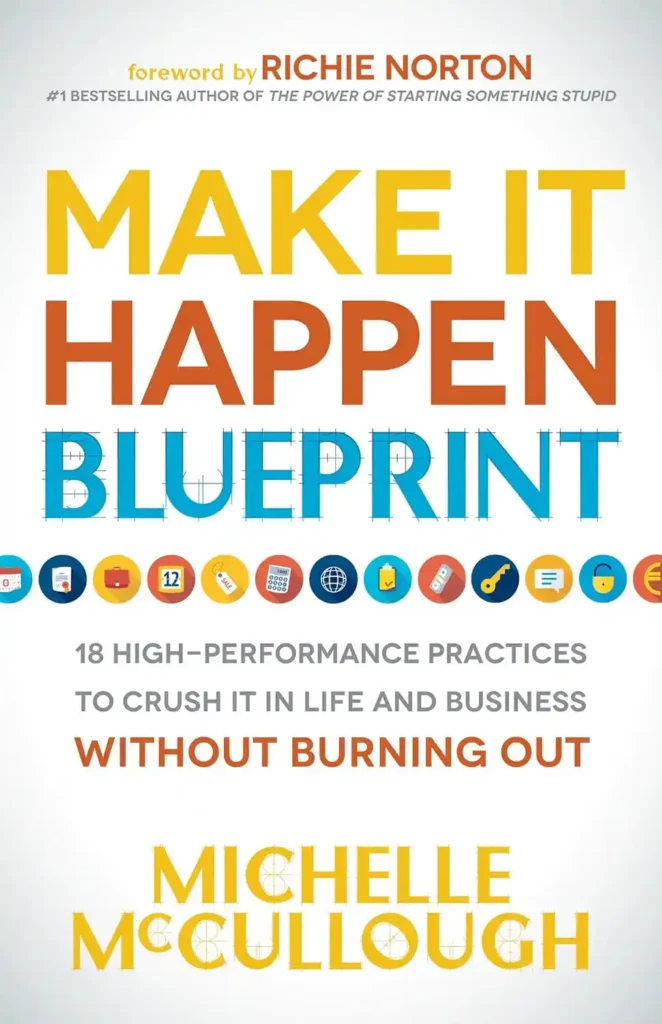
This article is inspired by the chapter on Power Team in Make It Happen Blueprint: 18 High-Performance Practices to Crush It in Life and Business Without Burning Out by Michelle McCullough (Morgan James Publishing, 2017).
Related posts:
 Team Human Summary: 25 Essential Ideas From Douglas Rushkoff
 Make It Happen Blueprint: 18 High-Performance Practices to Crush It in Life and Business Without Burning Out (Full Summary & Course)
 How to Read People Like the CIA in Business and Life
 Hume Band Review: Does This Stress-Tracking Wearable Actually Work?
 The Morning and Evening Routines That Set High Performers Apart