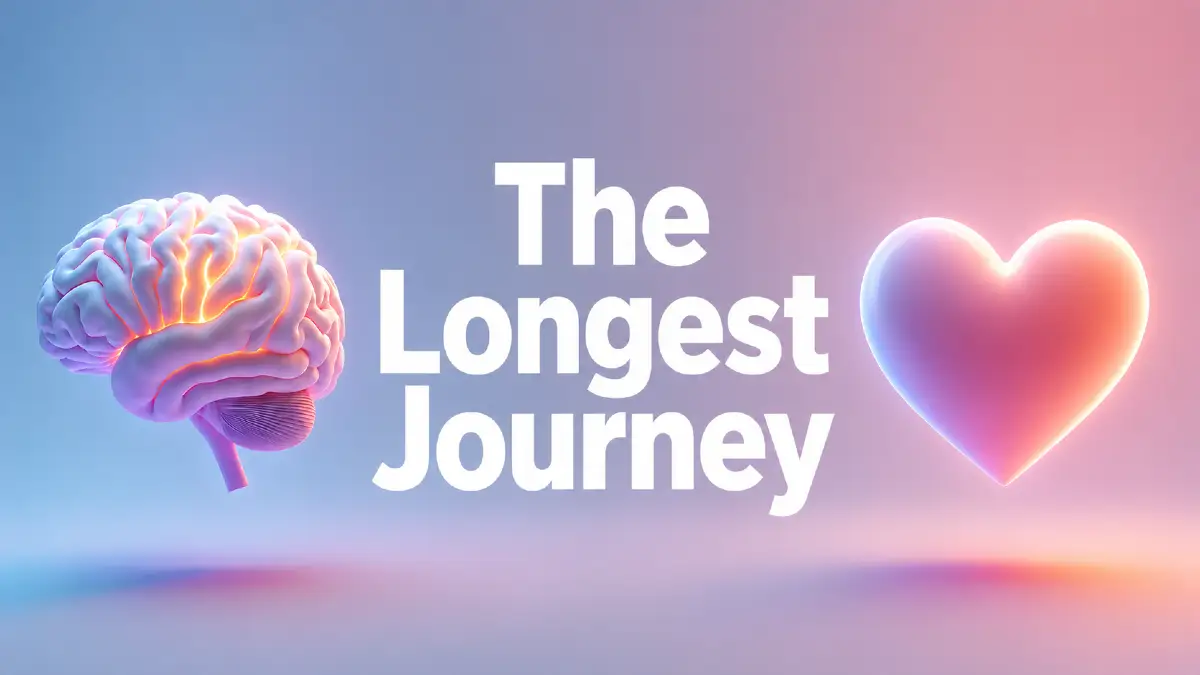
What makes us human in the age of AI is no longer our intelligence alone — machines now match or beat us at many thinking tasks — but the things that come from living a mortal, embodied, connected life: wisdom, feeling, chosen restraint and real relationship. That’s unsettling for a culture that built its sense of human worth on being the smartest thing around, and it may be one of the most important opportunities we’ve had in centuries. This article explores the story we built our identity on, why intelligence was never the whole of it, what remains distinctly human, and how a man can rest his worth on something sturdier than output.
It’s a Tuesday morning and you’ve just asked an AI tool to draft the report you’d normally spend two days on. It’s done in forty seconds. It’s good — better structured than yours would have been, with a couple of ideas you hadn’t thought of. You read it twice, then sit back with a strange, quiet feeling that isn’t quite relief. If this is what it can do, what exactly are you for?
That question is arriving in millions of lives at once. It deserves a better answer than panic or denial.
What Makes Us Human If Machines Can Think?
In the age of AI, what makes us human is less our ability to process information than our capacity for wisdom, emotional insight, chosen restraint and genuine relationship — qualities that come from having a body, a finite life, real stakes and other people who matter to us. Machines can increasingly reproduce the outputs of intelligence. They don’t live the life those outputs are about.
That’s not a consolation prize. It may turn out to be a correction. For several centuries, Western culture has treated rational intelligence as the defining human trait and the main measure of a person’s worth. AI is forcing a question we’d stopped asking: was that ever the whole story?
It’s worth saying clearly what this article isn’t arguing. It isn’t claiming machines are stupid, or that thinking no longer matters, or that men should retreat from technology. AI is a remarkable tool, and clear thinking remains one of the most valuable things a man can bring to his work and his family. The argument is narrower and more personal: if your entire sense of worth rests on being the smartest person in the room, that foundation is about to be tested — and there are firmer ones available.
The Story We Built Our Identity On
For around four centuries, since Descartes put thinking at the centre of what it means to exist, the West has told itself a flattering story: we are the thinking animal, and that’s what makes us special. We built schools, careers, status hierarchies and even our sense of personal worth around it. The smartest kid in class, the sharpest analyst, the man with the best ideas — these were the people the culture rewarded.
Then machines started taking that territory, one piece at a time. IBM’s Deep Blue beat the world chess champion Garry Kasparov in 1997, and we told ourselves chess was just calculation. Then came Go, translation, image recognition, coding, writing. In 2024, a study led by Stanford physician-researcher Ethan Goh gave 50 doctors a set of complex clinical cases; GPT-4 working alone scored around 92 on diagnostic reasoning, compared with roughly 75 for the doctors, with or without AI help. The researchers stressed that AI should support, not replace, a physician’s judgement. But the direction of travel is hard to miss.
Some of the people who built these systems have reached the same conclusion. In 2023, Geoffrey Hinton — one of the pioneers of the neural networks behind modern AI — left Google and said publicly that he’d changed his mind after forty years: he now believed digital intelligence might become a better form of intelligence than our own.
For a man whose sense of worth rests on being the capable one, the clever one, the one with answers, this isn’t just an economic problem. It’s an identity problem. That’s why the fear of becoming obsolete — FOBO — hits so many men so hard, and why questions about whether AI will take all jobs are often really questions about who we’ll be.
Intelligence Was Never the Whole Story
Here’s the good news, and it’s backed by research: intelligence and wisdom are not the same thing, and it’s wisdom that seems to matter more for a good life.
In 2013, a team led by University of Waterloo psychologist Igor Grossmann, with Richard Nisbett and colleagues, studied 241 adults from across the age range in Michigan. They measured standard intelligence — vocabulary, processing speed, working memory — and also how wisely people reasoned about real social conflicts: whether they considered other perspectives, recognised uncertainty, looked for compromise. Wise reasoning was linked to higher life satisfaction, better relationships, less negative emotion and less brooding. Standard intelligence showed no systematic link to well-being at all.
Wisdom, in other words, isn’t a matter of raw processing power. It grows from perspective-taking, humility about what you don’t know, and the ability to hold competing views at once. And Grossmann’s later research with Ethan Kross found something even more human: people tend to reason more wisely about other people’s problems than their own, until they step back and see themselves from a little distance — the effect we explore in the Batman Effect. Wisdom isn’t a fixed trait. It’s a stance you can choose.
A machine can summarise every book on wisdom ever written. What it can’t do — at least not in any way we understand — is have something at stake in its own decisions, feel the weight of them, and grow from the consequences.
The Thing No One Can Fully Explain
There’s a deeper question underneath all of this, and honesty requires admitting we don’t know the answer. Nobody yet understands consciousness: why there is something it feels like to be you, rather than just information being processed. Scientists and philosophers disagree on whether machines could ever have experience in that sense, and on how we’d know.
What we can say is that producing words about pain and being present with someone in pain are different things. An AI can generate a compassionate reply to a grieving friend. It isn’t sitting in the room, tired, uncertain, choosing to stay. When people describe what helped them most in their hardest moments, it’s rarely the perfect sentence. It’s that someone was there.
This matters for men in particular, because many of us have been trained to show love through competence: fixing, providing, solving. If machines can increasingly solve, then the forms of love that can’t be automated — presence, attention, real listening — become more valuable, not less. It’s also why it’s worth being clear-eyed about what it means that ChatGPT has quietly become America’s most-used therapist, and about the hollowness of AI situationships: being answered isn’t the same as being known.
The Longest Journey: From the Mind to the Heart
There’s an old saying in several contemplative traditions that the longest journey a person ever makes is the eighteen inches from the head to the heart. For centuries, Western culture has been travelling in the opposite direction: valuing analysis over intuition, argument over feeling, what can be measured over what can only be lived. The psychiatrist and writer Iain McGilchrist has argued that modern culture has come to favour a narrow, analytical way of attending to the world at the expense of a broader, more relational one.
AI may push that pendulum back. Not by making thinking worthless — it remains essential — but by making clear that thinking alone was never enough. The skills that will matter most in an AI-saturated world look increasingly like the ones our culture undervalued: emotional intelligence, judgement under uncertainty, moral courage, the ability to read a room and a person, and the willingness to act on what you sense when the data runs out.
This isn’t a call to abandon reason for feelings. Intuition without reason is easily fooled, and feeling without thought can be cruel. The journey from mind to heart is about integration, not replacement: a man who can think clearly and feel deeply, and who knows which to trust when. That’s close to what we mean by emotional mastery, and it’s the kind of emotional attunement that relationships actually run on.
What Survives the Handover
If machines take over more and more of the work of thinking, four distinctly human qualities seem likely to remain — and to matter more.
The first is skin in the game. Human decisions carry real consequences for the person making them. You will live with your choices, in a body that ages, in a life that ends. Mortality gives our decisions weight. An AI can recommend; a man has to decide and then live with it.
The second is emotion as a source of insight, not a bug to be routed around. The sinking feeling that a deal is wrong, the warmth that tells you a friendship is real, the guilt that tells you you’ve crossed a line — these aren’t failures of rationality. They’re information, often arriving faster than conscious reasoning can.
The third is the capacity to act against your own interest, on purpose. Humans can choose restraint, sacrifice and loyalty when nothing forces them to: keeping a promise that costs us, giving credit away, standing by someone at our own expense. That is the root of character.
The fourth is relationship. Humans don’t just process each other’s words; they change each other by being together over time. Douglas Rushkoff’s Team Human makes the case that being human is a team sport — and that technology should serve that, not replace it.
None of these can be downloaded. All of them can be developed.
What This Means for Men at Work
For most men, the question of what makes us human arrives first at work. It’s worth being practical about it.
The tasks most exposed to AI are the ones that can be fully specified: drafting, summarising, analysing, routine coding, standard advice. The capacities that grow in value are the ones that can’t — judgement when the information is incomplete, trust built over years, the ability to lead people through uncertainty, taste, and the willingness to take responsibility for a decision. None of these is new. They’ve always separated good professionals from great ones. AI is simply stripping away the work that used to hide them.
That suggests a different career strategy. Rather than competing with machines on speed and volume, invest in the things they amplify but can’t supply: deep expertise in a field, the kind that comes from decades of craft; relationships with people who trust your judgement; and the courage to make calls and own them. Our guides to the craftsman mindset and economic life expectancy go deeper on how to think about this.
It also means using the tools without being used by them. A man who lets AI handle the routine and spends the time saved on thinking, mentoring and relationships is becoming more valuable. A man who uses it to avoid ever struggling with a hard problem may find his own judgement quietly weakening. The difference isn’t the tool. It’s what you do with the hours it gives back. For the broader picture of jobs, identity and relationships, our complete guide to AI and the future of men is a good next read.
The Risk Isn’t Only Replacement — It’s Retreat
There’s a quieter danger than machines taking our jobs: men retreating from the very things that make them human because the machine versions are easier.
It’s easier to get affirmation from a chatbot than from a partner who sometimes disagrees. It’s easier to scroll an AI-only social network than to call a friend. It’s easier to let a tool write the condolence note than to sit with the discomfort of writing it yourself. Each of these is understandable. Added up, they can hollow out a life — the pattern behind the rise of men choosing AI girlfriends over real women.
At the larger scale, some technologists have openly embraced the idea of leaving human limits behind altogether. Our pieces on the transhumanist delusion and the Silicon Valley death cult look at that ideology critically. Whatever you think of it, the more grounded response for most men isn’t to compete with machines on their terms, but to deepen the things machines can’t do.
How to Practise Being More Human
If the human qualities that matter most are wisdom, feeling, restraint and relationship, they can be practised like any other skill. A few habits make a real difference.
Spend some time each week doing something difficult without help: writing a letter by hand, fixing something, working through a problem yourself before reaching for a tool. Struggle is part of how judgement forms.
Pay attention to what you feel before you decide. When a choice matters, pause and notice your gut response, then check it against the facts. Over time, you learn when your intuition is reliable and when it isn’t.
Protect undistracted time with people. An hour with a friend or your children with phones away does more for your humanity than any amount of optimisation. And practise small acts of chosen restraint: keeping a promise that costs you, listening when you’d rather talk, letting someone else have the credit.
None of this is dramatic. That’s the point. Being human is mostly practised in ordinary moments, by men who decide those moments matter.
This Isn’t Demotion. It’s an Invitation
It would be easy to read all of this as bad news: the end of human specialness, a long slide into irrelevance. Some versions of the future do look bleak, and we’ve written honestly about AI doomsday scenarios and the mental preparation mass unemployment might require.
But there’s another reading. If a man’s worth was ever based mainly on his output, it was always fragile — vulnerable to age, illness, redundancy and comparison. AI simply makes that fragility visible. The invitation is to rest your sense of worth on something sturdier: your character, your integrity, the quality of your attention, the people you love and are loved by, the way you show up when things are hard.
That’s not a smaller life. It’s the life most of the wisest people in history were pointing at all along. And there’s a paradox in it worth noticing, which we explore in how AI might make us more human: by taking over so much of the thinking, machines may free us to do more of the living.
You can’t stop the technology, and you can’t out-compute it. You can decide what you’ll be when it’s everywhere. You already know what that looks like; you’ve seen it in the best people you’ve known, and probably in your own best moments.
When machines think faster, the only race left worth running is the one toward your own heart. Where are you in that race today?
7 Questions to Sit With About What Makes You Human
Answer these as a man, not as a résumé — what you are, not what you produce.
- Think of the last time an AI tool did in seconds something you used to be proud of doing: what did you feel, and what did it reveal about where your worth sits?
- What has defining yourself by your competence given you over the years, and what has it made harder to receive — rest, help, being loved without performing?
- When you face a decision the data can’t settle, what does your gut say before your mind starts arguing — and how often have you overruled it?
- Like the people in Grossmann’s study whose wisdom mattered more than their IQ, where in your life would perspective and humility serve you better than another clever answer?
- Which relationship in your life is already proof that you matter for who you are, not what you do?
- If you stripped “being useful” down to what’s actually true, what would you build to help men find their worth beyond their output?
- If no machine could ever replace the way you love, listen and stand by people, how would you spend more of your time?
If questions about obsolescence, work or worth are leaving you feeling hopeless rather than reflective, talk to someone — a friend, a mentor, or a counsellor. These are heavy questions, and they’re easier to carry with company.
Stop, Start, Keep: 5 Questions for Being Human in the Age of AI
Use this as a simple strategy review for the next month.
- What will you stop handing to a machine this month — a condolence message, a hard conversation, a creative project — because doing it yourself is the point?
- What will you start practising that no tool can do for you: an hour of undistracted presence with someone, a weekly walk without your phone, a skill learned with your hands?
- What are you already doing well, as a person rather than a producer, that you’ll deliberately keep?
- Before the month ends, which three men who feel threatened by AI will you ask what would help them, and what simple idea will you write down from their answers?
- Who is most affected by your answers — your partner, children or team — and once you’ve made the changes, how will you let go of out-competing machines?
Which part of you would you never want a machine to do, and how much of your week does it currently get?
Frequently Asked Questions About Being Human in the Age of AI
What makes us human in the age of AI?
As AI matches or surpasses humans at many thinking tasks, what remains distinctly human is less raw intelligence than wisdom, emotional insight, chosen restraint and genuine relationship. These come from having a body, a finite life, real stakes in our decisions and people who matter to us, things machines can describe but don’t live.
Will AI make humans obsolete?
AI is likely to change or replace many tasks and some jobs, but obsolescence depends on how we define human worth. If worth means output, many people will feel threatened. If worth includes character, wisdom, presence and relationship, AI may shift what we value rather than make people obsolete. Preparing for both economic and identity changes is wise.
Is wisdom different from intelligence?
Yes. Research by psychologist Igor Grossmann and colleagues found that wise reasoning, which involves considering other perspectives, recognising uncertainty and seeking compromise, was linked to greater life satisfaction and better relationships. Standard measures of intelligence, such as vocabulary and processing speed, showed no systematic link to well-being in the same study.
Can AI understand emotions?
AI can recognise emotional language and generate replies that sound caring, and it can be genuinely useful for reflection. But scientists don’t know whether machines experience anything at all, and producing words about feelings is different from feeling them or being present with someone. For many people, human presence remains central to real comfort and connection.
Why does AI make men feel threatened?
Many men have been raised to tie their worth to competence, problem-solving and providing. When machines can solve problems faster, that identity can feel under attack, which is why the fear of becoming obsolete hits men hard. Resting worth on character, relationships and presence offers a sturdier foundation that technology can’t take away.
How can I stay human in an AI-driven world?
Use AI as a tool, not a replacement for the things that make life meaningful. Protect undistracted time with people, do some important things yourself even when a machine could, practise reflection and perspective-taking, and build skills that involve your body and your relationships. Above all, define your worth by who you are, not only what you produce.
References
- Goh, E., Gallo, R., Hom, J., Strong, E., Weng, Y., Kerman, H., Cool, J. A., Kanjee, Z., Parsons, A. S., Ahuja, N., Horvitz, E., Yang, D., Milstein, A., Olson, A. P. J., Rodman, A., & Chen, J. H. (2024). Large language model influence on diagnostic reasoning: A randomized clinical trial. JAMA Network Open, 7(10), e2440969.
- Grossmann, I., Na, J., Varnum, M. E. W., Kitayama, S., & Nisbett, R. E. (2013). A route to well-being: Intelligence versus wise reasoning. Journal of Experimental Psychology: General, 142(3), 944–953.
- Grossmann, I., & Kross, E. (2014). Exploring Solomon’s paradox: Self-distancing eliminates the self–other asymmetry in wise reasoning about close relationships in younger and older adults. Psychological Science, 25(8), 1571–1580.
- McGilchrist, I. (2009). The master and his emissary: The divided brain and the making of the Western world. Yale University Press.
Related posts:
 9 Machines People Are Using to Build Real Smal Businesses Right Now
 Humanoid Robot Companions and the Man Who Stopped Listening
 Team Human Summary: 25 Essential Ideas From Douglas Rushkoff
 FOBO: The Fear of Becoming Obsolete and Why It’s Hitting Modern Men Hardest
 The Hero’s Journey for Men: The Making of a Hero Through Twelve Stages