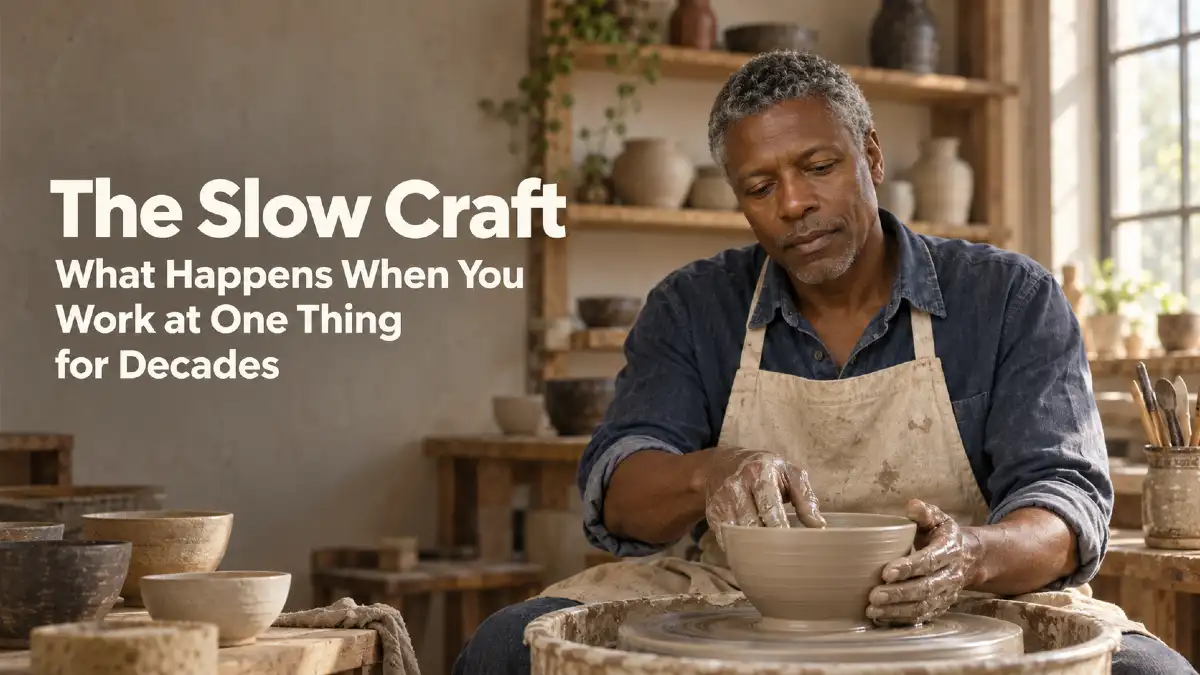
Expertise in a complex craft takes roughly ten years of serious work; mastery, the point where the craft becomes the way you see, usually takes twenty or more. The research on deliberate practice, chess memory and skill acquisition explains why the numbers fall where they do, and why the 10,000-hour rule is both half right and badly misunderstood. What the research can’t do is carry you through the middle years where most men quit, so that is where this piece spends its time.
The short answer, and the longer one
Watch a cabinetmaker who has been at the bench for thirty-five years run his palm along a board before he cuts it. He isn’t checking anything in the way a beginner checks. He’s reading the wood, the way you read a familiar face, and the decision about where to cut arrives before he could explain it. That moment, quiet and unremarkable to anyone watching, is what mastery looks like from the outside. It took him about three decades to get there.
So, how long does it take to master a craft? The honest answer runs in two stages. Reaching expertise in a demanding field (chess, surgery, a musical instrument, serious woodworking, writing) takes around ten years of focused work. Reaching mastery, where technique has dissolved into perception and the work begins to carry a quality that can’t be produced any other way, usually takes twenty to thirty years. Japan’s craft tradition puts a number on it: a takumi, a master artisan, is generally reckoned to need about 60,000 hours of practice, which works out to eight-hour days, 250 days a year, for thirty years. The sushi chef Jiro Ono, whose restaurant became the subject of Jiro Dreams of Sushi, kept apprentices for ten years before he considered them real craftsmen. His own career at the counter ran for most of a century.
These numbers can feel discouraging on first contact. They’re meant to be clarifying instead. A man who knows the road is thirty years long doesn’t panic at year six because he isn’t great yet. He was never supposed to be.
Expertise and mastery are not the same thing
Most confusion about the slow craft comes from collapsing three different things into one.
A long career is not a slow craft. A man can spend forty years in an industry, collect titles, move sideways every few years and never go deep into any actual body of work. Presence in a field is not the same as sustained attention to a practice.
Expertise is not mastery either. The philosopher Hubert Dreyfus and his brother Stuart, a professor of industrial engineering, spent years studying how pilots, chess players, nurses and drivers acquire skill. Their model describes a learner moving through five stages: novice, advanced beginner, competent, proficient and expert. The beginner follows rules. The proficient performer starts to see what a situation calls for without reasoning it out, and the expert acts on that intuition almost entirely. Later the Dreyfus brothers added a sixth stage, mastery, for the performer who isn’t content with conventional expertise and keeps widening the range of what his intuition can handle. Expertise is the point where the rules have been absorbed. Mastery is what happens when a man keeps living inside the craft long after he no longer needs the rules.
And none of this is productivity. A master cabinetmaker may finish fewer pieces a year than a young, fast craftsman with more energy than attention. Output measures miss what is actually accumulating, which is the subtle shift from doing the work to seeing through it. If you’ve followed the argument for slow productivity and deep work, this is its long-horizon version: fewer things, done at a natural pace, with obsessive attention to quality, stretched across decades instead of a quarter.
The sociologist Richard Sennett, in The Craftsman, compresses the whole idea into a three-word maxim: “making is thinking.” The hands are not executing what the head already decided. Over enough years, the hands become part of how the head decides.
What the 10,000-hour rule got right, and what it got wrong
The 10,000-hour rule began with a 1993 study by the psychologist K. Anders Ericsson and colleagues, which found that the best violin students at a Berlin music academy had accumulated around 10,000 hours of practice by age twenty, far more than less accomplished students. Malcolm Gladwell popularised the figure in Outliers, and it hardened into folk wisdom: put in the hours and you become an expert.
The research since then has complicated that story in useful ways. In 2014, the psychologist Brooke Macnamara and her colleagues pooled 88 studies in a meta-analysis and found that deliberate practice explained about 12 percent of the differences in performance overall. The share varied a great deal by domain: roughly 26 percent in games like chess, 21 percent in music, 18 percent in sports, 4 percent in education, and under 1 percent in professions. A preregistered 2019 replication of the original violin study, led by Macnamara and Megha Maitra, found practice still mattered but explained about 26 percent of the difference between good and elite violinists, not the 48 percent the original paper reported. Ericsson pushed back, arguing that the meta-analyses counted too many casual activities as “deliberate practice.” That argument is still running.
So what survives? Three things, and they matter more than the number.
First, practice always helps; it just doesn’t explain everything. Talent, starting age, the quality of teaching, personality and plain luck all play their part. Second, the kind of practice matters more than the quantity. Ten thousand hours of repeating what you already know is a different thing from ten thousand hours spent at the edge of your ability, with feedback. Third, and this is the part that rarely makes it into the summaries, the original 10,000 hours described students around age twenty who were entering elite training. It was a marker of serious beginning, never a finish line.
That last point is what the slow craft is about. The 10,000 hours gets you to the door. The decades after it are where mastery lives.
Why it takes a decade just to see the work
The clearest scientific window into why depth takes so long comes from chess. In the early 1970s, Herbert Simon and William Chase showed chess masters a board for five seconds and asked them to reconstruct it. Masters could do it almost perfectly, as long as the position came from a real game. With pieces placed randomly, their advantage largely disappeared. They didn’t have better memories. They had a vast internal library of familiar patterns, or “chunks,” which let them see a cluster of pieces as a single meaningful shape. Simon’s estimates put a grandmaster’s library at a minimum of 50,000 chunks, and he noted that reaching strong grandmaster level takes at least ten years of intense work, a period that turned up again in a dozen other fields.
This is what a craftsman is quietly doing for his first decade: building the library. Every joint cut badly, every diagnosis missed, every paragraph rewritten adds patterns that will one day be recognised in a glance. It is invisible work, which is exactly why it feels like nothing is happening.
Sennett adds a layer the laboratory studies can’t capture. Much of what a craftsman knows is tacit knowledge, understanding that lives in the hands and eyes and can’t be fully written down. You can’t learn to catch a ball from the playbook, and you can’t learn the feel of a plane blade biting into oak from a video. Tacit knowledge only accumulates through contact with the material, over and over, for longer than seems reasonable.
You’ve almost certainly done a smaller version of this already. There was a time when driving a car took your whole attention: mirror, signal, clutch, the terror of a roundabout. Now you drive home and barely remember the route. Nothing magical happened. You built the library. The slow craft is the same process, applied to something harder, for longer, on purpose.
The four seasons of a craft
Across fields that reward depth, the path tends to move through four recognisable phases. The years vary by craft and by person, so treat these as seasons rather than a schedule.
The early years (roughly one to five) are mostly imitation. You learn the basic vocabulary, copy the received techniques and slowly acquire the motor and mental patterns the work requires. Robert Greene, in Mastery, calls this the apprenticeship and insists there’s no way around it. The feeling from inside is often one of inadequacy: you can see what the masters are doing, and your work falls painfully short. That gap is not evidence you’re on the wrong path. It is evidence your eye is developing faster than your hands, which is exactly the right order.
The middle years (roughly five to fifteen) are where most paths end. The fast early gains are gone. Your work is technically competent but lacks the quality the older practitioners have. Progress becomes almost impossible to see, and the question of whether to continue gets louder each year. This is the stretch George Leonard, the aikido teacher and author of Mastery: The Keys to Success and Long-Term Fulfillment, called the plateau, and his central argument is that it isn’t an obstacle on the path. It is the path. Learning moves in brief spurts followed by long flat stretches, and the man who can’t tolerate the flat stretches never gets the next spurt.
The shift (somewhere around fifteen to twenty years) is hard to describe to anyone who hasn’t reached it and unmistakable to those who have. Techniques you once applied consciously start to operate on their own. Judgments you used to reason out now arrive as perception. The work begins to feel less like applying skill to material and more like a conversation between you, the material and the problem. In Dreyfus terms, this is the move from expertise toward mastery: intuition stops being something you occasionally have and becomes the medium you work in.
The later decades (twenty-plus) are where the deepest work becomes possible. The practitioner is drawing on a reservoir that no shorter engagement could have filled. This is why surgeons with long careers handle the unusual case calmly, why a writer’s best book often arrives in his fifties, and why life after 50 can become the decade of mastery for men who didn’t abandon their craft in their thirties.
Why the middle years break most men
Leonard described three ways people fall off the path, and most of us will recognise at least one of them in ourselves. The dabbler loves beginnings, the rush of a new pursuit, and leaves when the novelty fades. The obsessive attacks a new skill with ferocious effort, refuses to accept the plateau when it arrives, pushes harder, burns out and quits. The hacker gets competent enough to get by and then settles, staying on the plateau indefinitely without any real intention of climbing again.
All three are understandable responses to a long stretch without visible reward. If you’ve quit something in its middle years, that isn’t a verdict on your character. It’s one of the most common patterns in human learning, and it’s learnable. The question is only what you do with the next craft, or the one you’re still in.
What makes the middle years harder now is that the surrounding culture provides almost no support for them. Three pressures are worth naming plainly.
The economics have shifted. According to the U.S. Bureau of Labor Statistics, median tenure with a current employer was 3.9 years for private-sector workers in January 2026 and only 2.9 years in management and professional occupations. In many white-collar fields, switching employers every few years pays better than staying. That says nothing about switching crafts, but the habit of leaving bleeds from one into the other.
The culture celebrates reinvention. The man with four careers is presented as more interesting than the man with one. Sometimes that’s fair. Sometimes the man with one career saw what depth was worth and chose it against a lot of noise.
And the attention economy rewards novelty. A thirty-year master with no online presence is nearly invisible; a newcomer with a following is everywhere. Younger men see mostly the visible work, so they learn to measure themselves against people who are not on the same path at all. It’s an easy way to fall into the comparison trap and conclude you’re behind when you are simply early.
None of this is a reason to despair about the path. It is a reason to understand that if the middle years feel lonely, the loneliness is partly structural. It’s not a sign you’ve misjudged yourself.
The case for range, and where it stops
Any honest account of the slow craft has to deal with David Epstein’s Range, which argues that most top performers don’t specialise early. Epstein’s research found that elite athletes, musicians and scientists usually went through a sampling period, trying many things before narrowing their focus, and that this breadth tends to produce a better long-term fit. He also argues that specialisation works best in closed, predictable domains like chess or classical music performance, and less well in messy, fast-changing ones.
This doesn’t contradict the slow craft. It refines it. The sampling period is how you find the craft that deserves your decades. Roger Federer played squash, handball and football before tennis, and then he played tennis for over twenty years. The mistake is not exploring; the mistake is treating permanent exploration as a strategy. Range tells you how to choose. The slow craft tells you what happens after you’ve chosen.
If you’re still in the sampling phase, the most useful move is to test career directions through small experiments instead of dramatic leaps. If you’ve been sampling for fifteen years and nothing has gone deep, it may be time to admit the sampling has turned into dabbling.
Does mastering a craft still matter in the age of AI?
It is a fair question in 2026, and one that sits behind a lot of the fear of becoming obsolete. If machines can produce competent code, prose, designs and diagnoses, why spend thirty years getting good at anything?
The answer is in what the decades actually build. AI is very good at the codified layer of a craft, the part that can be written down. It is far weaker at the tacit layer Sennett describes: the judgment about which rule to break, the sense that a situation is off before the data says so, the feel for quality that comes only from thousands of hours of contact with real material and real consequences. As the codified layer gets cheaper, the tacit layer becomes the scarce part. Competence is being commoditised. Depth is not.
There’s a second, quieter answer. The slow craft was never only about economic value. It changes the man doing it. He learns patience that isn’t passivity, standards that don’t depend on applause, and a relationship with difficulty that carries over into marriage, fatherhood and friendship. Those benefits don’t depreciate when a new model is released.
What the slow craft asks of you
The path is open to most men in most fields. It also has real requirements, and it’s better to see them clearly before the middle years arrive.
A field that rewards depth. Crafts with deep accumulated tradition (carpentry, surgery, many forms of writing, music, certain sciences, skilled trades) keep paying out at the long end. Fields where the core problem changes every few years reward depth less. Be honest about which kind you’re in, because not every field repays thirty years equally. Where you can’t change fields, you can often deepen the craft inside the job you already have.
A teacher, and later, peers. Greene argues that almost every master he studied had a mentor, and the research on deliberate practice agrees that feedback is what turns hours into skill. Men are notoriously bad at asking for this. Finding a mentor is not a sign you can’t do it alone; it’s how serious people shorten the dark stretches. Later in the path, a few peers who are also going deep do the same work in a different way.
Patience with delayed rewards. The returns on a craft are back-loaded, sometimes by fifteen years. That requires the same capacity behind every other long game, the discipline of delayed gratification, and the quieter strength that comes from building persistence rather than waiting on talent.
An internal standard. Because most people can’t see what is accumulating in a long craft, the man on the path has to learn to judge his own work without a vote. Depending on outside praise will mislead you, partly because most observers can’t tell competent from excellent, and partly because praise arrives on its own schedule, not the work’s. This is the same muscle men build when they stop seeking validation and learn to own their worth: you keep a standard, revise it slowly as your eye improves, and let it be enough.
Accepting the trade-offs. Depth costs breadth. The maximum short-term income is often found in switching. The social variety of several careers isn’t available to the man who spends three decades on one. The question is not whether these costs exist but whether what the path builds is worth them to you.
There is one small practice that makes the middle years far easier to survive. For the next month, keep a craft log. Once a week, write a single sentence answering one question: what can I see in my work now that I couldn’t see a year ago? Some weeks the answer will be thin. Over time, the log becomes evidence, the visible record of the invisible library you’re building, and it’s very hard to quit something when you can read your own progress in your own handwriting. Do the week’s work and write the line. Leave the verdict on your whole career to a later year.
And if the grind has turned grey in a way that follows you home, so that flatness at work has become flatness everywhere, say so to someone you trust, or to a professional. Endurance is a strength. Enduring alone is not a requirement of it.
The work that becomes the man
The slow craft is not for everyone, not available in every field, and not the only way to build a meaningful working life. But for the man it fits, it produces something the more visible forms of achievement can’t: an integration between the person and the work so complete that it’s hard to say where one ends. How you do anything is how you do everything, and a man who has given thirty years of honest attention to one thing tends to bring that attention to everything else, including the people he loves.
You can’t control whether the world notices. Most masters were never famous, and the market rarely prices depth correctly. What you can control is whether you show up for the next hour of real work, at the edge of what you can do, and whether you let go of the outcome once the work is done. That is the whole method, repeated for decades.
You already know how to do this, at least in miniature. You’ve stayed with something past the point it was exciting. You’ve kept going on a hard week when nobody was watching. The slow craft asks for that same capacity, stretched across a life.
So start small, this week, with one hour of work at your real edge and one line in the log. And then a harder question, worth sitting with: what would you keep working on if nobody ever saw it?
Frequently Asked Questions
How long does it take to master a skill?
For a complex skill, expertise typically takes around ten years of focused, deliberate practice, a figure Herbert Simon observed across chess and roughly a dozen other fields. Mastery, where intuition replaces rule-following and the practitioner can handle novel situations fluidly, usually takes twenty to thirty years. Simpler skills can reach competence in months; the long timelines apply to deep crafts.
Is the 10,000-hour rule true?
Partly. Practice reliably improves performance, but a 2014 meta-analysis of 88 studies found it explained only about 12 percent of performance differences overall, with large variation by field. The 10,000 hours in Ericsson’s original study described elite students at around age twenty, the start of serious work, not the point of mastery.
What is the difference between expertise and mastery?
Expertise means you have absorbed the rules of a domain and can perform at a high level reliably. Mastery means the rules have become how you perceive, so you see what a situation needs before analysing it and can extend the craft beyond its conventions. In the Dreyfus model of skill acquisition, mastery is a sixth stage beyond expertise.
Is it better to specialise or be a generalist?
Research summarised in David Epstein’s Range suggests most high performers sample widely first and specialise later. The best approach for most people is a genuine sampling period, followed by sustained depth in the craft that fits. Breadth helps you choose; depth is what produces mastery.
Is it too late to master a craft at 40?
No. Starting at forty gives you twenty to thirty years of runway, the same span a twenty-year-old needs. Adults also bring discipline, self-knowledge and transferable skills that shorten the early learning curve. The main risk at any age is not starting late but quitting in the middle years.
What is a shokunin?
Shokunin is the Japanese word for a craftsman or artisan, but it carries a wider meaning: a person who devotes his life to perfecting one craft and treats doing it well as an obligation to the people he serves. The sushi chef Jiro Ono is the best-known modern example.
Related posts:
 The Craftsman Mindset: Why Mastery Beats Passion
 What Makes Work Meaningful? The 5 Components Research Says You Need
 Slow Productivity: What Cal Newport Got Right About Deep Work in the Age of AI
 Slow Productivity Summary: Cal Newport’s 3 Principles and an Honest Review
 The Daily Walk: The Most Underrated Practice in Men’s Health