There’s something quietly compelling about the idea of buying a machine, setting it up somewhere people gather, and watching it work. No venture capital. No app store submissions. No algorithm to chase. Just a machine doing what it was built to do, and you building a business around it.
This isn’t a new idea — it’s actually one of the oldest ones. What’s changed is the range of machines available to everyday people, the power of social media to make a local product go national overnight, and a growing appetite among consumers for experiences that feel real, handmade, or visually unlike anything they’ve seen before.
In a video breaking down nine machines people are currently using to build serious income streams — some doing several thousand a month, others scaling to half a million — the examples reveal a pattern worth paying attention to. These aren’t passive income machines in the fantasy sense. They’re real businesses that require real work. But they have lower barriers to entry than almost anything else you can think of, and several of them have proven capable of scaling far beyond a side hustle.
Let’s walk through all nine.
1. Cotton Candy Vending Machine
Dak Downey was 22 years old and in college when he stumbled across a robotic cotton candy vending machine after failing to get a pizza vending machine approved. He placed one unit, watched it pay for itself within weeks, and now operates ten machines across amusement parks in Florida, California, and Texas — projecting $500,000 in revenue for the year.
The machine is fully autonomous. A robotic arm spins cotton candy in various shapes and flavors, hands it out a window, and keeps running 24/7 without a human attendant. You restock the materials; the machine handles everything else. A typical unit pays for itself within three to six months in a well-trafficked location.
The business isn’t just about cotton candy. It’s about choosing the right location and then getting out of the way.
2. Laser Cleaning Machine
One of the more technically impressive entries on this list, a laser cleaning machine vaporizes rust, paint, grease, and carbon buildup from metal surfaces using the same museum-grade technology once reserved for restoring ancient Egyptian obelisks and Mesopotamian artifacts.
The business model is simple: load the machine into a van, drive to clients — auto restoration shops, metal fabricators, municipalities, antique dealers — and charge $100 to $200 per hour for a service that costs about sixty cents an hour in electricity to deliver.
A survey of 47 operators found average first-year revenue of $127,000, with 85% profitable within eighteen months. Entry-level machines start around $3,800. The market is still early — many towns have no one offering this service — which means low competition and strong word-of-mouth potential for those who move first.
3. Freeze Dryer Machine
Aubrey Sink started freeze-drying candy at fourteen years old in Florence, Kentucky. By sixteen, she had eight machines and twenty-five employees, and her products were being sold inside the Cincinnati Zoo and Kings Island. She started with $5,000 saved from selling jam at a farmers market.
A freeze dryer removes nearly all moisture from food, transforming something like Skittles into a puffed, airy, crunchy version of itself that people go slightly obsessed over. The economics are striking: bulk Skittles cost around $2 per pound, but after freeze-drying, the same pound sells for $16 to $25. That’s roughly a 10x return on raw materials.
The story shared in the video of a woman who started freeze-drying candy as a side hustle at her local farmers market — only to find lines forming before she even set up — illustrates something important about this business: the product sells itself the moment someone tries it.
4. Flower Vending Machine
Picture a hospital lobby at 11 PM. Someone walks in, sees a refrigerated vending machine full of fresh flowers, taps their credit card, and walks out with a bouquet. That’s the flower vending machine business, and while it’s relatively new to the United States, Japan already has over 2,300 of them operating successfully.
Royal Flora Holland, the world’s largest flower auction, launched their own brand — Flora Go — now operating across six countries. Quality machines run $8,000 to $15,000 and include temperature and humidity controls to keep flowers alive. Sellers of these machines report that a well-placed unit can generate $3,000 to $6,000 in profit per month, though those figures should be taken with appropriate skepticism and verified through independent research.
The opportunity here is largely a timing one: the demand exists, the technology is proven globally, and the US market is still early.
5. Hydro Dipping Machine
Hydro dipping is the process of submerging an object — a gaming controller, a firearm, a helmet — into a tank where a printed film wraps itself perfectly around every curve and contour. The result looks like a factory finish.
Barry Nelson, a retired law enforcement officer in Wisconsin, taught himself the process, built a 3,000 square foot facility, and has since expanded into 9,000 square feet as demand for his services grew. Common pricing: gaming controllers for $40, firearms for $75, custom finishes for $200 to $500.
The startup costs are modest — a tank, a spray booth, proper ventilation, and hydrographic film. The niche is specific enough that most markets have very little competition.
6. Rug Tufting Gun
A $250 tool that shoots yarn through fabric backing at high speed to create custom rugs, wall art, and home décor. Before 2020, almost no one outside of carpet factories had seen one. Then TikTok happened, and now the hashtag has billions of views.
The real business model here isn’t selling rugs — it’s running workshops. At $80 to $150 per person, with eight to ten participants per session and material costs of $20 to $30 per person, a single two-hour workshop can generate $400 to $1,200 in profit. Tim Eids built Tuft the World in Philadelphia into a ten-thousand-member community, selling machines, supplies, and running workshops. Mush Studios in Brooklyn built a large TikTok following from custom-tufted pieces.
This is the kind of business where the product markets itself socially — one post of someone’s finished rug reaches everyone in their network.
7. Gum Removal Machine
There are roughly 300 million pieces of gum stuck to surfaces across the United States right now. Sidewalks, parking garages, stadiums, schools. Dwayne Cumins turned this unsexy reality into a six-figure business — Gum Busters in Washington D.C. — with clients including the US Capitol Building, the Holocaust Museum, and the National Mall.
High-pressure steam machines designed to remove gum without damaging surfaces cost between a few thousand and $7,500 for professional units. Operators typically charge $100 to $200 per hour or around $1 per square foot. Monthly revenue from a single machine can range from $4,500 to $10,000. Large venue contracts can reach $50,000 annually.
It is, without question, the least glamorous business on this list. It is also one of the most recession-resistant.
8. Ice Cream Rolling Machine
A steel plate cooled to negative thirty degrees Celsius. Liquid ice cream base poured over it. Toppings mixed in by hand. Metal spatulas scraping the frozen surface into perfect rolls, presented to the customer in a cup. The whole process takes about three minutes and is, as the video notes, “one of the most watchable things at a farmers market.”
Katie Pole started Suzu Rolled Ice Cream at a single farmers market in the Seattle area combining French custard with Thai-style rolling technique. Customer loyalty became so intense that people were rearranging their schedules to attend. It eventually became a brick-and-mortar shop.
Machines cost $400 to $1,200. Ingredients run 50 cents to $1 per serving. Each cup sells for $7 to $12 — a 91% gross margin on materials. The key insight: this isn’t ice cream. It’s an experience that happens to be edible.
9. Nut Butter Stone Grinder — The Machine That Created a $500K/Month Brand
Raw peanuts, almonds, cashews, pistachios loaded into a granite stone grinder, slowly crushed into fresh nut butter in front of the customer. No heat, no additives, no preservatives. People who try it, the video notes, almost never go back to store-bought.
Ali Peterson and Craig Mount started Nerdy Nuts in 2019 with $2,500 and a single grinder at their local farmers market. They built a loyal following around creative, unusual flavor combinations — dark chocolate sea salt, sriracha, cinnamon honey — things you couldn’t find at a grocery store. One TikTok video went viral. They did over $500,000 in sales in a single month. Today they operate seventeen grinders and have twenty-plus employees producing over 4,000 jars a day.
The guy who started Justin’s Peanut Butter — now sold in Target and Safeway across the country — also began at a farmers market. Fresh nut butter is a proven industry. What Nerdy Nuts understood is that the grinder isn’t the product. The flavor story is.
What These Nine Machines Have in Common
Every business on this list shares a few structural qualities worth noting. First, the product or service is visible — people can watch it happen, film it, and share it. Second, the barrier to entry is a machine and a good location, not a degree or a large team. Third, most of them work best in high-foot-traffic, community-oriented environments like farmers markets, events, and public spaces.
None of this guarantees success. The video is careful to note that the stories it shares aren’t typical — they represent people who found success, not a statistical average. But they do illustrate something true: that building a business around a machine you can load into a van or set up at a table is one of the most accessible and time-tested paths to entrepreneurship that exists.
The machine is just the beginning. Location, flavor, personality, and consistency are what turn a machine into a business.
Q: What is the cheapest machine to start a business with? A rug tufting gun starts at around $250, making it one of the most affordable entry points. A full startup kit including materials runs $400 to $800. The real income comes from running workshops rather than selling finished products, which can generate $400 to $1,200 profit per session.
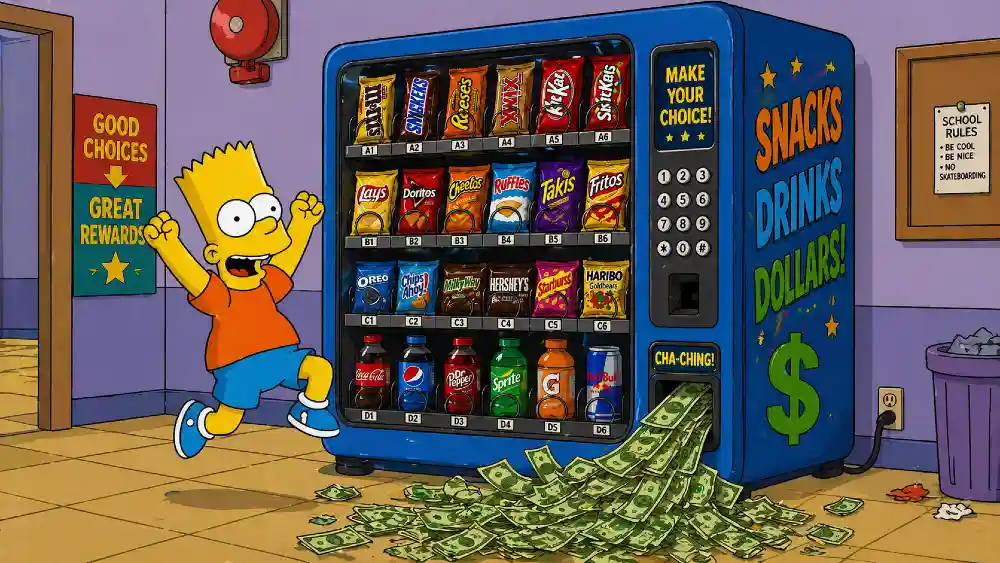
Q: Can you really make money with a vending machine business? Yes, though success depends heavily on location. Cotton candy vending machines placed in high-traffic amusement parks have generated six-figure annual revenues. Flower vending machines in hospitals and airports are also gaining traction in the US after proving successful in Japan and Europe.
Q: What machine business works best at farmers markets? Ice cream rolling machines, nut butter stone grinders, and freeze dryers are among the highest-performing machines at farmers markets because they produce a visible, shareable experience. The visual process acts as its own marketing, attracting crowds and generating organic social media content.
Q: How long does it take a machine business to become profitable? It varies by machine type and location. Cotton candy vending machines have reportedly paid for themselves within weeks in premium locations. Laser cleaning machine operators average profitability within 18 months. Most machine-based service businesses recoup their investment within three to twelve months.
Source:
Related posts:
 Proven Chicken Farming Business Idea Strategies for Massive Profit
 Work-Life Balance for Entrepreneurs Through Integrated Wealth
 Carbon Diet Coach: The Science-Based Macro Tracking App Created by Dr. Layne Norton That’s Revolutionizing Nutrition Coaching
 Team Human Summary: 25 Essential Ideas From Douglas Rushkoff
 Ridge Wallet Review (2026): Is the Minimalist Metal Wallet Actually Worth It?