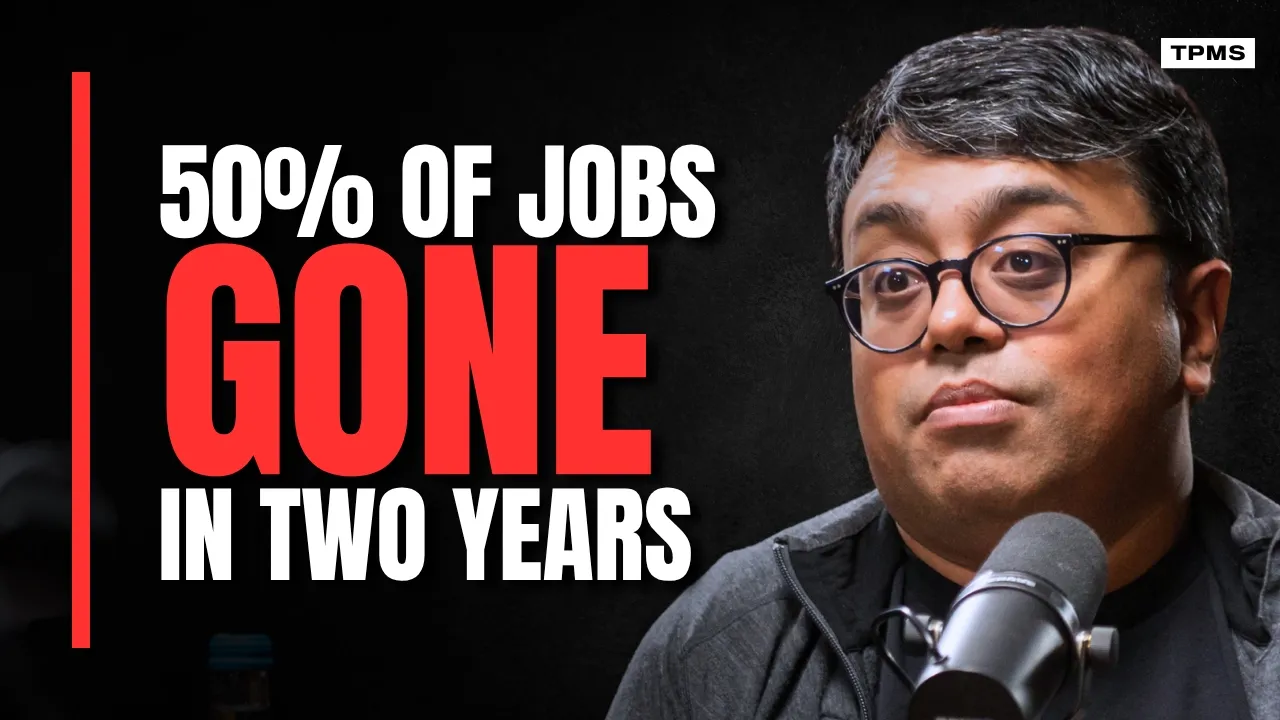
Credit and context: this article is built on Emad Mostaque’s conversation with Peter McCormack on The Peter McCormack Show. The predictions, figures and examples attributed to Emad below are his, and full credit for them belongs to him. Where we add research, context or our own view, we say so. For background on the man himself, see Who Is Emad Mostaque?
Most predictions about work arrive wrapped in qualifiers. This one did not.
Early in his conversation with Peter McCormack, Emad Mostaque, the founder of Stability AI and author of The Last Economy, was asked to explain a phrase he has been using for a while: economic life expectancy. His answer was blunt. For any job that can be done remotely, he said, your economic life expectancy ends effectively in two years. For work that needs a body in a physical place, a few years after that, once the robots get a little better.
You can read that as a headline, a provocation, or a plain description of a trend. Probably it is a bit of all three. What we want to do here is different from the clips and summaries that have circulated since. We want to explain exactly what Emad means, lay out the mechanism he describes step by step, separate the parts that are well supported from the parts that are bold guesses, and then ask the question forecasts like this almost never ask: what happens to a man when the thing he has built his identity on is put on the clock?
Because that is where the real damage tends to land. Not in the spreadsheet. In the self.
What “economic life expectancy” actually means
Life expectancy is the number of years a person can expect to live. Economic life expectancy, as Emad uses it, is the number of years a person can expect their labor to be worth paying for. It is not a prediction that you will die, and it is not even strictly a prediction that you will be unemployed. It is a claim about the value of what you do compared with the alternative.
The phrase sits at the front of his book. The publisher’s description opens with the sentence “Your economic life expectancy is shrinking” and then adds that this is not a recession but a phase transition. That distinction matters. A recession is a dip you wait out. A phase transition, like water becoming steam, is a change in the state of the system itself. Nobody waits out steam.
In the interview he explains the thinking behind it in human terms. Most of us, he says, have been trained to do a certain task, have it verified, and repeat it, and in that sense we have been turned a little into robots by the system we work in. The pandemic exposed this, because once work went remote it became obvious how much of it was tasks passing across a screen. Now, he argues, AI is becoming genuinely competent at exactly that kind of work.
The cruel arithmetic comes next, and it is the part worth reading slowly. Emad’s claim is not only that AI will be able to do your job. It is that once an AI team can be cloned at will, with all the knowledge and mannerisms of your workforce, and at a hundredth of the cost, a human on that team makes it worse: humans sleep, make errors, and wake up grumpy without coffee. In his words, your cognitive value goes negative. That is a harder thing to hear than “a machine can help with your job.” It says that the very qualities that make us human, in a narrow production sense, become a liability on the balance sheet.
Hold that thought, because we will come back to it. The balance sheet is not the whole of a man.
The mechanism, step by step
It helps to separate the forecast into its moving parts, because each part has a different level of evidence behind it.
Step one: remote work goes first
Emad’s timeline in the interview is short. AI becomes “really usable” next year; the year after, you can press a button and replicate an entire workforce, to the point where you cannot tell whether a human or an AI is on the other side of the screen. For any job that can be done remotely, that is the end of the economic runway, in his view, within about two years.
He cites estimates from McKinsey and OpenAI that around half of all tasks are exposed. Note the word tasks. It is a different unit from jobs, and we will return to why that matters when we look at what holds up.
Step two: the ladder loses its bottom rungs
The example he reaches for is law. Junior hiring in law firms is already shrinking, he says, because a junior’s work can be handled by pushing a button. What is the job of a partner? In his framing it is a relationship job and a liability job: someone has to know the client and someone has to be on the hook. Those survive longest. The entry-level work that used to train the next generation goes first, because the people who own the assets, the knowledge base and the relationships can now use compute to leverage themselves without having to deal with graduates.
McCormack put it well: it is a ladder, and the first rung has been taken off. Emad agreed, and added the uncomfortable corollary that the second rung comes next, and so on until the whole ladder is gone.
This is the part of the argument we find most worth taking seriously, whatever you think of the timeline, because it describes a structural problem rather than a prediction about any single job. If the bottom rungs vanish, how does anyone become a partner? Apprenticeship is how skill is built. Remove the apprenticeship and you eventually remove the skill. We explore a related worry in Will AI Take All Jobs? What 20–30% Unemployment Would Actually Mean.
Step three: bodies are next, because robots fit human-shaped holes
The physical economy is slower, Emad says, but not by much. His example is trucking. Retrofitting a truck for autonomy is a hassle. A humanoid robot, which he says could cost around a dollar fifty an hour, can climb into the driver’s seat of an ordinary truck and drive it away. No retrofit. The trucks, the roads, the doors and the pedals were all designed for a human body, so a human-shaped machine slots into the existing world. He puts the exposure at a million American truck-driving jobs, plus roughly three million people who service them.
He also describes how the first consumer humanoids arrive: they take a taxi to your house and ring the doorbell. It is a funny image, and it makes a serious point about logistics. The cost of deploying a robot is collapsing toward the cost of an invitation.
Step four: it will feel like a sand pile, not a switch
Here Emad adds a nuance that most clips leave out. He does not say fifty percent of people will be fired overnight. He uses the image of a sand pile: pressure builds quietly, small slides happen, and then a large section collapses.
Why the delay? Part of it is human. Nobody enjoys firing people, and firing damages morale. Part of it is contractual: the call centers in the Philippines, he says, are starting to crack, but service contracts take time to unwind. Part of it is structural: in the public sector the question of efficiency barely matters at all. So a job can become economically irrelevant long before it is eliminated. You may still be on the payroll, still attending the meeting, while the underlying value of your seat has quietly gone to zero.
We would add our own observation here. This is arguably the more psychologically dangerous scenario. A clean layoff tells you where you stand. A slow hollowing leaves a man employed, anxious and unsure whether his work still counts. If you have ever felt the low hum of that uncertainty, our piece on FOBO, the fear of becoming obsolete describes it well.
Step five: the government response is digging holes
What do governments do with tens of millions of displaced workers? Emad’s guess is a repeat of the 1930s: a New Deal–style infrastructure push where, in his words, you dig holes and fill holes. The robots could do the work better, he concedes, but people need to be out working and sweating, and the jobs will not be high paid.
He is not advocating this. He is predicting it, and predicting that it will be a crude patch rather than a solution. The more interesting part of his answer comes later, when he talks about money flowing to people simply for being human, an idea we unpack in our summary of The Last Economy.
Why this time might be different: what a job actually bundles
Every era of technological change has produced the same comfort: new jobs will appear. Sometimes they did. Emad’s counterargument, drawn from the book, is that this inversion differs from the earlier ones in one specific way.
Historically, human labor, whether of the muscle or the mind, was done by what he calls a metabolic engine: a body that needs food, shelter and rest. That need created a bargain. If you wanted work done, you had to feed the worker, and so wages, and with them an entire economy of human demand, followed. AI and robotic labor are non-metabolic: they need electricity, not dinner. The book calls the break in the old bargain the Metabolic Rift.
The companion idea, from the book’s own site, is the one we find most useful for men. A job, it argues, quietly bundles five things together: income, identity, community, purpose and structure. The Intelligence Inversion unbundles them. Of the five, only income needs a machine to replace it.
Read that again, because it changes what the problem is. If a job is a bundle, then losing it is not one loss but five at once. Most conversations about AI and work discuss only the first. The other four are where men tend to come apart, often silently.
What holds up, and what is a bold guess
A fair reading means saying plainly where Emad is on firm ground and where he is not. Our own guidelines at Masculine Synergy point us toward truth over comfort, and that cuts both ways: we should not wave away an uncomfortable forecast, and we should not swallow it whole either.
What is well supported. The direction of travel is not seriously disputed. Capable AI is getting cheaper, entry-level knowledge work is the most exposed, and agentic systems that complete multi-step tasks are real products rather than demos. The reasoning about apprenticeship, that removing junior work erodes the pipeline of senior talent, is a genuine and under-discussed problem. And his observation about “hedonic adaptation,” that we absorb astonishing technology within minutes, as he did with his first self-driving taxi ride, rings true to anyone who has watched people stop noticing miracles.
What is contested. The two-year timeline is the boldest part. Reviewers of his book have called it a provocative manifesto whose speculative timelines, the thousand-day window in particular, lack evidence. That is a fair criticism, and Emad himself provides some texture against his own timeline in this interview. When asked how many call-center jobs have already gone, he said he could not remember exact figures and that the cracks are only starting to show. When asked what surprised him, he said adoption has been slower than he expected because interfaces and memory have not caught up with the raw capability.
There is also the tasks versus jobs gap. A technology can be able to perform half the tasks in a profession without eliminating half the jobs, because jobs include judgment, accountability, relationships and the odd mess that does not fit a task list. Emad would answer that the bundle gets rebuilt around fewer people. Others would answer that new bundles appear. Nobody knows yet, and anyone who tells you they do is selling something.
Finally, a word on incentives. Emad runs companies building in this space and he sells the thesis through a book and a lecture circuit. That does not make him wrong. It does mean you should hold the timeline more loosely than the logic. We would say the same about any founder.
So here is a stance we would defend: treat the direction as real and the date as unknown. That is enough to act on, and acting is what matters. For a broader and more measured look at the unemployment scenarios, see The Economic Singularity: How AI Will Reshape Jobs, Money, and Society.
The part no forecast includes: “I’m a job, I’m a role”
Late in the conversation, Emad says something that is easy to miss amid the robots and the trillions. The deepest problem, he suggests, is that for most people identity has collapsed into function. It is no longer “I am a member of a community.” It is “I’m a job, I’m a role, I’m a robot effectively.” We built a world, he says, where we needed an identity, needed to feel part of something, needed to feel successful, and for most that came through work.
This lands hardest on men, and it is worth being precise about why, without sliding into stereotype.
Many men were raised on a quiet equation: I am worth what I produce. The provider role gave that equation a moral shape. If you are useful, you are good; if you provide, you matter. It is a heavy way to live, and a brittle one, because the equation makes your worth depend on something you do not fully control: the market’s appetite for your skills. We examine the cost of that bargain in The Male Provider Role: Why More Men Are Choosing to Walk Away and in Lost Myself in My Job.
If the equation is wrong, then a forecast that says “your labor will be worth less” is not a verdict on you. It is a verdict on the equation. This is the first principle we return to again and again at Masculine Synergy: a man’s worth is not conditional on status, money or productivity. He has intrinsic value. That is not a slogan to repeat in the mirror. It is a structural fact about what a human being is, and the coming years may force a great many men to find out whether they actually believe it.
The men who struggle most will probably not be those who lose a paycheck. They will be those who lose a paycheck and discover that there was nothing else underneath: no friendships that exist apart from the office, no practices that are not performance, no sense of self that survives the question “So what do you do?” We have written about that dynamic in The Loneliness of Success and The Hidden Costs of Career Success. The pattern is the same: people who built one tall tower and called it a life.
A five-bundle audit: how to prepare without panic
If a job bundles income, identity, community, purpose and structure, the sensible response is to build each one so that it can stand on its own legs. This is not doom preparation. It is the kind of resilience a mature man builds anyway, and an uncertain economy simply raises the stakes.
We suggest sitting down with a notebook and scoring each of the five from one to ten, honestly, with the question: if my job vanished next month, how much of this would survive?
1. Income. The least interesting question to ask, though it is the one everyone asks first. The practical task is to widen your sources and lengthen your runway. Reduce fixed costs where you can. Build a cash buffer. Learn the tools that raise your leverage, because Emad’s most hopeful point is that a single person now has more leverage than at any time in history. You can give an agent a task that once required a team. Treat that as your apprenticeship, and read our guidance on how to protect your money from inflation and on the five types of wealth for a wider view of what “enough” is made of.
2. Identity. Write down who you are without using a job title. If the page is thin, that is useful information, not a failure. Identity grows from what you do repeatedly when no one is paying you: the craft, the practice, the way you treat people. Our piece on the craftsman mindset and the one on how men find purpose after 30 are good places to start.
3. Community. Emad makes a striking observation on this. Asked which people will be least affected, he points to places like his family’s village in Bangladesh, a self-sustaining community. Groups with strong ties, he says, will be able to pick each other up. In a shock, community is the asset that does not depreciate. Yet it is the one most men let atrophy first. If you have not looked at your friendships in a while, do the Friendship Audit at 40, explore how to build social wealth, or consider joining one of the groups described in The Men’s Group Renaissance. Brotherhood is not a luxury in a period like this. It is infrastructure.
4. Purpose. Purpose is not the same as employment, although the two overlap for lucky people. Ask what you would work on if no one were paying, and what problem in your neighborhood, family or craft you could serve. Emad’s own answer is revealing: after a period of despair about AI risk, he decided to focus on children and on building tools that help kids reach their potential, because that was something concrete he could do whatever happened. Purpose is often a small, near, specific thing. Our guide on how to find your purpose offers seven questions to get you there.
5. Structure. This is the one almost nobody plans for. A job gives you a reason to get up, a place to go, a rhythm to the week. Remove it and many men drift. Build the structure deliberately: a morning routine, training, a daily walk, fixed hours for the project that matters. See The Morning and Evening Routines That Set High Performers Apart and The Daily Walk.
Then the second question, which turns anxiety into action: which of these five is my weakest, and what is one small thing I can do about it this week? Do not try to rebuild all five at once. Pick the thinnest and thicken it.
For the mental side of this, read AI and Mass Unemployment: The Mental Preparation No One Is Talking About, and for the broader picture of work, relationships and identity, AI and the Future of Men.
Where to stand: toward what is scarce
If you want a practical compass for your working life, Emad’s own examples point in a consistent direction: move toward what remains scarce for longest.
He names a few. Relationship and liability, the partner’s job in the law firm. Ownership, the people who own the assets and the knowledge base. Human attention, which he calls the most valuable thing in the long run. And creators and organizers whose work depends on being this particular person: his example is Taylor Swift, whose scarcity is that there is only one of her.
You are probably not a pop star. But the principle scales down. Being the person a client trusts, the colleague who tells the truth, the neighbor who organizes the street, the man whose word is good: these are forms of scarcity that no model can copy, because they are made of reputation and history, and those accumulate only slowly and only through being present. We cover how trust compounds in Building Your Professional Reputation and why Your Networking Skills Impact Your Success.
What he tells a father about his daughter
One of the more human moments in the interview comes when Peter McCormack mentions his daughter, who has just finished her GCSEs and is starting A levels. If everything changes in five years, he asks, what should she be learning?
Emad’s answer is not a subject. It is a stance: she should learn agency. Most children, he notes, are taught somewhere along the way that they are not creative and cannot do things. Ask a room of adults how many are creative and few raise a hand; ask whether every child is creative and nearly all do. Now that anyone can direct AI agents, the old barrier of needing to persuade talented people to join you is falling. So his advice is that she should believe she has agency, and then find her passion.
We would add that agency is something fathers can model rather than lecture about. A girl or boy who watches a father take responsibility, try things, fail without collapsing and keep going learns agency by osmosis. That is better than any curriculum. Our pieces on curiosity in children and being known by your children go further.
There is also a line from the interview worth keeping: a robot will never replace holding your daughter’s hand while she grows up. Whatever the economy does, that remains yours.
The fisherman, the cat, and what “enough” means
Towards the end Emad tells the old story of the investment banker and the fisherman. The banker urges the fisherman to catch more fish, buy a boat, build a fleet, sell the company, so that one day he can retire to a beach, spend time with his family and enjoy some fishing. The fisherman, who has already caught his fish by two o’clock and is going home to his family, asks the obvious question: what do you think I am doing now?
McCormack answers with a story of his own. His family has recently taken in a stray cat, and the joy it has brought has reminded him how simple life can be. Emad’s reply connects it to the paper that launched modern AI, Attention Is All You Need: the machines learned to pay attention to what matters in their training data, and most of us have forgotten to do the same in our lives.
We do not want to romanticize this. Not everyone can step off the treadmill, and “just enjoy life” is easy advice from a man who built a billion-dollar company. But the story contains a real diagnostic question for any man facing an uncertain economy: what is the thing I am working toward, and have I already got some of it? The answer is often a surprise. Read more in What “Enough” Actually Means and The Pleasure of Ordinary Days.
A note on fear
It would be dishonest to pretend this subject is not frightening. Emad himself says he has gone through periods of real despair about the trajectory, and that his own estimate of catastrophic risk sits around the fifty percent mark, though he says it has been coming down. Fear is a reasonable response to a large uncertain change.
But fear is a poor navigator. It narrows attention, rushes decisions and makes men either freeze or grab at whatever promises certainty, which is how people end up following whoever sounds most confident. The calmer alternative is the one our editorial guidelines return to: face reality without collapsing into fear, ego or denial. Look at the forecast. Hold the direction as probable and the date as uncertain. Then do the next small useful thing. Our guides on how to stay calm under pressure and how to stop stressing over things you can’t control are practical companions.
Frequently asked questions
What is economic life expectancy? It is the number of years your labor can be expected to remain worth paying for, compared with what AI and robots can do. Emad Mostaque uses the phrase in The Last Economy and in interviews to describe a rapid decline in the economic value of human work, starting with jobs that can be done remotely.
Who coined the term? The phrase is closely associated with Emad Mostaque, founder of Stability AI and Intelligent Internet. It appears prominently in his book and in his appearance on The Peter McCormack Show.
Does it mean I will be unemployed in two years? No. Emad’s claim is about economic relevance, not necessarily a dismissal date. He explicitly says people will not all be fired overnight, partly because firing is unpleasant, partly because of contracts, and partly because some sectors do not respond to efficiency pressure. The risk he describes is a long hollowing out, with some people holding jobs whose economic value has already gone.
Which jobs does he say are most exposed? Remote, screen-based work comes first: call centers, junior legal work, routine analysis. Physical jobs follow, with truck driving as his headline example, as humanoid robots improve.
Is the two-year timeline credible? It is the most contested part of the argument. The direction is widely accepted; the date is a forecast, and reviewers of his book have questioned the evidence for the compressed schedule. We suggest treating the trend as real and the timeline as uncertain.
What should I do about it? Build the five things a job bundles, income, identity, community, purpose and structure, so each can stand independently. Learn to use AI tools to raise your own leverage. Invest in relationships and reputation, which are slow to build and hard to copy.
The last word
The most useful thing about Emad Mostaque’s phrase is not its date. It is its honesty about the stakes. If your economic life expectancy is shrinking, then the question of what you are for, apart from what you produce, moves from philosophy seminar to kitchen table.
Our answer, the one this site exists to offer, is that a man is not his output. He has inherent worth, and the work of the coming years is to live as though that were true: to know himself, stay in truth, build brothers, take responsibility, and contribute from strength rather than fear. The economy may rewrite what labor is worth. It cannot rewrite what a man is.
Source and credit: Emad Mostaque in conversation with Peter McCormack on The Peter McCormack Show. Book details: The Last Economy by Emad Mostaque. Continue reading: The Last Economy Summary, Humanoid Robot Companions and the Man Who Stopped Listening, and AI Is More Persuasive Than You.
Related posts:
 Who Is Emad Mostaque? The Stability AI Founder Shaping the Open-Source AI Debate
 The Last Economy Summary. 20 Key Ideas From Emad Mostaque’s Book on AI, Work and Money
 Humanoid Robot Companions and the Man Who Stopped Listening
 AI Is More Persuasive Than You: How to Keep Your Own Mind in the Age of Super Persuaders
 The Economic Singularity: How AI Will Reshape Jobs, Money, and Society