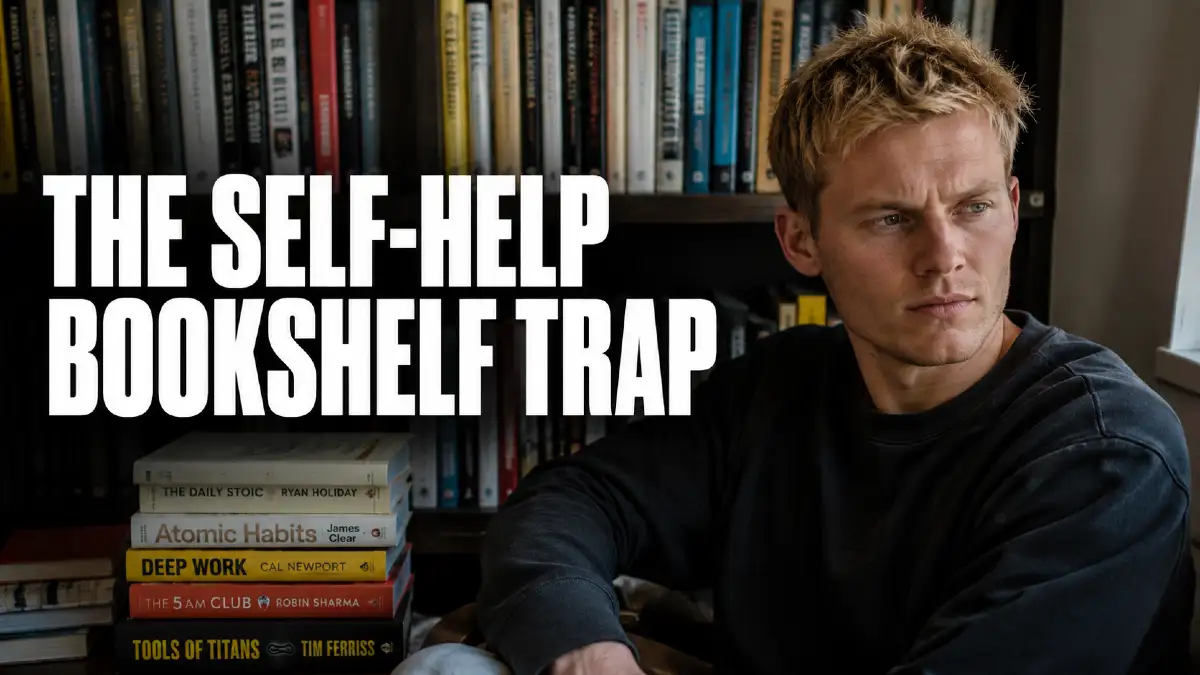
If you have read this far on a site like this one, you have almost certainly read more self-improvement content than 99% of the men in the world. You have probably worked through Marcus Aurelius and Epictetus. You have probably read Ryan Holiday, James Clear, Cal Newport, Robert Greene, David Goggins, Jocko Willink. You may have notebooks full of underlinings, highlights, quotes, and frameworks. You can probably recite the difference between dichotomy of control and amor fati. You know what compounding habits look like, what the four agreements are, what the seven habits of highly effective people are.
And if you are being honest about your life, much of it looks very similar to how it looked five years ago. The job is approximately the same job. The relationships are approximately the same relationships. The body is in approximately the same condition. The patterns you have been reading about how to break are still mostly intact. The frameworks you have collected are an impressive library on your shelf and a mostly inactive set of behaviors in your week.
This is the bookshelf trap. It is the most common failure mode in the entire self-improvement space, and the men most likely to fall into it are the men who care most about improving. The trap is not that the books are bad — most of the popular ones are useful — but that consuming them produces a sensation so similar to actual growth that it replaces the real thing. You feel like a man getting better. The bookshelf grows. The man does not.
Naming this is uncomfortable for a site that publishes book summaries. It is necessary anyway. The men reading this who recognize themselves in the trap deserve to have it named clearly, because no amount of additional reading will get them out of it.
What “action faking” actually is
The clinical term for what’s happening here is action faking. Brent Adamson and other behavioral researchers have documented the phenomenon across multiple domains. The mind, when presented with a difficult goal, will preferentially substitute lower-cost activities that produce a similar emotional payoff. The activities feel like progress toward the goal. They are not progress toward the goal. They are the brain’s negotiation with the goal: yes, I want this, but the actual thing is hard, so I will do this related-but-easier thing instead and call it the work.
In self-improvement specifically, the easier thing is consumption. The harder thing is application. The brain gets the dopamine hit of “I am working on myself” from reading the book, from watching the podcast, from listening to the audiobook on the morning walk. It does not get the difficult experience of actually changing behavior. The difficult experience is where the change happens. Everything else is preparation for the work that is not, in fact, getting done. Becoming more productive requires actually producing something — and most heavy self-improvement consumers are quietly avoiding that part.
This pattern compounds in a particular way. The man who has read many self-improvement books develops an increasingly sophisticated vocabulary for describing his own situation. He can talk about his attachment style. He can talk about his ego attachments. He can talk about his shadow. He can talk about the four laws of behavior change. The vocabulary itself becomes a substitute for the change. He has the words for what he is supposed to do, and the words have become the doing.
A man with the right vocabulary and no behavior change is in some ways harder to help than a man with no vocabulary at all. The naive man has not yet found a sophisticated way to perform engagement with his problems without actually addressing them. The well-read self-improvement reader has. The vocabulary is camouflage. It looks, from the outside and from his own inside, like he is the kind of man who would solve the problem. He is not. He is the kind of man who would read about solving the problem and feel as if that were the solution.
The numbers behind the action faking trap
The self-improvement industry is worth approximately $45 billion globally in 2024 and is projected to roughly double by 2034. The audiobook market specifically is exploding — Audible alone sees billions of hours of listening per year, with self-improvement consistently among the most-consumed categories. Social media is saturated with personal development content; podcasts dedicated to the genre routinely produce episodes consumed by hundreds of thousands or millions of men.
What the industry’s growth does not reflect is a corresponding growth in measurable life improvement among consumers. Surveys of heavy self-improvement consumers reliably find that the same problems persist — anxiety, relationship difficulty, career stagnation, body composition issues, financial precariousness — at roughly the same rates as in the general population. If consuming self-improvement content actually produced the outcomes it promises at any meaningful rate, the heaviest consumers should be visibly thriving compared to baseline. They are not.
This is the data point that should stop any serious reader cold. The industry is enormous, the consumption is intense, and the outcome is roughly the same as the population that doesn’t engage with it at all. Either the content is broadly useless — which it isn’t, demonstrably, when actually applied — or the relationship between consumption and outcome is broken in a way that almost no one in the industry is willing to name out loud, because naming it cuts against the entire commercial premise.
The relationship is broken because consumption is not application. The brain has substituted one for the other. The library grows. The reader does not.
How the trap gets reinforced
Three structural features of the self-improvement ecosystem make the trap nearly inevitable for any reader who isn’t actively guarding against it.
The dopamine economy of completion. Finishing a book produces a small reward signal. The brain logs it as accomplishment. Closing the last page of Atomic Habits feels like a victory. The victory is real. It is just not the victory the book was supposed to enable. The book was supposed to enable behavior change. The actual reward signal you got was for reading the book. These are different events. The brain does not distinguish them well, especially when the second one is much costlier than the first. So you read the next book. And the next. And the satisfaction of completion keeps replenishing without you ever doing the work the books were pointing at.
The recommendation engine. Algorithms surface adjacent content based on what you have already consumed. A man who reads Discipline is Destiny is shown Ego is the Enemy, then The Obstacle Is the Way, then Meditations, then Letters from a Stoic, then Lives of the Stoics, then a hundred Stoic-adjacent productivity books. The engine has identified him as a reader of this material. The engine optimizes for continued reading, not for life change. Every new recommendation feels like the next thing that will make the difference. None of them is. The next book is never the answer. The work the previous book pointed at is the answer.
The author’s incentive. Self-improvement authors are paid by selling more books. The structure of the genre therefore selects for authors whose work makes readers want to read more rather than authors whose work makes readers stop reading and start doing. The most commercially successful self-help authors are masters of producing the feeling of being on the verge of change. The feeling sells the next book. Actual change would end the relationship between author and reader. The authors are not consciously cynical about this. Most are sincere. But the structural incentive points away from telling readers, plainly, that they should stop buying books and start doing the things.
These three forces — the dopamine economy, the recommendation engine, and the author’s incentive — combine to produce an ecosystem optimized for sustained consumption rather than completed change. The reader who falls into the trap is not lazy. He is operating exactly as the system was designed to make him operate.
How to tell if you’re in it
The honest tests are uncomfortable. None of them are about how much you have read. They are about what the reading has produced.
Are you noticeably different from the man you were five years ago? Not “do you know more.” Different. In behavior, in body, in relationships, in work, in capability. If you would describe yourself, on balance, as the same man with a richer vocabulary, you are in the trap.
Can you name three specific behaviors you have changed because of something you read in the past year? Not three concepts you found interesting. Three actual changes — actions you take now that you didn’t take twelve months ago, sustained for at least three months, with measurable impact on your life. If the list is hard to compile, the reading is decorative.
Do the people who actually know you describe you as improving? Your wife. Your closest friend. Your colleagues. The honest signal is external. The internal feeling of progress is not reliable evidence. If the people who watch you live your life have not noticed the trajectory you are claiming to be on, the trajectory is mostly in your head.
Are you spending more time consuming content about a problem than working on the problem? This is the cleanest tell. Hours per week reading about how to fix your marriage vs. hours per week actually doing the difficult work of fixing your marriage. Hours per week reading about how to get in shape vs. hours per week lifting heavy. Hours per week reading about how to write a book vs. hours per week writing. If the consumption hours dwarf the application hours, the ratio is producing the symptom you experience.
When you finish a book, what is the first thing you do? If the answer is “look for the next book,” you are running the consumption loop. If the answer is “decide which one specific behavior I am going to install for the next 90 days, regardless of what else I learn,” you are using the book for its purpose. The first pattern is far more common than the second.
What actually works
The honest framework for breaking the bookshelf trap is unsexy and well-known. It is also nearly absent from the content most self-improvement consumers are reading, because it is not commercially attractive. No one builds a brand on “read less, do more.”
The 80/20 of self-improvement reading. A small number of books per topic, read carefully, applied seriously, will produce more change than a hundred books read superficially. Pick three to five books that have already proven their value to you — perhaps The Obstacle Is the Way, Mind Over Grind, The First Rule of Mastery, or whatever your equivalent is — return to them periodically, and use them as operating manuals rather than entertainment. The rest of the time, do the work the books pointed at.
Annual application contracts. Adopt the practice that for any book you read, you commit to applying one specific behavior from it for ninety days. Not “I’ll be more disciplined.” A specific, measurable, time-bound behavior: I will lift four times a week for ninety days. I will write 500 words a day for ninety days. I will not check my phone before 8 a.m. for ninety days. The contract is the bridge between reading and changing. Without it, the reading is decoration.
The 10-to-1 ratio. For every hour you spend consuming self-improvement content, spend at least ten hours actually doing the work it points at. This sounds extreme. It is the actual ratio under which change happens. Most readers run a ratio closer to 5-to-1 in the other direction — five hours of consumption per hour of actual application. The math is why the trap is so persistent.
A bookshelf moratorium. Periodically — perhaps once a year — stop reading any new self-improvement content for ninety days. Reread one book you already know works. Spend the saved time applying its content. Most men who try this report that the ninety days produces more measurable change than the previous year of consumption. The discovery is not that the books were bad. The discovery is that the consumption was substituting for the application.
Brutal honesty with a specific person. Find at least one friend who knows you well enough to call you on the gap between what you say and what you do. Self-improvement done in private with only book authors as your accountability partners is not real accountability. The author will never know if you change. A man who sees you weekly will. Choose someone whose judgment you respect, give them explicit permission to ask hard questions, and report back honestly on what you have actually done. Sometimes the harder work is giving yourself permission to succeed — and that move cannot be outsourced to a book.
The application bias. When you encounter a new framework — and you will, the ecosystem is endless — your default response should not be to read more about the framework. Your default response should be to identify the smallest possible application of the framework and try it for two weeks. The two weeks will tell you more about whether the framework matters than another ten hours of consumption ever will.
The harder reframe
Underneath the bookshelf trap is a deeper question about why men get caught in it. The honest answer is that consumption is safer than action.
The man reading his fiftieth self-improvement book is doing something low-stakes. He cannot fail at reading. He cannot be judged for it. He gets to occupy the identity of “man working on himself” without doing any of the work that would actually risk something — risk being seen trying and not succeeding, risk being uncomfortable in his body, risk having a hard conversation, risk launching the business, risk saying out loud what he actually wants. The bookshelf is, in part, an elaborate hiding place. The man inside it is performing engagement with his life while protecting himself from the encounters that would actually change it.
Ego is the enemy in a particular way here. Ego cannot stand the possibility of being seen failing. So ego finds activities that look like growth but cannot produce visible failure. Reading is the gold standard of these activities. You can never fail at reading. You will also, in any meaningful sense, never grow from it. The growth requires the risk that the reading is precisely engineered to avoid.
This is why taking 100% responsibility is the only real foundation. Not as a slogan. As an honest accounting: I have read the books. I have not done the work. The reason I have not done the work is not lack of information. I have abundant information. The reason is that the work is uncomfortable and I have used the reading to avoid it. The acknowledgment is the first move. Every move after it has to be in the direction of the work itself.
What to do tomorrow
If you have recognized yourself in this article, the response is not to add another book to the stack. The response is to close the page, identify the one specific behavior you have been reading about for years and not doing, and do it for the next ninety days.
The behavior is probably obvious to you. It is probably the thing you have been quietly avoiding. It is probably the thing where you have the most highlighted passages and the least action. Lift four times a week. Write the book you have been outlining for three years. Have the hard conversation with your partner. Quit drinking for six months. Build the friendship you have been meaning to build. Save the money you have been meaning to save. Apply for the job you have been afraid to apply for.
Do that one thing. For ninety days. Without reading anything else.
At the end of ninety days, you will know more about yourself than the last twenty books told you. You will have changed something measurable. You will have broken the consumption loop. You will discover, possibly to your alarm, that the books were not the limiting factor in your life.
You were.
The bookshelf is not the problem. The relationship to the bookshelf is the problem. The fix is not to burn the books. The fix is to make every book earn its place by leaving a specific, measurable trace in your behavior. If the trace isn’t there, the book wasn’t doing what you thought it was doing. It was decoration. The man in the chair was reading himself into the same life he was trying to escape.
You can change this. You can change it today. You don’t need another framework. You need to do the thing you already know.
Related posts:
 The Philosophy of Continuous Improvement: How CANEI and Kaizen Apply to Your Life
 Self Discipline and Personal Excellence: Become the Top 20%
 Cal Newport’s Slow Productivity: Book Summary and Honest Reading
 How to Apply Sahil Bloom’s Five Types of Wealth Framework
 The Anxious-Avoidant Trap: Why Some Relationships Feel Impossible