
The 5 types of wealth, in Sahil Bloom’s framework, are time wealth, social wealth, mental wealth, physical wealth and financial wealth, and his argument is that a rich life needs all five, not just the one that shows up in your bank balance. Most men are quietly bankrupt in at least one of them while working flat out to grow another. What follows defines each type, shows what the research says about why it matters, and turns the framework into a practical 90-day plan you can start this week.
Try a small sum before you read on. Think of your parents, or whoever raised you, if they’re still alive. Roughly how many days a year do you actually see them? Now estimate, honestly, how many years you might have left together. Multiply the two.
For many men in their thirties and forties who live a flight or a long drive away, the answer comes out somewhere between twenty and a hundred. Not years. Days.
That arithmetic is what turned Sahil Bloom‘s life around. In his early thirties, he was doing everything a successful man is supposed to do: a fast-rising investment career, a good income, a house in California. Then an old friend asked how often he saw his parents, who lived on the other side of the country, and did the maths out loud. At that rate, Bloom would see them about fifteen more times before they died. Within forty-five days, he has said, he had left his job, sold the house and moved his young family across the country to live near them. The book that grew out of that moment, The 5 Types of Wealth, is about the other scoreboards a man stops checking when he only watches one.
What Are the 5 Types of Wealth?
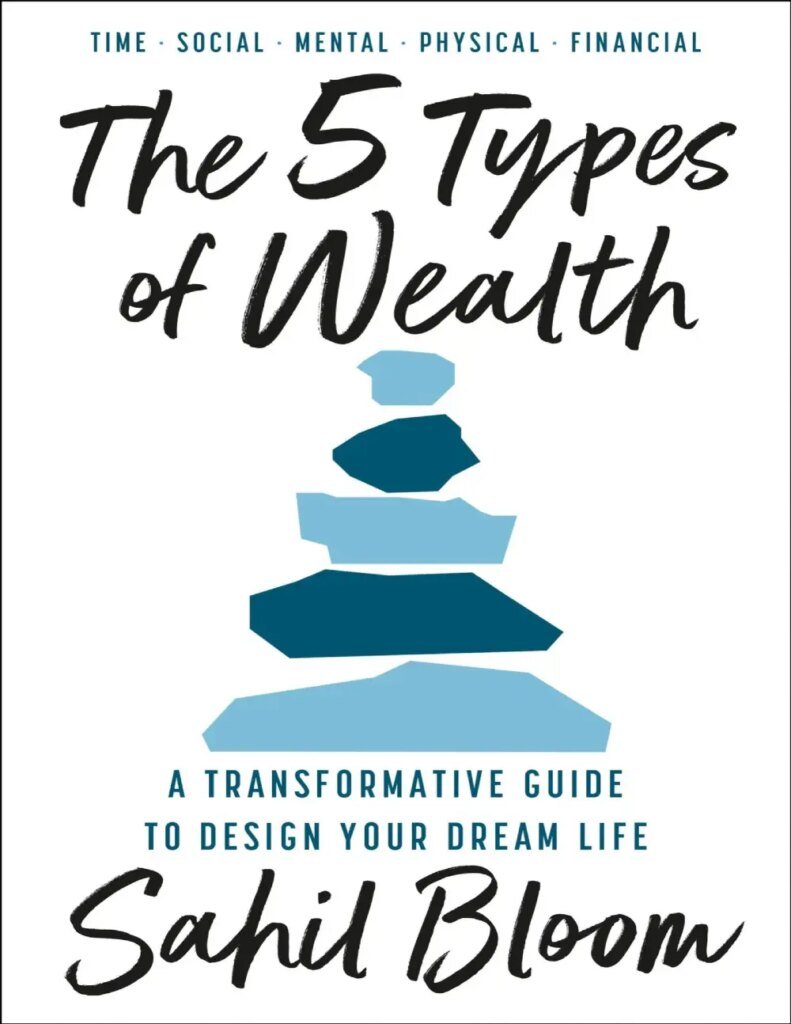
The 5 types of wealth are time wealth (freedom over how you spend your hours), social wealth (deep relationships and community), mental wealth (purpose, growth and room to think), physical wealth (health and energy that last into old age) and financial wealth (enough money, defined on your own terms). The framework comes from The 5 Types of Wealth: A Transformative Guide to Design Your Dream Life by Sahil Bloom, published by Ballantine Books in February 2025 and an instant New York Times bestseller.
Bloom, a former private-equity investor who writes the newsletter The Curiosity Chronicle, built the idea on a simple observation. Society hands most men a single scoreboard: money, and the status that comes with it. It’s easy to measure, easy to compare and easy to chase. The other four types of wealth are harder to count, so they’re neglected until something breaks: a marriage goes cold, a health scare arrives, a father dies before the long-postponed trip, or a man reaches a goal he’s chased for a decade and feels, as Bloom puts it, a strange letdown he calls the “is this it?” moment.
The framework doesn’t say money is bad. It says money is one form of wealth among five, and that a life built on it alone tends to look rich from the outside and feel poor from the inside. If you want a quick way to see where you stand, Sahil Bloom’s Wealth Score rates each of the five in a few minutes; this article focuses on what each one is and how to build it.
Why One Scoreboard Fails Men
There’s a reason so many capable men end up asset-rich and life-poor. Achievement is designed to keep moving. Psychologists call it the hedonic treadmill: you adapt quickly to each win, and the satisfaction fades until the next goal takes its place. Bloom describes a related trap he calls the arrival fallacy, the belief that reaching a particular milestone (the title, the house, the number) will finally deliver lasting happiness. It rarely does, and the man who believed it often feels faintly cheated.
The cost isn’t only emotional. When money is the only score, every other form of wealth gets quietly spent to grow it. Time goes first, then health, then friendships, then the space to think. The trade feels rational in each moment and absurd in total. It’s the pattern behind the hidden costs of career success, and behind the man who earns well yet wonders why he isn’t getting wealthy in any way he actually cares about.
Bloom’s answer is to keep five scoreboards instead of one, and to treat each as an asset you can invest in, neglect or rebuild.
Time Wealth: Freedom Over Your Hours
Bloom calls time the most fundamental form of wealth, because it’s the only one you can’t earn more of. His three pillars of time wealth are awareness (understanding that your time is finite), attention (spending it on what matters) and control (having the freedom to choose how you spend it). His question for this area is the one from his own story: how many moments do you have left with the people you love?
One of his best ideas is the time billionaire. A twenty-year-old has roughly two billion seconds ahead of him; a wealthy man of seventy has far fewer. In the currency that matters most, the young man is richer, and the older man would trade his fortune to swap places. Seen that way, every hour spent on something you don’t value is a withdrawal from the only account that can’t be topped up. The site explores this further in time wealth as the real currency of life and in the hidden crisis of time poverty.
There’s good evidence that buying back time pays off. In a 2017 study, the psychologist Ashley Whillans and colleagues surveyed more than 4,000 people in the United States, Canada, Denmark and the Netherlands and found that those who spent money to save time, on cleaning, errands or cooking, reported higher life satisfaction, regardless of income. In a follow-up experiment, working adults were given $40 on two weekends, once to spend on a time-saving purchase and once on a material one. They felt better and less time-pressed after buying time. The site’s guide on how money buys time, not happiness covers this in depth.
Bloom’s practical tool here is the Energy Calendar: for a week or two, note which activities leave you energised and which drain you, then deliberately shift your schedule towards the first and away from the second. It pairs naturally with managing energy rather than time, and with taking back the hours lost to the attention economy.
Social Wealth: Depth, Breadth and Earned Respect
Social wealth, in Bloom’s framing, has three pillars: depth (a few close relationships), breadth (a wider community that gives you belonging) and earned status (respect and trust that come from who you are, not what you own). His question: who will be sitting in the front row at your funeral?
It’s an uncomfortable question for many men, because social wealth is the type most often left to chance. Friendships that were automatic at school and university quietly thin out under the weight of work and family, and by forty, plenty of men can’t name a friend they’d call at 2 a.m. The male loneliness epidemic isn’t a slogan; it’s a slow, private drift, and success can make it worse, as described in the loneliness of success.
The strongest evidence for social wealth comes from the Harvard Study of Adult Development, which has followed hundreds of men since 1938. Its current director, the psychiatrist Robert Waldinger, has summarised one of its clearest findings: the men who were most satisfied with their relationships at fifty were the healthiest at eighty.
Bloom’s suggested starting point is relationship mapping: list the people who matter, rate how healthy and how frequent each connection is, and notice who you’ve let drift. Then pick one or two to invest in on purpose. The site’s guide to building social wealth goes further.
Mental Wealth: Purpose, Growth and Space
Mental wealth is the least visible of the five. Bloom’s three pillars are purpose (a personal sense of direction that guides your choices), growth (curiosity and the drive to keep learning) and space (time to think, rest and hear your own mind). His question: what would your ten-year-old self say to you today?
Space is the pillar most men have lost. Every gap in the day is now filled by a screen, which leaves little room for the slow thinking that produces clarity, ideas and peace. Bloom recommends deliberately protecting it, through walks without headphones, unscheduled time, or a regular block for thinking with no agenda.
There’s a reason this matters. In a 2010 study published in Science, the Harvard psychologists Matthew Killingsworth and Daniel Gilbert used an iPhone app to ask more than 2,000 people, at random moments, what they were doing and how they felt. People’s minds were wandering from the task at hand almost half the time, and they were generally less happy when their minds wandered than when they were focused. Mental wealth isn’t just about thinking more; it’s about being present for your own life.
Purpose is the other pillar worth attention. Bloom’s purpose exercise starts with a simple question: what do the people and communities around you need from you? If you’re unsure, how to find your purpose is a practical guide, and mental wealth in an age of infinite distraction covers the space pillar in more detail.
Physical Wealth: The Body You’ll Live In at Eighty
Physical wealth is the foundation the other four stand on. Bloom’s pillars are movement (daily activity that builds cardiovascular fitness, strength, stability and flexibility), nutrition (mostly whole, unprocessed food) and recovery (consistent sleep and genuine rest). His question is a memorable one: will you be dancing at your eightieth birthday party?
That question reframes health from vanity into capability. The aim isn’t a six-pack at forty-five; it’s being able to carry your grandchild up the stairs at seventy-five, get up off the floor without using your hands, and travel without fear of a bad back. Every choice you make now, Bloom argues, is a deposit into or a withdrawal from that future body.
The good news is that physical wealth responds quickly to simple habits. Walk more. Lift something heavy two or three times a week. Eat more protein and vegetables and fewer ultra-processed foods. Protect your sleep, which most adults need seven to nine hours of, and which affects everything from mood to decision-making, as covered in the importance of sleep for success. The site’s piece on the body budget explains why physical wealth quietly determines every other form of success.
Financial Wealth: Defining Enough
Financial wealth is the type most men already measure, which is why Bloom’s take on it is so useful. His pillars are income growth (building valuable skills and more than one source of income), expense management (avoiding the lifestyle inflation that eats every raise) and long-term investment (owning assets that grow without trading more hours). But his central question is different from the usual finance advice: what is your definition of enough?
Without an answer, the goalposts move forever. The man earning £60,000 thinks £100,000 would solve everything; the man on £100,000 thinks the same about £200,000. Bloom argues that defining “enough” is what turns money from a scoreboard into a tool, and the site’s essay on what “enough” actually means explores the idea further.
Does more money make you happier? The latest research says: usually, but not without limit. In 2023, the psychologists Matthew Killingsworth, Daniel Kahneman and Barbara Mellers, who had previously reached opposing conclusions, collaborated on a reanalysis. They found that for most people, emotional well-being keeps rising with income well beyond the $75,000 figure often quoted. But for the unhappiest group, extra income stopped helping beyond a certain point, because the miseries they faced weren’t the kind money could fix. Money solves money problems. It doesn’t solve the other four.
That’s why financial wealth works best when it serves the other types: buying time, funding health, creating space for relationships and thought. The site’s practical guides on how to create wealth as a man and why long-term thinking determines wealth cover the mechanics.
How to Apply the 5 Types of Wealth: Seasons, Not Balance
The most common mistake men make with this framework is trying to max out all five at once. That isn’t what Bloom recommends. He describes life as having seasons, in which some forms of wealth naturally take priority over others. A man building a business may lean heavily on financial and mental wealth for a few years; a new father leans into social and time wealth; a man recovering from burnout puts physical wealth first.
The goal isn’t perfect balance every day. It’s avoiding bankruptcy in any one area, while choosing on purpose where to invest most in this season. Three principles make that workable.
First, set minimums. Decide the floor for each type that you won’t drop below, however busy life gets: for example, one evening a week with someone who matters, ten minutes of stillness a day, three workouts a week, a protected day off, and spending less than you earn. Minimums stop slow erosion.
Second, choose one focus per season. Pick the type of wealth that’s weakest or most important right now, and put most of your extra effort there for the next ninety days.
Third, look for compound activities that build several types at once. A long walk with a friend builds social, physical and mental wealth together. Cooking a proper meal with your family builds time, social and physical wealth. Coaching your kid’s team, a weekly game of five-a-side, a Sunday hike: these are the highest-return investments in the whole framework.
And alongside the additions, remove drains: the commitments, habits and people that consistently cost more than they give. Bloom uses the idea of anti-goals here, defining what you refuse to sacrifice in pursuit of your goals; the site’s guide to anti-goals explains how to set them.
Your First 90 Days
Here’s a simple plan to move from understanding the framework to living it.
Days 1–7: Take stock
Score each type of wealth honestly from one to ten, or take Bloom’s Wealth Score quiz. Track your time for a week, including what energises and what drains you. Look at your bank statements and your calendar side by side: they’re the most honest record of what you actually value.
Days 8–30: Set your minimums
Choose one small, non-negotiable habit for each type. Not five big changes: five floors. A weekly call to a friend, a daily walk, a monthly money check, a protected morning, a fixed bedtime.
Days 31–90: Go deep on one
Pick the weakest or most important type and make it this season’s focus. Set one meaningful goal for it, and make one structural change that supports it, such as moving a recurring meeting, joining a club, hiring help for a task that eats your weekends, or setting up an automatic transfer to savings.
At day ninety, score yourself again. The aim isn’t a perfect fifty. It’s movement in the right direction, and no zeros.
What Gets in the Way
Knowing the framework is easy. Acting on it is hard, and the obstacles are predictable.
The first is waiting for the right time. There’s always a reason to start next quarter: the deal, the move, the kids being older. But clarity comes from action, not contemplation, and the right time rarely announces itself.
The second is sunk cost. Men who’ve spent fifteen years building a career, a reputation or a lifestyle often feel they can’t change course without wasting that investment. But the years are spent either way; the only question is what you do with the next ones.
The third is social pressure. Choosing time over money, or health over a promotion, can look strange to colleagues, friends and even family. Some will question it, and some of that questioning says more about their own choices than yours.
The fourth is identity. If you’ve always been the hardest worker in the room, stepping back can feel like losing yourself. That’s worth noticing; it often means your worth has become tied to output.
And the fifth is the lack of role models. Many men simply don’t know anyone who has built all five types of wealth well. That makes the path feel uncertain, but it also makes each man who walks it a model for the ones who come after.
When Small Changes Aren’t Enough
Sometimes minimums and habits aren’t enough, because the structure of your life is the problem. Bloom’s own move is the clearest example: no amount of better scheduling would have given him more than fifteen visits with his parents from the other side of the country. He had to change the structure.
For some men, that means a different job, or a different way of doing the same job. For others it means moving closer to family, scaling back a business, ending a relationship that drains every other form of wealth, or taking a deliberate pause, a structured break explored in the site’s piece on strategic sabbaticals for high achievers. Entrepreneurs face a particular version of this question, covered in building a business that serves all five types of wealth.
Big changes deserve careful thought, and they’re rarely risk-free. But the framework offers a useful test: does the life you’re building raise your total wealth across all five, or just grow one number at the expense of the others?
The Life You Design or the Life You Accept
Go back to the sum at the top of this page. Whatever number you got, it’s probably smaller than you’d like, and it may be the most important number in this article. Not because it’s a reason for guilt, but because it puts every other number in perspective.
You already know how to build wealth; most men who read articles like this have built at least one kind, often through years of discipline. The framework doesn’t ask you to stop. It asks you to point the same discipline at the forms of wealth you’ve been running down: the hours, the friendships, the space in your head, the body you’ll live in at eighty.
Which of the five have you been quietly spending to grow the one you can count?
Seven Honest Questions About Your 5 Types of Wealth
Before you answer, write the five types on a scrap of paper and give each a score out of ten in under thirty seconds, without overthinking. Keep the paper next to you as you go.
- Look at the score you wrote for each type: which number surprised you, and which did you round up to protect yourself?
- Do the sum from the start of the article: what number did you get, and what decision has been waiting for you on the other side of it?
- Read your lowest score aloud and notice your jaw and shoulders: which tightens, and what does that tension tell you about the trade you’ve been making?
- What has your strongest form of wealth bought you over the years, and which of the other four has quietly paid for it?
- If you could protect only one minimum for the next ninety days (one friendship, one workout, one free morning), which would you choose, and why that one?
- Which idea from a field you know well (training cycles, portfolio rebalancing, project management, your trade) could help men run their five types of wealth better, if someone carried it over?
- Picture yourself at eighty, at the party Bloom describes: who is there, what are you able to do, and what did you start doing at this age that made it possible?
5 Questions to Turn the 5 Types of Wealth Into Action
Think of this as a Stop–Start–Keep for your next season.
- Stop: which one drain (a commitment, a habit, a recurring obligation) will you remove or reduce before the end of this month to free time or energy?
- Start: what is the one minimum for your weakest type of wealth, and when this week will you do it for the first time?
- Keep: which compound activity already builds two or more types of wealth for you, and how will you protect it from being squeezed out?
- Who is one person (a partner, a friend, your father) whose time with you is affected by this season, and what will you tell them about the change?
- This weekend, sketch on one page the tool, routine or group you’d build to help men around you track all five types of wealth, then show it to three of them.
A rich life isn’t one big number. It’s five smaller ones, none of them at zero.
Frequently Asked Questions About the 5 Types of Wealth
What are the 5 types of wealth?
The 5 types of wealth, from Sahil Bloom’s book The 5 Types of Wealth (2025), are time wealth, social wealth, mental wealth, physical wealth and financial wealth. Bloom argues that society measures success almost entirely by money, but a genuinely rich life requires investing in all five and avoiding bankruptcy in any of them.
Who created the 5 types of wealth framework?
The framework was created by Sahil Bloom, a former private-equity investor, entrepreneur and writer of the newsletter The Curiosity Chronicle. He set it out in The 5 Types of Wealth: A Transformative Guide to Design Your Dream Life, published by Ballantine Books in February 2025, which became a New York Times bestseller.
What is time wealth?
Time wealth is freedom over how you spend your time, and awareness that your time is finite. Sahil Bloom calls it the most fundamental form of wealth because it can’t be earned back. Its pillars are awareness, attention and control. Research suggests that spending money to save time is linked to greater life satisfaction.
What is the Wealth Score?
The Wealth Score is Sahil Bloom’s self-assessment tool for measuring where you stand across the five types of wealth. You rate a series of statements about your time, relationships, mind, body and finances, which highlights the areas you’ve neglected. It’s designed as a baseline to repeat over time, not a one-off verdict.
Which type of wealth is most important?
Bloom argues that no single type matters most at all times. Life has seasons, and different types deserve priority at different stages. The goal is to avoid bankruptcy in any area while choosing on purpose where to invest most. Many people find that time and social wealth are the ones they’ve most neglected.
How do I start applying the 5 types of wealth?
Start by scoring each type honestly and tracking a week of your time. Then set a small minimum habit for each type, such as a weekly call with a friend or a daily walk. After a month, choose one type to focus on for the next ninety days, and rescore at the end to see what’s changed.
References
- Bloom, S. (2025). The 5 types of wealth: A transformative guide to design your dream life. Ballantine Books.
- Killingsworth, M. A., & Gilbert, D. T. (2010). A wandering mind is an unhappy mind. Science, 330(6006), 932.
- Killingsworth, M. A., Kahneman, D., & Mellers, B. (2023). Income and emotional well-being: A conflict resolved. Proceedings of the National Academy of Sciences, 120(10), e2208661120.
- Whillans, A. V., Dunn, E. W., Smeets, P., Bekkers, R., & Norton, M. I. (2017). Buying time promotes happiness. Proceedings of the National Academy of Sciences, 114(32), 8523–8527.
Related posts:
 Sahil Bloom’s Wealth Score: Measure All Five Types of Wealth
 Mental Wealth: How to Build Clarity in an Age of Infinite Distraction
 How to Create Wealth as a Man: 9 Powerful Strategies for Financial Freedom
 The Body Budget: Why Your Physical Wealth Determines Every Other Form of Success
 How to Build Social Wealth in an Age of Loneliness