
Eureka moments in math are sudden insights in which the solution to a problem, or the hidden structure behind it, arrives all at once, usually after long and frustrating effort and often during a break. The strange part is that the struggle you’d call wasted is precisely what makes the flash possible. This piece walks through the most famous mathematical breakthroughs, from Poincaré’s omnibus to Andrew Wiles at his desk, what research now shows about how insight works, and how to invite more of it into your own thinking.
It’s past eleven. The problem has been on the kitchen table since dinner. Maybe it’s your daughter’s geometry homework, the one you were sure you’d crack in five minutes. Maybe it’s a pricing model at work that refuses to balance, or a proof you’ve been chewing on for a week. You’ve tried it three ways and erased more than you’ve written. Finally you give up, switch off the light and go to brush your teeth.
Halfway through, mouth full of foam, the answer is simply there. Not a hint of it — the whole thing, along with an absurd certainty that it’s right.
Most men have had some version of this and filed it under luck. It isn’t luck. It’s one of the most studied experiences in the history of thought, and mathematics, the most unforgiving discipline we have, offers the clearest window into how it works.
What Is a Eureka Moment in Math?
A eureka moment in math is a sudden insight in which the solution to a problem, or the structure that makes it solvable, becomes clear all at once, typically after a long stretch of failed conscious effort and often while attention is somewhere else. Mathematicians also call it an aha moment, an illumination, or simply “seeing it.”
The name comes from Archimedes. According to the Roman architect Vitruvius, the Greek mathematician lowered himself into a bath, watched the water rise, and ran off shouting eureka: “I have found it.” Whether it happened quite like that is anyone’s guess; the experience is real.
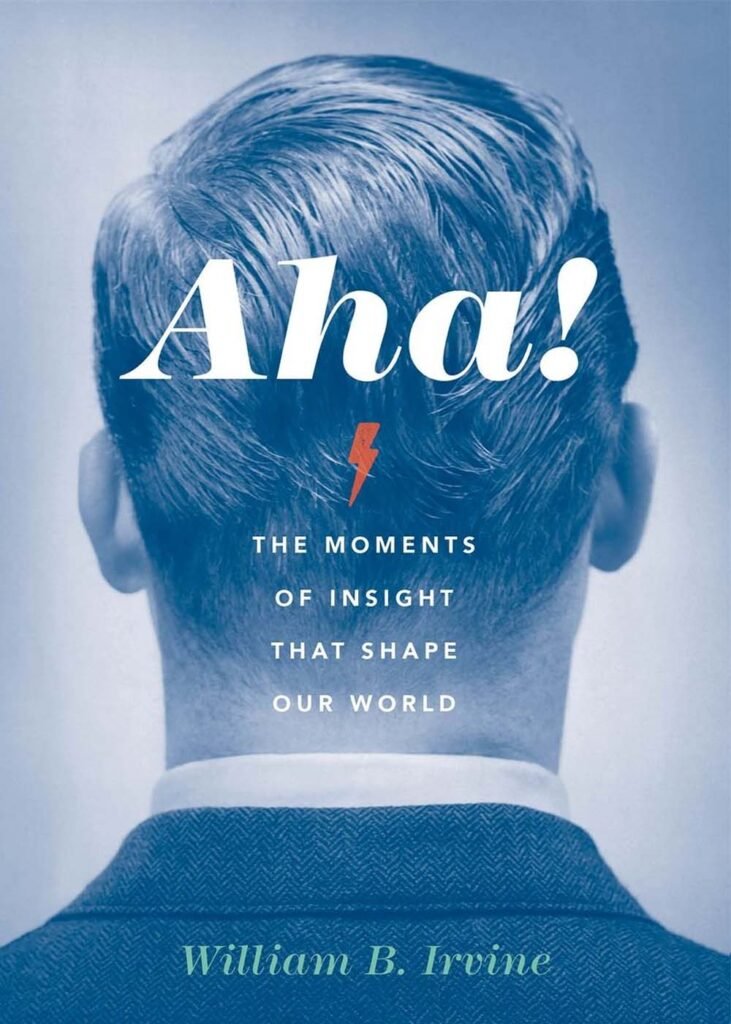
The philosopher William B. Irvine gives mathematics its own part in Aha! The Moments of Insight That Shape Our World (Oxford University Press), alongside religion, morality, science and the arts. Irvine, who studied mathematics before turning to philosophy and is better known today as a modern voice of Stoic joy, treats math as the purest case. A scientific hypothesis can be overturned by tomorrow’s data; a correct proof stays correct. That makes the mathematical aha unusually clean. It is the sudden recognition of something that was true all along and simply hadn’t been seen.
If you want the wider picture of aha moments across every field, or how the eureka effect drives scientific paradigm shifts, those are separate stories, and Irvine’s 25 big ideas on insight cover the whole book. This one stays with numbers, shapes and proofs, because that’s where insight leaves its sharpest fingerprints.
Poincaré’s Omnibus: The Most Famous Eureka Moment in Math
Around 1880, Henri Poincaré was a young mathematician living in Caen, and for fifteen days he had been trying to prove that a certain kind of function could not exist. Every day he sat at his table for an hour or two, tried combination after combination, and got nowhere. Then the ground shifted. By one morning he had shown the opposite: a whole class of these functions did exist. He would name them Fuchsian functions.
What came next is the passage quoted in nearly every serious book on creativity written since. Poincaré left Caen for a geological excursion organised by the School of Mines, and the travel made him forget his mathematics entirely. In the town of Coutances, the group climbed into a horse-drawn omnibus. As he put his foot on the step, an idea arrived that nothing in his recent thinking seemed to have prepared: the transformations he had used to define his new functions were identical to those of non-Euclidean geometry.
He didn’t check it. He took his seat, picked up the conversation he’d started, and felt complete certainty. Only back in Caen did he verify the result at his leisure, for conscience’s sake, as he put it.
Then it happened again. He turned to some questions in arithmetic, failed, and went to the coast for a few days in disgust. Walking along the cliffs one morning, he was struck with the same brevity, suddenness and immediate certainty: another hidden identity between arithmetic and non-Euclidean geometry.
Poincaré wrote all of this up in his essay “Mathematical Creation,” and he was careful about what it meant. The flash looked as if it came from nowhere, but it came only after days of stubborn, conscious, apparently fruitless work. In his reading, those failed efforts were what set the unconscious machinery running; without them, nothing would have moved. Irvine builds his account of mathematical insight on the same foundation. The conscious mind’s real job, as he describes it, is to try hard and fail, and then, once the unconscious hands over the answer, to take the credit.
Gauss, Hamilton and Wiles: Three More Famous Eureka Moments
In May 1801, Carl Friedrich Gauss wrote in his diary a guess about the sign of a particular sum, what number theorists now call the quadratic Gauss sum. Proving it took him more than four years. When the proof finally came in 1805, he wrote to his friend Wilhelm Olbers that the riddle had been solved “like a sudden flash of lightning,” and confessed he couldn’t say what thread connected what he already knew to what finally made it work.
On 16 October 1843, the Irish mathematician William Rowan Hamilton was walking with his wife, Helen, along the Royal Canal in Dublin. For years he’d been trying to find a way to multiply triples of numbers, the way complex numbers can be multiplied as points on a plane. At Brougham Bridge, now Broom Bridge, he saw that the trick worked not with triples but with quadruples. He was so struck that he cut the multiplication rule into the stone. A plaque now marks the spot. His quaternions now help track spacecraft and rotate objects in computer graphics and video games.
Then there’s Andrew Wiles, whose story corrects a popular myth. In 1993, after seven years of near-secret work, he announced a proof of Fermat’s Last Theorem. Referees, including his Princeton colleague Nick Katz, found a gap. For about a year Wiles and his former student Richard Taylor tried to repair it, and by September 1994 they were close to giving up. On 19 September, Wiles sat at his desk (not on a bus, not in a bath) and set out to understand exactly why the method he’d been relying on wouldn’t work. In the middle of explaining the failure, he saw that the broken method held exactly what he needed to rescue an approach he had abandoned three years earlier.
He later called it “the most important moment of my working life,” and said he spent the rest of the day walking around the department and coming back to his desk to check it was still there.
Wiles also gave one of the best descriptions of what comes before the flash. Doing mathematics, he said, is like entering a dark mansion. You walk into the first room and it’s completely dark, and you spend a long time feeling your way around. Only when the light finally comes on can you see exactly where you were. The flash is real. So are the months in the dark, and it’s the kind of persistence that outlasts talent that carries a man through them.
The Four Stages of Mathematical Insight
Ask a creativity researcher how eureka moments happen and you’ll almost certainly hear four words: preparation, incubation, illumination, verification. The model is often credited to Poincaré, but that’s only half right. The German physicist Hermann von Helmholtz had described three phases in his own discoveries: focused work, a period away from the problem, then the sudden solution. Poincaré insisted on a fourth, the conscious work of checking. In 1926 the English social psychologist Graham Wallas, a co-founder of the London School of Economics, set the pieces out as four stages in The Art of Thought, and that model has been the backbone of the creative process ever since.
Preparation is the stage nobody photographs. You gather what’s known, try the obvious routes, map the dead ends. In mathematics it means hours of calculation that produce nothing visible. It’s also the stage that decides everything after it. Incubation has nothing to work on if preparation was shallow, which is why real focus and long, undistracted blocks matter more than clever tricks.
Incubation is the stepping away. Illumination is the flash. Verification is the sober return: writing out the proof line by line to see whether the flash survives contact with logic.
Wallas himself warned that the stages blur. In the daily stream of thought they overlap constantly, one problem in preparation while another quietly incubates. Treat the model as a map of tendencies, not a production line.
Why Incubation Works — and When It Doesn’t
Is the break really doing anything, or do we only remember the times it worked? In 2009, Lancaster University psychologists Ut Na Sio and Thomas Ormerod pooled the experimental evidence into a single meta-analysis. Their verdict was that the effect is real but conditional. Longer preparation produced a bigger incubation effect. Filling the break with a demanding task shrank it. And on some insight problems, an easy, low-effort activity helped more than resting.
The walk only pays off if you’ve wrestled with the problem first. A break spent answering emails or scrolling a feed isn’t incubation; it’s just a different kind of load. What you want is something that occupies the body and leaves the mind loose: a daily walk, the dishes, a shower, a drive along a familiar road. Poincaré’s omnibus step fits the pattern almost too neatly.
Why it works is still argued over. The romantic view, Poincaré’s and Irvine’s, is that the unconscious mind keeps combining ideas in the background and pushes the right one up when it’s ready. A more modest account says time away simply lets you forget the wrong approach you’d locked onto, so you come back and see the problem fresh. Some cognitive scientists doubt the unconscious does much heavy lifting at all. The studies Sio and Ormerod reviewed didn’t hand either camp an outright win. You don’t need to settle the theory to use the practice.
One distinction is worth keeping. Incubation is not rumination. Turning a problem over in a tight loop while you lie awake at 3 a.m. is closer to overthinking than to insight. The incubating mind has loosened its grip. Sleep belongs on the incubating side of that line; John Kounios, a Drexel University psychologist who has spent his career studying insight, describes sleep as a powerful trigger of aha moments because it reorganises what you know and brings hidden relationships to the surface. It’s one more reason why we dream is a question worth caring about.
If you’ve been quietly punishing yourself for walking away from a hard problem, you can stop. Walking away, done properly, is part of the work.
What Happens in the Minutes Before a Breakthrough
For a century, eureka moments were studied mostly through memoirs. In 2025 a team led by cognitive scientist Shadab Tabatabaeian, with Tyler Marghetis of the University of California, Merced, tried something more direct. They filmed six mathematicians with PhDs working at blackboards in their own offices and seminar rooms on problems from the Putnam Competition, an exam so hard that in many years the median score is a point or less out of 120. Then they coded more than 4,600 moment-to-moment actions: writing, pointing, erasing, shifting attention.
The pattern they found came from an unlikely place. In the two minutes before a breakthrough, the mathematicians’ attention around the board became markedly less predictable, the same kind of signal that comes before tipping points in ecosystems and climate systems. The researchers were careful to note the signals were small and that not every burst of restlessness ended in an insight.
That matters for the man at the kitchen table. The scattered phase (jumping between corners of the page, starting over, sketching something that seems unrelated) usually feels like falling apart. It may be closer to the opposite: the old way of seeing losing its grip so a new one can form. You don’t have to enjoy that phase. You can stop reading it as proof that you’re failing.
Stop here for a moment. Think of the last time a problem went messy right before it went clear. You’ve already lived this pattern.
Why Mathematical Insights Feel Certain — and Usually Are
Poincaré didn’t verify his idea on the omnibus because he didn’t feel he needed to. Mathematicians report that certainty constantly. Is it earned, or a pleasant illusion?
Carola Salvi, John Kounios, Mark Beeman and colleagues tested exactly that in 2016. People solved timed puzzles and reported, for each answer, whether it had arrived as a sudden insight or been worked out step by step. The insight answers were right more often. On word puzzles, about 94 percent of insight solutions were correct, against about 78 percent of analytic ones, and the analytic answers were the ones more likely to be wrong in the final seconds before the deadline. Kounios’s explanation is practical: deadlines create a background anxiety, and anxiety pushes thinking away from insight toward rushed analysis.
The lesson isn’t that analysis is bad. It’s that when a genuine flash arrives, it deserves to be taken seriously, and that hard, novel problems often deserve more time than a ticking clock allows. That’s the case for slow thinking in high-stakes decisions, and one reason staying calm under pressure is a thinking skill as much as an emotional one. Keep the limit in view, too: these were puzzles in a lab, not research mathematics, and “more often right” is not “always right.”
Poincaré knew that better than anyone. He warned that the feeling of certainty sometimes deceives, no less vivid for being wrong, and that you only find out when you sit down to write the proof. Mathematics is full of results that offend intuition: the Banach–Tarski paradox, in which a solid ball can in principle be cut into finitely many pieces and reassembled into two balls of the same size, is only the most famous. That’s why verification isn’t optional. Insight is a strong signal; the proof is the verdict. Real self-trust includes checking your own work.
Beauty as a Compass
If the unconscious throws up countless combinations, why do only a few cross into awareness? Poincaré thought the filter was aesthetic: a genuine feeling for mathematical beauty, for the harmony of numbers and forms and the elegance of a geometric idea, which every true mathematician recognises.
Mathematicians still talk this way. Wiles described his September 1994 breakthrough as indescribably beautiful, simple and elegant. Two proofs can establish the same theorem, yet one merely shows that it’s true while the other shows why it must be. The educator and computer scientist Seymour Papert took Poincaré’s point seriously: you can’t understand how mathematicians think, he argued, using logic alone, without reference to their sense of beauty.
This is useful well outside mathematics. When a solution at work feels clunky (too many exceptions, too many patches), that discomfort is information: you probably haven’t found the real structure yet.
You Don’t Need to Be a “Math Person” to Have Eureka Moments
Poincaré drew a hard line. In his view most people lacked the delicate mathematical sensibility; some had the memory to follow mathematics but not create it; and a rare few could invent. Plenty of men still carry a version of that verdict from school, usually in the form of one sentence: I’m just not a math person.
The evidence is kinder than Poincaré was. In 2024, a team at Université Paris Cité and France’s CNRS led by Charlotte Barot and Véronique Izard taught adults a genuinely counterintuitive concept from geometry: geodesics, the straightest possible paths on curved surfaces. Sixty-one percent of participants reported a eureka experience. Those who did went on to identify geodesics on new surfaces more accurately, which means the flash tracked real understanding rather than a feeling. Their conclusion was blunt: eureka experiences aren’t reserved for privileged minds.
Here’s the proof of capability you probably already have. If you’ve ever stared at a gearbox, a contract clause or a chess position and suddenly seen how it fits together, you’ve had one. The machinery is the same. What differs is how much preparation it gets to work with, and preparation is something you can choose. Reasoning is a set of cognitive abilities you can build, and the brain that does it stays changeable well into adulthood.
History narrowed who got to try. Sophie Germain, one of the most original number theorists of her era, first corresponded with Gauss under a man’s name because women were shut out of the field. If you’re a father, the most useful thing you can do at homework time may be to protect your child’s permission to be stuck for a while, the same curiosity worth protecting that every good mathematician keeps.
The Flash Is Solitary; Mathematics Isn’t
The great eureka stories star one man at one moment, and that’s misleading. Wiles’s gap was found by colleagues; the repair came alongside Taylor, and one of the two final papers was jointly written. Two months after Hamilton’s walk, his friend John Graves, who had first drawn him into algebra, wrote back with an eight-part extension of the new numbers. The flash happens inside one head; the knowledge is built in company.
Explaining a problem out loud forces you to lay it out in order, and the gaps become visible in a way they never do in your own head. It’s one of the quieter arguments for having a mentor or a small circle of men who’ll hear you think out loud, the kind of thing the men’s group renaissance is rediscovering.
How to Invite More Eureka Moments
You can’t schedule an insight, but you can set the table for one. Start by going deep. Insight rewards preparation, so give the hard problem a protected block of time with nothing else on the screen, the kind of deep work that feels unproductive while you’re doing it. Write down every approach that fails, and why. A record of dead ends is not a record of failure; it’s a map of where the answer isn’t, and treating it that way is the essence of learning from failure.
Then step away on purpose, into something light. Walk, shower, cook, drive a familiar road. Leave the phone out of it; a feed is a demanding task wearing a relaxing mask. Before bed, write the problem in a single line and put it down. Sleep is part of the process, not an interruption of it.
Keep a second problem alive, the way Poincaré turned to arithmetic when Fuchsian functions stalled. When you’re stuck, try Wiles’s move: stop trying to fix the problem and explain precisely why your approach fails. Say it out loud to someone, and give yourself more time than the deadline-driven part of you wants.
When the flash comes, write it down, then check it. Poincaré did, even with perfect certainty.
For one week, try this with a single stuck problem: one focused block a day, one empty twenty-minute walk afterward, one line on paper before sleep. Then let it go. You’ve done your part; the rest isn’t yours to force. Some problems won’t crack this week or this year, and that isn’t a verdict on your mind. Wiles needed seven years and one very bad autumn. Learning to let go of the outcome while still showing up for the work is most of the skill.
The Foot on the Step
Poincaré’s insight didn’t arrive because a genius happened to board a bus. It arrived because he had spent fifteen days failing at a table, and then had the sense to go look at rocks. Gauss carried his problem for four years; Wiles sat with his failure until it explained itself.
Each of them did the work they could control and then made room for what they couldn’t. That’s the whole pattern, and it isn’t reserved for famous names. It’s available to you tonight, with whatever problem is sitting on your own kitchen table: a proof, a business decision, a conversation you can’t yet see how to have.
Give it a real hour. Then walk away and let it breathe. Which problem in your life has had enough preparation, and is waiting only for you to step off the path and let it come?
7 Questions to Sit With When the Eureka Moment Won’t Come
Answer each question twice: once now, quickly, and once after a walk or a night’s sleep. Notice which answers changed while you weren’t looking.
- Think of the last time an answer arrived when you’d stopped looking for it, in the shower, on a drive, mid-conversation: what had you been doing in the days before it came?
- Look back over your last ten evenings: how many minutes did your mind spend with nothing to do, no screen, no podcast, no task, and what does that number tell you without blame?
- Tonight, write one stuck problem in a single line before you sleep. Before you reach for your phone in the morning, write the first thought that surfaces: what did it notice?
- Wiles found his answer by explaining why his method failed: if you stopped trying to fix your hardest problem and explained its failure instead, what would you write first?
- If a sharp colleague read your notes and failed attempts on this problem, which piece would they say you’ve already got and keep underrating?
- Millions of students hit a wall in math and decide they’re “not a math person”: which part of how we treat being stuck has everyone accepted, and what would you replace it with?
- A year from now, with this problem behind you, where do you suspect the answer will turn out to have been hiding all along?
If being stuck has turned into a dread you carry everywhere (nights you can’t switch off, a knot in your stomach before every class or meeting), tell someone you trust. If it doesn’t ease, a counsellor can help you untangle it.
5 Questions to Turn Eureka Moments Into Action
These five questions set up a seven-day experiment that tests one belief about where your best ideas come from.
- Which belief will you test this week, “I must stay at the desk until it breaks” or “I’m not an insight person,” and on which stuck problem?
- Starting tonight, what will you remove from your breaks (the phone, the podcast, the news) so that one twenty-minute walk or shower a day stays genuinely empty?
- Where will you log every idea that arrives, with the time, the place and what you were doing, so that by next Thursday you’re reading evidence instead of an impression?
- Who will you explain the problem to out loud before Friday, and what will you tell yourself in advance so whatever the week shows counts as data, not a verdict on your mind?
- This weekend, which five people who get stuck the way you do will you ask how they get unstuck, and what rough one-page tool will you sketch from their answers?
Somewhere in the coming week there’s an omnibus step. Do the work first, then go and put your foot on it.
Frequently Asked Questions About Eureka Moments in Math
What is a eureka moment in math?
A eureka moment in math is a sudden insight in which the solution to a problem, or the structure that makes it solvable, becomes clear all at once. It usually follows a long period of conscious effort that seemed to fail, and it often arrives during a break, a walk or a moment of distraction. Mathematicians also call it an aha moment or illumination.
What was Henri Poincaré’s famous eureka moment?
Around 1880, after weeks of work on what he called Fuchsian functions, Henri Poincaré left Caen for a geological excursion. In Coutances, as he stepped onto a horse-drawn omnibus, he suddenly saw that the transformations defining those functions were identical to those of non-Euclidean geometry. He felt certain immediately and verified the result once he returned home.
What are the four stages of mathematical insight?
The classic model has four stages: preparation (focused work on the problem), incubation (stepping away), illumination (the sudden insight) and verification (checking it rigorously). Graham Wallas set it out in The Art of Thought in 1926, building on Hermann von Helmholtz’s three phases and Henri Poincaré’s insistence on conscious verification. In practice the stages overlap.
Why do eureka moments happen in the shower or on walks?
A meta-analysis by Sio and Ormerod found that breaks help problem solving when they follow serious preparation, and that light, low-effort activities can help more than demanding ones. Showers, walks and chores occupy the body while leaving the mind loose, which may let a stuck approach fade or let unconscious processing surface a new connection. Scrolling a phone is not the same.
Are eureka moments in math usually correct?
Often, but not always. In 2016 experiments by Salvi and colleagues, solutions people experienced as sudden insights were correct more often than step-by-step analytic answers. Poincaré himself warned that the feeling of certainty can be vivid and still wrong, and mathematics is full of counterintuitive results. That is why every insight still needs a formal proof before it counts.
Can anyone have eureka moments in math?
Yes. A 2024 study from Université Paris Cité taught adults a counterintuitive geometry concept, and 61 percent reported a eureka experience, which was linked to genuinely better understanding. The researchers concluded such moments are not reserved for gifted minds. What matters most is preparation: time spent seriously engaging with a problem before stepping away from it.
References
- Irvine, W. B. (2015). Aha! The moments of insight that shape our world. Oxford University Press.
- Poincaré, H. (1910). Mathematical creation. The Monist, 20(3).
- Wallas, G. (1926). The art of thought. Jonathan Cape.
- NOVA. (1997). The proof [Television broadcast transcript]. WGBH Educational Foundation / PBS.
- Sio, U. N., & Ormerod, T. C. (2009). Does incubation enhance problem solving? A meta-analytic review. Psychological Bulletin, 135(1), 94–120.
- Tabatabaeian, S., O’bi, A., Landy, D., & Marghetis, T. (2025). An information-theoretic foreshadowing of mathematicians’ sudden insights. Proceedings of the National Academy of Sciences, 122(35), e2502791122.
- Salvi, C., Bricolo, E., Kounios, J., Bowden, E., & Beeman, M. (2016). Insight solutions are correct more often than analytic solutions. Thinking & Reasoning, 22(4), 443–460.
- Barot, C., Chevalier, L., Martin, L., & Izard, V. (2024). “Now I get it!”: Eureka experiences during the acquisition of mathematical concepts. Open Mind, 8.
- Papert, S. (1978). The mathematical unconscious. In J. Wechsler (Ed.), On aesthetics in science (pp. 105–120). MIT Press.
Related posts:
 Aha Moments Explained: The Science Behind Sudden Insights That Changed History
 25 Transformative Insights from “Aha! The Moments of Insight that Shape Our World” by William B. Irvine
 The Unconscious Mind and Creativity: Where Your Best Ideas Actually Come From
 Whay Is The Eureka Effect: How Aha Moments Drive Scientific Breakthroughs and Paradigm Shifts
 Modern Parenting Advice Is Making Parents Anxious—Here’s Why Less Works Better