Your brain isn’t fixed—it’s constantly reshaping itself based on what you think, do, and repeat every day. Neuroplasticity is the process that allows you to rewire your brain by strengthening useful pathways and weakening those that no longer serve you. This article breaks down how habits, thoughts, and behaviors physically change your brain over time—and how to use that process to your advantage. If you want lasting change in mindset, performance, or identity, it starts by understanding how to deliberately rewire your brain.
Most people carry a quiet assumption about themselves: this is just who I am.
It shows up in subtle ways. A belief that discipline is something other people have. A sense that motivation is inconsistent. A feeling that certain patterns—procrastination, avoidance, self-doubt—are simply part of one’s personality.
But neuroscience challenges that assumption.
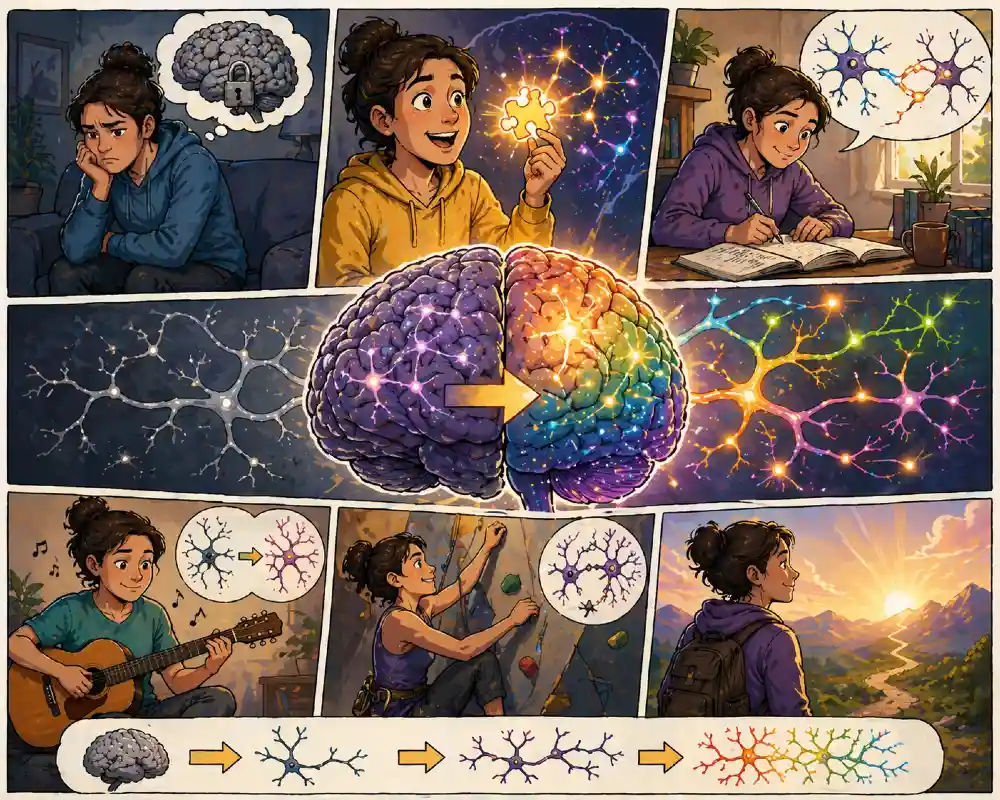
According to David Eagleman, the brain is not a fixed structure. It is dynamic, constantly reshaping itself in response to experience. This ability, known as neuroplasticity, means that your brain is always adapting to the life you live.
The implication is both simple and demanding: who you are is not just something you inherit, but something you reinforce.
Neuroplasticity and Why Your Brain Becomes What You Practice
At its core, neuroplasticity is about efficiency. The brain is designed to conserve energy, and one of the ways it does this is by strengthening pathways that are used frequently and weakening those that are not.
Every time you repeat a behavior, you are making that pathway easier to access again. Over time, what once required effort becomes automatic.
This is why habits feel so powerful. It is not because they are abstract psychological tendencies, but because they are physically embedded in the brain’s circuitry.
If you spend years avoiding discomfort, your brain becomes efficient at avoidance. If you regularly take on difficult tasks, your brain becomes more capable of handling challenge.
In this sense, the brain does not distinguish between what you want and what you repeatedly do. It simply adapts to what is practiced.
Why Change Feels Hard as You Get Older
Many people believe that the ability to change declines sharply with age. There is some truth to this, but not in the way it is often understood.
As Eagleman explains, the brain in early life is characterized by fluid intelligence—the ability to learn new things quickly and adapt to unfamiliar environments. As we grow older, this gradually shifts toward crystallized intelligence, which reflects accumulated knowledge and experience.
This shift is not a loss, but it does create a kind of stability. The brain becomes better at operating within known systems and less inclined to reorganize itself unnecessarily.
Change feels harder not because the brain has lost the ability to adapt, but because it has become efficient at the patterns it already knows.
To rewire your brain, you have to give it a reason to change.
How to Rewire Your Brain Through Challenge and Novelty
The most reliable way to create change in the brain is through challenge.
Eagleman emphasizes that growth happens in a specific zone—somewhere between what is comfortable and what is overwhelming. If something is too easy, the brain does not need to adapt. If it is too difficult, the system becomes stressed without learning effectively.
The key is to seek out experiences that are difficult but achievable.
This might mean learning a new skill, taking on a responsibility you have avoided, or placing yourself in environments that require new forms of thinking. What matters is not the specific activity, but the demand it places on your brain.
When you engage with something unfamiliar, your brain becomes highly active. It recruits multiple systems, forms new connections, and begins to map out new pathways.
Over time, what was once difficult becomes familiar. And at that point, the process must begin again.
One of the more counterintuitive insights from neuroscience is that once you become good at something, it is often time to move on. Mastery reduces the need for adaptation. Growth requires returning to the state of being a beginner.
The Role of Effort and Friction in Brain Change
There is a tendency to look for efficient ways to improve—to optimize, automate, and reduce effort wherever possible. But when it comes to rewiring the brain, effort is not an obstacle. It is the mechanism.
Eagleman makes a useful distinction between two types of friction. There is what might be called unnecessary friction—repetitive, low-value tasks that do not contribute to growth. And then there is meaningful friction—the kind that forces you to think, adapt, and engage deeply.
Rewiring your brain depends on the second type.
If you consistently avoid effort, you are not preserving your energy for something better. You are reinforcing a pattern of disengagement. On the other hand, when you choose to engage with difficult problems, you are signaling to the brain that this is territory worth developing.
The brain responds accordingly.
Using Structure to Shape Future Behavior
One of the more practical insights from this perspective is that willpower alone is not enough to create lasting change.
The brain is not a single unified system making consistent decisions. It is made up of multiple competing networks, each with different priorities. At one moment, you may feel motivated and disciplined. At another, those qualities may disappear.
This is why relying on intention alone often fails.
Instead, Eagleman suggests shaping your environment in a way that supports the behavior you want. This can involve removing temptations, creating commitments, or building systems that make certain actions easier and others more difficult.
These are sometimes referred to as precommitment strategies—decisions you make in advance to guide your future behavior.
By doing this, you reduce the reliance on moment-to-moment willpower and instead work with the structure of the brain, rather than against it.
What It Means to Become the Architect of Your Brain
To say that you can rewire your brain is not to suggest that change is immediate or effortless. It is gradual, often uncomfortable, and requires consistency over time.
But it is also real.
Every action you take contributes to the structure of your brain. Every challenge you engage with builds new pathways. Every habit you repeat strengthens a pattern that becomes easier to follow.
The process is not about becoming someone entirely different overnight. It is about steadily reshaping the underlying systems that guide your behavior.
In that sense, personal change is less about motivation and more about direction.
Final Thoughts on How to Rewire Your Brain
If there is one idea that stands out from neuroscience, it is this: your brain is always changing, whether you are intentional about it or not.
The question is not whether change is happening, but what direction it is taking.
To rewire your brain, you do not need a dramatic transformation. You need consistent exposure to challenge, a willingness to engage with effort, and an understanding that growth comes from stepping beyond what is already familiar.
Over time, those choices accumulate. And eventually, they reshape not just what you do, but who you are.
Related posts:
 Thinking in Systems Book Summary: 25 Key Takeaways Explained
 Why Alexandr Wang Is Waiting for Neuralink Before Having Children
 Can Teacher Expectations Make Students Smarter? What the Pygmalion Effect Really Shows
 How to Keep Your Brain Healthy as You Age: What Neuroscience Actually Says
 Why Do We Dream? Neuroscientist Dr David Eagleman Explains