Why do we dream—and what purpose could something so strange actually serve? Neuroscientist David Eagleman suggests dreams aren’t random at all, but a biological “defense system” that keeps your brain’s visual cortex active while you sleep. Without this nightly stimulation, other senses could gradually take over that part of the brain due to neuroplasticity. This article breaks down Eagleman’s theory and what it reveals about how the brain protects itself, adapts, and maintains your ability to see the world clearly.
Why Do We Dream? A Different Perspective on Dreams
For most of human history, people have asked the same question: why do we dream?
Ancient traditions treated dreams as messages from the divine. Later, psychology reframed them as expressions of the unconscious. Even today, many assume dreams must carry hidden meaning.
But neuroscientist David Eagleman offers a different perspective—one grounded not in symbolism, but in biology. His explanation suggests that dreaming may exist not to reveal meaning, but to preserve function.
Brain Plasticity and Why the Brain Is Always Changing
To understand why we dream, we first need to understand how the brain works.
The brain is not static. It is constantly adapting, reorganizing, and reallocating resources. This property—known as brain plasticity—means that no part of the brain remains unused for long.
When a sensory system is deprived, something remarkable happens. Other senses begin to take over. In individuals who are blind, the visual cortex does not sit idle. Instead, it becomes involved in processing sound or touch.
What surprised researchers is how quickly this shift can begin. In experiments where sighted individuals were blindfolded, the visual cortex started responding to other senses in as little as an hour.
The implication is clear: the brain does not tolerate inactivity. If a region is not being used, it becomes available for reassignment.
The Neuroscience of Dreams: Protecting the Visual Brain
This is where the question why do we dream begins to take on a new meaning.
Every night, we enter darkness. Our eyes close, and the visual system stops receiving input. From the brain’s perspective, this creates a risk. If the visual cortex remains inactive for too long, other sensory systems could begin to take over.
According to Eagleman, dreaming is the brain’s solution to this problem.
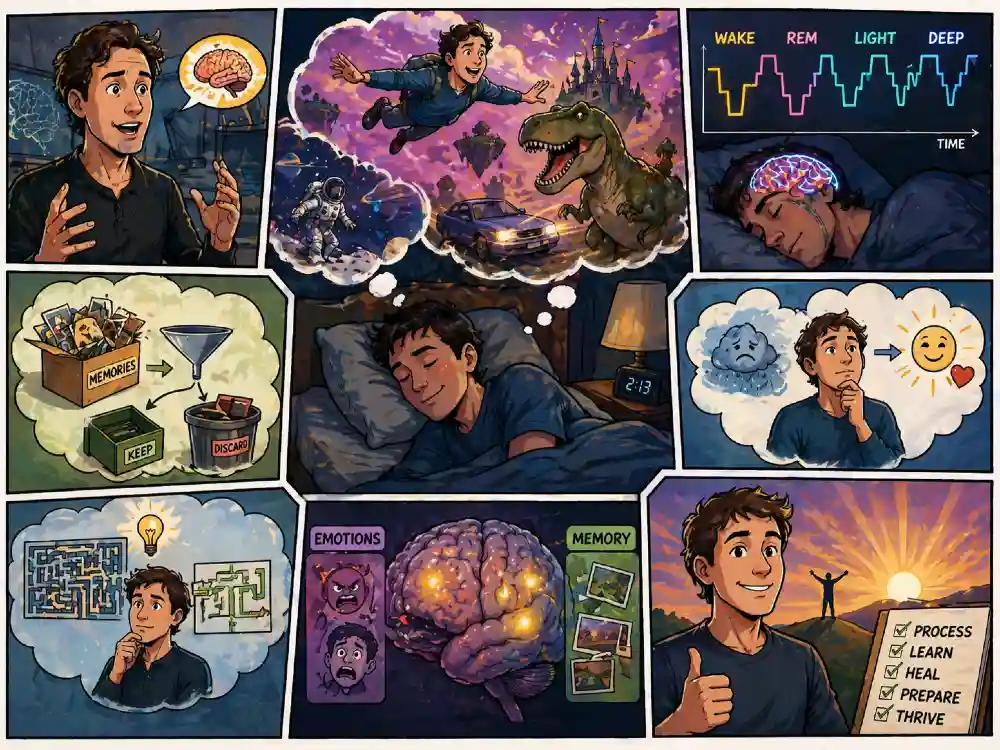
Roughly every ninety minutes, the brain sends bursts of activity into the visual cortex. This activity is not structured in the way waking perception is—it is random, fragmented, and internally generated. But it is enough to keep the visual system active.
What we experience as dreams may simply be the mind’s interpretation of this internal stimulation.
Why Dreams Feel Meaningful Even If They Are Functional
If dreaming is primarily functional, why do dreams feel so vivid and meaningful?
The answer lies in the brain’s natural tendency to create stories.
When random signals are fired into the visual system, the brain does not leave them as noise. It organizes them into images, scenes, and narratives. It draws from memory, emotion, and recent experience, weaving them into something coherent.
This is why dreams can feel deeply personal. But the meaning we perceive may not be the purpose of the process itself. Instead, meaning is something we impose after the fact.
In other words, dreams feel meaningful because the brain is a storyteller—not because dreaming evolved to deliver messages.
REM Sleep, Aging, and How Dreaming Changes Over Time
Understanding why we dream also helps explain how dreaming changes across the lifespan.
Infants spend a significant portion of their sleep in REM, the stage associated with dreaming. This is when the brain is most plastic—still forming connections and organizing itself.
As we age, the brain becomes more stable. It requires less constant restructuring, and the proportion of dream sleep decreases.
Dreaming does not disappear, but its intensity and frequency shift. The need to defend the visual system becomes less urgent as the brain settles into more established patterns.
What This Theory of Dreams Means for Everyday Life
This perspective challenges the way many people think about dreams.
It suggests that dreams are not necessarily:
- Messages to decode
- Hidden truths about the self
- Symbols waiting for interpretation
Instead, they are part of a biological maintenance system—one that keeps the brain’s visual machinery functioning properly.
And yet, this does not make dreams irrelevant. It simply changes how we relate to them.
When a dream feels significant, the value lies not in the dream itself, but in how we interpret it. The brain provides the raw material; we provide the meaning.
Final Thoughts: Why We Dream and What It Reveals About the Brain
So, why do we dream?
According to neuroscience, dreaming may exist to protect the brain—to keep the visual system active during periods of darkness and prevent other senses from taking over.
It is a reminder that not everything we experience is designed to guide us. Sometimes, the brain is simply maintaining itself in the background, quietly ensuring that the systems we rely on continue to function.
Dreams may feel mysterious, but their purpose may be surprisingly practical.
Related posts:
 The Importance of Sleep for Success (Why Discipline Depends on Rest)
 Can You Function on Bad Sleep? Why Your Belief Matters More Than Your Hours
 How to Find Purpose in Your Work and Career With Audacious
 Hume Band Review: Does This Stress-Tracking Wearable Actually Work?
 How to Set Goals and Achieve Them With Audacious: A Bold Guide to Building the Life and Career You Want and Deserve