For two decades, the productivity advice aimed at serious men has been variations on a theme: do more, do it faster, do it earlier in the day. The Tim Ferriss aesthetic of the four-hour workweek. The David Allen aesthetic of getting everything into a system. The Cal Newport aesthetic of deep work as the rare and valuable resource. The Atomic Habits aesthetic of compound improvement. The whole genre rested on a shared premise: the path to a successful life ran through systematic, optimized, hyperefficient effort applied across a wide surface.
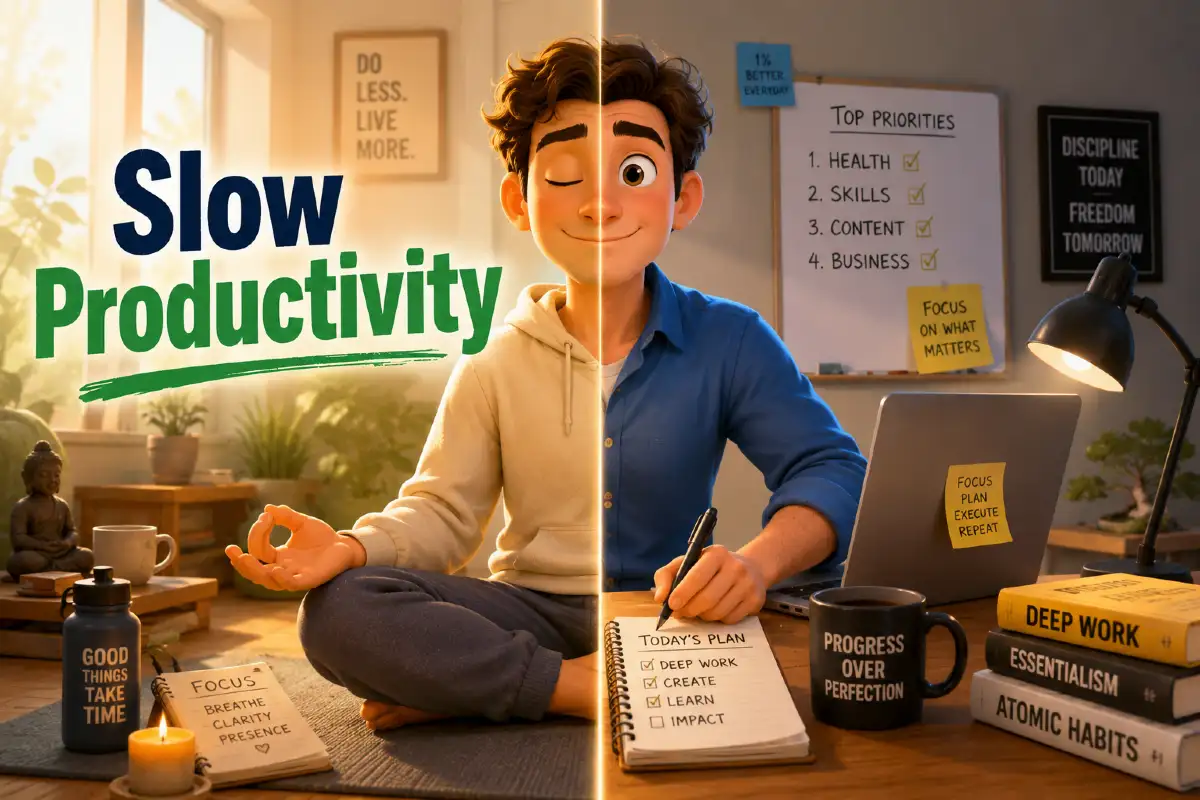
In 2024, Cal Newport — who built much of this discourse with his Deep Work in 2016 — released Slow Productivity, a book that quietly inverted the framework he had spent a decade promoting. The book has become, for a specific population of serious knowledge workers, the most influential productivity book since Deep Work itself, and it has done so by arguing for something almost no productivity author had argued for before: that doing fewer things, at a natural pace, with obsessive focus on quality, is the only sustainable path to substantive achievement.
Newport’s pivot is not contrarian for the sake of contrarian. It is a careful reading of how serious work has actually been done historically, combined with an honest assessment of what the modern knowledge-work environment has been doing to the people inside it. The thesis is uncomfortable for a generation of men trained on hustle culture. It is also, by every measure that matters, more useful than the framework it replaces.
For a serious man trying to do serious work in the age of AI, slow productivity is the operating manual most ambitious knowledge workers actually need in 2026.
What Newport got wrong, by his own admission
Deep Work remains a useful book. The central argument — that the ability to concentrate deeply has become rare and economically valuable as more people lose the capacity for sustained attention — is correct. The recommendations to protect blocks of focused time, to reduce shallow work, to treat attention as the scarce resource it has become — these hold up.
What Deep Work implicitly endorsed, and what Newport has spent the past few years walking back, was the surrounding hustle-culture framework. The book was read by many of its consumers as a productivity-maximization manual: deep work plus more hours plus better systems equals more output equals success. The men who took this seriously built lives organized around extracting maximum cognitive output from every available hour. They optimized their mornings, their inboxes, their workouts, their sleep, their nutrition, their relationships — everything in service of the central project of producing more deep-work output per week.
The results, after five to ten years of this lifestyle, were not what the framework predicted. The most committed practitioners often produced less impressive bodies of work, not more. They burned out. They produced shallow versions of what was supposed to be deep work. They optimized themselves into a kind of high-performance shallowness that resembled deep work from the outside but did not produce the substantive results deep work was supposed to enable.
Newport noticed this. Slow Productivity is the result of him noticing. The book diagnoses the failure mode that the hustle-culture reading of Deep Work produced, and offers an alternative framework grounded in how the historical figures Newport admires — scientists, writers, builders — actually did their work.
The three principles
Slow Productivity organizes around three principles. Each cuts against the dominant productivity culture in a specific way.
Principle one: Do fewer things. Modern knowledge workers, especially ambitious ones, have a tendency to take on too many projects simultaneously. The logic is that more projects means more chances of success, more skill development, more income, more visibility. The empirical reality is that beyond a small number of concurrent projects, the cost of context-switching, the dilution of attention, and the inevitable shallowness produced by spreading too thin start to compound. The output quality on every project drops. The total output, measured by substantive results rather than completed tasks, often drops in absolute terms.
Newport’s prescription is to actively limit the number of concurrent active projects, often to two or three. The other things — the ideas, the opportunities, the requests, the obligations — get held in a queue or actively declined. This sounds simple. In practice it requires the discipline to say no to a lot of things that look like opportunities, and to accept that you will not capture every possibility, that you will deliberately miss out on things that would have worked out if you had said yes. The man who can do this consistently has a structural advantage over the man who cannot.
Principle two: Work at a natural pace. This is the principle that hustle culture has the hardest time accepting. Newport argues that serious work — the kind that produces lasting contributions — has historically been done at a pace that includes seasonal variation, periods of intense effort followed by periods of recovery, and a rhythm that does not maintain peak intensity continuously. Darwin worked roughly four hours a day of actual focused intellectual labor. Most great scientists and writers did similar. The image of the eighteen-hour workday genius is mostly a modern fabrication; the real historical record shows substantial output produced by people who worked moderate hours, walked frequently, slept well, and accepted that some weeks and months were going to be less productive than others.
The natural-pace principle aligns with Burkeman’s imperfectionism and with broader stoic notions about working within natural limits. It is not a license for laziness. It is permission to stop performing the appearance of constant effort, which is exhausting and often anti-productive, and instead build a sustainable rhythm that includes the rest periods serious work requires.
Principle three: Obsess over quality. Of the three principles, this is the one most aligned with the original Deep Work ethos. Newport argues that the man producing serious work treats quality as the dominant variable, even when this means producing less, taking longer, and resisting the modern pressure to publish, ship, and iterate constantly. The historical figures who built lasting bodies of work were almost universally quality obsessives. They published less than their peers. What they published mattered more. The trade looked unfavorable in their own time and obviously favorable in retrospect.
For knowledge workers in 2026, this principle is particularly important because AI has made volume of output trivial. Any reasonably competent professional can now produce a vast volume of mediocre work with AI assistance. The differentiator going forward is not volume. It is the quality of the rare, hard-to-produce output that cannot be generated by an LLM or its successors. The man obsessed with quality has a long-term moat. The man obsessed with volume is about to be commoditized.
What slow productivity means for the modern man
For a working man in 2026, these principles have practical implications that cut against most of what he has been told.
Stop running so many projects. The man with twelve concurrent active projects is not actually working on twelve projects. He is shallowly maintaining twelve projects and substantively progressing on none. The discipline of selecting two or three projects and committing to them seriously, while actively declining or queuing everything else, will produce more measurable output than the twelve-project strategy across any meaningful time horizon. This is hard because every project feels important and saying no feels like leaving value on the table. The man who can do this consistently is the man who will, in five years, have built something that compounds.
Stop performing constant effort. The modern professional environment rewards visible activity — the late-night emails, the weekend Slack messages, the LinkedIn posts about working through the holidays. Most of this is theater. It signals dedication without producing substantive output. The serious man stops performing and starts producing. He works his actual hours. He takes his actual breaks. He uses his actual rest. He delivers actual quality at the end of the cycle. The performance class is the people working 60 hours a week and shipping shallow work; the producer class is the people working 40 deliberate hours and shipping substantial work. The performance class makes more noise. The producer class makes more impact.
Stop optimizing for the next quarter. The compound effects of slow productivity are largely invisible at three-month time horizons and dramatic at three-year time horizons. The man who optimizes for what he can show in the current quarter ends up producing a long career of impressive quarters and an unimpressive body of work. The man who optimizes for what he will have built in three years sometimes has worse quarters and almost always has a more substantive trajectory. Long-term thinking is not just useful for wealth-building. It is the structural condition for serious work in any domain.
Embrace seasonal intensity. Slow productivity does not mean uniformly slow work. It means accepting that some periods are intense and some are recovery, and not feeling guilty about either. A serious project can absorb three months of high-intensity focus, followed by a month of slower work, followed by another sprint. The rhythm produces more output than the steady-state grinding pattern most knowledge workers default to. Most men have not given themselves permission to actually rest in the recovery weeks. The recovery is where the next sprint’s quality comes from. Skipping it produces increasingly shallow sprints.
Use AI as a quality multiplier, not a volume amplifier. The dominant pattern in AI adoption among ambitious knowledge workers in 2026 is using AI to produce more content faster. This is a losing pattern. Everyone is doing it. The market for AI-generated volume is collapsing into commodity pricing. The winning pattern is using AI to elevate the quality and depth of the work a human is still doing — to research more thoroughly, to test more drafts, to challenge more assumptions, to produce work that would not have been possible without the AI but whose quality is genuinely human-level. The man who uses AI this way has a long-term advantage. The man who uses AI to produce volume is racing toward the bottom of his profession.
The friction with modern work
The honest difficulty of slow productivity is that most modern workplaces do not reward it. The performance signaling that slow productivity rejects is what most managers, clients, and colleagues are actively looking for. The man who tries to implement slow productivity inside a typical professional environment encounters constant pressure to take on more projects, respond faster, ship more, be more available. Refusing this pressure has career costs.
The Newport response to this is partly that the costs are smaller than they look, and partly that the costs are real but worth paying. Most knowledge workers overestimate how much their visible busyness matters to their actual career trajectory. The man who produces substantively better work over time tends to advance, even when his weekly performance signals look weaker than his peers. The output ultimately legible. The performance is forgotten. But this is not always true, and in some environments — certain corporate cultures, certain client-facing roles, certain industries — the performance signals are a meaningful share of the actual evaluation. Slow productivity in those environments produces real risk.
A few moves that help:
Make your output visible in chunks that match your rhythm. If you are working in monthly sprints rather than weekly grinds, find ways to communicate progress that align with your actual cycle. Send a substantive monthly update rather than a thin weekly one. Present completed work rather than constant updates on work-in-progress. The performance class loses some of its advantage when the comparison happens at the level of finished output rather than ongoing activity.
Build a reputation for quality rather than availability. This is a multi-year investment. Be the person whose work, when it ships, is reliably the best work in the room. Over time, this builds a kind of professional capital that protects you from the pressure to perform availability. People wait for your work. They stop expecting instant responses. The reputation, once established, is durable.
Manage upward deliberately. The slow productivity principles are easier to implement when your manager understands what you are doing and why. Have the conversation. Explain that you are committing to fewer, deeper projects with longer timelines. Show the output. Most managers, when given the choice between someone who responds to every email in seven minutes and produces mediocre work versus someone who responds in a day and produces excellent work, will eventually choose the second — if they are aware that’s the trade being made.
Have the financial cushion to absorb the risk. Slow productivity is easier when you are not financially desperate. The man living paycheck to paycheck cannot afford the career risk of saying no to projects, refusing the late-night calls, or producing less visible activity. The man with a year of expenses saved can. Financial peace is the precondition for emotional peace, and it is also the precondition for the kind of professional risk-taking that slow productivity sometimes requires. Build the cushion. It funds the principles.
What slow productivity is not
A few clarifications, because the framework is often misread.
It is not slow. The pace of the work itself, during the active phases, can be quite intense. What is slow is the rhythm — the cycles of intensity and recovery, the willingness to take long projects on long timelines, the resistance to the modern pressure for constant visible activity. A man practicing slow productivity may have weeks of fourteen-hour days during peak project phases. He just has weeks of normal hours between them, and he does not pretend the entire year is at peak intensity.
It is not laziness. The criticism that slow productivity is a sophisticated excuse for working less is incorrect. Newport explicitly criticizes the laziness this might enable. The position is that the right amount of work, at the right rhythm, on the right number of projects, with obsessive focus on quality, produces more substantive output than the volume-and-velocity model. The discipline required is at least as high as the hustle-culture version. It is just discipline in a different direction.
It is not anti-ambition. Many of the men who have adopted slow productivity are deeply ambitious. They want to build companies, write books, conduct research, raise families, leave bodies of work behind. The framework is not in tension with these ambitions. It is, on the evidence, the most reliable path to actually achieving them. The hustle-culture men often burn out, produce shallowly, and arrive at midlife with impressive resumes and unimpressive substance. The slow-productivity men more often arrive at midlife with deeper bodies of work and more sustainable lives.
It is not a system to optimize. This is the most common misreading. Newport’s framework is not a productivity hack with rules to follow. It is a philosophical orientation toward how work should fit into a life. The man who reads Slow Productivity and immediately builds an elaborate system around it has missed the point. The point is to do less, more deliberately, and to stop trying to engineer your way to mastery. The engineering urge is itself part of what the framework is correcting.
What this means for the next decade of your career
If you are a serious knowledge worker in 2026, the next ten years of your career will be defined by two forces.
The first is AI commoditizing volume work. The output that any competent professional could produce by working hard for an hour is now being produced by AI in seconds. The professions that depend primarily on producing volume are restructuring rapidly. The men whose careers were built on showing up and being competent are watching that competence become economically uninteresting.
The second is the corresponding premium on substantive depth. The work that AI cannot do — the genuine insight, the deep expertise, the original synthesis, the relationship-based judgment — is becoming more valuable, not less, in absolute terms. The professional who can produce this kind of work has a moat that gets deeper as the surrounding professions get more commoditized.
Slow productivity is the operating framework for being on the right side of this trajectory. The principles align almost perfectly with the kind of work AI cannot easily produce. Few projects, taken seriously, at a sustainable pace, with obsessive focus on quality — this is the description of the work that will still pay in 2035. The opposite — many projects, taken on simultaneously, at frantic pace, with focus on volume — describes the work that AI is currently replacing.
Become more productive in the sense Newport means: produce more substance, not more activity. Use energy management rather than time management to allocate yourself across the few projects that matter. Stop confusing being busy with being productive — they are different things, and the world increasingly pays for the second.
The men who get this right in the next decade will have built bodies of work that compound, careers that endure, and lives that have room for the things careers were supposed to enable in the first place. The men who get this wrong will look up at 45 and find that the volume-based career they spent two decades building is being replicated by software, and that they did not, in all those years, build anything substantive enough to survive the transition.
Cal Newport gave you the framework. The implementation is your work to do, slowly, and well.
Related posts:
 Cal Newport’s Slow Productivity: Book Summary and Honest Reading
 Imperfectionism: The Oliver Burkeman Reframe That’s Killing the Productivity Cult
 Self Discipline at Work: Double Your Productivity, Income and Career Success
 Why Energy Management Beats Time Management (The Productivity Secret of High Achievers)
 The Four Ways to Meet Women in 2026: A Modern Dating Strategy for Men