
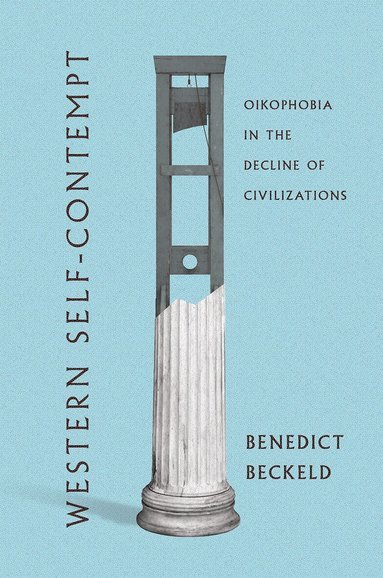
What is oikophobia?
It’s a strange question to sit with, because the honest answer is uncomfortable. Oikophobia — from the Greek oikos, meaning home or household, and phobia, meaning aversion — is the reflexive belief that one’s own culture is uniquely bad, while distant or foreign cultures are quietly assumed to be better, purer, more just. It’s the mirror image of xenophobia. Where the xenophobe fears the outsider, the oikophobe turns that same suspicion inward, onto his own home.
And here’s the part that should really give you pause: this isn’t a new mood. It isn’t a symptom of social media, or a particular political party, or a single generation gone soft. It’s a pattern that has shown up, again and again, in nearly every advanced civilization that ever reached the peak of its power — Greece, Rome, France, Britain, and now, it seems, the modern West. Something about success itself seems to plant the seed of self-doubt.
That’s worth sitting with for a moment, because it reframes the whole conversation. If this pattern is old — older than any of our current headlines — then it isn’t really a story about who’s right in today’s arguments. It’s a story about what wealth, security, and comfort quietly do to the human mind, and to the minds of entire civilizations. Understanding that pattern doesn’t hand you a political conclusion. It hands you something more useful: the ability to see your own moment clearly, instead of being swept along by it.
Oikophobia Isn’t the Same as Honest Criticism
Before going further, it’s worth drawing a hard line, because this is where the conversation usually goes sideways.
Criticizing your own country, your own institutions, your own history — that’s not oikophobia. That’s called being an adult. Healthy societies need internal critics. They need people willing to say this isn’t good enough about slavery, about corruption, about cruelty, about the gap between a nation’s stated ideals and its actual behavior. A culture that can’t look honestly at its own failures is a culture that never improves. The Bronte sisters writing about the constrained lives of women, or Dickens writing about the brutal underside of industrial London — that’s not self-hatred. That’s clear-eyed love, the kind that wants the thing it loves to be better.
Oikophobia is something else. It’s not selective criticism aimed at fixing a specific wrong. It’s a totalizing verdict — a background assumption that your own civilization is uniquely oppressive, uniquely racist, uniquely violent, while other cultures, examined with far less scrutiny, get romanticized almost by default. It’s a double standard dressed up as moral clarity. And once you can see that distinction, you start noticing it everywhere: in the way certain historical crimes get discussed only when they’re Western crimes, in the way certain cultures are held to exacting standards while others are given a pass out of a kind of patronizing pity.
The point isn’t to swing to the opposite extreme and pretend your own civilization did nothing wrong. That’s just oikophobia’s mirror image — an equally distorted, equally lazy story. The point is proportion. Every civilization in history has done things worth being proud of and things worth being ashamed of, often in the very same century. The mature response isn’t blind loyalty or blanket contempt. It’s the harder, more honest work of holding both truths at once.
The Pattern: How Success Quietly Builds the Conditions for Self-Contempt
So why does this keep happening? Why do the richest, freest, most secure societies in human history seem to be the ones most prone to turning on themselves?
There’s a pattern here, and it plays out with almost eerie consistency across very different civilizations, separated by thousands of years and thousands of miles.
It starts with struggle. A young civilization is usually tribal, hungry, and somewhat unrefined — but it’s also cohesive. Everyone is oriented around survival. Religion tends to be strong, because shared belief is one of the few things that can hold a fragile, resource-poor group together. There isn’t much room for internal division, because there’s an external threat that demands unity.
Then comes success. The group wins its early conflicts. It grows wealthier. A sense of shared identity solidifies, often expressed through stories, myths, and early literature that celebrate what the people have accomplished. This is the phase where a civilization starts writing its own epic — the story it tells about who it is.
Success builds a leisure class. As wealth accumulates and external threats fade, for the first time in that civilization’s history, some people no longer have to spend all their energy on survival. This is usually also the high-water mark of a culture’s art, philosophy, and science — because leisure and security are what make deep thought possible in the first place. But leisure has a side effect nobody plans for: it separates the person who acts from the person who thinks. The soldier and the philosopher, once the same person defending the same tribe, become two different types of people with two different lives.
Distance breeds introspection — and introspection, unchecked, breeds excessive self-criticism. This is the hinge point. A class of thinkers, no longer needing to personally defend the civilization that sustains them, starts examining it instead. Some of that examination is genuinely valuable. But some of it curdles into something else: criticizing your own culture becomes a way to seem sophisticated, a status marker among educated peers. It’s not really about truth-seeking anymore. It’s about being seen as the kind of person who’s above the tribal loyalties of the unwashed masses back home.
Meanwhile, the society fragments. Population grows. New groups gain rights and a political voice — which is, on balance, a good thing, but it also means more competing interests pulling in more directions. If the civilization has also been successful enough to absorb outsiders through trade, conquest, or migration, it now contains multiple cultures living side by side, and this naturally produces a kind of moral relativism: if my neighbor’s traditions are just as valid as mine, on what grounds do I still believe mine are worth defending?
And here’s the ironic twist at the center of the whole pattern: the very success that made a civilization great is what eventually undermines its confidence in itself. The wealth that built leisure also built distance from struggle. The power that pacified rivals also removed the external pressure that had kept people unified. The empire that absorbed diverse peoples also diluted the shared story that had once held everyone together. Nothing about this requires villains or conspiracies. It’s closer to a law of physics than a moral failing — success generates the very conditions that later produce self-doubt.
This mirrors something worth understanding at the level of entire civilizations, and if you want the fuller mechanics of how empires actually come apart once they hit that stage, Why Civilizations Collapse: The Definitive Guide to Goliath’s Curse goes deep on the structural side of the same story — inequality, elite overproduction, and the slow unraveling of shared purpose.

The Pattern of Oikophobia Repeating Through History
What makes this idea genuinely persuasive isn’t just the theory — it’s how consistently it shows up across civilizations that had no contact with each other and no knowledge of the pattern they were repeating.
Ancient Greece shows an early version of it. The outer Greek territories, in closer contact with Lydia, Babylon, and Persia, developed faster culturally and grew wealthier — but observers at the time noted they’d also grown softer, more given to luxury, less rugged than the farmers of the interior. By the time Athens reached its golden age, having defeated Persia and built the world’s most celebrated democracy, you start to see figures like Diogenes the Cynic, who took pride in mocking his own countrymen and calling himself a “citizen of the world” — a term he’s credited with coining, and one that should sound very familiar to modern ears. By the end of the classical era, Greek city-states were fractured into competing factions more interested in undermining each other than in standing together, which left them vulnerable to Macedonian conquest.
Rome followed a similar arc, but with an important twist. Roman elites were deeply influenced by Greek philosophy and culture, and traditionalists like Cato the Elder worried openly that this influence would soften and effeminize Roman character. Later Stoic writers like Seneca dismissed patriotism as a kind of simple-mindedness fit only for the unsophisticated. And yet — Rome held together longer than most, for a specific reason: the transition to empire concentrated authority under a single ruler, which slowed the fragmentation that had been accelerating under the late Republic. Rome also never fully lost its militaristic, practical character, because it always had a vast, unruly empire that needed defending. That ongoing demand for competence kept the worst excesses of self-contempt in check, even as the seeds of it were clearly present.
Enlightenment France offers one of the starkest examples. Thinkers like Rousseau romanticized “primitive” societies as more authentic and natural than corrupted, artificial European civilization. Voltaire built a career partly on mocking French tradition, French religion, and French institutions, often favorably comparing distant cultures he knew mostly through imagination. What followed wasn’t stability — it was a cascade of revolutions, coups, and regime changes, as different factions spent more energy destroying each other than building anything that lasted.
Britain resisted longer than France did, and the reasons are instructive. The presence of restless neighbors in Scotland and Ireland kept a sense of “the other” alive close to home. The fusion of church and state during the Reformation gave national identity a religious backbone that was hard to dislodge. Political compromises — expanded parliamentary power, an evolving bill of rights — released pressure before it could build into revolution. Britain’s version of oikophobia didn’t fully arrive until after the horrors and costs of the two World Wars, combined with the dismantling of its empire, produced a genuine crisis of elite confidence. George Orwell, writing in 1945, observed that among the British intelligentsia of his day, a mildly hostile, dismissive attitude toward one’s own country had become almost a badge of sophistication — and he noted, with some discomfort, that this wasn’t performance. People actually felt it.
America, according to this framework, reached its peak of relative global power after World War II, and the first unmistakable wave of oikophobia arrived with the Beat Generation of the 1950s — writers who immersed themselves in Eastern spirituality partly as a rejection of what they saw as a hollow, materialistic homeland. That’s a pattern worth noticing on its own: in Rome’s late empire, in France, and now in America, periods of rising self-doubt correlate with a turn away from the civilization’s traditional religion and toward imported spiritual or philosophical systems.
None of this is a claim that democracy is somehow inferior to more centralized forms of government, or that questioning your country is unpatriotic. It’s simply an observation about timing: the more successful, secure, and internally free a society becomes, the more room it creates for its own thinkers to turn critical energy inward — and the harder it becomes to tell the difference between necessary correction and corrosive contempt.
If you’re curious how this same arc plays out in the collapse mechanics of specific empires — not just the psychology but the hard structural failures — Why Every Great Civilization Eventually Falls and How the Roman Empire Survived Its Own Collapse are worth your time.
The Narcissism Connection
There’s a psychological ingredient here that’s easy to miss, and it has less to do with politics than with a much older idea: what happens to a culture’s sense of self once its traditions stop anchoring it.
When a civilization forgets or discards the traditions that once told people who they were and how to behave, something has to fill that vacuum. Often, what fills it is a kind of inflated, self-referential identity — a narcissistic orientation where the self becomes the primary unit of moral judgment, rather than the culture or the community. This isn’t really a criticism of any individual person’s character. It’s closer to a description of what happens at scale when shared meaning dissolves and gets replaced by individual self-focus.
Here’s where it connects back to oikophobia in a genuinely interesting way: an inflated sense of the self also breeds an inflated confidence in your ability to judge the past. If you believe your own moral instincts are more or less perfect on their own, unaided by any tradition or teaching, then it becomes very easy to look back at historical figures — who lived under completely different constraints, information, and assumptions — and conclude that you would obviously have behaved better than they did. That conclusion feels like moral clarity. It’s actually a kind of blindness, because it erases the fact that every person, including you, is shaped by the specific moment they were born into. It’s a comfortable illusion, and comfortable illusions are exactly the kind that spread fastest.
This is also, not coincidentally, one of the deeper threads running through modern conversations about masculinity, self-image, and purpose — the way an untethered, tradition-free identity leaves people (and cultures) more fragile, not less. If that idea interests you, it’s worth spending time with Why Narcissists Are More Sensitive to Criticism (Not Less), which explores the same psychological terrain at the individual level.
Why This Isn’t Really About Politics
It would be easy to read everything above and slot it neatly into one side of the current political argument. Resist that urge. The honest version of this idea cuts against comfortable narratives on every side.
The pattern doesn’t say a civilization’s traditions are always right just because they’re traditions — plenty of traditions deserved to be questioned and eventually abandoned. It doesn’t say every critical voice is secretly motivated by status-seeking rather than genuine moral concern — some of history’s most important reformers were accused of exactly this and were, in fact, right. It doesn’t say multiculturalism or immigration are civilizational threats — societies that absorbed outside influence often did so precisely during their most creative, dynamic periods, and closed, homogenous societies are rarely the ones producing lasting art, science, or philosophy.
What it does say is more modest and, frankly, more useful: unchecked self-contempt and unchecked self-glorification are both distortions, and a mature civilization — like a mature person — needs the discipline to hold a more complicated picture than either extreme allows.
There’s also a subtler point buried in here about timing. A young, developing society generally benefits from a progressive posture — openness to new ideas, willingness to absorb outside strength, hunger to improve. A mature, established society generally needs more of a conservative posture — the discipline to protect and maintain what took generations to build. The frustrating irony is that societies tend to do the opposite. Early on, when they most need openness, they tend to be rigid and traditional. Later, once they’ve built something worth protecting, they tend to swing toward the kind of unrestrained self-criticism that erodes the foundation underneath them. Recognizing that mismatch doesn’t hand you a political conclusion. It just means you can ask, honestly, at any given moment: does this society need more openness right now, or more backbone? That’s a harder, more useful question than picking a team.
The Balanced View
Here’s the caveat that matters most, and it’s the whole point of writing this piece rather than just cataloguing historical grievances in one direction.
Every civilization in history — every single one, without exception — has had both its genuine achievements and its genuine failures. Rome gave the world durable law and engineering that still shapes how we build cities, and it also built an empire on conquest and slavery. Enlightenment France gave the world extraordinary advances in science, philosophy, and human rights, and it also descended into a revolution that consumed its own architects. The modern West gave the world unprecedented material abundance, individual liberty, and scientific progress, and it also has real historical sins that deserve honest reckoning, not minimization.
Holding both of those truths at the same time is uncomfortable. It’s much easier, psychologically, to pick one narrative — either uncritical pride or blanket condemnation — and stop thinking. Both extremes offer the same seductive relief: they let you stop doing the harder work of actually weighing evidence.
The alternative is slower and less satisfying, but it’s the only version of this that actually leads anywhere useful. It means being willing to say: this part of our history, our institutions, our traditions — this worked, this served people, this is worth protecting and building on. And also: this part didn’t work, this caused real harm, this needs to be corrected, not defended out of loyalty. Doing that well requires a few things that are in genuinely short supply right now — an open mind that isn’t threatened by inconvenient facts, real dialogue with people who see the balance differently than you do, and a commitment to objectivity that doesn’t bend just because a conclusion is uncomfortable or unfashionable.
That’s a demanding standard. It’s much easier to perform certainty in either direction, because certainty feels like strength and complexity feels like weakness. But real strength — the kind that actually holds up under pressure — is usually quieter than that. It’s the capacity to look at something you love, see its flaws clearly, and stay committed to improving it rather than either defending it blindly or walking away from it in disgust.
That’s true of civilizations. It’s also true, if you look closely, of almost everything else worth building in a life — a marriage, a career, a body of work, a relationship with your own father. The instinct to either idolize or discard, rather than sit with the mess of something genuinely mixed, shows up everywhere once you start looking for it. Making Peace With the Man You Used to Be explores that same tension at the level of a single life, and it’s worth reading alongside this piece — the psychology is more similar than you’d expect.
A Practical Way to Apply This in Your Own Thinking
All of this can feel abstract — something for historians and philosophers to argue about over coffee. But there’s a practical skill hiding inside it, and it’s one you can start using immediately, in conversations that have nothing to do with ancient Rome.
Notice when a judgment feels too easy. If your opinion about your own country, your own institutions, or your own history arrives instantly and requires no real thought — total pride or total contempt, no exceptions, no nuance — that’s usually a sign you’re running on inherited narrative rather than actual reasoning. Genuine understanding tends to feel a little more effortful than that. It has edges. It has “yes, but.”
Ask what the strongest version of the opposing view would say. If you find yourself convinced your civilization is uniquely oppressive, spend real time with the counter-evidence: the freedoms, the innovations, the rare and historically unusual stability that let you have this conversation at all without fear of being imprisoned for it. If you find yourself convinced your civilization has nothing to answer for, spend real time with the counter-evidence there too: the people who were genuinely harmed, the promises that went unmet, the gap between the ideal and the practice. Both directions require the same discipline — sitting with discomfort instead of resolving it too quickly.
Watch for status motives in yourself, not just in others. It’s tempting to assume oikophobia is something that happens to other people — the detached elite, the out-of-touch intellectual, the person performing sophistication for an audience. But the honest move is to ask whether your own opinions about your culture are serving your understanding, or serving your image. Do you hold this view because the evidence genuinely points there, or because holding it makes you feel like a certain kind of person in front of a certain kind of crowd? That question is uncomfortable precisely because it’s useful.
Separate the specific from the total. A specific historical wrong — a war, a policy, an injustice — deserves specific, honest reckoning. It does not automatically license a total verdict on an entire civilization across all of its history and all of its people. Precision matters here. Sloppy thinking in either direction, whether it’s blanket condemnation or blanket defensiveness, is a way of avoiding the actual work of moral reasoning.
None of this makes the questions easy. It’s not supposed to. But it does make them honest, which is a rarer and more valuable thing than most public conversation right now seems willing to offer.
Where This Leaves Us
So, is oikophobia inevitable? Does every successful civilization eventually talk itself into decline?
The honest answer is: probably, to some degree, unless people consciously interrupt the pattern. But interrupting it doesn’t mean silencing critics or manufacturing blind loyalty — history shows that approach doesn’t actually work either, and it tends to produce its own kind of brittleness. It means something closer to what Britain managed for a few centuries longer than most: building enough shared purpose, enough honest self-examination alongside genuine pride, and enough ongoing engagement with real challenges that a civilization doesn’t drift into the kind of comfortable, consequence-free self-loathing that eventually hollows it out from the inside.
There are signs, in various corners of Western culture right now, of people trying to recover exactly that — a renewed interest in tradition, community, and shared meaning that isn’t naive nostalgia, but a genuine attempt to rebuild the thick attachments that give a civilization its spine. Whether that effort succeeds, or whether the older pattern simply repeats itself one more time, is genuinely an open question. Nobody — not historians, not philosophers, not anyone writing about this today — knows the answer with certainty.
But you don’t actually need certainty about civilizational trends to do something useful with this idea. You need something much smaller and more immediate: the discipline to notice, in your own thinking, when you’ve slipped into one of the two lazy modes — reflexive pride that refuses to see a flaw, or reflexive contempt that refuses to see a strength. Both are forms of not thinking. The harder, more honest path is the one that stays curious, stays willing to be wrong, and keeps looking at the whole picture — the good and the bad, together, without flinching from either one.
That’s not a comfortable place to stand. But it’s the only place from which you can actually see clearly enough to build something better.
Sources:
https://academic.oup.com/cornell-scholarship-online/book/45160
Related posts:
 25 Key Takeaways From Luke Kemp’s Book Goliath’s Curse
 What Ancient Societies Teach Us About Resilience: The Adaptive Cycle Framework
Why Civilizations Collapse: The Definitive Guide to Goliath’s Curse by Luke Kemp
What Ancient Societies Teach Us About Resilience: The Adaptive Cycle Framework
Why Civilizations Collapse: The Definitive Guide to Goliath’s Curse by Luke Kemp
 How the Roman Empire Survived Collapse and Reinvented Itself
 The Rungless Ladder Theory: Could Civilization Rebuild?