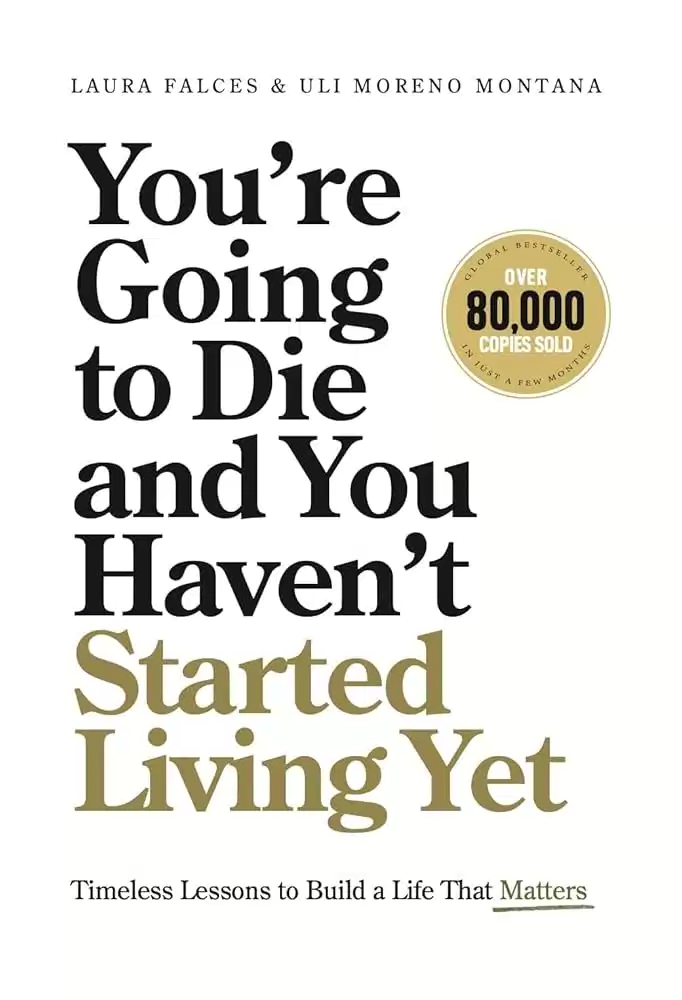
You’re Going to Die and You Haven’t Started Living Yet by Laura Falces and Uli Moreno Montana is a short, practical book of 29 lessons about building a life that matters, organised around one uncomfortable idea: the worst outcome isn’t dying, but dying without ever having really started to live. Its chapters range across self-knowledge, habits, time, money, critical thinking, relationships, conflict, work and mortality, each ending with a one-line principle. This summary distils the book into 20 key insights, links each to a deeper guide, and gives an honest view of where the book is strongest and where a few of its claims need updating.
It’s a Sunday evening in late autumn. A man of forty-two is sitting on the edge of his bed, scrolling through photos from a weekend he barely remembers enjoying because he was answering emails through most of it. His father’s birthday is next week; he hasn’t called in a month. He’s been “about to start” training again since January. None of this is a crisis. That’s the problem. It’s just a life drifting slightly off course, one reasonable postponement at a time.
That’s the reader this book was written for.
What Is You’re Going to Die and You Haven’t Started Living Yet About?
You’re Going to Die and You Haven’t Started Living Yet is a self-development book by Spanish authors Laura Falces and Uli Moreno Montana that offers 29 short lessons, each ending with a principle, on making better decisions about self-knowledge, habits, time, money, relationships, critical thinking, work and purpose, so that your life is shaped by your choices rather than your circumstances.
The book was first published in Spanish in 2025 as Te vas a morir y todavía no has empezado a vivir and appeared in English in March 2026, translated by Matthew G. Hollander. Its authors are partners in life and work. Falces is a chemical engineer and science communicator with a large online following; Moreno Montana is an audiovisual producer and entrepreneur. You can find their work at lauufaal.com.
The introduction sets the tone with an image worth borrowing. Imagine walking into a room and finding your younger self waiting for you. He knows your whole story. Would he like what he sees? Would he trust you if he needed help? Would he want to spend an ordinary day with you? The book’s 29 lessons are, in a sense, an answer to that question.
The authors advise reading it slowly, one or two chapters a day. It’s short, but dense, and most of its value comes from sitting with each idea. Our guide on how to read a book that actually changes you pairs well with that advice.
Part One: Yourself First
1. The only place you can’t leave is yourself
The book opens with the relationship you’ll have every second of your life: the one with yourself. You can change cities, jobs and partners, the authors write, but not the inner world you live in. They argue for time alone and in silence, for treating yourself with the kindness you’d give someone you love, and for choosing yourself even when it means leaving people, places and habits behind. Principle 1 is simple: no one can move forward if they forget themselves.
2. Happiness is a consequence, not a destination
We’ve been sold the idea that happiness is a prize waiting at a finish line, and that we should feel good all the time. The authors argue our biology is built for survival, not permanent happiness, and that discomfort, restlessness and sadness are normal signals, not malfunctions. They’re sharp about consumer culture: the same system that points out your flaws sells you the fix. Our article on the hedonic treadmill explores this in depth.
3. Check the nine pillars before you look for a quick fix
Instead of chasing external solutions, the authors suggest looking honestly at nine pillars of well-being: how you handle your thoughts, your relationships, the mismatch between modern life and human biology, work, status and respect, comparison, uncertainty about the future, your body, and your biology. When life wobbles, they suggest writing down which pillars are shaky and working on them one at a time.
Part Two: From Intention to Action
4. Stop being “seemingly committed, always about to start”
Chapter four is one of the book’s best. We name goals, know the first step and still wait, until we’ve convinced ourselves it’s not for us. The authors’ fixes are practical: you don’t need the whole map, only the next step; lower your standards and expect failure; and don’t rely on motivation, which runs out on long journeys. Discipline, they argue, is behaviour that doesn’t depend on mood, and action often creates motivation rather than the other way round.
5. Design your environment so good habits are easy
Borrowing from habit research, the authors explain how to make good habits visible, attractive, easy and rewarding, and bad habits hidden, unattractive, hard and embarrassing. A book on the nightstand. The phone in another room. The gym on your usual route. Life, their principle says, doesn’t change through big decisions but through small actions repeated, the same idea behind our guide to systems versus goals.
6. Complaining and the victim mindset are the real chains
Bad luck happens, the authors acknowledge, but complaining is resistance to the inevitable, and a victim mindset hands control of your life to circumstances. Drawing on Seneca and the wider Stoic tradition, they separate what you control (your actions, decisions and attention) from what you don’t, and argue that taking responsibility is empowerment, not guilt. Our guides to locus of control and how to take 100% responsibility for your life builds on the same idea.
7. Your tribe sets your course
You become, in part, like the people you keep close. The authors take the famous “average of five people” saying seriously but not literally, and offer a practical playbook for finding a better tribe: get specific, go where those people are, and become the kind of person you’re looking for. We cover the research in our guide to the five people you spend the most time with.
Part Three: Time, Stress and Work
8. Obsessing over making the most of your time wastes it
The authors take aim at constant busyness and the fear of missing out. With endless options a click away, they write, we always feel we could be doing something better. Their answer is to accept that we can’t do it all, remember that time is the one payment that’s non-refundable, and make room for doing absolutely nothing, rest for its own sake.
9. A fire that doesn’t burn doesn’t forge
Avoiding all discomfort makes us fragile. The authors argue for deliberately choosing small doses of discomfort, cold, effort, fasting, facing fears, while also learning from the hardships we didn’t choose. They add an important counterweight: asking for help isn’t weakness, it’s human. Our guide to voluntary discomfort explores the evidence and a sensible way to start.
10. Work expands to fill the time you give it
Using Parkinson’s law, the authors show how work stretches to fill an eight-hour container, and offer a sharp exercise: if you only had two hours a day to work, what would you focus on? Their parable of the carpenter and the businessman asks what all the extra effort is for. Their principle is blunt: if all you know is how to work, you have no idea how to live. Our guide to Parkinson’s law adds the research.
Part Four: Thinking Clearly
11. Range beats narrowness in a changing world
The authors make the case for generalists in a world that worships specialists, arguing that complex problems sit between fields and that adaptability matters more than ever. They’re not against depth; they’re against digging so deep you never look up. We explore the research and the T-shaped alternative in our guide to generalist vs specialist.
12. Question what you hear, or you’ll speak in someone else’s voice
Chapter twelve is a compact field guide to spotting charlatans and pseudoscience: ask who’s telling you, how they know, and what they’re selling; distrust complexity used as smoke; look for independent sources; beware repetition, extremes and “science can’t explain everything”. Our guide on how to spot pseudoscience applies it to men’s health and money.
13. The biggest lies come from inside your own head
The authors walk through common cognitive biases: the stories we invent to fill gaps, confirmation bias, the sunk cost fallacy, availability bias and the self-serving bias that credits our wins to talent and our losses to luck. Knowing them doesn’t remove them, they note, but it helps. We go deeper in our guide to the sunk cost fallacy.
Part Five: Relationships
14. Be the person everyone wants around
You are what you leave in other people’s hearts, the authors write. They describe the habits of people others love to be around: truly listening, asking real questions, saying “I love you”, “thank you” and “I’m sorry” while you can, and tending the relationships you already have instead of assuming they’ll always be there. Our article on how to be a better friend puts this into practice.
15. Healthy relationships balance adapting with staying yourself
Every relationship requires concessions, the authors argue, but not endless self-erasure. When only one person is adapting, it stops being a relationship and becomes exhaustion. And sometimes saying goodbye is itself an act of love.
16. Check the foundations with honest questions
The authors list eight traits of the most satisfying couples, from shared attraction and respect to humour, space and reciprocity, and five questions, drawn from psychologist Walter Riso, to know whether you’re with the right person. We cover both, with research on what predicts relationship satisfaction, in our guide am I with the right person?
Part Six: Money, Expectations and Emotions
17. Real wealth is time you control
The book’s ten money lessons are grounded and unglamorous: wealth is what you don’t see, what you spend matters more than what you earn, possessions impress others far less than they impress you, bad debt drains you, a cash cushion lets you sleep, inflation quietly erodes savings, financial literacy protects you, compound interest rewards patience, extremes mislead, and learning to be happy with less is a raise you control. Our guides to money buying time, not happiness and what enough actually means expand on this.
18. Expectations rise faster than life improves
Your mood often depends on the gap between what you expected and what happened, the authors write, and expectations climb faster than circumstances. Placing your well-being in “when I get that job” or “when I move” keeps you permanently dissatisfied.
19. Self-control is knowing what to do with what you feel
One of the book’s most refreshing chapters challenges the self-help mantra that “if something bothers you, it’s because you’re judging it”. In real conflict, the authors argue, biology is in the room, and suppressing your reaction can make things worse. Their advice is to set clear boundaries and then discharge the stress physically. We add research on doing that well in our guide on how to calm down after an argument.
Part Seven: Practical Life and Mortality
20. Imagine absence to honour presence
The final chapters cover a surprising mix of practical topics, the home as sanctuary, eight emergency skills from CPR to driving and basic repairs, how to learn and keep your brain sharp, and using AI to think better rather than less. Our guides to keeping your brain healthy as you age and AI and the future of men go deeper on the last two. Then the book ends where its title points: with death. The authors suggest occasionally imagining the worst case, the call, the diagnosis, the loss, not to frighten yourself but to wake up from autopilot, appreciate what you have and stop postponing. Their closing principle: to honour presence, imagine absence. Our guide to memento mori turns this into daily practice.
How to Read the Book: Strengths and Cautions
The book’s great strength is breadth with a practical edge. It covers in one short volume what most readers would need a dozen books to find, from habits and money to conflict and critical thinking, and every chapter ends with something you can use. Several chapters stand out: the one on being “always about to start”, the case for generalists, the chapter on spotting charlatans, and the unusually honest take on conflict and fight-or-flight. The authors’ own commitment to science, they have a whole chapter on scepticism, makes it all the more useful to check a few of their figures.
A handful of claims are worth reading with care. The introduction says around 75 per cent of lottery winners go broke within a few years; that figure is widely repeated, but we couldn’t trace it to reliable data, so we’ve left it out of our guides. The same goes for the oft-quoted “35,000 decisions a day”. The money chapter cites the well-known finding that well-being levels off at around $75,000 a year; newer research by Matthew Killingsworth, Daniel Kahneman and Barbara Mellers found that happiness generally keeps rising with income, though it plateaus for the least happy people. The book says strong relationships add seven to fifteen years of life; the best-known meta-analysis, led by Julianne Holt-Lunstad, found about a 50 per cent greater likelihood of survival over the studies’ follow-up periods, a striking finding, but not one that translates directly into years. And the famous Biosphere 2 story about trees collapsing for lack of wind is a powerful metaphor, but the scientific record doesn’t establish wind as the cause.
None of this undermines the book’s message. But in the spirit of its own chapter on scepticism, it’s worth knowing where the evidence is firm and where it’s illustrative.
A final note for some readers: the book quotes a Bible verse and the Serenity Prayer in passing. They’re used as illustrations, and readers of any or no faith will find the lessons stand on their own.
Who Should Read It?
This book is for you if your life isn’t in crisis but is drifting: you know roughly what you should be doing and keep not doing it, your days are full but not satisfying, and you’d like a practical framework rather than another motivational speech. It’s especially useful for men in their thirties and forties who’ve built a career and want to rebalance health, relationships and purpose.
It’s less suited to readers looking for deep treatment of a single topic. Each chapter is a doorway rather than a room. Use it to spot which areas of your life need attention, then go deeper with specialised books or the guides linked above.
Start Before You’re Ready
Go back to the man on the edge of his bed, the photos of a weekend spent half present, the father he hasn’t called, the training he’s been about to start since January. The book won’t fix his life. As the authors say in their introduction, these pages won’t change your life for you, but they’ll help you become the one who does.
Its principle for chapter twenty sums up the whole project: “A life without frequent reflection is inertia.” Reflection without action is just another kind of drift. So read a chapter. Pick one idea. Call your father. Start the first session. And notice, maybe for the first time in a while, that you’ve started living.
7 Questions to Ask Yourself After Reading You’re Going to Die and You Haven’t Started Living Yet
Take these the way the authors suggest taking the book: one or two a day, with time to sit with each.
- If your younger self spent an ordinary day with you this week, what would he enjoy, and what would disappoint him?
- Which goal have you been “about to start” for more than three months, and what is the very next step, small enough to do tomorrow?
- When you imagine the last ordinary day of your life, what does your gut tell you was missing from this week?
- Which of the nine pillars, thoughts, relationships, work, status, comparison, uncertainty, body, biology or modern mismatch, is wobbling most, and what single action would steady it?
- What do you already have, people, health, skills, time, that you’d ache to lose and rarely stop to appreciate?
- Which part of modern life that everyone accepts as normal, constant busyness, endless comparison, quick fixes, would you most like to replace, and with what?
- A year from now, which of the 29 principles do you hope will describe how you actually live?
A 29-Day Experiment With the Book: 5 Questions
Use the book’s structure as a one-month experiment: one lesson a day, one small action each time.
- For the next 29 days, when and where will you read one chapter, and what will you write down afterwards?
- What habit will you remove to make room, such as fifteen minutes of scrolling before bed or the news in the morning?
- What will count as evidence the experiment is working: actions taken, calls made, sessions trained, or simply how you feel on Sunday evenings?
- Who will you read it with or report to, a partner, a friend or a brother, so the ideas turn into conversations?
- At the end of the month, which one lesson could you turn into a small habit, ritual or group to share with other men, and what is the simplest first version?
A book is only a map. The first step on the ground is the one you take tomorrow.
Frequently Asked Questions About You’re Going to Die and You Haven’t Started Living Yet
What is You’re Going to Die and You Haven’t Started Living Yet about?
It’s a self-development book by Laura Falces and Uli Moreno Montana offering 29 short lessons, each ending with a principle, on self-knowledge, habits, time, money, critical thinking, relationships, conflict, work, practical skills and mortality. Its core message is that your life should be shaped by your values and decisions, not only by circumstances.
Who are Laura Falces and Uli Moreno Montana?
They are Spanish authors and partners in life and work. Laura Falces is a chemical engineer and science communicator known online as @lauufaal. Uli Moreno Montana is an audiovisual producer, entrepreneur and founder of Team Montana Films. Together they write about health, responsibility, meaning and everyday decisions, and also wrote Nacidos para estar fuertes.
When was the book published?
The original Spanish edition, Te vas a morir y todavía no has empezado a vivir, was published in May 2025. The English edition, translated by Matthew G. Hollander and published by Kairund Books, appeared in March 2026. The authors recommend reading one or two chapters a day rather than finishing it quickly.
What are the main lessons of the book?
Key lessons include caring for your relationship with yourself, treating happiness as a consequence, starting before you feel ready, designing your environment for good habits, rejecting the victim mindset, choosing your tribe, avoiding busyness for its own sake, embracing healthy discomfort, thinking critically, building balanced relationships, managing money for freedom, and using mortality to live fully now.
Is the book scientifically accurate?
Mostly, and it includes a strong chapter on scepticism. A few figures should be read with care: the claim that 75 per cent of lottery winners go broke, the $75,000 happiness plateau (since revised), the “seven to fifteen years” longevity claim, and the Biosphere 2 wind story. The core lessons don’t depend on these details.
Who should read it?
It suits readers whose lives aren’t in crisis but are drifting, who know what they should do and keep postponing it, and who want a practical, wide-ranging framework rather than a single-topic deep dive. Men in their thirties and forties rebalancing career, health, relationships and purpose may find it especially useful.
References
- Falces, L., & Moreno Montana, U. (2026). You’re going to die and you haven’t started living yet: Timeless lessons to build a life that matters (M. G. Hollander, Trans.). Kairund Books. (Original work published 2025)
- Holt-Lunstad, J., Smith, T. B., & Layton, J. B. (2010). Social relationships and mortality risk: A meta-analytic review. PLoS Medicine, 7(7), e1000316.
- Killingsworth, M. A., Kahneman, D., & Mellers, B. (2023). Income and emotional well-being: A conflict resolved. Proceedings of the National Academy of Sciences, 120(10), e2208661120.
- Seery, M. D., Holman, E. A., & Silver, R. C. (2010). Whatever does not kill us: Cumulative lifetime adversity, vulnerability, and resilience. Journal of Personality and Social Psychology, 99(6), 1025–1041.
Related posts:
 Build the Life You Want Summary: Arthur Brooks and Oprah’s Guide to Getting Happier
 The 10 Best Wildlife Outdoor Knives of 2026: A Complete Buyer’s Guide for Hunting, Hiking, Survival, Camping and Bushcraft
 Mind Over Grind Book Summary: Guy Winch’s Field Manual for Men Whose Work Has Quietly Taken Over
 Happy Money by Ken Honda: Summary, Key Ideas, and Takeaways
 Is Loving Your Job Always Good? The Dark Sides of Meaningful Work and How to Manage Them