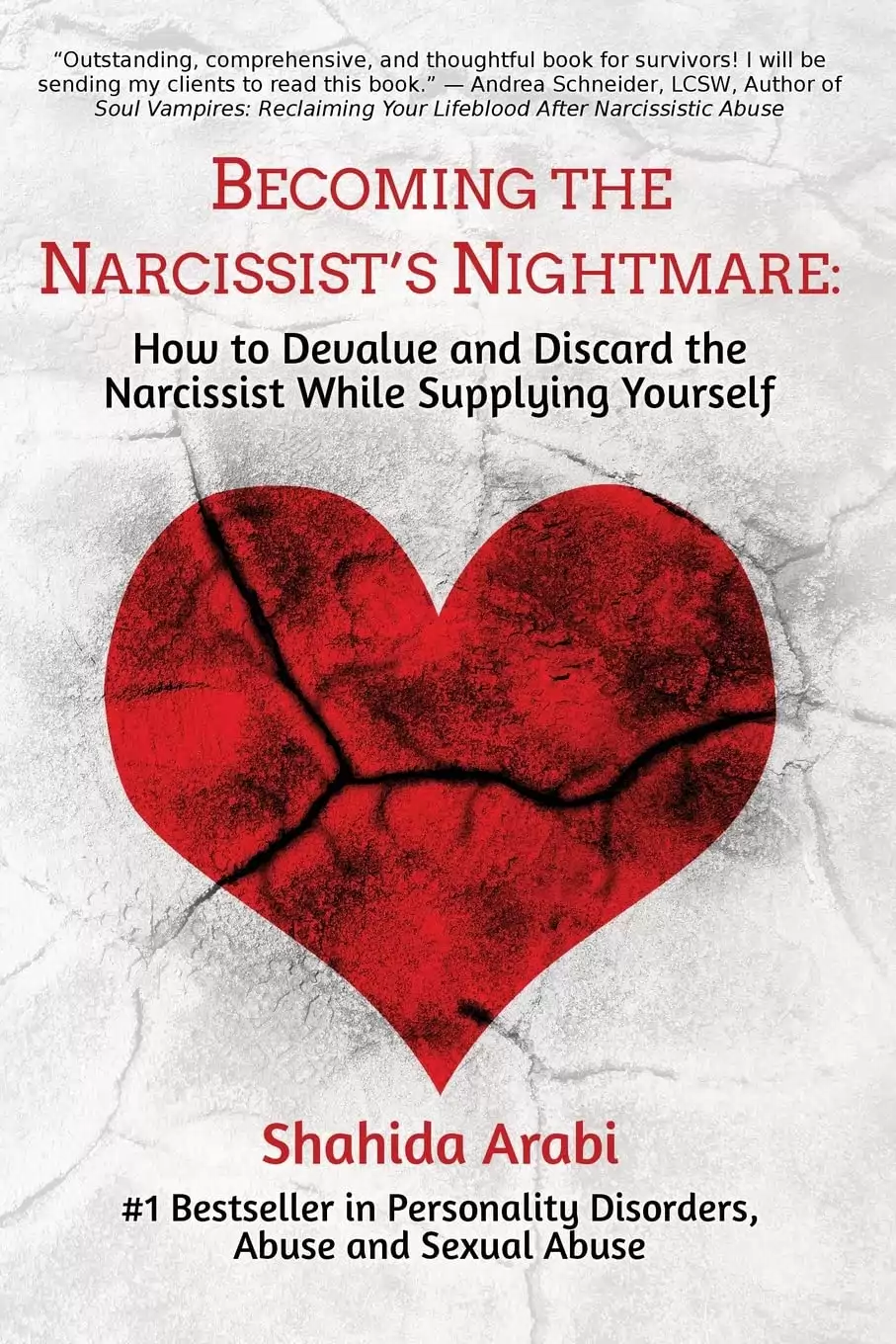
Becoming the Narcissist’s Nightmare by Shahida Arabi is a recovery handbook for people leaving manipulative relationships, and its central idea is that you heal by turning the abuser’s own tactics around: stop supplying them, and start supplying yourself. Beneath that provocative title is a surprisingly practical book about why these relationships are so hard to leave and what actually loosens their grip. This summary distils the book into 20 insights in four parts: understanding the pattern, why you stay, how to detach, and how to heal. It also gives an honest take on where the book is strongest and where to read it with care.
It’s a Sunday evening and a man in his thirties is sitting in his car outside the gym, not going in. He left a relationship four months ago. He’s read the articles, watched the videos, learned the vocabulary. He can explain love bombing and gaslighting to anyone who asks. And still, every evening, he loses an hour to replaying old arguments and resisting the urge to check her profile. What he needs isn’t more definitions. He needs a plan.
That gap, between understanding narcissistic abuse and actually getting free of it, is where Arabi’s book lives.
What Is Becoming the Narcissist’s Nightmare About?
Becoming the Narcissist’s Nightmare is a self-help book by survivor and writer Shahida Arabi that explains how narcissistic abuse works, why victims stay bonded to their abusers, and how to detach and heal by “devaluing and discarding” the narcissist in their own minds while giving themselves the care they once gave away.
Arabi published the book in 2016, after years of writing for survivors online and coaching people through no contact. She writes as a survivor first. She describes having dated and befriended a series of manipulative people, and having studied psychology at Columbia, and she combines that lived experience with research, hundreds of survivor surveys and chapters from therapists and advocates.
The subtitle carries the thesis: How to Devalue and Discard the Narcissist While Supplying Yourself. Those words describe the abuse cycle, and Arabi deliberately repurposes them. In her version, devaluing means finally seeing the person as they are. Discarding means cutting contact. Supplying yourself means taking back the attention, admiration and energy you once poured into someone who used it.
The book runs ten chapters, from recognising the narcissist through the chemistry of the bond, detachment, no contact, narcissism in families and workplaces, to owning your agency and writing your way to closure. It’s long, sometimes sprawling, and full of practical tools. What follows are the 20 ideas that matter most.
Part One: Understanding the Pattern
1. Judge the behaviour, not the diagnosis
Arabi opens with the clinical definition of Narcissistic Personality Disorder, then sets it aside. The diagnosis, she argues, matters less than the behaviour you lived with: the chronic put-downs, the hot-and-cold cycles, the control, the lack of empathy. Someone who shows these behaviours and refuses to change doesn’t need a label for the relationship to be harmful.
This is the most useful starting point in the book, especially for men who get stuck on the question “Is she really a narcissist?” You don’t have to answer that to protect yourself. Look at the pattern, and at what the relationship did to you.
2. The charming persona is the hook
Arabi leans on the idea of a false self: a charming, generous, confident persona shown to the world and especially to a new partner, and a colder, contemptuous self that emerges in private. The mask is why friends can’t believe your account, and why you doubt it yourself every time the nice version reappears.
Her reading is stark. The sweet periods are the mask and the cruel periods are the truth. You don’t have to accept that in its strongest form, since people are complicated, but as a protective rule it works: trust the side that reliably shows up when you need something or disagree. Our article on whether a narcissist believes their own lies explores how sincerely that mask can be worn.
3. Empathy, not weakness, is what gets targeted
One of Arabi’s most liberating points is that intelligence doesn’t protect anyone. Manipulative people target people with empathy: those who give the benefit of the doubt, stay loyal and want to help. The survivors she heard from were often accomplished, articulate and strong.
What raises the risk is empathy combined with old wounds, such as a childhood in which love had to be earned, or a parent who blew hot and cold. That’s not a flaw. It’s a vulnerability that can be understood and protected.
4. The cycle runs on a predictable rhythm
Arabi maps the relationship as a cycle: idealise, devalue, discard, and often hoover. First comes the flood of attention and mirroring, the love bombing phase where you feel you’ve met the one. Then comes devaluation: put-downs disguised as jokes, silences, comparisons. Then comes the discard, often abrupt and humiliating, frequently followed by a smear campaign. And then, as you begin to heal, the attempt to pull you back.
Seeing the rhythm is protective. It turns a chaotic experience into a pattern you can anticipate. Our idealize, devalue, discard guide walks through each stage in detail.
5. Your reactions are supply too
Arabi’s concept of narcissistic supply, the attention and admiration a narcissistic person needs, includes something many readers don’t expect: your negative reactions. Your anger, hurt, jealousy and long explanatory messages all confirm that you can still be moved.
This is the insight that changes behaviour most. If reaction is fuel, then winning the argument stops being the goal. Withdrawing the reaction is.
6. Gaslighting’s real aim is to make you doubt yourself
Arabi defines gaslighting as the invalidation of your perception of reality, with “crazy” as the word manipulative people reach for most. Her sharpest observation is that the goal is to make you gaslight yourself, so that you start editing your own memory before anyone asks.
Her defence is simple: keep a private record of what happened, and keep people around you who can reflect reality back. Our guide to gaslighting in relationships covers the signs and the specific scripts often used against men.
7. Triangulation turns love into a competition
Bringing in a third person, such as an idealised ex, a flirtatious “friend” or a stranger at the bar, keeps you insecure and competing. Arabi notes it’s often staged so you notice, and followed by accusations that you’re jealous.
Her response is to refuse the contest: neutral face, change the subject, walk away, stop watching their social media after a breakup. Our article on narcissist triangulation goes further.
8. Old and new wounds open at the same time
Arabi coins the term “simultaneous wounding” to push back against a popular idea: that a toxic partner only brings up wounds you already had. She argues that manipulative partners do reopen old wounds, but they also create new ones, and the two compound. For survivors of a narcissistic parent, that’s why an adult relationship can feel both shockingly painful and strangely familiar.
The point is mercy. You’re not just “working through your own stuff”. You were also injured.
Part Two: Why It’s So Hard to Leave
9. The bond works like an addiction
Arabi’s chapter on what she calls biochemical bonds is the most memorable in the book. She describes how cycles of affection and cruelty work like a slot machine: unpredictable rewards produce more persistent attachment than steady ones. Hormones tied to bonding, reward and stress, she argues, entangle love with fear until leaving feels like withdrawal.
Some of her specific chemical claims go further than the science can confirm for any single relationship, so read that chapter as a survivor’s synthesis. But the core holds. When Canadian psychologists Donald Dutton and Susan Painter followed women who had left abusive partners, the on-off rhythm of the abuse and the power imbalance best predicted how attached they still felt six months later. The swing itself does the binding. Our guide to the trauma bond with a narcissist covers this in depth.
10. Your mind resolves the contradiction in the wrong direction
Loving someone who hurts you creates cognitive dissonance, and Arabi argues that most victims resolve it by denying, minimising or rationalising the abuse rather than seeing the person clearly. She calls one result “abuse amnesia”: during the good stretches, the bad memories fade.
Her fix is one of her “inalienable truths”. To detach, do the opposite of what your mind wants: treat the cruel pattern as the real person and the charm as the performance, and keep the written record that stops nostalgia from editing the past.
11. “Just leave” and “let it go” are bad advice
Arabi is scathing about outsiders who claim they’d have walked out at the first sign of disrespect, and about clichés that harm survivors: “forgive and forget”, “let it go”, “it takes two”. Trauma, she argues, needs to be processed, not dismissed, and people who leave late usually stayed because of the bond, the fear and the self-doubt, not because they were weak.
For men, this insight comes with permission. You can stop measuring your strength by how fast you left.
12. Explanations aren’t excuses
Arabi takes on the question of where narcissism comes from and lands on honest uncertainty: probably an interaction of temperament and upbringing, including both neglect and excessive indulgence. One well-known study supports part of this. Researchers led by Eddie Brummelman followed hundreds of Dutch children and found that those whose parents overvalued them, treating them as more special and entitled than others, became more narcissistic over time, while parental warmth predicted healthy self-esteem instead.
But Arabi is firm on what follows. A hard history may explain behaviour without excusing it. You can feel compassion, she writes, as long as it never becomes a reason to release someone from accountability or to stay in harm’s way.
Part Three: How to Detach
13. Turn their tactics around
This is the book’s signature idea. Arabi takes four terms from the abuse cycle and reverses them. Devalue the narcissist by replacing the idealised picture with reality. Discard them through no contact. Re-idealise and supply yourself with the attention, care and admiration you used to hand over. And triangulate, in a healthy way, by surrounding yourself with friends, family, counsellors and fellow survivors who keep you grounded.
It’s a clever reframe, and it gives readers a sense of agency at the moment they feel most powerless. You don’t become cruel. You simply stop being available for the old game.
14. No contact is self-care, not a strategy to win them back
Arabi distinguishes no contact from the dating-blog trick of going silent to make someone miss you. Real no contact means blocking on every channel, avoiding updates through mutual friends, removing reminders and, where possible, stepping away from the ex’s circle, which may have been turned against you.
She also makes a crucial distinction: no contact is not the silent treatment. One is a weapon used inside a relationship. The other is a boundary that protects you after it. Her practical target is thirty days of no contact, then ninety, tracked on a calendar and celebrated.
15. Ride the craving instead of fighting it
Arabi treats the urge to make contact the way addiction counsellors treat cravings: accept that they come, peak and pass, and don’t act on them. Her rule of thumb is to wait at least an hour before doing anything, and to fill the hour with something physical, social or absorbing. Her list of 111 alternatives to breaking no contact is built on pattern interruption: break the loop with an action, any action.
The research on unwanted thoughts backs her approach. In Daniel Wegner’s famous white bear experiments, people told not to think about something thought about it more than once a minute, and later even more. Fighting thoughts head-on backfires. Redirecting attention works better. Our guide on how to stop thinking about a narcissist turns these tools into a plan.
16. When you can’t cut contact, become boring
Not everyone can disappear. For co-parents, colleagues and family members, Arabi offers six responses, led by the grey rock method: brief, factual, emotionally flat replies that give provocation nothing to feed on. She adds derailing provocative topics, opposite action, boundaries you enforce yourself rather than demanding them, and reframing the person’s tactics as tactics.
She also warns about the workplace “hit man”, the more powerful ally a manipulative colleague feeds distorted stories to, and advises keeping personal information out of reach. Our guide to setting boundaries at work pairs well with this chapter.
17. Indifference beats revenge
Arabi is fond of the idea that the best response to provocation, hoovering or post-breakup posturing is no response at all. Her line is short: “Indifference is their kryptonite.” Hatred keeps you engaged. Indifference doesn’t.
The healthy reading of this, and the one worth keeping, is that indifference isn’t a performance aimed at hurting someone. It’s what happens naturally when your life fills up again. If you’re checking whether your silence is working, you’re still playing.
Part Four: How to Heal
18. Talk back to the voice in your head
Many of the thoughts that loop after an abusive relationship are lines that were said to you. Arabi’s technique for these is “reverse discourse”: write the line down and answer it, bluntly and privately, on paper; replace it with a phrase you can actually believe; and reclaim insults by giving them new meaning. One of her examples is aimed at men: a partner telling a man he isn’t a “real man” because he’s too sensitive, and how to rewrite that line on his own terms.
It’s cognitive restructuring with the gloves off, and for many survivors it’s the most cathartic tool in the book. Our guide to CBT techniques for overthinking covers the gentler version.
19. Expect to grieve twice, and get the right help
A chapter by advocate Lilly Hope Lucario contains one of the book’s most clarifying ideas: survivors grieve twice. First you grieve the person you thought they were, and later you grieve the person they really are. The second wave often arrives months after the first and can feel like going backwards. It isn’t.
Arabi also takes trauma seriously. Drawing on therapist Pete Walker and psychiatrist Judith Herman, she describes complex post-traumatic stress after prolonged abuse, including emotional flashbacks, a harsh inner critic, numbness, hypervigilance and toxic shame, and she urges readers to find a therapist who validates rather than minimises what happened. Our narcissistic abuse recovery guide brings these threads together.
20. Own your agency without blaming yourself
The book closes on a distinction Arabi clearly cares about. Victim-blaming says the abuse was your fault. Owning your agency says it wasn’t, and that you now have the power to protect yourself, notice red flags sooner and rebuild. You can be both a victim and a survivor at once.
She offers three steps: recognise the power you do have, however small it feels; ask for help, which she frames as strength; and change the beliefs the relationship left you with. And she ends with purpose. Many survivors, she notes, eventually channel what they learned into writing, coaching, volunteering or simply helping one friend through the same thing. That’s not an obligation. But it is often how the story becomes yours again.
How to Read the Book: Strengths and Cautions
Arabi’s book is at its best as a companion for the weeks and months after leaving. It validates without coddling, names patterns precisely and gives readers dozens of concrete things to do with the next hour. The survivor accounts make it far less lonely than a clinical text, and the reframing of the abuse cycle into a recovery plan is genuinely original.
There are things to read with care, though. It’s a self-published survivor’s book from 2016, not a clinical manual, and some of its neuroscience, particularly the specific hormone mechanics, runs ahead of the evidence. It uses the word “narcissist” freely, which can tempt readers into diagnosing people rather than describing behaviour. Its view that narcissists never change is more absolute than many clinicians would be, although that doesn’t change what you need to do to protect yourself. Some passages on karma and spirituality reflect the author’s personal beliefs and won’t suit every reader. And most examples feature women harmed by men, although Arabi is explicit that anyone, regardless of gender, can be on the receiving end, and several of her tools are written with men in mind.
For a man coming out of a manipulative relationship, the most useful way to read it is selectively. Take the frameworks (the cycle, supply, the four reversals), take the tools (the one-hour rule, grey rock, reverse discourse, no contact milestones) and take the permission to stop blaming yourself. Use them alongside, not instead of, real support. Men who recognise themselves in these pages may also find our guides on emotional manipulation in relationships and how to detach from someone useful next reads.
Who Should Read Becoming the Narcissist’s Nightmare?
This book is for you if you’ve recently left, or are planning to leave, a relationship that kept you off balance, and you understand what happened but can’t stop going back to it in your head. It’s especially helpful if you’re struggling with no contact, if the relationship has left you doubting your own judgement, or if you’re dealing with a manipulative co-parent, colleague or family member you can’t avoid.
It’s less suited to readers looking for a balanced clinical account of personality disorders, or to anyone hoping to understand and fix the other person. Arabi’s focus is relentlessly on you, the reader, and what you can do next. That focus is the book’s greatest strength.
From Understanding to Freedom
Go back to the man in the car outside the gym. He knows the vocabulary. What Arabi’s book offers him is a different question. Not “What is wrong with her?” but “Where is my energy going, and where do I want it to go instead?”
That shift is the heart of the book. The abuse cycle ran on your attention, your admiration, your reactions and your hope. Recovery runs on the same things, pointed back at your own life: the training session, the friend you haven’t called, the project you shelved, the quiet evening that isn’t spent replaying anything. Arabi calls this becoming the narcissist’s nightmare. You could also call it becoming yourself again.
He gets out of the car and goes in. It’s not dramatic. It’s just one hour that belongs to him. Which hour of yours will you take back first?
7 Questions to Ask Yourself After Reading Becoming the Narcissist’s Nightmare
Read these aloud rather than silently, and notice which ones change your voice.
- Of the 20 insights, which one made you stop reading for a moment, and what memory did it bring back?
- If your reactions really were part of the fuel, which recent reaction would you most like to have kept to yourself?
- When you say out loud what happened in that relationship, what happens to your voice, and how does it sound when you say what you want next?
- Which of Arabi’s four reversals, seeing them clearly, cutting contact, supplying yourself or building your own support, is the one you’ve been avoiding, and why that one?
- What strengths came through the relationship intact, your loyalty, your humour, your work ethic, and where are they waiting to be used?
- If and when you’re ready, which idea from your own work, sport or trade could make recovery from relationships like this easier for other men?
- A year from now, when someone asks how you got through it, what do you hope you’ll be able to tell them?
If reading the book or this summary has stirred up more than you expected, especially flashbacks, hopelessness or a harsh inner voice, please speak to a counsellor who understands emotional abuse; Arabi herself insists her tools are a complement to real support, not a replacement.
A Seven-Day Experiment With Arabi’s Ideas: 5 Questions
Pick one idea from the book and test it for a week, instead of trying to absorb all twenty at once.
- Which single insight will you test for the next seven days: the one-hour rule, a reverse-discourse page, grey rock with one person or a no contact calendar?
- What will you stop doing during the experiment, such as checking their social media, replying to provocations or replaying old arguments before bed?
- What will count as evidence it’s working: fewer hours lost, shorter conversations, better sleep, a quieter head on the drive home?
- Who will you tell about the experiment, so that someone asks you on day four how it’s going?
- When the week is over, what will you write down about what worked, and how could you pass that on to one other man who needs it?
A book is a map. The first step on the ground is yours.
Frequently Asked Questions About Becoming the Narcissist’s Nightmare
What is Becoming the Narcissist’s Nightmare about?
It’s a 2016 recovery book by survivor and writer Shahida Arabi about narcissistic abuse. It explains the abuse cycle, why victims stay bonded to manipulative partners, and how to detach and heal. Its central idea is to reverse the abuser’s tactics: devalue them by seeing them clearly, discard them through no contact, and supply yourself with the care you once gave away.
What does “supplying yourself” mean in the book?
Narcissistic supply is the attention, admiration and reaction a narcissistic person seeks from others. Shahida Arabi argues that recovery means redirecting that supply to yourself: rebuilding self-worth through self-care, positive self-talk, new goals, exercise, friendships and purpose. It’s less about self-indulgence than about reclaiming the energy, attention and care the relationship drained from you.
What are the main takeaways from Becoming the Narcissist’s Nightmare?
Key takeaways include judging behaviour rather than diagnoses, recognising the idealise-devalue-discard cycle, understanding that your reactions feed the dynamic, seeing the trauma bond as addiction-like, resolving cognitive dissonance toward the truth, using no contact or grey rock, riding cravings rather than fighting them, rewriting harmful self-talk, grieving twice and owning your agency without self-blame.
Is Becoming the Narcissist’s Nightmare worth reading?
For people recovering from a manipulative relationship, it’s a validating and practical companion, full of concrete tools. Read it as a survivor’s guide rather than a clinical text: some of its neuroscience goes beyond the evidence, and it uses the word narcissist freely. It works best alongside support from friends and, where needed, a therapist.
Is the book useful for men?
Yes. Although many examples involve women harmed by men, Shahida Arabi states that anyone can experience narcissistic abuse regardless of gender, and her tools, such as no contact, grey rock, reverse discourse and the one-hour rule, apply equally. Men may find her points about shame, staying too long and rebuilding self-worth especially relevant.
What is reverse discourse?
Reverse discourse is Shahida Arabi’s set of techniques for reclaiming language used against you. You write down hurtful lines that replay in your head and answer them privately on paper, replace them with phrases you can believe, and give old insults new meanings. It’s designed to quiet rumination and rebuild self-worth, especially after verbal abuse.
References
- Arabi, S. (2016). Becoming the narcissist’s nightmare: How to devalue and discard the narcissist while supplying yourself. CreateSpace Independent Publishing Platform.
- Dutton, D. G., & Painter, S. (1993). Emotional attachments in abusive relationships: A test of traumatic bonding theory. Violence and Victims, 8(2), 105–120.
- Brummelman, E., Thomaes, S., Nelemans, S. A., Orobio de Castro, B., Overbeek, G., & Bushman, B. J. (2015). Origins of narcissism in children. Proceedings of the National Academy of Sciences, 112(12), 3659–3662.
- Wegner, D. M., Schneider, D. J., Carter, S. R., & White, T. L. (1987). Paradoxical effects of thought suppression. Journal of Personality and Social Psychology, 53(1), 5–13.
Related posts:
 Idealize, Devalue, Discard: The Complete Stage-by-Stage Guide to the Narcissistic Abuse Cycle
 Trauma Bond With a Narcissist: Why You Can’t Let Go, and How the Hook Loosens
 Why Does a Narcissist Make You the Villain? The Psychology Behind the Role Reversal
The Six Stages of a Female Narcissist: From Childhood Wound to Bitter Isolation
 Does a Narcissist Believe Their Own Lies? Why Innocence Matters More Than Truth to Them