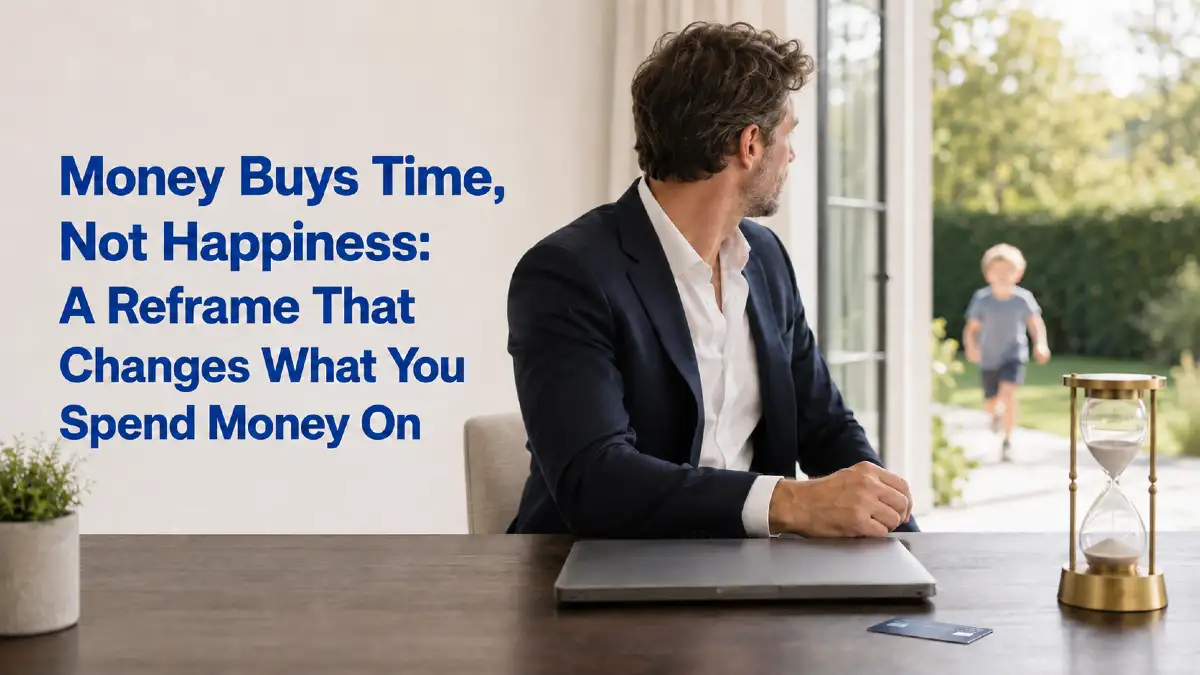
Money buys time, not happiness, in the sense that the most reliable thing money gives you, once your needs are covered, is control over how you spend your hours. The strange part is that research shows money does keep adding some happiness for most people, and yet the purchase most strongly linked to feeling better is one that few people make even when they can afford it. This article covers what the reframe means, what the research on income and happiness actually says, why buying time works, what the time view changes in how you spend and work, and where to start.
It’s Saturday morning, and you’re in the car again. The job pays well, better than you ever expected, but the week has already taken fifty-five hours of it, and the weekend is filling up with the rest: the tip run, the lawn, the gutter, the shopping, the two hours of email you promised yourself you’d clear before Monday. By Sunday evening, you’ve earned plenty and lived very little. The money is fine. The week isn’t yours.
What Does “Money Buys Time, Not Happiness” Mean?
“Money buys time, not happiness” is the idea that, beyond the basics, money’s greatest value is not more consumption but more control over your time: the freedom to decide what you do, when, and with whom. It reframes money from a scoreboard into a tool for buying back your own life.
The reframe is most closely associated with Morgan Housel, the author of The Psychology of Money. In a chapter on freedom, Housel argues that the ability to do what you want, when you want, with the people you want, is worth more than almost anything money can buy. His summary of the idea is blunt: “Controlling your time is the highest dividend money pays.”
That’s a different goal from the one most men are raised with. The usual script says earn more, buy more, show more. Housel’s version says earn enough, then use the surplus to buy yourself room: a shorter commute, a lighter schedule, a cushion that lets you say no. Money, in this view, is less a measure of success than a means of time wealth, the currency that actually determines how your days feel.
Does Money Buy Happiness? What the Research Actually Says
The honest answer is: some, and more than the old line suggests.
For years, the best-known finding came from Daniel Kahneman and Angus Deaton, whose 2010 analysis suggested that day-to-day emotional well-being rose with income up to about $75,000 a year and then levelled off. It became the most quoted number in personal finance. Then, in 2021, Matthew Killingsworth published data from thousands of people reporting their feelings in real time, which showed happiness continuing to rise with income well beyond that point.
Rather than argue in print, Killingsworth, Kahneman and Barbara Mellers worked together to resolve the conflict, publishing a joint analysis in 2023. They found that, for most people, happiness does keep rising with income. The plateau was real, but only for the least happy group: for them, happiness rose with income up to about $100,000 and then stopped improving. For the happiest people, the link actually grew stronger above that level.
What that means for you is twofold. First, the comforting idea that money stops mattering after a modest salary isn’t quite true; more money does tend to help most people. Second, if you’re unhappy for reasons money can’t touch (loneliness, a marriage under strain, work you find meaningless), earning more past a comfortable level is unlikely to fix it. So “money buys time, not happiness” is best read not as a scientific law but as a guide to spending: of everything money can buy, time is the purchase most likely to change how your life feels. What actually makes people happy is mostly a matter of relationships, purpose and how you spend your days, and time is the raw material of all three.
Why Time Is What Money Buys Best
Think about what extra money usually buys once the basics are covered. A bigger house, a better car, a nicer watch. Each brings a lift, and each lift fades as you get used to it. The third luxury car rarely feels much better than the second.
A great deal of that spending is positional: it matters mainly because of how it compares with what other people have. That’s a race with no finish line, because there’s always someone with more. It’s also why status spending so often fails at the very thing it’s meant to achieve; you can’t buy a woman’s respect, and the same is largely true of anyone else’s.
Time is different. An hour freed from a draining task is an hour you can spend with your children, on your health, on work you care about or simply resting. It doesn’t depend on comparison, and it doesn’t wear off in the same way, because what you do with it is new each time. That’s the heart of Housel’s reframe: money spent on things competes with everyone else’s things; money spent on time gives you back the one resource nobody can make more of.
There’s a catch, and the live version of this article put it well: buying back an hour only to spend it scrolling on your phone is a poor trade. The value of the purchase depends entirely on what you do with the time.
Buying Time: The Purchase Most People Skip
If buying time is so valuable, you’d expect people to do it. Mostly, they don’t.
Psychologist Ashley Whillans, working with Elizabeth Dunn at the University of British Columbia, studied more than 6,000 adults in the United States, Canada, Denmark and the Netherlands. People who spent money on time-saving purchases, such as paying for cleaning, delivery or help with chores, reported greater life satisfaction, and the link held regardless of income. In a follow-up experiment, working adults were given $40 to spend on a time-saving purchase one weekend and $40 on a material purchase another weekend; they felt happier after buying time. Yet in a sample of more than 800 Dutch millionaires, almost half said they spent nothing at all on outsourcing tasks they disliked.
What that means for you is that the barrier is rarely money. It’s habit, guilt and a sense that you should be doing these things yourself. Many men feel that paying someone to clean or cut the grass is an indulgence, or even a small failure. But if an hour of your Saturday costs less to buy back than it’s worth to your family or your sanity, keeping it is a bad trade, not a virtuous one. Whillans and Dunn found that time-saving purchases helped people on ordinary incomes too, so this isn’t advice only for the wealthy.
Start small. Pick the task you dread most, and price what it would cost to hand it over once.
The Commute: A Time Cost Hidden in Plain Sight
Few things show the trade between money and time more clearly than the commute.
Economists Alois Stutzer and Bruno Frey studied German household data across nearly two decades and found what they called the “commuting paradox”: people with longer commutes reported systematically lower well-being, and they weren’t fully compensated for it by higher pay or cheaper housing. By the researchers’ estimate, a typical commute of about 22 minutes each way would require roughly a third more income to make up for the loss in well-being, though they’re careful not to insist on the exact figure.
What that means for you is that a job offer or a house move should be judged in hours as well as money. A pay rise that comes with an extra forty minutes in the car each day may leave you worse off where it counts. A smaller house nearer work, a role with some remote days or a job closer to home can be worth more than they appear on paper. The live version of this article named the commute as the first place to look, and it’s still the best.
How the Time View Changes What You Spend Money On
Once you see money as a way to buy time, your spending starts to sort itself.
The first change is converting low-value hours into high-value ones. Housework you dislike, errands, admin, long journeys: anything that drains your hours without giving much back is a candidate for spending money on, as far as your budget allows. The second change is cutting status spending, the purchases that exist mainly to signal. A good deal of luxury spending, looked at honestly, is about what other people will think; when you drop it, the money becomes available for time.
The third change is subtler: building a cushion. Savings buy time too, just not immediately. A few months’ income in the bank gives you the freedom to leave a bad job, take a career risk or ride out a difficult year without panic. That kind of freedom is a form of financial peace, and it’s one reason financial discipline matters even to men who are wary of chasing money. Saving isn’t the opposite of buying time; it’s buying time in advance, and it’s one mark of a healthy relationship with money.
None of this means spending freely on outsourcing everything. It means asking one question before a purchase: will this give me more control over my time, or less?
Judge Career Moves by Time, Not Just Pay
The time view has its sharpest edge at work.
Consider the promotion that comes with a 30 percent raise and twenty more hours a week. On paper, it’s a step up. In hours, you’ve sold a large part of your evenings and weekends, often at a lower hourly rate than before. Many of the hidden costs of high-paying careers are, at bottom, time costs: missed dinners, a body that never quite recovers, children who grow up while you’re on calls.
Research suggests that how you weigh the trade matters. Hal Hershfield, Cassie Mogilner and Uri Barnea asked more than 4,400 Americans whether they’d prefer more time or more money. Most, about 64 percent, chose money. But those who chose time were happier on average, even when compared with people on similar incomes.
What that means for you isn’t that ambition is a mistake. It’s that the question “how much does it pay?” should always come with a second one: “how much of my week does it take?” Sometimes the answer will still be yes; a demanding role can be worth it for a season, for a purpose or for the skills it builds. Your earning ability is a real asset, and developing it often takes long hours early on. The time view simply makes the price visible, so that you choose it rather than drift into it.
It also changes how you think about work arrangements. Flexibility, remote days, a four-day week, control over your own schedule: these are worth real money, and they’re often easier to negotiate than a raise. The work-life balance myth is that you can have everything at once; the more useful aim is deciding, deliberately, which hours belong to work and which belong to you. Hours aren’t the whole story either; energy management, rather than time management, decides how much of each hour you actually get to live.
What the Time View Does Not Say
It’s easy to overread this idea, so it’s worth being clear about its limits.
It doesn’t say hard work is a mistake. Periods of intense effort, early in a career or while building something, are often how men create the freedom they later enjoy. It doesn’t say everyone should retire early either. The FIRE movement (Financial Independence, Retire Early) takes the time view to its extreme, and for some men it’s the right path, but plenty of men who leave work early discover that they’ve bought back time they don’t know what to do with.
And it doesn’t say money doesn’t matter. Money matters a great deal, especially when there isn’t enough of it. The time view is about what to do with money once your basic security is in place, not a reason to ignore it.
Most important of all, freed-up time needs a life to fill it. Hours are only valuable if you use them on something worth doing: relationships, health, craft, faith, service, rest, or simply the pleasure of ordinary days. A man who buys back his evenings and fills them with busyness as avoidance hasn’t gained much. That’s why the time view works best alongside a clear sense of what enough actually means and what you want the time for.
Time at Home: Who Gets the Hours You Buy Back
The hours you buy back don’t belong only to you. For most men with families, the deepest value of the time view shows up at home. Men raised to treat earning as the whole of the male provider role can find this uncomfortable at first, as if spending money to be present were a kind of slacking. It isn’t. Presence is part of providing.
An hour freed on a Saturday can become an hour at the park with your children, a long breakfast with your partner or a quiet morning that leaves you calmer for everyone. The research on buying time points the same way; much of the benefit seems to come from reducing the feeling of being rushed, and a less hurried man is easier to live with. If you share finances, it’s worth deciding together which time purchases matter most, a conversation that’s part of the financial conversation couples don’t have.
There’s also a quieter benefit: learning to switch off. A man who has bought back his evening but spends it thinking about work hasn’t really bought anything. Knowing how to unwind after work is the skill that turns purchased time into rest.
What Changes Over the Years
The time view compounds, just as money does.
A man who applies it from his thirties tends to arrive at fifty with more control over his days than many of his peers. He’s made a series of small choices (a shorter commute here, a turned-down promotion there, a habit of saving that gave him options) and each one bought a little more freedom. Along the way he may even take a planned break, a strategic sabbatical, without it wrecking his finances. By sixty, he’s often in a position to choose how he works, or whether he works, without fear.
The man who spent thirty years maximising income at any cost can end up in a different place: wealthy on paper, but with a body worn down, relationships thinned out and a set of habits that make free time feel uncomfortable. Neither outcome is guaranteed, of course. But the direction is set by thousands of small decisions about time, made long before the outcome is visible. It’s the same principle that makes long-term thinking so powerful in wealth-building, applied to hours instead of money.
Time is also one of the five types of wealth, alongside financial, physical, mental and social wealth, and it connects to all the others. A man rich in time can invest it in his health, his mind and his relationships. A man poor in time often can’t, however much money he has, which is why time poverty quietly costs so many successful men so much.
A Practical Starting Point
You don’t need to change your life to start. You need to change one hour.
Each quarter, pick one time drain: a commute you could shorten, a chore you could hand over, a meeting you could drop, a weekly errand you could have delivered. Work out what it would cost to reclaim that time, and if the cost is reasonable, spend the money. Then use the hour you’ve bought deliberately, on something that matters to you, rather than letting it disappear into the general noise.
Most men who try this find that the time is worth more than the money spent. If it isn’t, you’ve learned something useful for the price of one small purchase. Repeat the exercise each quarter, and over a few years the shape of your week changes. Housel later turned his attention to spending in a book of its own, The Art of Spending Money; the time view is perhaps the simplest version of that art.
The Life You’re Actually Buying
Go back to that Saturday morning in the car: the good salary, the full week, the weekend slipping away to chores and email. Nothing about the money was wrong. What was wrong was what the money was being used for.
Money buys time. Time, used well, is the life. That’s the reframe in a sentence, and it asks only one thing of you: that you look at your spending, your work and your week in hours as well as pounds or dollars, and choose accordingly.
If you could buy back one hour of every week, starting this month, where would you want that hour to go?
Time or Money? 7 Questions for Your Week
Read these with your calendar for last week open beside you. The answers are in there.
- Looking at last week’s calendar, which hour do you most wish you could have back, and why did you keep it?
- When you picture paying someone to take over a task you dislike, what thought arrives first: relief, guilt or “I should do this myself”?
- Notice your jaw as you read your schedule for next week: does it clench at any particular day or hour?
- Which of your recent purchases was mainly about how it would look to others, and how long did the pleasure last?
- If you’d taken your last job or promotion for time rather than pay, what would you have chosen differently?
- A good career is assumed to cost most of your weekday hours; what could you build, a service, tool or way of working, that lets many men earn well without losing their weeks?
- At sixty, how do you want an ordinary Tuesday to feel?
The Time Purchase Experiment: 5 Steps
Treat this as an experiment, not a lifestyle overhaul. You’re testing a hypothesis: that one hour bought back is worth more to you than the money it costs.
- Choose: pick one recurring time drain from last week’s calendar, the one you resent most.
- Price: find out what it would cost to hand it over, shorten it or remove it once.
- Test: spend the money this week, and write down beforehand exactly what you’ll do with the freed hour.
- Build: within two weeks, sketch the first version of the service, tool or way of working from question 6, and describe it to one man who’d use it.
- Compare: at the end of the week, rate the hour and the money spent out of ten each, and decide whether to repeat it next quarter.
If the experiment fails, you’ve spent a small sum and learned something true about what you value. That’s a cheap price for the information.
Frequently Asked Questions About Money, Time and Happiness
Does money buy happiness?
To a degree, yes. A 2023 analysis by Matthew Killingsworth, Daniel Kahneman and Barbara Mellers found that, for most people, happiness keeps rising with income, with no clear plateau. For the least happy group, however, happiness rose until about $100,000 a year and then stopped improving, suggesting money can’t fix every source of unhappiness.
What does “money buys time, not happiness” mean?
It means that beyond the basics, money’s greatest value lies in buying control over your time rather than more possessions. The idea is associated with Morgan Housel, author of The Psychology of Money, who argues that controlling your time is the most valuable thing money can give you, because it lets you choose what you do and with whom.
Does buying time make you happier?
Research suggests it does. Ashley Whillans, Elizabeth Dunn and colleagues found that people who spent money on time-saving purchases, such as cleaning or delivery, reported greater life satisfaction across four countries, regardless of income. In an experiment, working adults felt happier after spending $40 on a time-saving purchase than on a material one.
Is a longer commute worth a higher salary?
Often not. Economists Alois Stutzer and Bruno Frey found that people with longer commutes reported lower well-being and weren’t fully compensated by higher pay or cheaper housing. Their estimate suggested a typical 22-minute commute each way would need roughly a third more income to offset, so it’s worth judging job offers in hours as well as money.
Is it better to choose more time or more money?
Research by Hal Hershfield, Cassie Mogilner and Uri Barnea found that most people, about 64 percent, would choose more money, yet those who preferred more time were happier on average, even compared with people on similar incomes. Money still matters, especially when it’s short, but valuing time tends to go with greater well-being.
How can I use money to buy time?
Start with one recurring drain on your hours, such as a chore, errand or long journey, and price what it would cost to hand it over or shorten it. Cut status spending to free up money, build savings that give you options, and judge job and housing decisions by their effect on your week, not just your pay.
References
- Hershfield, H. E., Mogilner, C., & Barnea, U. (2016). People who choose time over money are happier. Social Psychological and Personality Science, 7(7), 697–706.
- Housel, M. (2020). The psychology of money: Timeless lessons on wealth, greed, and happiness. Harriman House.
- Housel, M. (2025). The art of spending money: Simple choices for a richer life. Portfolio.
- Kahneman, D., & Deaton, A. (2010). High income improves evaluation of life but not emotional well-being. Proceedings of the National Academy of Sciences, 107(38), 16489–16493.
- Killingsworth, M. A., Kahneman, D., & Mellers, B. (2023). Income and emotional well-being: A conflict resolved. Proceedings of the National Academy of Sciences, 120(10), e2208661120.
- Stutzer, A., & Frey, B. S. (2008). Stress that doesn’t pay: The commuting paradox. Scandinavian Journal of Economics, 110(2), 339–366.
- Whillans, A. V., Dunn, E. W., Smeets, P., Bekkers, R., & Norton, M. I. (2017). Buying time promotes happiness. Proceedings of the National Academy of Sciences, 114(32), 8523–8527.
Related posts:
 Why You Can’t Buy a Woman’s Respect: Why Real Wealth — Not Spending — Is What Actually Earns It
 63% of Young Men Are Single. The Real Reasons Aren’t What You Were Told.
 Hume Band Review: Does This Stress-Tracking Wearable Actually Work?
 What Money Really Means to You (and How to Read Your Money Mirror)
 The Financial Conversation Couples Don’t Have: How to Talk About Money With Your Partner