Introduction: Why Your Wildlife Knife Is Your Most Critical Outdoor Tool in 2026
A wildlife knife is the single most important tool you carry into the wilderness. Whether you are field dressing a bull elk on a mountainside, building a shelter in a survival scenario, or processing firewood for a backcountry camp, the right blade transforms dangerous situations into manageable tasks. In 2026, the market for outdoor fixed blades has never been more diverse or more capable.
Today’s wildlife knives represent three distinct philosophies. First, the rugged American survival knife, built thick and heavy to handle abuse that would destroy lesser blades. Second, the refined Scandinavian bushcraft knife, optimized for wood processing and precision camp tasks. Third, the purpose-built hunting knife, designed specifically for field dressing, skinning, and butchering game animals. Each philosophy serves different needs, and understanding these differences is essential before investing in a blade that could one day save your life.
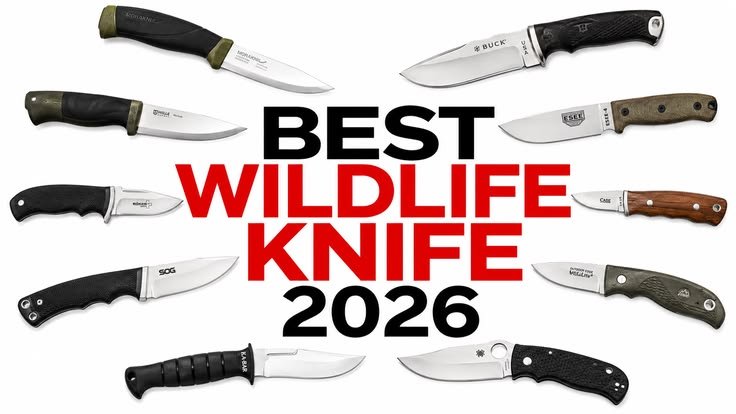
After extensive research across professional field testing, military evaluations, survival school curricula, and thousands of user reviews, we have identified the 10 best wildlife knives from 10 different brands that dominate the 2026 market. Each knife on this list has been evaluated for edge retention, durability, balance, handle comfort, sheath quality, and overall value in real outdoor conditions.
1. Montana Knife Company Blackfoot 2.0 — The Best Fixed Blade Hunting Knife of 2026
Brand: Montana Knife Company (USA)
Style: American Hunting Fixed Blade
Blade Steel: 52100 Ball-Bearing Steel (also available in MagnaCut)
Blade Length: 3.5 inches
Weight: Approximately 5 oz
Price Range: $300
Product Link:Montana Knife Company Blackfoot 2.0
Why It Tops Our List
The Montana Knife Company Blackfoot 2.0 earned the title of Best Fixed Blade in Field and Stream’s 2026 expert testing, and for good reason. This knife was born from founder and Master Bladesmith Josh Smith’s desire to create one knife that could handle everything in his home range along the Blackfoot River in Montana. The result is a blade that genuinely does it all.
The Blackfoot 2.0 features 52100 ball-bearing steel with a parkerized and mirror finish. In rigorous testing, this steel breezed through 20 cuts of one-inch sisal rope while maintaining a razor-sharp edge. The G10 handle is comfortable, well-finished, and perfectly sized for any hunting knife task. Its full-tang construction is extremely strong, making this the kind of knife you can put away bloody and rinse off next hunting season, and it will be just as sharp as the last time you used it.
Performance Highlights
GearJunkie contributor Morgan Nowels carried only the Blackfoot 2.0 through an entire hunting season and used it to completely process two whitetail deer. Initially concerned about the small 3.375-inch blade for big game, those worries disappeared after the first animal. The 52100 steel proved exceptionally resistant to chipping — even after hammering the knife to split two rib cages open, the edge remained in pristine shape with zero nicks.
The Blackfoot 2.0 is small enough to function well as a knife for cleaning upland birds and gutting trout, without being unwieldy or too large, as many big-game blades are. Couple that with its ability to tackle heavy-duty tasks, and the Blackfoot 2.0 aligns perfectly with Josh Smith’s vision. It may not be the best at anything, but the Blackfoot 2.0 can do everything.
All MKC knives come with a Kydex sheath featuring an adjustable belt clasp. The only downside is the price, but honestly, it is worth it. It may be the last knife you will ever buy.
Who Should Buy It
The Blackfoot 2.0 is ideal for hunters who want one knife that handles everything from small game to big game, from field dressing to camp chores. If you hunt in varied terrain and want maximum versatility without carrying multiple blades, this is arguably the safest choice in 2026.
2. Benchmade Saddle Mountain Skinner — The Platonic Ideal of a Hunting Knife
Brand: Benchmade (USA)
Style: American Hunting Fixed Blade
Blade Steel: S90V (tested) or S30V with wood handle option
Blade Length: 4.2 inches
Overall Length: 8.7 inches
Weight: 4.38 oz
Price Range: $250-$300
Product Link:Benchmade Saddle Mountain Skinner
The Gold Standard for Big Game Processing
Benchmade has been crafting knives in Oregon since 1987, and the Saddle Mountain Skinner represents the pinnacle of their hunting knife lineup. This knife was put through one of the most brutal tests imaginable when GearJunkie Editorial Director Sean McCoy used it to process an entire bull elk — from a Colorado mountainside to steaks, burgers, and brats in his freezer.
The Saddle Mountain Skinner features S90V steel with a Richlite and G10 handle, or an S30V version with a stabilized wood handle. The premium S90V version tested uses extremely high vanadium carbide content, which provides better wear resistance and edge stability than almost any other hunting steel on the market.
What Testers Love
After nearly four decades of elk hunting, McCoy called this knife one of his favorites of all time. The factory-keen blade proved incredibly sharp, taking very little pressure to pierce hide and follow muscle groups. A buddy and McCoy worked on cutting down the bull for probably 2 hours in total, from removing quarters all the way to picking off the last bits of neck meat and batoning the blade through the neck to remove the head. By the time they hauled the last of five loads off the mountain, the Saddle Mountain Skinner was still very sharp.
The handle deserves special mention. At 4.5 inches long with a subtle palm swell, the Richlite scale material provides exceptional grip even when wet and bloody. The spine of the handle allows the steel tang to show through, protruding in an undulating nature that enhances grip security during hard cuts. It is a genius design rarely seen on other knives.
Considerations
The S90V steel is harder to resharpen than softer steels, though Benchmade offers free sharpening for life. The included sheath does not come with a belt loop in its stock configuration, but aftermarket clips and leather sheaths are available. For hunters who want a single knife that can handle a whole elk in one go, this is it.
3. Fallkniven A1 — The Scandinavian Survival Benchmark
Brand: Fallkniven (Sweden)
Style: Scandinavian Survival Fixed Blade
Blade Steel: Laminated VG10 (420J outer cladding, VG10 core)
Blade Length: 6.3 inches
Overall Length: 11 inches
Weight: 12 oz (305g)
Price Range: $200-$250
Product Link:Fallkniven A1
The Official Survival Knife of the Swedish Air Force
Fallkniven has been crafting knives in Boden, Sweden since 1987, and the A1 represents the ultimate expression of Scandinavian survival knife design. This knife was developed at the request of the Swedish Defence Materiel Administration for a new survival knife for the Swedish Air Force. Since 1995, the smaller F1 has been the official Pilot Survival Knife of the Swedish Air Force, and the A1 scales that proven design up for more demanding tasks.
The A1 features laminated VG10 steel with 420J outer cladding and a VG10 core, hardened to 59 HRC. The laminated construction adds more than 20% flexibility compared to non-laminated steel — crucial for a survival knife that must bend and return to true without breaking. The 6mm thick blade with a convex grind creates a wedge-like geometry that pounds through wood with ease.
Real-World Performance
In independent testing, the A1 proved itself as a true all-rounder. It batons through even difficult and hard logs quite well, yet even finer work is surprisingly easy for a knife of its size. At 305 grams, it is about 150 grams lighter than an ESEE-5, yet better both at chopping as well as carving. The Kraton handle is extremely comfortable with no slipping or hot spots after extended use.
The A1 is deliberately understated but highly capable. It will not look as flashy or aggressive as some other survival knives, but if you understand the nuances of good knife design, this should be very high on your list. Fallkniven was officially declared a Purveyor to the Swedish Royal Court in 1999 — an honor only awarded to manufacturers of products of the finest quality.
The Verdict
The A1 bridges the gap between chopper and precision tool. It is beautiful enough to display, functional enough for any survival scenario, and backed by a company that has supplied military forces worldwide. For outdoorsmen wanting Scandinavian engineering with proven military pedigree, the A1 is unmatched.
4. ESEE 6 — The Do-It-All Survival Beast
Brand: ESEE (USA)
Style: American Survival Fixed Blade
Blade Steel: 1095 High Carbon Steel (55-57 Rc)
Blade Length: 6.5 inches
Overall Length: 11.75 inches
Weight: 12 oz
Price Range: $130-$160
Product Link:ESEE Knives
The Knife You Want When Civilization Ends
ESEE knives are designed by Randall’s Adventure and Training, a company with real-world survival training experience in the jungles of Peru. The ESEE 6 represents their vision of a standalone survival knife — one capable of performing most tasks very well when you only have one tool to rely on.
The ESEE 6 features a 6.5-inch blade of 1095 high carbon steel with a textured powder coating to prevent corrosion. The full flat grind and drop point blade shape provide versatility across chopping, batoning, carving, and precision cutting tasks. The linen micarta handle scales are grippy when wet or dry, and the full tang construction ensures the knife will never fail at the handle.
What Testers Say
One reviewer put it perfectly: “If I was to be placed in a survival situation and only allowed one tool, that tool would be a knife, and that knife would be the ESEE 6.” The knife can do heavy duty tasks with ease. Light chopping and batoning are not a problem, but it can also do finer bushcraft work, especially using the finger choil.
The ESEE 6 is a large, solid, heavy beast of a knife, yet it does not feel heavy due to great balance. It arrives hair-shaving sharp out of the box, and ESEE is known for their excellent heat treat. The polymer sheath is nothing fancy but very solid, and the knife fits with a satisfying click.
The ESEE Warranty
ESEE offers what many consider the best warranty in the knife industry. If you break an ESEE knife, no questions asked, they will replace it. This no-nonsense warranty reflects their confidence in the knife’s ability to take abuse that would destroy lesser blades.
5. KA-BAR Becker BK2 Campanion — The Indestructible Camp Knife
Brand: KA-BAR (USA)
Style: American Survival/Camp Fixed Blade
Blade Steel: 1095 High Carbon Steel
Blade Length: 5.25 inches
Overall Length: 10.625 inches
Weight: 16 oz (1 pound)
Price Range: $65-$85
Product Link:KA-BAR Becker BK2
The Tank of the Knife World
KA-BAR has been making knives for the US military since World War II, and the Becker BK2 Campanion carries that legacy of toughness into the civilian survival market. Designed by Ethan Becker, this knife is a statement piece. At 6.35mm thick and weighing a full pound, it is by far the chunkiest knife in its class.
The BK2 features a classic drop point blade with a high flat grind and sturdy tip. The .25-inch thick slab of 1095 high carbon steel is powdercoated for corrosion resistance. The spacious Zytel handle over the full steel tang provides a comfortable grip with an oversize lanyard hole and generous exposed pommel for hammering.
Performance Reality
The BK2 excels at camp chores. It splits logs with up to a 4-inch diameter easily through batoning. It can carve, whittle shavings for tinder, and even handle some finer tasks despite its heft. The 1095 steel is inexpensive and hearty, easy to sharpen and holding a nice edge when working with wood.
However, the BK2 does not particularly excel at anything. It has the heft of a chopper but not enough blade length to really be useful for heavy work. It has a shorter blade like a utility knife but too much heft for delicate work. As one reviewer noted, it is the quintessential jack-of-all-trades, master-of-none — with emphasis on master of none.
That said, at around $65, this is a lot of high-quality tool for the money. If you are looking for an indestructible camp knife or a compact but very stout survival knife, the BK2 delivers exceptional value.
6. Gerber StrongArm — The Budget Military Survival Knife
Brand: Gerber (USA)
Style: Military/Tactical Survival Fixed Blade
Blade Steel: 420HC Stainless Steel
Blade Length: 4.8 inches
Overall Length: 9.8 inches
Weight: 7.2 oz
Price Range: $75-$90
Product Link:Gerber StrongArm
Made in Portland, Oregon
Gerber’s reputation took hits from poorly made imports, but the StrongArm is proudly stamped Made in Portland, Oregon. It is the successor to the LMF II Infantry, resolving that knife’s lack of full tang construction while trimming weight and improving carry options.
The StrongArm features a 4.8-inch blade of 420HC steel with a Cerakote black matte finish. The glass-filled nylon handle is covered with a rubber overmold featuring a raised diamond textured pattern that glues the knife to your hand even when wet. The full tang construction and thick blade stock provide enough weight for limited chopping without a baton.
What Makes It Special
The StrongArm’s sheath system is where Gerber truly innovated. It includes a MOLLE mount, drop leg system, and belt loop option for horizontal carry. This means the knife can be mounted on backpacks, body armor, or belts in multiple configurations. The sheath employs both passive and active retention, with an indent in the center of the handle that locks the knife securely in place.
In testing, the StrongArm proved capable of hacking into branches, batoning through logs for kindling, and handling general camp tasks. The 420HC steel does not hold an edge as long as premium steels, but it is easy to sharpen and resists corrosion well. For the price, this is a good versatile knife that should serve for years of use and abuse.
7. Morakniv Companion Spark — The Bushcraft Fire Starter
Brand: Morakniv (Sweden)
Style: Scandinavian Bushcraft Fixed Blade
Blade Steel: Sandvik 12C27 Stainless Steel
Blade Length: 4.09 inches
Overall Length: 9.4 inches
Weight: 4.5 oz (128g)
Price Range: $30-$45
Product Link:Morakniv Companion Spark
The Bushcraft Knife That Starts Fires
Morakniv has been making knives in Mora, Sweden since 1891. The Companion Spark is not necessarily a hunting knife, but it can do hunting knife things while offering something no other knife on this list provides: a built-in fire starter.
The Companion Spark features a 4.09-inch blade of recycled Swedish stainless steel with a Scandi grind. The polymer handle contains a concealed ferro rod that twists into place. Using the baton technique, the Companion Spark chops wood effectively. Its Scandi grind gets a good bite in softer woods like pine, and it is perfect for making feather sticks.
Field Testing Results
In Field and Stream’s 2026 testing, the Companion Spark cut through 18 inches of sisal rope. For cutting up game, it does a so-so job. Its straight blade profile is not great at skinning. But unlike other bushcraft knives, it is light enough to pack alongside a dedicated hunting knife, giving you an extra layer of fire redundancy and a backup blade for use on game.
The Scandi grind is also easy to touch up. Just lay each beveled side on a sharpening stone and pull it across a few times. At around $30, the Companion Spark represents one of the best values in outdoor knives. It is the knife you throw in your pack and forget about until you need it — and then it delivers.
8. TOPS Knives Wilderness Guide 2023 — The Ultimate Wilderness Tool
Brand: TOPS Knives (USA)
Style: American Survival Fixed Blade
Blade Steel: Tungsten Cerakoted 1095 High Carbon Steel
Blade Length: 4.38 inches
Overall Length: Approximately 9.5 inches
Weight: 9.6 oz
Price Range: $260
Product Link:TOPS Knives
Designed by Survival Experts
TOPS Knives operates out of Idaho Falls, Idaho, and their Wilderness Guide 2023 replaced the legendary Tom Brown Tracker in GearJunkie’s 2026 survival knife rankings. This knife was designed with input from actual survival instructors and represents a refinement of everything TOPS learned from decades of wilderness knife production.
The Wilderness Guide features a 4.38-inch blade of tungsten Cerakoted 1095 high carbon steel with a drop point shape. At 9.6 ounces, it strikes a balance between the heavy choppers and the lightweight bushcraft blades. The Cerakote finish provides excellent corrosion resistance while the 1095 steel core delivers the toughness and edge retention that survival situations demand.
Why It Earned Its Place
The Wilderness Guide 2023 earned its spot by being a true multi-role knife. It can baton firewood, process game, carve tent stakes, and even handle defensive situations if necessary. The handle design accommodates multiple grip styles, from a standard hammer grip for chopping to a choked-up precision grip for detailed work.
TOPS knives are known for their overbuilt construction, and the Wilderness Guide is no exception. The full tang extends through the entire handle with a protruding pommel for hammering and crushing tasks. The included Kydex sheath offers multiple carry options and secure retention in any position.
9. Buck 119 Special — The American Classic
Brand: Buck Knives (USA)
Style: American Hunting Fixed Blade
Blade Steel: 420HC Stainless Steel (S35VN available in custom shop)
Blade Length: 6 inches
Overall Length: 10.5 inches
Weight: Approximately 7.5 oz
Price Range: $100-$125
Product Link:Buck Knives
Over 75 Years of American Craftsmanship
Buck Knives has been family-owned and operated in Post Falls, Idaho since 1902. The 119 Special is perhaps their most iconic design, having been carried by hunters, soldiers, and outdoorsmen for generations. Its clip point blade and classic styling have made it a symbol of American knife-making heritage.
The 119 Special features a 6-inch clip point blade of 420HC stainless steel with a polished finish. The phenolic handle with aluminum guard provides a classic look and comfortable grip. The full tang construction ensures durability through decades of use.
Performance in the Field
The 119 Special is a viable tool for general woodcraft and hunting tasks. The clip point blade offers excellent penetration for field dressing and the long belly provides plenty of cutting edge for skinning and butchering. The aluminum guard prevents the hand from sliding forward during heavy use.
The 420HC steel holds an edge reasonably well and is very easy to sharpen in the field. While it does not match the edge retention of premium steels like S90V or MagnaCut, it is more than adequate for most hunting and camping tasks. The classic styling means this knife looks as good on a display shelf as it does on a hunting belt.
For hunters who appreciate American tradition and want a knife that has proven itself across three generations of outdoorsmen, the Buck 119 Special remains a solid choice in 2026.
10. Opinel No. 8 Carbon — The Humble Legend
Brand: Opinel (France)
Style: Traditional Folding/Fixed Blade
Blade Steel: XC90 Carbon Steel
Blade Length: 3.28 inches
Overall Length: 7.6 inches
Weight: Approximately 1.6 oz
Price Range: $15-$25
Product Link:Opinel Knives
The Knife That Costs Less Than Lunch
Opinel has been making knives in the French Alps since 1890, and the No. 8 Carbon is perhaps the most beloved budget knife in the outdoor world. At around $20, it costs less than a fast food meal, yet it has been used to gut and skin countless deer, process small game, and handle general camp tasks.
The No. 8 features a 3.28-inch clip point blade of XC90 carbon steel. The beechwood handle expands and contracts with moisture, and the Virobloc safety ring locks the blade open or closed. It is an ideal size and shape for small game and birds.
Why It Deserves a Place on This List
Field and Stream’s expert testing named the Opinel No. 8 Carbon the Best Budget hunting knife of 2026. The carbon steel blade is easy to get shaving-sharp in seconds with almost any sharpening method. The downside is that you will need to sharpen it periodically while working through a deer, but the upside is that almost anyone can maintain this edge.
The wooden handle requires basic care — washing debris from the handle and drying the blade when it gets wet. Under normal use, you should not break an Opinel No. 8, though they can chip and wear down with extensive sharpening. By the time they do, you will probably have another $20 bill to spend on a new one.
For beginning hunters, backpackers who want a backup blade, or anyone who believes that price should never be a barrier to quality tools, the Opinel No. 8 Carbon is unbeatable.
How to Choose Your Perfect Wildlife Knife in 2026
Survival vs. Hunting vs. Bushcraft: The Fundamental Choice
Your first decision should be philosophical. Do you want a survival knife, a hunting knife, or a bushcraft knife?
Survival knives like the ESEE 6, KA-BAR BK2, and TOPS Wilderness Guide prioritize thick blades, full tang construction, and the ability to handle abuse. They excel at chopping, batoning, prying, and general camp destruction. They are heavier and less precise than dedicated hunting knives.
Hunting knives like the Montana Knife Company Blackfoot 2.0, Benchmade Saddle Mountain Skinner, and Buck 119 Special prioritize edge retention, precise cutting geometry, and handles that remain secure when covered in blood. They excel at field dressing, skinning, and butchering but are not designed for chopping firewood.
Bushcraft knives like the Fallkniven A1 and Morakniv Companion Spark prioritize wood processing, feather sticking, and fire starting. They feature Scandi or convex grinds optimized for slicing through wood fibers rather than muscle and hide.
Blade Steel: What Matters Most
The most important quality of a wildlife knife is edge retention. Being able to cut through hide, baton through wood, and process game without constant resharpening goes a long way. Professional testing uses sisal rope cutting as a benchmark — knives that maintain their edge through 20 cuts are deemed more than capable.
1095 high carbon steel, found in the ESEE 6, KA-BAR BK2, and TOPS Wilderness Guide, is tough, easy to sharpen, and holds a good edge on wood. It requires oiling to prevent rust.
S90V and S30V stainless steels, found in the Benchmade Saddle Mountain Skinner, offer exceptional edge retention but are harder to resharpen in the field.
VG10 laminated steel, found in the Fallkniven A1, provides excellent edge retention with stainless properties and added flexibility from the laminated construction.
52100 ball-bearing steel, found in the Montana Knife Company Blackfoot 2.0, offers exceptional toughness and chip resistance.
420HC steel, found in the Gerber StrongArm and Buck 119, is inexpensive, corrosion resistant, and easy to sharpen, though it requires more frequent maintenance.
Handle and Ergonomics
A wildlife knife handle must remain secure when wet, bloody, or gloved. Materials like G10, micarta, Kraton, and rubber overmolds provide the best grip security. Handle shape should prevent hand fatigue during extended use and prevent the hand from sliding forward onto the blade.
Weight and Balance
Survival knives typically weigh 10-16 ounces to provide chopping power. Hunting knives typically weigh 4-7 ounces for maneuverability. Bushcraft knives fall somewhere in between. The best weight is the one you will actually carry.
Budget Considerations
- Under $30: Opinel No. 8 Carbon, Morakniv Companion Spark (exceptional value)
- $30-$100: Gerber StrongArm, KA-BAR BK2 (solid performance)
- $100-$200: Buck 119 Special, ESEE 6 (mid-tier performance)
- $200-$300: Fallkniven A1, Benchmade Saddle Mountain Skinner (premium options)
- $300+: Montana Knife Company Blackfoot 2.0, TOPS Wilderness Guide (professional-grade)
Maintenance Tips for Longevity
Regardless of which knife you choose, proper care extends its life dramatically:
- Clean after every use, especially after contact with blood or acidic foods
- Dry thoroughly before storing
- Oil carbon steel blades regularly to prevent rust
- Sharpen before storage, not just when dull
- Store in a dry place, never in leather sheaths long-term
- Touch up edges with a ceramic rod between full sharpenings
- Send premium knives to manufacturer sharpening services when available
Final Verdict: The Best Wildlife Knives of 2026
After evaluating performance, value, durability, and user satisfaction across professional testing, military evaluations, and real field use, our top recommendations are:
- Best Overall Hunting Knife: Montana Knife Company Blackfoot 2.0 — unmatched versatility from birds to bull elk
- Best Big Game Processing: Benchmade Saddle Mountain Skinner — the platonic ideal of a hunting knife
- Best Survival Knife: Fallkniven A1 — Scandinavian engineering with military pedigree
- Best Budget: Opinel No. 8 Carbon — proven performance under $25
- Best Bushcraft: Morakniv Companion Spark — wood processing plus fire starting
- Best Heavy Duty: ESEE 6 — the knife you want when civilization ends
- Best Value Survival: KA-BAR Becker BK2 — a pound of indestructible steel for $65
- Best Military Style: Gerber StrongArm — made in USA with versatile carry system
- Best Classic: Buck 119 Special — 75 years of American hunting heritage
- Best Wilderness Multi-Tool: TOPS Wilderness Guide 2023 — designed by survival experts
The perfect wildlife knife is ultimately the one that matches your specific outdoor activities, budget, and personal preferences. Whether you choose Scandinavian precision, American toughness, or French simplicity, investing in a quality blade will serve you faithfully for years of adventures to come.
Ready to upgrade your outdoor gear? Click the product links above to explore each knife on the brand’s official website, where you will find detailed specifications, warranty information, and authorized purchasing options.
This guide was compiled from professional field testing data, military evaluations, survival school curricula, and extensive user feedback from 2026. Prices and availability are subject to change.
Related posts:
 The 10 Best Chef Knives of 2026: A Complete Buyer’s Guide for Every Kitchen
 Carbon Diet Coach: The Science-Based Macro Tracking App Created by Dr. Layne Norton That’s Revolutionizing Nutrition Coaching
 Ridge Wallet Review (2026): Is the Minimalist Metal Wallet Actually Worth It?
 Our Place Titanium Pro Cookware Review: NoCo Tech Tested
 Living at Your Edge: How to Stop Playing Small and Embrace Your Full Masculine Capacity (The Way of the Superior Man)