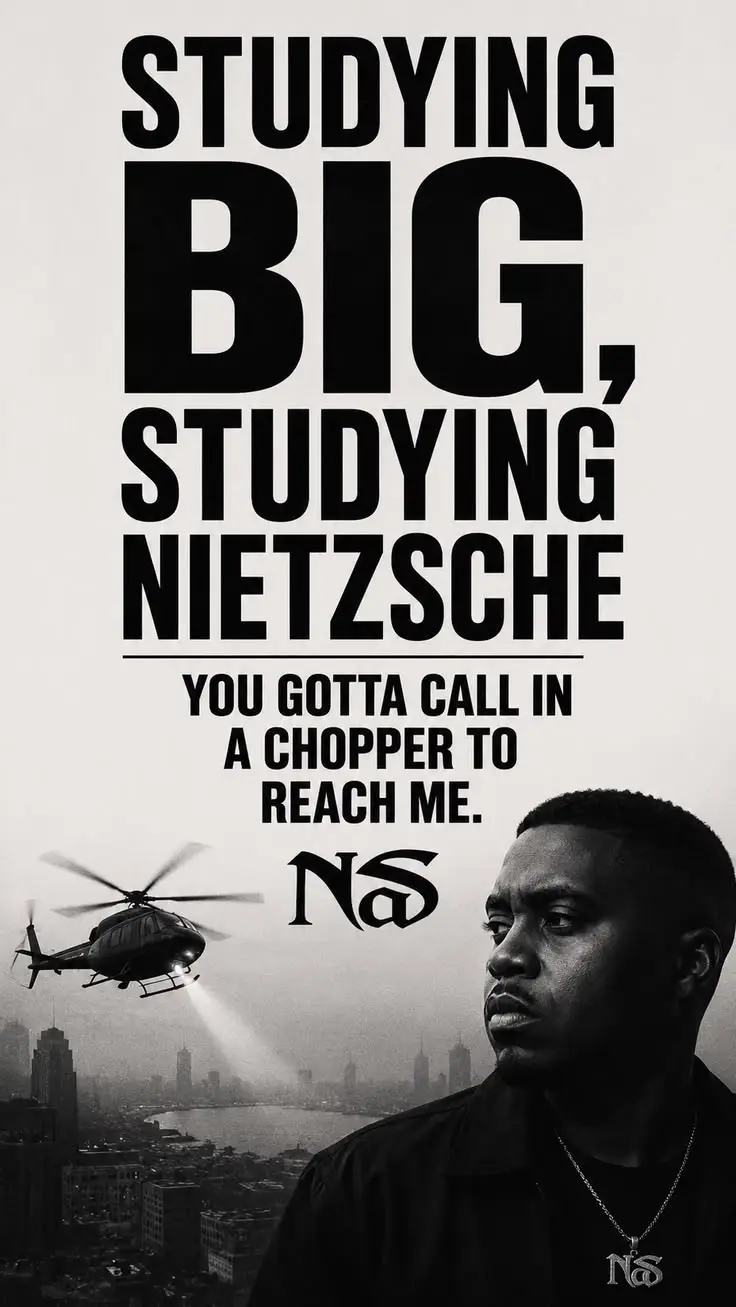
There’s a moment on Nas’s second album where the invincible young MC who declared he’d never sleep because sleep is the cousin of death admits, almost offhandedly, that he lies awake calculating his own mortality. It’s not a boast. It’s a confession dressed as a boast, which is a trick Nas has been pulling for thirty years — smuggling tenderness into rooms that only let tough men in.
We tend to remember Nasir Jones for the résumé: the kid from Queensbridge who wrote Illmatic at nineteen and got called the best lyricist alive before he could legally drink, the man who traded verses with Jay-Z in a feud that reshaped New York rap, the mogul who now sits on boards and writes checks to tech startups. But the résumé misses the more interesting story, which is what he did with everything underneath it — the father who left, the mother who raised him and then died in his arms, the friends buried before thirty, the marriage that ended in public. Nas didn’t hide any of it. He wrote it down, set it to a beat, and let millions of men who’d never admit to crying alone hear a version of themselves in a voice that also, in the same breath, sounded completely in control.
That combination — control and exposure, hardness and ache, street theology and literary ambition — is the actual lesson. Not “Nas is deep,” which is a compliment with no edges. The lesson is narrower and more useful: a man doesn’t have to choose between being formidable and being known. He can be both, and the wideness of that range is itself a kind of strength.
Most conversations about male vulnerability treat it like a single switch — a man is either guarded or he’s open, either stoic or he’s soft. Nas’s life is a thirty-year argument against that binary. He’s been, often within the same album, a battle rapper capable of ending careers with a single verse and a son writing about his mother’s final hours in language that has nothing to prove. He’s negotiated business deals worth millions and also sat with a camera crew describing, in exact and unguarded detail, watching a parent die. There was no contradiction in any of it, because the underlying premise — that toughness and tenderness are mutually exclusive — was never true to begin with. It’s a premise most men absorb early and rarely examine, and Nas’s career is one of the clearest public counterexamples available.
The Boy Who Watched Everything
Nas was born Nasir bin Olu Dara Jones in Queensbridge, the largest public housing project in America, to a mother, Fannie Ann Jones, who worked to keep the household stable, and a father, Olu Dara, a touring jazz and blues cornet player whose absences shaped his son as much as his music did. Dara chose the name Nasir specifically because of its Arabic meaning — “helper” or “protector.” The name was a kind of prophecy nobody could have planned for: a boy who grew up to narrate an entire generation’s unspoken fear back to itself.
By his own account, adolescence in Queensbridge in the 1980s meant watching addiction and violence eat through people he loved while he was still forming his sense of who he’d become. The turning point came in 1992, when his brother and his closest friend were both shot on the same night. His brother survived. His friend didn’t. Nas has called it a wake-up call — the kind that either hardens a man into silence or cracks him open into language. For Nas, it did both at once. He didn’t stop being hard. He just stopped pretending hardness was the whole story.
This is worth sitting with, because it’s the exact pattern so many men repeat without realizing it: convinced that softening the exterior means losing the strength underneath, when in reality the men who eventually build the deepest self-respect are usually the ones who’ve done the harder work of breaking free from a past that tried to define them by its worst chapter.
Illmatic: Toughness as a Disguise for Honesty
Illmatic, released in 1994 when Nas was twenty, is routinely called the greatest hip-hop album ever made, and the reasons usually cited are technical — the internal rhyme schemes, the jazz-sample production from DJ Premier and Pete Rock and Q-Tip, the density of the imagery. All of that is true. But what actually holds the record together, underneath the bravado, is a nineteen-year-old openly terrified of dying and trying to say so without ever using the word “afraid.”
On “N.Y. State of Mind,” the narration isn’t a victory lap — it’s closer to what a psychologist would recognize as hypervigilance, a mind that can’t stop scanning for threat because threat has never stopped being real. Critics have long noted the album’s quiet insistence on gratitude even inside despair: Nas is still grateful just for being alive and turning twenty, which wasn’t guaranteed in his neighborhood, and that gratitude sits right next to some of the bleakest imagery on the record without ever resolving the tension. One reviewer summarized the album’s emotional register bluntly: the lyrics are unguarded and vulnerable, laid over music that sounds almost peaceful by contrast — the mismatch is the point.
“One Love,” structured as a series of letters to incarcerated friends, does something rap had rarely attempted with this much craft: it turns grief and worry into direct address, man to man, without performance. Scholars have pointed out that Nas essentially invented a kind of epistolary rap, borrowing a literary device — the letter as narrative form — from novelists like Alice Walker, whose work he’s referenced throughout his career. One academic who has studied the record closely put it plainly: Nas’s use of literary technique opened up avenues for discussing trauma and vulnerability inside a hyper-masculine genre that had almost no vocabulary for either.
This is the first real evidence of the broad-spectrum personality this article is named for. A nineteen-year-old from Queensbridge, surrounded by a culture that rewarded stoicism and punished anything read as weakness, chose to write like a novelist about subjects most men in his position were taught to bury. He didn’t ask permission to be complicated. He simply demonstrated it was possible — which is the same quiet demonstration at the heart of letting people actually know you: not a grand confession, just a refusal to keep performing a smaller version of yourself.
“Dance”: Grief With No Exit
In April 2002, Nas’s mother, Fannie Ann Jones, died of cancer after a three-year battle. He left a tour to be at her side and, by his own description, was in the room when she passed. Talking about it years later, he offered one of the most unguarded accounts of loss you’ll hear from any public figure, describing how he saw the tear come down her eye and knew she was waiting for him to arrive before she let go. That’s not a lyric. That’s a man remembering the worst night of his life out loud, on camera, for an audience.
The song “Dance,” from the album God’s Son, is his response to that loss — a slow, aching tribute built around an imagined final dance with his mother, produced with his father contributing a mournful instrumental solo on cornet. Writers who’ve covered the track describe it as one of hip-hop’s most poignant explorations of maternal loss, distinguished by its raw vulnerability — a rapper known for lyrical dominance choosing instead to sit inside grief without resolving it into a lesson or a flex.
What makes this more than a sad song is what Nas did with the grief afterward instead of just performing it once and moving on. He described a kind of ongoing relationship with his mother’s memory, saying that when he’d look in the mirror he’d see her there — still alive with him, his brother, and her grandchildren — and that recognition, he said, gave him a great feeling, because that’s what life demands: you keep living. That’s not denial. That’s a man finding a way to carry loss without either suppressing it or being flattened by it — which is close to the actual architecture of transforming suffering into something other than an identity, the difference between a wound that defines you and one that simply becomes part of the terrain you walk on.
Men rarely get permission to grieve a parent publicly and specifically — to name the exact moment, the exact sound, the exact detail that broke them. Nas did it on a platinum album, and it didn’t cost him an ounce of respect in a genre notoriously allergic to softness. If anything, it’s one of the most enduringly beloved records in his catalog, which tells you something about what audiences actually want from men, as opposed to what men assume audiences want.
The Marriage, the Collapse, and the Refusal to Pretend
Nas married R&B singer Kelis in 2005. Four years later, she filed for divorce, and the split played out with unusual public rawness — Nas announced the birth of their son against her wishes, and the fallout became tabloid material for months. Rather than retreat into silence or spin the narrative into something flattering, Nas processed the divorce directly in his music: the split was visually reflected in his song “Bye Baby,” with a music video showing him holding his ex-wife’s wedding dress, an image so unresolved and unglamorous it became the cover art for his next album, Life Is Good.
There’s nothing strategic-looking about that choice. A wedding dress on an album cover isn’t a flex — it’s an artifact of failure, kept in frame instead of edited out. It’s the opposite of the instinct most men have after a public collapse, which is to erase the evidence and rebuild the image as fast as possible. Nas did the harder, less image-conscious thing: he let the failure stay visible while he kept working. That’s a useful model for anyone navigating the aftermath of a relationship that didn’t survive — not performing composure you don’t feel, but not disappearing either.
The Broad-Spectrum Personality: Businessman, Collector, Reader, Father
Here’s where the “broad spectrum” part of this story gets concrete, because it’s easy to admire an artist’s emotional honesty in the abstract and harder to see what a genuinely wide personality actually looks like in practice.
Nas is a venture capitalist. Through Queensbridge Venture Partners, he made early investments in companies including Dropbox, Robinhood, Lyft, and Coinbase — years before those names were household brands — building a reputation in Silicon Valley circles as a genuinely sharp allocator of capital, not a celebrity with a rubber-stamped fund. He co-founded Mass Appeal, a media and record label that has released work by artists across generations, and he’s produced television and film. None of this is a side hustle bolted onto a rap career for headlines; friends and collaborators describe someone who reads seriously, thinks in decades, and treats business the way he treats verses — as a craft worth taking slowly.
He’s also an active mentor inside his own industry, using Mass Appeal to platform younger artists rather than simply competing with them for relevance, a choice that runs against the grain of an industry that often treats aging icons as threats to be outshone rather than resources to be drawn on. That instinct — using accumulated standing to open doors for people coming up behind him instead of guarding territory — is closer to what real mentorship looks like when it actually works than the transactional version most men default to.
Asked directly what drives his range of interests, Nas gave an answer that reveals more about his internal architecture than most interviews manage in an hour. He said he respects intellectuals from a generation before his own who actually had to read and learn, without the shortcuts modern technology provides, and when asked what success looks like to him now, after decades of wealth and acclaim, his answer wasn’t cars or chart positions. It was, simply, clean, smart, healthy children. A man who built an empire on lyrical dominance measuring his life’s success by his kids’ wellbeing is not a contradiction. It’s the whole point of this article.
This is what a genuinely integrated man looks like — not a man who suppressed one half of himself to succeed at the other, but one who let hardness and curiosity, ambition and tenderness, grief and discipline all occupy the same body without demanding that any of them cancel the others out. It’s the same principle behind personal responsibility as the foundation of real freedom: the wider a man’s internal range, the less any single setback or single emotion has to define the whole of him.
What This Actually Teaches Men About Vulnerability
It would be easy to read all of this and conclude the lesson is “cry more” or “write poetry about your feelings.” That’s not quite it, and it would flatten what’s actually instructive here.
The real pattern in Nas’s life is that vulnerability and competence were never in competition. He didn’t become a worse businessman by grieving his mother in public. He didn’t become a less formidable lyricist by admitting fear on his debut album. He didn’t lose respect by keeping a failed marriage’s most painful image on an album cover instead of hiding it. Each time, the honesty ran alongside the strength — not instead of it, not as an apology for it.
This matters because so much of the cultural conversation about male vulnerability treats it as something men have to be talked into, an obligation imposed from outside, usually framed as an antidote to “toxic” hardness. Nas’s example suggests something more useful: vulnerability isn’t the opposite of strength. It’s what strength looks like when it’s not spending all its energy on concealment. A man who has to constantly manage what he’s hiding has less capacity left for the things that actually require his full attention — his work, his family, his growth. This is close to what shows up in the research on the shame ceiling that keeps most men from ever being fully known — the exhausting, invisible labor of maintaining a smaller self than the one you actually are.
There’s also something worth naming about timing and permission. Nas didn’t wait until he was safe, established, and beyond criticism to reveal any of this. The fear on Illmatic came out when he was nineteen and had nothing yet to protect. The grief on “Dance” came out at the height of a very public rivalry with Jay-Z, a moment when any perceived softness could have been weaponized against him by a competitor who wasn’t shy about attacking personal vulnerabilities. He wrote it anyway. That’s a different posture than waiting for permission or safety before letting anyone see the fuller picture — closer to the discipline described in male emotional intelligence as strength and self-control, where regulation isn’t about suppression, it’s about choosing when and how to let something real through with intention rather than being ambushed by it.
“One Mic”: Restraint as a Form of Depth
If “Dance” shows the grief side of Nas’s range, “One Mic” shows something rarer: a man building a song entirely out of controlled intensity, the volume rising and falling like breath held too long and finally released. Musically, the track is famous for its dynamic structure — near-whispered verses that erupt into shouted hooks and then pull back into quiet again, cycling through that pattern until the song resolves. Critics and fans alike have long read it as one of the most emotionally direct performances of Nas’s catalog, precisely because the production refuses to let the intensity sit at one register. It has to keep escalating and retreating, the way real emotional pressure actually works in a body that’s spent years learning to manage rather than express what it’s carrying.
What’s notable is what the song asks for. Not wealth, not status, not vindication against rivals — just the mic itself, the platform to be heard clearly, stripped of every other demand. It’s a strange kind of vulnerability: an artist at the height of his commercial relevance writing a song whose entire emotional engine is the fear of not being truly heard, dressed up as a demand rather than a confession. That’s a subtler move than crying on record. It’s a man translating an emotional need into a request he can actually make out loud, which is closer to what real emotional articulacy looks like than raw catharsis is — the ability to name what you need, specifically, instead of just performing the feeling and hoping someone notices. It’s the difference between venting and asking, a distinction that shows up constantly in how men learn to ask for help without it curdling into manipulation or resentment.
From “Escobar” to Elder Statesman: A Public Image That Kept Widening
Part of what makes Nas’s arc instructive is how visibly his public persona shifted without ever fully discarding earlier versions of himself. In the mid-to-late ’90s, during his “Nas Escobar” period, he leaned into a harder, more mafioso-inflected persona on records like It Was Written — a deliberate widening of his commercial appeal that some longtime fans read as a retreat from the literary vulnerability of Illmatic. It wasn’t a retreat so much as an addition. The introspective narrator never disappeared; he just got joined by other registers — the kingpin narrator, the battle rapper trading some of the most quoted disses in hip-hop history during the feud with Jay-Z, the political commentator on records addressing police violence and cultural decline, and eventually the reflective elder appearing on records with his own son and mentoring a new generation of artists through Mass Appeal.
Most men are taught that identity has to be singular and defensible — pick a lane, stay consistent, don’t give critics ammunition by seeming to contradict yourself. Nas’s career argues the opposite: that a man’s public self can hold multiple, even contradictory registers across decades without any of them being a betrayal of the others, as long as there’s an honest throughline underneath. The throughline for Nas was never a fixed persona. It was a commitment to precision — saying exactly what he meant, in whatever voice the moment required. That’s a far more durable foundation for an identity than consistency for its own sake, and it echoes what shows up in research on men who eventually learn to stop seeking external validation and instead build worth from the inside out: the goal was never to look consistent. It was to stay honest, even when honesty meant sounding like a different man at forty than he had at twenty.
The Father Question, Answered Differently Each Decade
Olu Dara’s absence during much of Nas’s childhood could have become the defining wound of his life, the kind of story a man tells himself forever to explain his limitations. Instead, the relationship evolved. Dara appears on Nas’s records — most memorably contributing the cornet solo on “Dance,” playing at his son’s mother’s memory in the same recording that mourns her. That’s a complicated, adult kind of reconciliation: not forgetting what was missing, but making room for what showed up later.
Men carry father wounds differently than most conversations about masculinity acknowledge. Some spend decades in reaction to an absent or difficult father, either overcorrecting into rigid self-reliance or drifting into the same patterns they resented. Nas’s arc — estrangement, then collaboration, then genuine presence in each other’s work — models something closer to coming to actual peace with a father rather than either idealizing him or writing him off. It’s neither a Hallmark reconciliation nor a permanent grievance. It’s just two men, one of whom became a father figure to himself out of necessity, finding their way back to each other on terms that made sense once they were both older.
Legacy as an Ongoing Project, Not a Trophy
Nas is over fifty now, still releasing acclaimed records — the King’s Disease trilogy with producer Hit-Boy won him his first Grammy in 2021, nearly three decades after Illmatic first defined what the genre could sound like. That timeline matters. A man who peaked commercially and critically at nineteen could easily have spent the following thirty years chasing that specific version of himself. Instead, the work kept changing shape — grief records, business ventures, collaborative albums, mentorship of younger artists — because the man underneath the catalog kept growing instead of freezing at his most famous moment.
This is the version of legacy worth building toward: not a single achievement enshrined and defended forever, but an evolving project that outlives any one era of a man’s life. Nas’s discography reads less like a highlight reel and more like a diary that happens to have sold millions of copies — each album a snapshot of wherever he actually was, not a performance of where he thought he should be.
The Wider Point
Strip away the platinum plaques and industry politics, and what’s left is a genuinely useful template. A boy from one of the hardest environments in the country grew into a man capable of holding grief and ambition, fear and control, literary ambition and street credibility, all without needing any one of them to cancel out the others. He never treated vulnerability as a phase to grow out of or a weakness to manage — he treated it as material, as real as anything else he’d lived through, worth putting into the world with the same care he gave everything else.
That’s the broader lesson for any man trying to figure out how much of himself he’s allowed to show. The range itself is the strength. Not choosing between the hardness that got you through and the honesty that lets you actually be known — building a life wide enough to hold both.
For more on building the kind of internal range this piece describes, see our guides on self-acceptance and owning your worth without seeking validation, working with anger instead of against it, and the emotional education most men never received growing up.
Related posts:
 Coming to Peace With Your Father
 The Engaged Father: What the Data Actually Shows About Your Impact on Your Kids
 The Way of the Vir: 7 Roman Virtues for the Modern Man
 The American Midlife Crisis Is Getting Worse — Especially for Men
 What Dave Chappelle Told Michelle Obama About Joy, Simplicity and Legacy