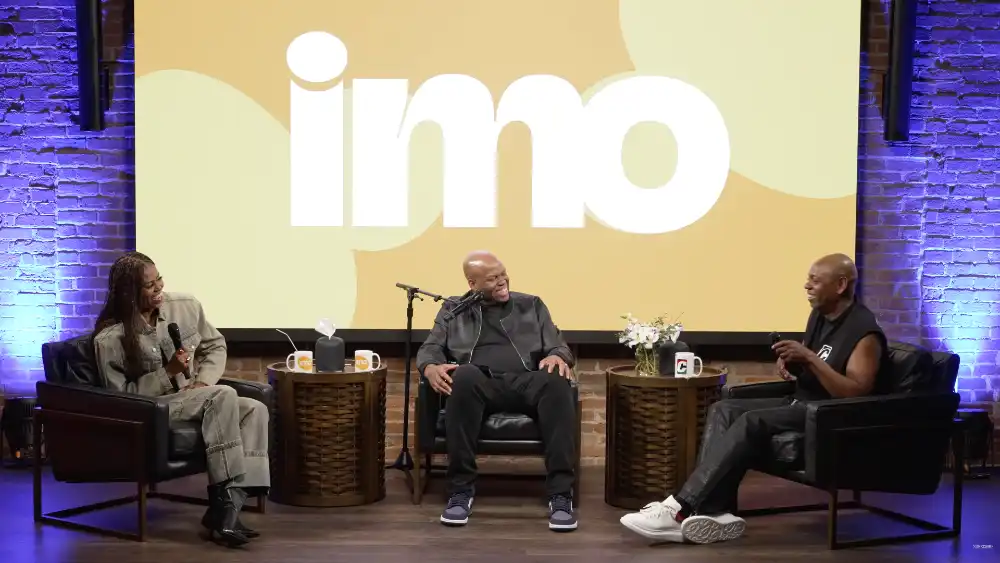
There is a version of success that looks brilliant from the outside and feels hollow from within. Dave Chappelle has lived that version. He has also chosen something different — and what he told Michelle Obama and her brother Craig Robinson on the podcast IMO offers a rare and unusually honest account of what that choice actually looks like.
The conversation took place in Yellow Springs, Ohio, Chappelle’s longtime home base. Michelle Obama, a first-time visitor, described the feeling she got driving through the town as familiar — the same quiet decency she’d felt campaigning through small-town America. Chappelle seemed pleased, but not surprised. To him, Yellow Springs was never just a backdrop. It’s the architecture of his life.
What followed was one of the most candid conversations Chappelle has given in years — about his father, his mother, his marriage, the show he walked away from, and what he actually wants his legacy to mean.
The Father Who Asked the Right Question
Chappelle grew up splitting his time between Washington D.C. and Yellow Springs, where his father lived. His parents separated when he was two. Christmas breaks and summers in Ohio became formative in ways that didn’t fully register until much later.
He described a habit his father had — not with everyone, but with certain people. His father would greet someone, hear the obligatory “I’m good, man,” and then pause, look them in the eye, and ask again: “How are you doing?”
That second ask changed everything. People answered honestly. The real thing came out.
“It taught me,” Chappelle said, “that everyone’s like a book I haven’t read.” His father modeled something that most people avoid: genuine curiosity about the inner life of others. Not small talk as a social formality, but contact. It was, Chappelle suggested, one of the most valuable things he inherited — and one he carries with him everywhere, including on stage.
In a culture that has largely replaced deep listening with broadcasting, that small practice carries enormous weight.
The Mother Who Made Greatness Feel Safe
If his father taught him to be curious about other people, his mother taught him to stop being afraid of himself.
Chappelle described her as “a greatness whisperer.” She didn’t push him toward achievement the way ambition is usually taught — through comparison, pressure, or the fear of falling short. She did something subtler and, in the long run, far more powerful: she made greatness feel like something he was allowed to pursue without apology.
“She made me not afraid to be great,” he said. “So many people who have greatness inside of them are timid — they don’t want to be noticed because there’s a target on you that comes with that.”
One phrase from his mother stayed with him across decades: “Sometimes you have to be a lion so you can be the lamb that you really are.” She saw his natural warmth, his gentleness, and understood that without the courage to stand fully in himself, that gentleness would be buried under the weight of other people’s expectations.
She also gave him something harder to name — an antidote to shame. He described watching people swim in “a broth of self-loathing,” unable to move forward, and recognizing that his mother had quietly inoculated him against that particular paralysis.
For anyone who has felt their own potential but couldn’t quite give themselves permission to act on it, that framing lands with real force.
What He Walked Away From — and What He Found
It is impossible to discuss Dave Chappelle without eventually arriving at the moment he walked away from Chappelle’s Show and a reported fifty-million-dollar deal at the height of the show’s cultural dominance. It became one of the most dissected decisions in modern entertainment history.
His account on IMO was characteristically stripped of drama. He left. He thought he might go back. He eventually understood he wouldn’t. He mourned the narrative he’d constructed about his life — and then got over himself.
“Imagine how liberating it is to believe that it’s over,” he told the Obamas. “I got over it and then I just went back to work.”
What’s worth sitting with in that account is the sequence: mourning first, liberation second, return to work third. He didn’t skip the grief. He also didn’t let it become a permanent residence.
His wife Elaine — who gave up Brooklyn and an entire social world to come to Yellow Springs — played a quiet, decisive role in that period. “She just always keeps it moving,” Chappelle said. “She helped remind me that my life is about more than myself.”
He noted, with characteristic dry humor, that when it came to forgetting about his lost fortune, she had practical motivation as well: “I guess technically she lost the money too.”
The career rebuilt itself. Tour of the year. Forbes lists. He found out after the fact, because he wasn’t watching. That detail says something essential about how he’s chosen to live.
The Radical Simplicity of Yellow Springs
When Michelle Obama pressed him on what a typical day in Yellow Springs looks like, Chappelle’s answer was deceptively plain. He gets up at 4 a.m. He walks across the red bridge. He goes down the bike path. He knows his neighbors. He takes in the air.
“Everyone’s as famous as I am here,” he said. “We all kind of know each other. We all see each other every day.”
That sentence, thrown out casually, contains a serious argument about the relationship between fame and wellbeing. Fame, Chappelle suggested, is one of the worst things that can happen to a comedian — because it removes you from authentic life, surrounds you with people who respond to your status rather than your character, and cuts you off from the very human material that makes creative work honest.
Yellow Springs doesn’t allow for that. Neighbors notice when you’re struggling. Kids you watched grow up become wise adults in front of your eyes. The community grieves together, celebrates together, and corrects each other. None of that is available when your life is managed by handlers and governed by optics.
He saw during COVID what so many people discovered about their choices: when the world stripped away everything optional, what remained was what truly mattered. For him, what remained was good.
What He Saw in Richard Pryor — and What He’s Wanted Ever Since
One of the most quietly devastating moments in the conversation came when Chappelle described opening for Richard Pryor at Newark Symphony Hall as a teenager.
Pryor was ill. It wasn’t his night. Thirty minutes into the set, he stopped — and simply told the audience the truth: he wasn’t feeling well, he was sorry, he didn’t have it in him.
And the room exploded.
A man in the back stood up: “We love you, Richard.” The ovation went on for minutes. Pryor stood there receiving it. Some people were crying.
“It was the first time I had seen actual love — like bouncing off the walls,” Chappelle said. “No one has it like Rich like that.”
He knew in that moment what he wanted. Not the money. Not the fame as a commodity. Whatever that thing was — that love, that particular quality of being witnessed and genuinely known by an audience — that was worth working for.
He has spent his career trying to earn it.
On Legacy: Hoarding Memories
When Michelle Obama asked him about legacy — a question prompted by the impending opening of the Obama Presidential Center — Chappelle answered in a way that felt genuinely earned rather than rehearsed.
“I hoard memories,” he said. He described visiting Eddie Murphy on his birthday, sitting on the back patio while Murphy’s grandkids played in the pool. He described chasing down Bob Dylan until Dylan explained what Lenny Bruce was like. He described the day he spent with the Obamas in Yellow Springs itself.
“As simple as these meetings are, they’re important. They happen.”
What he seemed to be describing wasn’t legacy in the monumental sense — not the statues or the center or the record books — but a kind of relational continuity. The way meaning passes between people when they’re genuinely present with each other. The way a jazz singer telling an eight-year-old “you’re gonna be a comedian” can alter the entire trajectory of a life.
His hope, stated plainly, was to earn something like the ovation Pryor received at Newark. Not the noise of it. The love underneath the noise.
What You Can Take From This Conversation
Dave Chappelle’s choices are not replicable in their particulars. Most of us are not deciding between a fifty-million-dollar contract and a walk across a red bridge. But the underlying questions are available to everyone.
What are you building your life around — and can it hold you when the external validation disappears? Who in your life asks the second question, the real one? Have you given yourself permission to pursue what you’re actually capable of, or are you making yourself smaller to avoid the target that comes with being fully seen?
His mother called it not being afraid to be great. His father called it asking how someone is really doing. He calls it hoarding memories.
Translated into ordinary life, it might just be the practice of being present — in a community, in a marriage, in a conversation — with enough courage to mean it.
Dave Chappelle appeared on Michelle Obama and Craig Robinson’s podcast IMO, recorded live in Yellow Springs, Ohio. All quotes are drawn directly from that conversation.
10 SEO Keywords (comma-separated): Dave Chappelle Michelle Obama podcast, Dave Chappelle Yellow Springs, Dave Chappelle on fame and happiness, Dave Chappelle life philosophy, Dave Chappelle IMO podcast, Dave Chappelle on community, Dave Chappelle on legacy, Dave Chappelle on success, Dave Chappelle wisdom, Dave Chappelle on what matters
What did Dave Chappelle talk about on Michelle Obama’s podcast? Chappelle discussed his upbringing in Yellow Springs, Ohio, his decision to walk away from Chappelle’s Show, his philosophy on fame and community, lessons from his parents, and what legacy means to him. The conversation was one of the most candid interviews he has given in years.
Why does Dave Chappelle live in Yellow Springs, Ohio? Chappelle has said Yellow Springs provides a grounded, authentic community life that counteracts the isolation of fame. He values the simplicity of knowing his neighbors, walking the same paths daily, and being part of a town where his celebrity doesn’t separate him from real human connection.
What did Dave Chappelle say about walking away from his show? He described mourning the loss, then gradually accepting it was over, and finally finding liberation in that acceptance. He credits his wife Elaine with helping him move forward and return to work — eventually rebuilding a career that exceeded what he’d left behind.
What did Dave Chappelle say his mother taught him? He called her a “greatness whisperer” who made him unafraid to pursue his potential. One phrase she repeated was: “Sometimes you have to be a lion so you can be the lamb that you really are.” She also provided what he described as an antidote to self-loathing and shame.
What is Dave Chappelle’s philosophy on legacy? He says he “hoards memories” — valuing rare, genuine human connections over monuments or accolades. His hope is to earn the kind of love he witnessed Richard Pryor receive from an audience late in Pryor’s life: not performance, but authentic mutual recognition.
Dave Chappelle appeared on Michelle Obama and Craig Robinson’s podcast IMO, recorded live in Yellow Springs, Ohio. All quotes are drawn directly from that conversation.
Related posts:
 Who is Ryan Holiday and His Impact on Philosophy Presented By Masculine Synergy
 The Simple Communication Framework That Improves Every Relationship
 The Real Stories Behind Stoic Philosophy: People Who Transformed Devastating Setbacks Into Victory
 Who Is Hoemath? The Anonymous YouTuber Redefining Red Pill Content for Men
 The Bathtub Theory: How Cognitive Load Affects Decisions