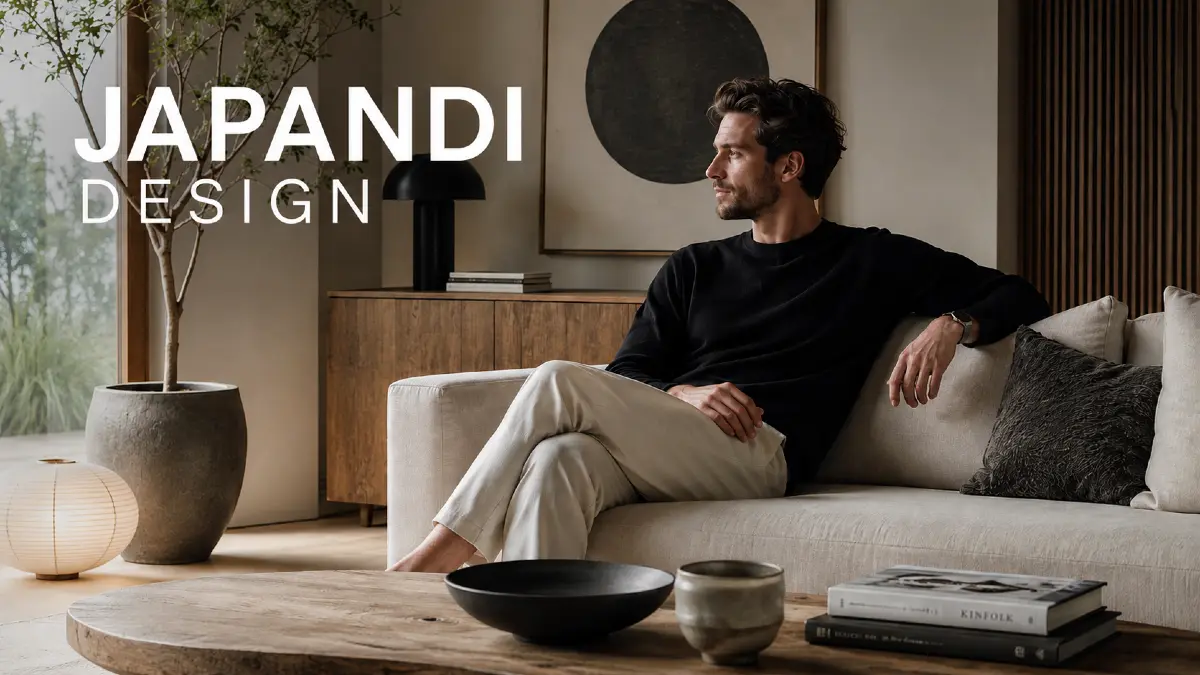
Most men spend years figuring out who they are. They invest in their health, their work, their relationships, their inner lives. And then they come home — and live in a space that reflects none of it.
A secondhand couch. Furniture chosen by default, not decision. An apartment that whispers “I haven’t thought about this” to anyone who walks in.
Your environment is not neutral. It shapes your nervous system, your focus, your sense of self. The space you inhabit either grounds you or unsettles you. It either reflects your values or contradicts them. And for a man who is serious about how he lives, that matters more than most interior design content will ever admit. There’s a reason how your environment affects overthinking is one of the most underexplored topics in men’s development — we spend enormous energy on mindset and almost none on the physical conditions we return to every day.
That’s what this article is actually about. Not curtain swatches. Not the best throw pillow for your sofa. But the design philosophy that might be the closest thing to a physical expression of conscious, intentional masculinity that the modern world has produced.
It’s called Japandi.
What Is Japandi Design?
Japandi is a fusion of Japanese and Scandinavian design principles — two aesthetic traditions that, on paper, come from opposite sides of the world, but share a remarkable set of values: simplicity, craftsmanship, restraint, and deep respect for natural materials.
The word itself is a compound — Japanese + Scandi — and it describes an interior style defined by clean lines, muted natural palettes, a disciplined relationship to objects, and a quietly powerful sense of calm.
At its philosophical core, Japandi draws from two distinct but resonant frameworks.
From Japan comes wabi-sabi — the acceptance of imperfection, the appreciation of things that age, wear, and carry history. A ceramic bowl with an uneven glaze. A timber beam with visible grain. A wall that shows the texture of the plaster rather than masking it. Wabi-sabi is not laziness or neglect. It’s the courage to find beauty in what is real rather than what is polished to perform.
From Scandinavia comes hygge — the Danish and Norwegian concept of warmth, coziness, and the kind of ease that a well-designed space creates for the people inside it. Not luxury in the showy sense. But comfort that’s earned through good materials and honest function.
Together, these two philosophies create something unusual in modern design: a space that is simultaneously minimal and warm. Precise and natural. Structured and alive.
It’s worth knowing that this fusion has roots going back roughly 150 years — to the mid-1800s, when Scandinavian designers and travelers first encountered Japanese culture as Japan opened its borders to the world. Both traditions shared a reverence for natural materials, skilled craftsmanship, and lives built around function and simplicity. What we now call “Japandi” is simply the modern articulation of that long conversation between two cultures who recognized something true in each other.
Why Japandi Resonates Now — and Why Most Coverage Misses the Point
Search for “Japandi design” and you’ll find pages of beautiful images. Neutral linen. Pale wood. A single ceramic on a floating shelf. Everything tasteful, everything still.
What you won’t find much of is why. Why this aesthetic, this particular blend, is resonating so powerfully in 2025. Why it keeps showing up on the most-searched design lists. Why architects, interior designers, and homeowners across cultures keep returning to it.
The surface answer is aesthetics: it photographs well, it’s calm, it’s trending.
The real answer is more interesting.
We are living in a period of relentless noise. Maximalist media, notification overload, performative consumption, the constant demand to be seen and stimulated. This is what mental wealth in the age of infinite distraction actually looks like in practice — an environment engineered to extract your attention, leaving you depleted by the time you get home. The average modern man is surrounded by things — many things, competing things, things that require attention he’d rather spend elsewhere. And somewhere in that accumulation, the actual shape of his life gets lost.
Japandi is, at its root, a response to that. It’s the design equivalent of deciding that you will only keep what you actually value. That you will not decorate for performance. That your home will be a place where you can find peace in a busy life, think clearly, breathe deeply, and actually rest.
That’s not a trend. That’s a way of seeing.
And for men who are working on themselves — men who are developing discipline, self-awareness, emotional intelligence, a cleaner relationship with what matters — it maps onto something real. Your space can either reinforce the kind of man you’re becoming, or it can pull against it. Japandi tends to reinforce it.
The Space That Sets You Apart
Walk into most men’s homes and you’ll find one of two things: a space that’s been decorated by someone else, or a space that hasn’t been thought about at all. Either borrowed taste or no taste. Neither says anything true about the man who lives there.
Japandi offers something rarer — a space that is unmistakably yours, without trying to be. Not because you’ve filled it with personality pieces and statement furniture. But because every decision in it reflects a genuine set of values: restraint, quality, honesty, calm. That combination is unusual enough that anyone who walks in will feel it, even if they can’t name it.
There’s a reason this matters beyond aesthetics. Most people — men included — live in spaces that are essentially invisible to them. They stopped seeing the room years ago. Japandi works against that. Because the space is spare and intentional, you actually inhabit it. You notice the light changing in the afternoon. You appreciate the grain of a well-made table. The room stays present rather than fading into background noise. It’s the same logic behind blue ocean thinking applied to how men move through the world — when you stop imitating what everyone else is doing and make deliberate choices, you become genuinely distinctive.
At its deepest level, Japandi is profoundly — even classically — masculine in its values. Not masculine in the performative sense of exposed concrete and taxidermied heads. But masculine in the way that real maturity is masculine: disciplined, purposeful, understated, grounded in substance rather than appearance.
Consider what each principle actually signals about the man behind it:
Less, but better. A Japandi space says you’ve stopped accumulating and started discerning. That you’d rather own one exceptional thing than ten forgettable ones. It’s the same philosophy behind quiet luxury brands like Ron Dorff — no logos, no noise, just craftsmanship that earns its place. In a world of more, restraint is its own kind of confidence.
Form follows function. Everything in the room earns its place. Nothing is there to perform. This maps directly onto what self-discipline and character actually look like in practice — the willingness to cut what doesn’t serve, and to invest fully in what does. A room built on that principle communicates something about its owner without a word being spoken.
Time shows. Wabi-sabi’s appreciation of aging — the patina on brass, the grain in a well-used timber table, the softening of natural linen — is an acceptance of reality that most modern interiors actively resist. Things are allowed to be what they are, to carry their history. Men who have done real work on themselves understand this instinctively. The Roman virtues that shaped great men were never about surface presentation — they were about what endured. Japandi is an interior built on the same premise.
Silence is not absence. The negative space in a Japandi room — the empty wall, the clear surface — is not a lack of ideas. It’s a decision. It communicates that the person who lives here is comfortable with stillness. Not every corner needs filling. Not every moment needs noise. That quality is rarer than any piece of furniture you could buy, and it’s the one people feel most clearly when they enter the space.
The Core Elements of Japandi Design
If you want to understand how this translates to an actual room, here are the fundamental elements.
Natural Materials
Japandi interiors are built around wood, stone, linen, cotton, wool, bamboo, rattan, and ceramics. These are materials that have texture. That age. That feel different at different times of year and under different light conditions. Oak, pine, beech, and bamboo are the workhorses — warm in tone, honest in grain. Natural stone — granite, slate, limestone — grounds a space and adds weight without decoration.
The key is letting these materials be themselves. No laminate pretending to be wood. No synthetic fiber imitating linen. In a Japandi space, the material is not a substitute. It’s the point.
Muted, Earth-Rooted Color Palette
The color palette is deliberately restrained. Soft whites, warm beiges, taupe, charcoal, muted sage, warm grey, deep olive. These are colors that soothe rather than announce. They recede, allowing the texture of materials and the quality of light to lead.
What this achieves is harder to explain than to feel. Walk into a room decorated in loud, competing colors and your nervous system registers it. Your attention is pulled in multiple directions simultaneously. Walk into a room in the Japandi palette and something different happens — a settling, a quiet permission to be present. This is not unlike what Loro Piana has built into quiet luxury fashion — the confidence to let quality speak without decoration.
Dark accents — charcoal, near-black, deep walnut — are used sparingly, as punctuation. They ground the lighter tones without overwhelming them.
Clean Lines, Low Profiles
Japandi furniture tends to be low, geometric, and honest in structure. No ornate legs, no decorative carving, no design that demands attention for its own sake. A low timber dining table. A platform bed frame with a natural finish. A sofa with clean, squared edges and natural linen upholstery.
The visual result is a sense of openness. The room breathes. Your eye moves through it without snagging.
Negative Space as Intention
Perhaps the most misunderstood element of Japandi is what’s not there. An empty wall is not an unfinished wall. An open surface is not a surface waiting to be decorated. Negative space is active in a Japandi interior — it slows things down, gives the eye somewhere to rest, and allows the objects that are present to be seen clearly.
This requires a different relationship to objects. In most Western interiors, more is more. In Japandi, every item is curated. The question isn’t “where do I put this?” but “does this earn a place here?”
Handcraft and Imperfection
Because wabi-sabi values the mark of human making, handcrafted objects are prized in Japandi design. A thrown ceramic with an uneven rim. A hand-stitched textile. Furniture made by a craftsman, not a factory. These objects carry something that manufactured perfection cannot: the evidence of process, of time, of a human being who made something.
There is an honesty in this that goes beyond aesthetics. It’s an acknowledgment that real things are imperfect. And that imperfection, properly understood, is not a flaw — it’s the signature of authenticity.
Connection to Nature
Light is a material in Japandi design. Large windows, unobstructed. Natural light that moves through the day and changes the quality of a room. Indoor plants — a bonsai, a monstera, a simple fern — bring living texture and a quiet vitality. The line between indoors and outdoors is softened wherever possible. This is also why elevated cabin and forest architecture resonates so deeply with men drawn to Japandi — both traditions prioritize the humility of a structure that serves its inhabitant rather than announces itself.
Room by Room: How to Apply Japandi to Your Space
The Living Room
The living room in a Japandi-influenced space is built around a single central anchor — usually a low timber coffee table or a clean-lined sofa in natural linen or wool. From there, the principle is discipline. One or two carefully chosen objects on a surface rather than a crowded shelf. A single piece of art rather than a gallery wall. A throw that actually gets used.
Storage is hidden wherever possible. Clutter is not inevitable — it is the result of not having made decisions. Built-in cabinetry, clean drawer units, and purposeful storage beneath furniture keep surfaces clear and maintain the sense of openness that makes the room work.
The Bedroom
This is where Japandi logic pays its clearest dividends for men. Most men’s bedrooms are either neglected or overcrowded. Neither supports genuine rest — and the importance of sleep for success is not something you can optimise your way around with supplements if the room itself is working against you.
A platform bed with a natural timber frame. A mattress of genuine quality. Linen sheets in warm white or warm grey. A bedside surface with only what belongs there: a lamp, a book, a glass of water. Nothing else.
No television in the bedroom — this is almost a Japandi commandment. The bedroom is for sleep and for being with oneself. Its function determines its contents. When that principle is applied honestly, the result is a room that genuinely helps you unwind after work and restores you rather than depleting you further.
The Workspace
Japandi is increasingly relevant to how men design their home offices and work areas. The principles translate directly: a clean desk surface, quality tools, concealed cable management, natural light positioned to reduce eye strain. A single object of meaning — a plant, a stone, a well-made cup — rather than a collection of distractions.
The Japandi workspace communicates that the work that happens here is taken seriously. Not through elaborate setup or expensive gear, but through order and intentionality.
The Kitchen
Natural wood cabinetry or matte-finish fronts in warm neutrals. Handmade ceramics for everyday use. A single quality knife set stored visibly rather than hidden in a drawer. The kitchen in a Japandi home is honest about its function — and elevated precisely by that honesty.
How to Start Without Starting Over
You don’t need a renovation. You need a shift in principle.
Start with subtraction. Before adding anything, remove what doesn’t belong. Ask of every object: does this serve a function, or does it have genuine meaning? If neither, it earns no place. This single act — done honestly — will change a room more than any purchase. It’s the same principle behind monk mode for men — a temporary, deliberate clearing of the field so you can see what actually matters.
Then, invest in one or two pieces of genuine quality. Not trend pieces. Not fast furniture. A timber table that will look better in ten years than it does today. A ceramic that was made by someone’s hands. These objects anchor a room and set a standard.
Introduce natural materials where you can — a linen throw, a wooden tray, a stone plant pot. The palette should shift toward the muted, the earthy, the quiet.
And then: hold the line. Every new object should meet the same standard as the ones already there. This is where most spaces fail — not in their initial curation but in their erosion over time. Japandi is not a style you apply and walk away from. It’s a practice of continued discernment — not unlike the philosophy of continuous improvement applied to who you are becoming: small, consistent decisions that compound over time.
What a Japandi Space Does to You
This is the thing that the design publications — focused on aesthetics and shopping — tend to miss.
A well-designed space doesn’t just look a certain way. It does something. It acts on you.
A room with too much in it creates a background hum of unresolved decisions. A room that’s honest and clear does the opposite. When you walk into a space where everything has been chosen with intention, where the materials are real, where there’s room to breathe — your nervous system responds. Something settles. The quality of your thinking changes. Your relationship to time in that space changes. Part of how to stop overthinking isn’t just cognitive — it’s environmental. A cluttered space generates cluttered thinking. This is not a metaphor; it’s measurable.
This is not mysticism. It’s neuroscience and basic psychology. Human beings evolved in natural environments. We are calmed by natural materials, natural light, clean order, and the absence of visual noise. Japandi simply creates those conditions in a modern home.
For a man who is serious about how he thinks and how he lives — a man doing the work of becoming more self-aware, more grounded, more intentional — the environment he returns to every day matters. It either supports that project or it doesn’t.
Japandi supports it.
The Deeper Point
There’s a temptation, when you encounter a design philosophy like this, to treat it as an aesthetic project. To scroll through Pinterest boards, order some linen cushions, and call it done.
That would be to miss what makes Japandi interesting.
The reason it resonates is not because it photographs well — though it does. It’s because the values it encodes are the same values that serious human development asks of us. Simplicity over accumulation. Substance over appearance. The patience to let real things be real things, and the discipline to hold the line against what doesn’t belong.
Your home is a mirror. Not of your taste — of your values. And for any man who is paying attention to how he lives, that’s not a decorating question. It’s a character question.
Japandi is just a very good starting point for answering it honestly.
Explore more on intentional living, environment, and conscious masculinity at Masculine Synergy.
Related posts:
 Our Place Titanium Pro Cookware Review: NoCo Tech Tested
 Ridge Wallet Review (2026): Is the Minimalist Metal Wallet Actually Worth It?
 Walipini Greenhouse: The Complete Guide to Year-Round Underground Growing
 10 Most Popular Gifts for Men in 2026 (That He’ll Actually Use)
 Elevated Cabin Design in Finland: Inside the Niliaitta Forest Retreat