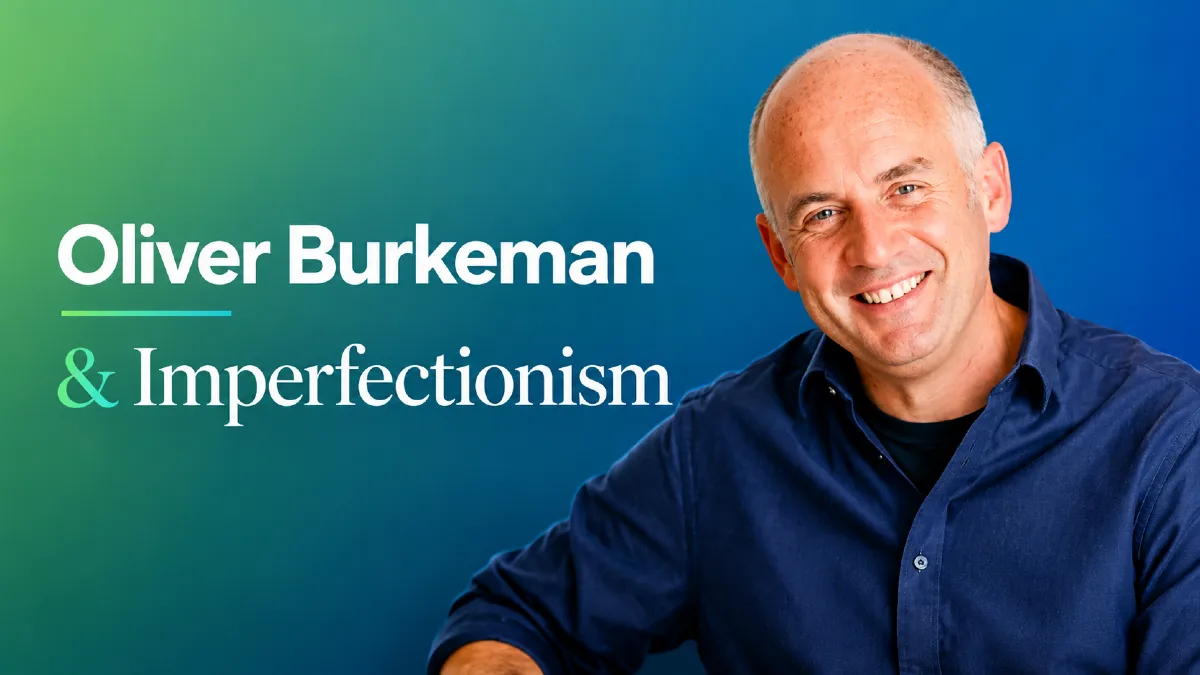
For the better part of two decades, the dominant narrative in self-improvement has been a single proposition with a hundred variations: you can do more, you should do more, and the obstacle is your own discipline. Tim Ferriss’s 4-Hour Workweek. David Allen’s Getting Things Done. Cal Newport’s Deep Work. Robin Sharma’s 5 AM Club. Hal Elrod’s Miracle Morning. Every popular productivity framework of the past twenty years has rested, more or less explicitly, on the assumption that the right system will let you finally fit everything in.
A British journalist named Oliver Burkeman has spent the past four years methodically dismantling this assumption. He started with Four Thousand Weeks in 2021 — a book whose central argument was that the average human life consists of about 4,000 weeks, that you cannot get even a fraction of what you want done in that span, and that pretending otherwise is the source of much of the anxiety the productivity industry claims to cure. He followed it in 2024 with Meditations for Mortals, which built on that foundation a philosophy he calls imperfectionism: the practice of organizing your life around what you can actually do rather than what an idealized version of you could theoretically do under perfect conditions.
The two books have sold millions of copies between them. They’ve been endorsed by everyone from Cal Newport to Mark Manson — which is itself a tell, because some of the figures who built the productivity industry are now quietly pointing to Burkeman’s work as the correction. The shift this is causing, in serious circles, is the most important development in self-improvement since Atomic Habits made habit formation mainstream.
For a generation of men raised on hustle culture, this reframe is harder to absorb than it should be. And it is the one most worth understanding.
The premise Burkeman is challenging
Modern productivity culture rests on a single hidden assumption: that the problem with your life is volume. You have too much to do, you are doing too little of it, and the gap is a function of your inefficiency. The promise of every productivity book is that if you optimize your morning, your inbox, your calendar, and your focus, you will close the gap. You will get it all done. You will become the man your to-do list is asking you to be.
Burkeman’s argument is that this premise is false at the foundation. The gap between what you want to do and what is humanly possible is not a productivity gap. It is a finitude gap. You have 4,000 weeks. The number of meaningful things you could conceivably pursue is functionally infinite. The math does not work, and no amount of optimization will make it work. You cannot get caught up. Anyone who tells you otherwise is selling something.
The harder implication is that the anxiety produced by your to-do list is not telling you to work harder. It is telling you that you have implicitly accepted an impossible standard — the standard of doing it all — and the failure to meet that standard registers as personal inadequacy. The productivity books are the cause of the disease they purport to treat. They keep you striving for completion in a system that cannot, ever, produce completion.
This is the part that hits men hardest, because masculine self-conception in modern culture is heavily tied to output. A man’s worth, in the implicit scoreboard most of us inherited, is the volume and quality of what he produces. The man at the top of the productivity book stack is being told that his anxiety is unmanly weakness — that a real man would just push through and get it done. Burkeman is saying, gently, that real men accept the math.
What imperfectionism actually is
Imperfectionism is not the same as giving up. It is not lowering your standards. It is not the soft, therapeutic message that you are enough as you are and shouldn’t try to grow. Burkeman is explicit on this point. He is not arguing against ambition or effort. He is arguing against the fantasy of completion — the idea that there is some achievable state in which all your obligations are met, all your projects are finished, and you can finally rest in the feeling of being on top of things.
The imperfectionist starts from the opposite premise. You will never be on top of things. The list is infinite. The mortality is real. Given those facts, the only question worth asking is what you want to do with the limited bandwidth you actually have. Not “how do I get more done.” But “given that most things will not get done, which things will I deliberately choose to do?”
The practical implications are uncomfortable. You will need to abandon things. Not the things you wish you could ignore — the inbox, the chores, the obligations. Real things. Things you genuinely care about, that you have promised yourself you will get to, that you imagined yourself completing. The book you have been meaning to write. The skill you have been meaning to learn. The relationships you have been meaning to deepen. Some non-trivial fraction of these will not happen, no matter how disciplined you become, and the work is to make peace with that and choose anyway.
This is a Stoic move, even though Burkeman doesn’t always frame it that way. Stoic wisdom on hardship returns repeatedly to a single idea: the man who suffers most is the man who refuses to accept the constraints he didn’t choose. Mortality is the largest of those constraints. The Stoics insisted you face it daily, not to be morbid, but because the man who has accepted his finitude makes different choices than the man who hasn’t. Burkeman’s imperfectionism is just this old idea translated into time-management language.
Why this lands differently for men
Several elements of imperfectionism cut against the cultural messages most modern men have internalized. The discomfort of reading Burkeman is partly the discomfort of recognizing how much of your self-concept is built on assumptions that don’t hold up to scrutiny.
The myth that the right system will fix you. Most men, when they feel overwhelmed, reach for a new system. A better calendar. A new app. A different morning routine. The implicit theory is that the wrongness is mechanical and can be engineered out. Burkeman’s data point is that the men who have tried the most systems are often the most overwhelmed. The system is not the problem. The expectation of completion is the problem. You will not optimize your way out of finitude.
The myth that productivity equals worth. Hustle culture sells a tight equation: produce more, become more valuable, deserve more love and respect. The flip side of this equation is brutal: produce less, become less valuable, deserve less love and respect. Most men have not examined this equation. It just runs in the background of their days. Burkeman doesn’t argue with the math directly. He just points out that the math is invisible because nobody questions it — and that questioning it is the precondition for a life not run by it.
The myth that you should be doing more right now. Underneath most men’s relationship with their time is a quiet, constant accusation: you should be doing more. Whatever you are doing — reading this article, eating dinner, playing with your kids, taking an actual break — there is something else you should be doing instead. This accusation is not productive. It is not even motivating. It is a low-grade time poverty that drains the present without delivering the future. The imperfectionist names this and starts the practice of disregarding it.
The myth that meaning is on the other side of completion. Many men live in the future tense. Once I hit this number, then I’ll relax. Once I finish this project, then I’ll spend time with the family. Once I’m caught up, then I’ll start the thing that matters. The trick this is playing is that you never hit the number, never catch up, never reach the state where the deferred life can begin. The deferred life is the actual life. Whatever you’re doing now is what you’re doing, full stop. Burkeman puts this plainly: the only life you have access to is this one.
The practical moves
Imperfectionism is not a system. That’s part of the point. But it has practical implications, and Burkeman names them across both books. The ones most worth implementing for men:
Decide what you will not do, and admit it. Most men have an unstated list of “things I haven’t gotten to yet” that they implicitly carry around as evidence of personal failure. Burkeman’s prescription is to convert that list into a list of things you have decided not to do. The relationships that aren’t going to happen. The hobbies that aren’t going to be picked up. The books that aren’t going to be read. The careers that aren’t going to be pursued. Naming these as choices rather than failures is the first step in stopping the constant low-grade self-flagellation that the unstated list produces.
Choose three or four things and let everything else be okay. A man’s life, examined honestly, has room for a few major commitments — a career, a family, a craft, a circle of close friendships, maybe a body of work or a faith — and not much more. The fantasy that you can do all of these well, plus a dozen other interesting things, is just that. Pick the three or four that matter. Be excellent at those. Let everything else be at the level it ends up at.
Stop trying to feel caught up. The feeling of being caught up is not available. The feeling of being slightly behind is the permanent state of any thinking adult with real responsibilities. If you organize your emotional life around achieving the feeling of caught-up-ness, you organize it around a sensation that will never come. Make peace with the busy life by accepting that “caught up” is a fantasy generated by the productivity industry, not a state real humans inhabit.
Do one thing at a time, fully. This is not a productivity tip. It is closer to a spiritual practice. The man who works while half-thinking about other work, eats dinner while half-thinking about emails, plays with his kids while half-thinking about projects, is having a worse version of every experience available to him. He is also getting less actual work done. Single-tasking, when you actually do it, feels almost shockingly powerful, and most men have not seriously tried it in years. Energy management beats time management almost every time, and presence is the elemental form of energy.
Stop optimizing your morning routine. This is heretical to a lot of men’s-development content. Burkeman’s point is that the obsessive engineering of morning routines is itself a symptom of the disease. You have decided the day will only be saved if you wake at 5, drink the right water, stretch the right amount, journal correctly, meditate correctly, exercise correctly, and read correctly — and you have implicitly committed yourself to two hours of pre-work performance before you have even started living. A man whose first instinct on waking is to execute a complex protocol is being run by the protocol. Wake up. Be a human. Start your day.
What this means for serious men
The pushback to Burkeman, when it comes, usually has a single shape: this is just an excuse for laziness. If you accept that you can’t do everything, you will end up doing nothing. Standards will collapse. The men who have built real things have built them by refusing to accept finitude. Surrender to limits and you become the soft, drifting, lukewarm modern male that everyone is rightly worried about.
This objection misreads the position. Burkeman is not arguing against effort. He is arguing for clarity about what effort is for. The man who refuses to accept finitude is not the man who builds great things. He is the man who spreads himself across too many things, finishes none of them well, and arrives at fifty exhausted by his own ambition. The men who actually build great things are almost always men who said no to nearly everything else. Cal Newport, who endorsed Burkeman, calls this “slow productivity.” It is the opposite of laziness. It is concentrated effort applied to a small number of important things, with full acceptance that everything else will be left undone.
The imperfectionist man is not less ambitious. He is more selective. He is not less disciplined. He is more honest about the cost of his choices. He is not less driven. He is less driven by the unexamined to-do list that runs most men’s days.
This is consistent with the wealth-score framework, with the five-types-of-wealth approach, and with the recognition that the work-life balance narrative was itself a fiction that just produced a new optimization target. Imperfectionism is the next stage of this same trajectory: the recognition that the problem is not how to get more done but how to choose which fewer things to do well.
The harder turn
The hardest part of imperfectionism, for most men, is the part Burkeman approaches most carefully. It is the question of meaning in a finite life. If you really accept that the to-do list will never be finished, that most of what you wanted to do will not get done, that the productivity machine cannot deliver the satisfaction it promised — what do you do with the days?
The answer Burkeman lands on is not optimistic in the usual sense. He is not telling you that the limited life is secretly enough, or that less is more, or that the simple things are what matter. His answer is closer to the Stoic position: the limited life is what you have, and the question is whether you will inhabit it on its own terms or spend it pretending you have access to a different one.
Letting go of outcomes — the actual practice, not the slogan — is what this looks like in daily life. You write the book because you want to write it, not because you need it to make you somebody. You raise your kids because the years are short, not because they will be your monument. You build the business because the work is meaningful, not because the exit will validate you. You exercise because it makes your life better today, not because optimization is the goal. The output remains. The deranged relationship to the output goes.
This is not soft. It is the opposite. It is what masculine maturity looks like when the adolescent fantasy of unlimited capacity has finally been put down. Most men get there in their fifties or sixties, often after burnout or failure has done the work for them. The men who get there earlier — at thirty-five or forty — get to live more of their actual lives inside it.
Burkeman has given a generation of overwhelmed men the framework for that earlier arrival. The men who take him seriously do not become less capable. They become more concentrated, more present, and more dangerous in the few things they have decided to actually do. The men who dismiss him stay caught in the loop the productivity industry built for them, refining the systems while the years they are trying to optimize quietly run out.
Four thousand weeks is the average. You have already spent a significant fraction of yours. The question is not how to fit more in. The question is what to fill the rest with — and what to finally let go.
Related posts:
 The Red Queen Effect Explained: Why Working Harder Often Gets You Nowhere
 Why Energy Management Beats Time Management (The Productivity Secret of High Achievers)
 Self-Discipline at Work: How Focus, Preparation and Reliability Build a Career
 Ridge Wallet Review (2026): Is the Minimalist Metal Wallet Actually Worth It?
 Hume Band Review: Does This Stress-Tracking Wearable Actually Work?