There’s a moment in every man’s life when he stops accepting the default. When he looks at his routine, his tools, his table — and asks himself whether what he’s using is actually good, or just what everyone else uses because nobody thought to question it.
That question is what built every great brand men love. It’s what put quality knives on kitchen counters and single-origin beans in morning cups. It’s why the Ridge Wallet exists, why men who think seriously about their gear stop at off-brand mediocrity and reach for something built with intent.
Milly Pepper is that question applied to the one ingredient that touches every single thing you cook.
Pepper Was Once Worth Its Weight in Gold
Before we talk about a Brooklyn brand and an Andean farm, you need to understand what pepper actually is — because the history of it tells you everything about what we’ve lost.
Pepper was once worth its weight in gold, traded as currency and prized for its flavor and power to preserve food. In medieval Europe, rents were paid in peppercorns. Kingdoms were funded by the pepper trade. The entire Age of Exploration — Columbus, Vasco da Gama, Magellan — was in large part a desperate race to control pepper routes and break the Arab and Venetian monopolies that made it so expensive.
Pepper didn’t just flavor food. It was civilization.
The hunt for it sent ships across oceans and redrew the map of the world. Somewhere along the way, we forgot why it mattered, and stale became the standard.
That’s where we are today. A spice that commanded entire fleets and reshaped geopolitics now sits in a plastic grinder in your cupboard, ground weeks or months ago, faded to almost nothing, adding heat but not flavor. Functional. Forgettable.
That’s the problem Milly Pepper was built to solve.
Who Built This, and Why It Matters
Milly Pepper was founded in Brooklyn by Michael Laniak and Roy Chan. These aren’t food hobbyists. Laniak spent over 15 years building and scaling consumer brands — Away Travel, Sabah, Best Made Company, Taylor Stitch, Primal Harvest — at the intersection of strategy, quality, and modern men’s taste. Chan brings over 30 years of global brand development. These are operators.
On May 12, 2026, the brand launched with a clear mission: to elevate one of the most ubiquitous yet overlooked kitchen staples.
Their starting point was a realization that sounds obvious only after you hear it: pepper is the most used spice in any kitchen, and almost no one treats it like it matters. It’s the salt-and-pepper shaker on every diner table, the dusty pre-ground tin that’s been in your pantry since you moved in, the afterthought sprinkled from a grocery store grinder made of plastic.
What would happen, they asked, if someone applied to pepper the same seriousness that the specialty coffee world applied to beans? The same philosophy that turned wine into an experience of terroir and vintage?
The answer is Milly Pepper.
Single-Origin: Why It Changes Everything
Most men have heard “single-origin” in the context of coffee. It means the beans come from one specific place — one farm, one region — rather than a blend of anonymous sources from across the globe. That specificity matters because where something grows shapes how it tastes.
The same principle, applied to pepper, is what separates Milly from everything else on the shelf.
Nearly all pepper sold today is a mass blend from dozens, if not hundreds, of farms. Whatever character it could have had is lost. What’s left is anonymous.
Milly Pepper searched globally and landed on Ecuador, where volcanic soil meets equatorial climate and Pacific breezes. The terroir creates a pepper that is wonderfully aromatic, layered, and alive. In this ideal climate, they found a fourth-generation family farm that grows nothing but pepper. Not a farm that happens to grow it alongside other crops.
That last detail matters more than it might seem. A farm devoted entirely to one crop doesn’t split its attention. The knowledge is generational — four generations of understanding this particular vine, this particular soil, this particular altitude. That’s not a supplier. That’s a partnership built on craft.
The farm is nestled in the Andean foothills of Ecuador, where volcanic soil, equatorial humidity, and elevation create optimal growing conditions for pepper. Each varietal is grown using organic and regenerative practices, ensuring that the flavor profile is rich and complex.
Fresh Beats Pre-Ground. Always.
Here’s the core truth about pepper that the industry has trained you to ignore: pepper is a fruit. When you grind it, you break open cells that have been holding essential oils — the compounds responsible for aroma, complexity, and real flavor. The moment those cells are breached, those oils begin to evaporate.
Fresh pepper is alive. The oils that carry its aroma, depth, and character start fading the moment it’s ground. That’s why pre-ground pepper tastes like heat and nothing else. The fix is simple: grind it fresh, right before it hits the dish. You’ll smell the difference before you taste it.
Most pepper on store shelves has been sitting in a warehouse for years, ground down and stale. Milly Pepper is freshly harvested, single-origin, and sealed at the source. The difference isn’t subtle. You’ll smell it the second you open the tin.
That detail — sealed at the source — is worth unpacking. Most pepper is processed, packaged, shipped, warehoused, and distributed before it ever reaches you. Each step is another opportunity for the essential oils to degrade. Milly seals directly at the Ecuadorian farm. What you receive is functionally as close to harvest-fresh as you can get without growing it yourself.
This is the same logic that drives serious men toward the best version of any tool — not the loudest, not the most expensive, but the one engineered to do its job without compromise.
The Three Peppers: A Taxonomy of Flavor
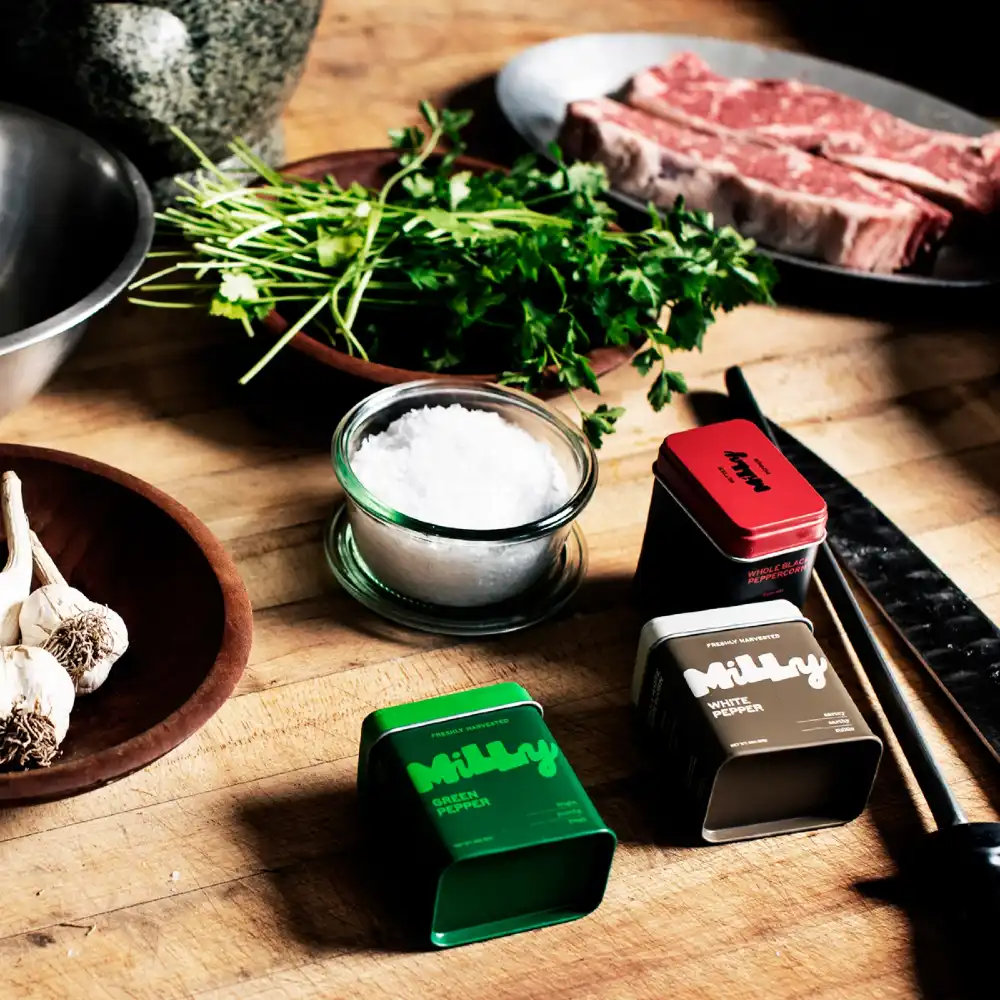
Most people think of pepper as one thing. Milly operates on the understanding that black, white, and green pepper are three distinct flavor experiences — the same fruit at different moments of ripeness, processed differently, built for different dishes.
Black Pepper
Hand-picked at peak ripeness in Ecuador, organically grown, and sealed fresh to preserve its essential oils. Bold, warm heat with depth you can actually taste. This is the everyday pepper.
Black is fully matured and sun-dried on raised beds. It’s what belongs on red meat, hearty pastas, roasted vegetables, eggs. It’s the backbone of cacio e pepe — that Roman pasta where pepper isn’t a garnish but a structural ingredient. If you cook one dish a week and reach for pepper, you’re reaching for this.
White Pepper
White is soaked and hulled — the outer skin removed, which changes the character entirely. Where black is bold and assertive, white is earthy heat that builds slow and adds quiet depth. It’s the pepper for cream sauces, mashed potatoes, soft cheeses, seafood. It’s quieter, more refined, the kind of ingredient professional chefs have been using for centuries without the grocery store ever explaining why.
Green Pepper
Green is picked early and bright. The youngest of the three varietals, it carries a bright, herbal punch with a clean, savory finish. Think light proteins, fresh salads, charcuterie boards. Anywhere you’d normally reach for fresh herbs but want something with more backbone.
Owning all three doesn’t make you a food snob. It makes you the man at the table who understands that a tool is only as good as the precision with which you choose it. You wouldn’t use the same knife to filet a fish and break down a rack of ribs.
The Milly Mill: Built to Last, Not to Replace
The hardware is as thoughtfully considered as the peppercorns themselves.
The Milly Mill is not just another grinder; it’s a thoughtfully designed tool made from durable steel with a ceramic grinding mechanism. This refillable mill allows chefs and home cooks to grind peppercorns to their desired texture, enhancing the cooking experience.
Ceramic over plastic. Refillable over disposable. Adjustable from coarse to fine. Color-matched to each pepper varietal — black mill for black pepper, and so on — so the set has the visual coherence of something that belongs on a counter, not buried in a drawer.
The refillable design is the anti-consumer move in the best sense. You’re not buying a new grinder every time your pepper runs out. You buy the mill once. You refill it with the tin. It’s the model that makes economic and ecological sense simultaneously — which is exactly the kind of decision that reflects the long-term thinking that builds wealth and genuine taste rather than disposable consumption.
Designed to escape the cupboard. A thoughtful upgrade to the everyday throwaway grinder.
That phrase — designed to escape the cupboard — gets at something real. The best tools don’t hide. They earn their place in the open.
The Pricing: Accessible Luxury, Not Pretension
Milly Pepper’s pricing structure is straightforward: Discovery Set ($78) includes all three varietals plus a matching mill each. Starter Set ($28) includes one varietal plus a matching mill. Individual Pepper Tins ($14) are two-ounce tins in black, green, or white.
The $14 tin entry point is the easiest upgrade you can make to your kitchen this year. If you’re already grinding pepper — even from a supermarket grinder — you’re already in the habit. You’re just upgrading the source and the freshness.
The Discovery Set at $78 is a complete system: three peppers, three mills, one giftable box. It’s also one of the strongest gifts you can give a man who cooks, because it’s genuinely useful and genuinely different from everything else in his kitchen. Not another gadget. Not another bottle of something he won’t finish. A complete, considered upgrade to a daily ritual.
Members receive 15% off every order, free shipping, and early access to new drops, with a fresh tin shipping every 30 days. A subscription model built for the man who, once he tastes the difference, will not go back.
The Values Behind the Brand
1% of every sale goes back to the planet in partnership with 1% For the Planet.
Milly’s sourcing isn’t just about flavor. Grown organically under regenerative practices and hand-harvested at peak ripeness, each peppercorn fruit is sun-dried on raised beds to protect its essential oils and piperine content. Never mixed, blended, stockpiled, or exposed to radiation.
That last clause — never exposed to radiation — refers to irradiation, the common commercial practice of treating spices with radiation to extend shelf life and kill pathogens. It’s legal, widespread, and strips out much of what makes fresh spices worth using. Milly refuses it categorically.
This is a brand that’s made a series of deliberate choices that cost them something — organic farming, single-source procurement, refusing irradiation, sealing at origin — because they believe the end product justifies it. That’s not a marketing posture. That’s what integrity looks like in supply chain form.
Men who think seriously about personal responsibility understand this: the choices that are harder to make are usually the ones that produce something worth having.
Why Modern Men Should Pay Attention
There’s a deeper reason this brand matters beyond flavor profiles and ceramic burrs.
We live in a moment where the average man is surrounded by objects he didn’t really choose — default purchases, inherited habits, products marketed to the lowest common denominator. The spice rack is a perfect metaphor for this. Nobody ever chose their grocery store pepper with intention. It was just there. It came with the house. It got replaced when it ran out with whatever was cheapest.
The same lack of intention shows up in relationships, careers, and self-development — and the courage to face uncomfortable truths is the first step toward changing any of them. But it also shows up in smaller things. In the tools you reach for. In what you put on the table when you cook for someone you care about.
Milly Pepper is, on the surface, about pepper. But what it’s actually offering is an invitation to recalibrate. To say: I’m done accepting the default. I’m going to understand what I’m using, why it matters, and choose accordingly.
Better pepper doesn’t ask you to change how you cook. It just makes the things you already do taste like more. A fried egg. A bowl of pasta. A steak off the grill. Small moments, big difference.
That’s not a trivial thing. The quality of daily rituals is inseparable from the quality of daily life. The man who makes a genuinely good cup of coffee every morning, who grinds his pepper fresh, who owns fewer things but better things — that man experiences his days differently. Not because he’s wealthy. Because he’s attentive.
This connects directly to what quiet luxury really means — not visible branding or conspicuous expense, but the deep satisfaction of things that are genuinely excellent at what they do. Pepper from a fourth-generation farm in Ecuador, ground fresh before it hits the dish, is quiet luxury in its purest form.
How to Start
The simplest entry point is a $14 tin of black pepper and whatever mill you already own. Smell it when you open it. Then crack some over a fried egg, a piece of steak, a bowl of pasta. Compare it to what you’ve been using.
If you want the full experience from day one, the Starter Set at $28 pairs a tin with a color-matched Milly Mill — everything you need, one box, no decisions. The Discovery Set at $78 is the move if you cook regularly and want to understand the three varietals and what they do differently.
Milly Pepper is available at Bespoke Post, one of the most trusted platforms for well-made goods aimed at men who care about quality. It’s the right home for a brand like this — curated, no noise, built around the idea that the objects in your life should be chosen, not defaulted to.
The SERP Landscape: Why Milly Pepper Has a Real Opportunity
If you search “Milly Pepper” today, you’ll find the brand’s own site, Bespoke Post’s product page, a handful of press releases on NOSH and EIN Presswire, and a few early food-curious coverage pieces. The brand launched in May 2026. It’s new. That means two things simultaneously: the SERP is wide open, and early content wins.
The competitive keyword space around single-origin peppercorns is thin. Most of the traffic and authority sits in generic queries — “best pepper grinder,” “fresh peppercorns,” “single origin spices” — and those are dominated by content farms and Amazon listicles. What’s missing is editorial. Real writing, by real people, with a specific perspective on why this product matters to a specific kind of man.
That’s the gap. The brand built by DTC veterans with supply chain integrity and a genuinely differentiated product deserves coverage that lives in the same world as the reader — not in a press release, but in an article that treats him as someone capable of understanding why this matters.
From a content strategy standpoint, the play here is clear: own “Milly Pepper review,” “single origin pepper men,” “Milly Pepper vs grocery store pepper,” and “best fresh peppercorns 2026” before the big food sites get organized. The brand is currently building its authority from scratch. Content like this — editorial, long-form, linking to the Bespoke Post storefront and the brand’s own site — is exactly the kind of third-party validation that moves SERP rankings and builds trust simultaneously.
The men who will love this product are already reading about the first rule of mastery and why the details of how you operate daily determine the life you live. They’re not waiting for a viral TikTok. They’re reading, thinking, and buying things that make their daily lives better. This article reaches them where they already are.
The Takeaway
Milly Pepper is a new brand with a very old argument: that what you use every day should be the best version of itself.
It was built by people who came from the best DTC brands in the country. It sources from a farm that has grown nothing but pepper for four generations in one of the most favorable climates on earth. It refuses compromises — no blending, no irradiation, no plastic. It donates to the planet. It’s priced to be accessible. And it produces a product that, once you taste it, makes the alternative feel impossible to return to.
For the man who has started to take his life seriously — his health, his relationships, his decisions, his earning ability as his most valuable long-term asset — the kitchen is not a separate domain. It’s part of the same operating system. What you eat, how you cook it, the attention you bring to daily rituals: it all coheres.
Men who study stoic philosophy understand that the quality of your character shows up in how you do small things as much as in how you handle large ones. Marcus Aurelius didn’t become a great emperor by ignoring the details of daily discipline. He built discipline into every corner of his life, and the empire benefited from it. The kitchen is not where philosophy takes a break. It’s where it shows up most honestly — every day, twice a day, in what you choose to put on the table.
Milly Pepper fits into that philosophy without effort. You’re not adding an elaborate ritual to your day. You’re replacing one bad habit — reaching for stale, anonymous powder — with one good one: cracking fresh, single-origin pepper from a farm that has cultivated this fruit for four generations. The discipline is almost zero. The upgrade in quality is immediate and permanent.
Milly Pepper is a small thing with an outsized impact. The kind of upgrade that doesn’t announce itself but quietly changes every meal you make from here on.
That’s enough.
Milly Pepper is available through Bespoke Post and direct at millypepper.com. Discovery Set ($78), Starter Set ($28), individual tins ($14).
Related posts:
 Proven Chicken Farming Business Idea Strategies for Massive Profit
 Ron Dorff Review: Is the Quiet Luxury Menswear Brand Worth It?
 The 10 Best Chef Knives of 2026: A Complete Buyer’s Guide for Every Kitchen
 Our Place Titanium Pro Cookware Review: NoCo Tech Tested
 Loro Piana Quiet Luxury: Why the Brand Whispers Wealth