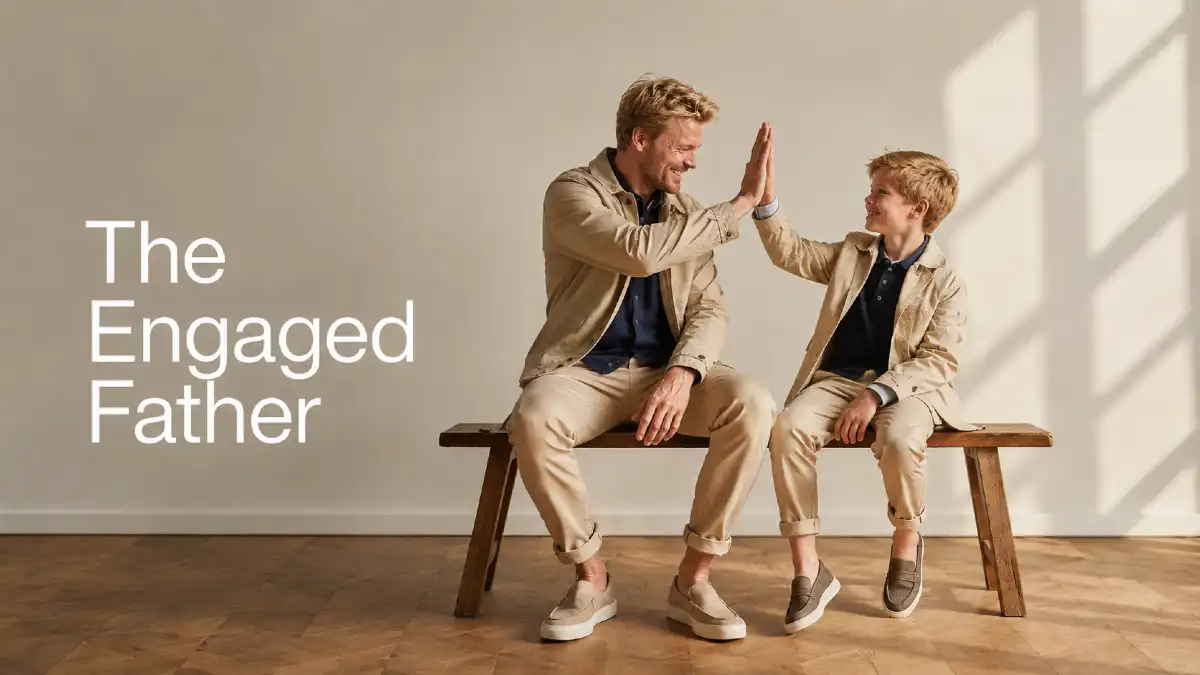
Being an engaged father isn’t about logging more hours of childcare; it’s about the emotional quality of the time you’re there. Two decades of research, including a UK study of more than 6,000 children, shows that a father’s warmth and responsiveness predict fewer behavioural problems, while the sheer number of nappies changed does not. Here’s what the evidence says, what it doesn’t, and what to do with the time you already have.
“Dad, are you listening?”
She’s halfway through a story about something that happened at school. It’s a long story, with a lot of “and then”, and somewhere in the middle your phone buzzes. You glance down for two seconds. When you look up, she’s stopped talking.
“Dad, are you listening?”
Most fathers know that moment, and most feel the small sting of it. It’s worth taking seriously, not as a reason for guilt, but because it captures what the research on fathers keeps finding. Children don’t measure their fathers by hours logged or money earned. They measure whether he’s actually there when he’s there.
For decades, fathers were treated in research mostly as providers or as stand-ins for mothers. That has changed. An engaged father is one who is emotionally present, responsive and warm with his children, who plays, talks and sets limits with them, and who shows up in difficult moments, not just one who shares a house with them or performs a set number of childcare tasks. The evidence now suggests this kind of engagement shapes how children behave, feel and think, in ways that last into adulthood.
What father involvement actually means
Researchers have long distinguished between three kinds of involvement: engagement (direct interaction with the child), accessibility (being available) and responsibility (making sure needs are met). The research increasingly points to the first as the one that matters most, and specifically to its emotional quality.
The clearest evidence comes from Bristol’s long-running ALSPAC birth cohort. In a 2016 analysis published in BMJ Open, Christopher Opondo and colleagues at the University of Oxford looked at how fathers described their involvement when their babies were eight months old, then tracked behavioural problems in more than 6,000 of those children at ages nine and eleven. Children whose fathers reported a stronger emotional response to them, and who felt more secure in their roles as fathers and partners, had fewer behavioural problems a decade later. The amount of hands-on childcare and domestic work fathers did, on its own, made no measurable difference.
That finding deserves to sink in. It doesn’t mean practical care is unimportant; children obviously need it, and partners notice who does it. It means that what shapes a child’s development most is how a father relates to his child, not just how many tasks he ticks off. Thirty minutes of real attention can matter more than two hours spent half in the room and half on the phone.
In practice, engagement tends to look like a handful of things. Attention without distraction. Emotional responsiveness, noticing and naming what a child feels, which is a learnable skill and part of male emotional intelligence. Physical play. Gentle stretching, encouraging a child to try something slightly beyond them while making it safe to fail. Conversation. And above all, showing up when things are hard. The gap between being there and being present is exactly the gap the research measures.
What the research shows about fathers’ impact on children
The most widely cited synthesis is a 2008 systematic review in Acta Paediatrica by Anna Sarkadi and colleagues at Uppsala University. They included only longitudinal studies, where father involvement was measured at least a year before child outcomes, covering 24 papers from 16 studies and more than 22,000 participants. Active, regular engagement by fathers was associated with fewer behavioural problems in boys, lower psychological distress in young women, less delinquency in children from low-income families and better cognitive development, particularly in disadvantaged families. The authors concluded that direct engagement, rather than any specific activity, was the form of involvement with the strongest support.
Language is one area with a striking result. In a 2006 study of dual-earner families, Nadya Pancsofar and Lynne Vernon-Feagans recorded parents playing with their two-year-olds at home. The richness of fathers’ vocabulary predicted children’s language development a year later, at age three, more strongly than mothers’ did. One explanation is that fathers, being with children slightly less, tend to use words children don’t already know, which stretches them. Talking with your child, not just near them, is part of how they learn to think, and it supports the curiosity children are born with.
Play matters too, especially the rough-and-tumble kind many fathers do instinctively. Canadian psychologist Daniel Paquette has proposed that fathers often build an “activation relationship” with children: encouraging them to take risks, explore and test themselves, while staying close enough to keep them safe. Wrestling, chasing and being thrown in the air, with the father in charge and stopping when it goes too far, may help children learn to handle excitement, frustration and limits. The research here is still developing, but it fits what many fathers already sense: the play isn’t frivolous. It’s practice for regulating big feelings.
Fathers are also more involved than they used to be. Pew Research Center found that American fathers spent about 7.3 hours a week on childcare in 2011, compared with 2.5 hours in 1965. The question for most men now isn’t whether to be involved but how to make the time count.
Non-resident fathers: why quality counts more than contact
For fathers who don’t live with their children, the research carries a message that is both demanding and hopeful. A 1999 meta-analysis of 57 studies by Paul Amato and Joan Gilbreth found that how often non-resident fathers saw their children mattered less than what happened when they did. Fathers who kept an authoritative style, warm but with clear limits, explaining rules and taking an active part in discipline and schoolwork, were associated with better outcomes. Paying child support also mattered, especially for academic results. A 2013 update by Kari Adamsons and Sara Johnson reached a broadly similar conclusion: the kind of involvement counts for more than mere contact.
The practical implication is clear. The “Disneyland dad” model, where every visit is a treat and nobody mentions homework, may feel generous, but it isn’t what helps most. A father who lives twenty minutes away and shows up as a real parent (asking questions, holding standards, being reliably there) can still have a large positive influence. Part-time doesn’t mean less important.
The intergenerational pattern
Fathering tends to be passed down. Research led by Sandra Hofferth at the University of Maryland found that young men whose own fathers were involved in their childhood showed more positive parenting as fathers themselves, decades later. Men who grew up in unstable families, on average, became fathers earlier and were more likely to live apart from their children.
That’s a tendency, not a sentence. Plenty of men become the father they never had, and they usually do it on purpose: by noticing the template they inherited, deciding which parts to keep, and working on the rest, sometimes through therapy, a men’s group, honest conversations or simply a lot of reflection. If you’re trying to make sure the father wound isn’t passed on, it helps to understand how your past affects your relationships, and in time to come to some peace with your own father.
What the research doesn’t say
It’s worth being precise about the limits, because fatherhood research is easily misused.
It doesn’t say fathers matter more than mothers, or that children of single mothers are doomed; many thrive, and the research is about what fathers add, not what anyone else lacks. It doesn’t say all father involvement is good: a harsh, volatile or abusive father can do real harm, and children are better protected from that. Much of the research is correlational, and while the better studies control for income and education, families with engaged fathers may differ in other ways too. And it doesn’t prescribe a single correct style. What counts is warmth, responsiveness and reliability, expressed in whatever way fits you and your child.
What an engaged father actually does
The research translates into a handful of practices most men can start this week. None requires being a different person. They require being a little more deliberate with the person you already are.
Put the phone away. Time together with a phone in your hand is only half time together. Children read the glance down as a verdict on how interesting they are. Reclaiming your attention from systems designed to capture it is one of the simplest gifts you can give them.
Build a ritual. A Saturday breakfast, a bedtime story, a walk with the dog, the drive to practice. Rituals create reliable time for the relationship without anyone having to schedule “quality time.”
Play physically while they still want it. Wrestle, chase, build things, climb. Keep it safe, stay in charge, and stop before it tips into tears. The window for this kind of play doesn’t stay open forever, and what it looks like changes as children grow, which is why engagement looks different at different ages.
Show up for the hard moments. The illness, the rejection, the exam that went badly, the first heartbreak. These are the moments children remember, and your steadiness in them teaches more than any lecture.
Have real conversations. Ask open questions and listen to the answers. Lists of questions to ask your teenage son or your teenage daughter can help start them, and there are conversations worth having before your children leave home.
Model what you want to see. Children learn more from how you handle frustration, apologise or treat their mother than from anything you tell them. Whether a father controls his emotional reactions or is controlled by them becomes part of the child’s own template.
Don’t outsource the relationship. Schools, coaches and clubs are valuable, but they’re not substitutes for a father who knows what’s going on in his child’s life.
Repair when you get it wrong. Every father loses his temper, misses something important or says the wrong thing. What matters is coming back: naming what happened, owning your part and reconnecting. A real apology to a child is one of the most powerful things a father can model.
You already do some of this, probably more than you give yourself credit for. The bedtime you rarely miss, the lifts you never complain about, the way your child runs to you after a fall: that’s engagement. The goal isn’t a new identity. It’s more of what already works.
The deeper claim
Most of what a man builds in his career ends with his career. A company is sold, a role is filled by someone else, a portfolio is spent. What he builds in his children doesn’t end that way. It shapes how they handle stress, how they treat partners and how they raise their own children, and through them it reaches people he’ll never meet.
That’s why fatherhood may be the highest-leverage work a man ever does, and why it belongs in any honest account of the five types of wealth. It’s also why it’s worth doing imperfectly rather than waiting to do it perfectly. You can’t control who your children become, and you’re not the only influence in their lives. You can control how present you are tonight. The deepest form of that is simply letting your children know you, and taking the time to know them back.
7 Questions for the Engaged Father to Sit With After Bedtime
Skip any question that lands too close to your own childhood today. You can come back to it when you’re ready.
- Think of the last time your child said some version of “are you listening?”: what had your attention, and what did their face do when you looked up?
- Which habits of your own father do you catch in yourself, and which ones are you glad to have kept?
- When was the last time your hands were busy with your child, wrestling, building or carrying, rather than holding a screen, and how did your body feel afterwards?
- Which of your child’s recent moods has your gut flagged as more than a phase, even though you haven’t said anything about it yet?
- If, as the Oxford study suggests, your warmth matters more than your hours, where in this week is there a thirty-minute window you could make entirely theirs?
- If your child described you to a friend at 25, what would you most want them to say about how you showed up when things went wrong?
- Picture your grandchild being raised by the child you’re raising now: what part of you do you hope is passed on?
If these questions stir up something painful about your own father, that’s common and worth taking seriously. A counsellor or a men’s group is a good place to work it through, for your sake and for theirs.
The Engaged Father’s Conversation: 5 Questions to Plan One This Week
One real conversation, planned a little in advance, is worth more than a dozen interrupted ones.
- Which child, and which setting where talking comes easily, will you choose this week: the car, a walk, the edge of the bed at lights-out?
- What will your opening line be, something curious rather than a test, such as “What was the best and worst bit of this week?”
- What will you deliberately not do in that conversation: fix it, lecture or reach for your phone?
- Who could you ask, your partner or another dad who knows your child, what they’ve noticed your child wanting to talk about lately?
- If it falls flat or ends in a shrug, how will you leave the door open, perhaps with “I’m here whenever you want to pick this up”?
The next time she’s halfway through a long story with too many “and thens”, the phone can buzz all it likes.
Frequently asked questions
What is an engaged father? An engaged father is emotionally present, warm and responsive with his children. He plays, talks and sets limits with them and shows up in difficult moments. Research suggests this emotional engagement matters more for children’s development than the number of childcare tasks a father performs.
Why are fathers important for child development? Longitudinal research links engaged fathers to fewer behavioural problems in boys, less psychological distress in young women, lower delinquency and better cognitive development. A 2008 review of 16 longitudinal studies with more than 22,000 participants found these associations across several outcomes.
Does time or quality matter more for fathers? Quality appears to matter more. A 2016 UK study of more than 6,000 children found fathers’ emotional response and confidence in their role predicted fewer behavioural problems at ages nine and eleven, while the amount of hands-on childcare did not.
Do non-resident fathers still make a difference? Yes. A meta-analysis of 57 studies found that non-resident fathers who maintained warm, authoritative parenting were associated with better child outcomes, and that this mattered more than how often they saw their children.
Is rough-and-tumble play good for children? The research is still developing, but many researchers believe physical play with a father who keeps it safe and sets limits helps children learn to manage excitement, frustration and risk. The key is that the adult stays in charge and stops before it becomes upsetting.
How can I be a more engaged father? Put the phone away during time together, build regular rituals, play physically, show up for hard moments, ask open questions and listen, and repair quickly after you get something wrong.
References
- Adamsons, K., & Johnson, S. K. (2013). An updated and expanded meta-analysis of nonresident fathering and child well-being. Journal of Family Psychology, 27(4), 589–599.
- Amato, P. R., & Gilbreth, J. G. (1999). Nonresident fathers and children’s well-being: A meta-analysis. Journal of Marriage and the Family, 61(3), 557–573.
- Hofferth, S. L., Goldscheider, F., Roy, K., LaTaillade, J., & Cabrera, N. Family processes, intergenerational learning and involved fathering [Research project]. Maryland Population Research Center, University of Maryland.
- Opondo, C., Redshaw, M., Savage-McGlynn, E., & Quigley, M. A. (2016). Father involvement in early child-rearing and behavioural outcomes in their pre-adolescent children: Evidence from the ALSPAC UK birth cohort. BMJ Open, 6(11), e012034.
- Pancsofar, N., & Vernon-Feagans, L. (2006). Mother and father language input to young children: Contributions to later language development. Journal of Applied Developmental Psychology, 27(6), 571–587.
- Paquette, D. (2004). Theorizing the father-child relationship: Mechanisms and developmental outcomes. Human Development, 47(4), 193–219.
- Parker, K., & Wang, W. (2013). Modern parenthood: Roles of moms and dads converge as they balance work and family. Pew Research Center.
- Sarkadi, A., Kristiansson, R., Oberklaid, F., & Bremberg, S. (2008). Fathers’ involvement and children’s developmental outcomes: A systematic review of longitudinal studies. Acta Paediatrica, 97(2), 153–158.
Last updated: October 19, 2026.