There’s a particular weight that comes with the question of purpose. Conferences, books, and coaches have built entire industries around it, often making the discovery of your “why” sound like a single mountaintop moment that will solve everything afterward. The pressure to find your purpose can become its own obstacle to actually finding it.
In Make It Happen Blueprint, business coach Michelle McCullough offers a refreshingly grounded take. She shares that her own father — who died of SARS in 2003 while teaching English in China — used to ask everyone he met, “What is the meaning of life?” Not as a riddle. As a sincere invitation. He wanted everyone to know the answer for themselves.
McCullough’s own answer arrived gradually, not in a single revelation: her purpose is to choose happiness despite whatever comes, and to help others do the same. From there, everything else in her work makes more sense — the speaking, the coaching, the books on business and high performance. The work isn’t the purpose. The work is how she sells it.
This article walks through how to find your own answer using the seven questions McCullough offers, plus the underrated distinction that quietly trips most people up.
Purpose Doesn’t Have to Be Grand
Before the questions, a reframe. The cultural script tells us a real purpose has to be world-changing — curing a disease, building a movement, leaving a legacy that outlives you. Some purposes are like that. Most aren’t.
McCullough is direct about this. Your purpose doesn’t have to be saving the world. It could be saving your own world, or your kids’ world. It could simply be enjoying each day. There are no right or wrong answers. What matters is that the answer is yours and that it gives you a clear orientation when life forces you to choose between competing demands.
This is freeing because it lets you stop searching for a purpose worthy of being on a TED stage. The honest, smaller, truer answer is the one that actually does the work.
The 7 Questions
Here are McCullough’s seven questions for discovering your purpose. Sit with them. Don’t try to answer all of them in one sitting. The answers tend to surface over weeks, not minutes.
1. What motivates you to do what you do every day?
Not the surface answer (paying the mortgage, keeping the kids alive). Look underneath. What’s the deeper engine? People who can’t answer this often discover their motivation has been external for so long — meeting expectations, avoiding criticism, keeping up with peers — that the internal engine has gone quiet. Reactivating it sometimes requires sitting with the question for longer than feels comfortable.
2. What do you want to change about your world?
Notice the word world, not the world. The change doesn’t have to be planetary. It might be in your home, your community, your industry, your circle. What is the bothersome thing you keep wishing were different? That bother is often the back door to your purpose.
3. Whom do you want to influence, and why?
Whose attention or wellbeing do you actually care about? It might be a specific group — small business owners, single parents, teenagers, your own children. The “why” matters as much as the who. People who answer this question well usually find their work is animated by a population they can name.
4. What are you most passionate about?
Notice when your eyes light up in conversation. Notice what you talk about for too long at parties. Notice what you read about for fun when no one’s making you. Passion doesn’t have to be theatrical. Often it shows up as quiet, sustained interest that doesn’t fade with novelty.

5. What do you love to learn about?
Closely related but distinct. What are the topics where the next book, the next podcast, the next conversation always feels worth your time? The subjects you can’t get enough of are pointing somewhere — usually toward an arena where your purpose has room to grow.
6. What activities make you the happiest?
Not what you think should make you happiest. Actually happiest. The activities that leave you energized rather than depleted. The ones where you lose track of time. These are clues. The activity itself may not be your purpose, but the feeling it produces tells you something about what your purpose needs to include.
7. What do you want to accomplish before you die? What would you regret not doing?
The discomfort question. The one that bypasses our usual filters because it’s hard to fool yourself in front of the prospect of regret. The honest answer here, even if you whisper it, tends to be close to the truth.
The Distinction Most People Miss
Here’s the insight from McCullough’s chapter that quietly does the most work: your purpose and your message are not the same thing.
Your purpose is your life’s mission — the deeper thing you’re really up to. Your message is how you sell it, the public face of the work, the way you bring your purpose into specific exchanges with the world.
McCullough’s purpose, she writes, is to help individuals choose happiness and fulfillment in every stage of life. So why does she work as a business consultant for entrepreneurs? Because if she introduced herself as a “happiness coach,” most people would dismiss her. Because her own background and education in marketing make her useful to entrepreneurs. Because work is where most people spend most of their hours, and so it’s a natural place to start the larger conversation about fulfillment.
The message is the vehicle. The purpose is the cargo.
This distinction matters because most people get stuck trying to find a job title that is their purpose. They search for the perfect career that captures everything they care about, and when no such career exists, they conclude they don’t have a purpose. They do. They just haven’t separated the cargo from the vehicle.
What’s your cargo? And what vehicles could carry it?
When Your Answer Doesn’t Sound Like a Purpose
Sometimes the honest answer to these questions sounds underwhelming. I want to be present with my kids. I want to be financially secure. I want to be useful to people I work with. I want to enjoy my days.
These can feel like cop-outs. They aren’t. McCullough is clear: every person has unique gifts and talents to share, and they’re all important. A purpose centered on raising thoughtful kids is not lesser than a purpose centered on building a billion-dollar company. Different scope, equal validity.
The trick is honesty. If your real answer is small and quiet, name it. Don’t dress it up to sound more impressive. Dressed-up purposes don’t actually orient you because part of you knows they aren’t true. The purpose that does the work is the one you’d give to a trusted friend in a quiet moment, no audience.
What Purpose Does for You
Once you have an answer — even a provisional one — it changes how you operate.
Decisions get easier. McCullough recommends writing your purpose statement on a 3×5 card and putting it where you’ll see it daily. When invitations come in — speaking gigs, projects, partnerships, requests for your time — you can hold them up against the card. If they support your purpose, you can say yes. If they don’t, you have a clear basis for declining.
Hard moments get more bearable. Doubt and vulnerability creep in for everyone. Looking at your card during those moments reconnects you to why the work is worth it. It’s not magic. It’s just a reminder that the path you’re on isn’t arbitrary.
Energy gets directed. Without a purpose, ambition tends to scatter. You take on too much, chase too many things, end up exhausted and unsure why. Purpose acts like a filter, letting through what aligns and quietly redirecting what doesn’t.
And you become more bearable to be around. McCullough quotes Peter Shankman: he doesn’t see himself as successful, just as someone who looks for ways to do something rather than reasons not to. People rooted in their purpose tend to operate this way. They have less to defend, less to perform, more to offer.
When Purpose Evolves
Your purpose statement isn’t permanent. McCullough is explicit about this — the wording can change over time as you gain more experience and clarity. A purpose appropriate for your twenties may not be appropriate for your fifties. A purpose centered on your young children will reshape itself as those children grow.
This isn’t failure. It’s life. The honest practice is to revisit your purpose statement once a year — McCullough does this as part of her annual planning — and ask whether it still fits. If it doesn’t, rewrite it. The point isn’t to honor an old version of yourself. The point is to stay aligned with the version you’re actually becoming.
A Few Practices That Help
McCullough recommends a handful of practices for actually doing the work of discovering and living your purpose.
Spend time in nature without your phone. The constant input of devices keeps the surface of your mind busy. Quiet, unmediated time outside lets the deeper questions surface.
Practice meditation and prayer, or whatever your equivalent is. Some kind of contemplative practice — religious or secular — gives the deeper self room to speak.
Keep a journal. Not a diary. A place to record insights about yourself as you live, what energizes you, what depletes you, what you keep returning to. Patterns reveal themselves over time.
Talk to people who know you well. Sometimes other people see your purpose more clearly than you do. Ask three people whose judgment you trust: what do you see me being most alive doing? Their answers may surprise you.
Don’t Wait
McCullough closes her chapter with a Grace Hansen line: Don’t be afraid your life will end, be afraid it will never begin. The deeper risk isn’t choosing the wrong purpose. The deeper risk is spending your life waiting for the perfect one to be revealed before you start moving.
Pick a working answer. Write it down. Test it against your daily decisions for a season. If it holds up, deepen it. If it doesn’t, refine it.
The purpose that becomes real isn’t the one you found in a single dramatic moment. It’s the one you’ve practiced living for long enough that it shaped you. Start practicing.
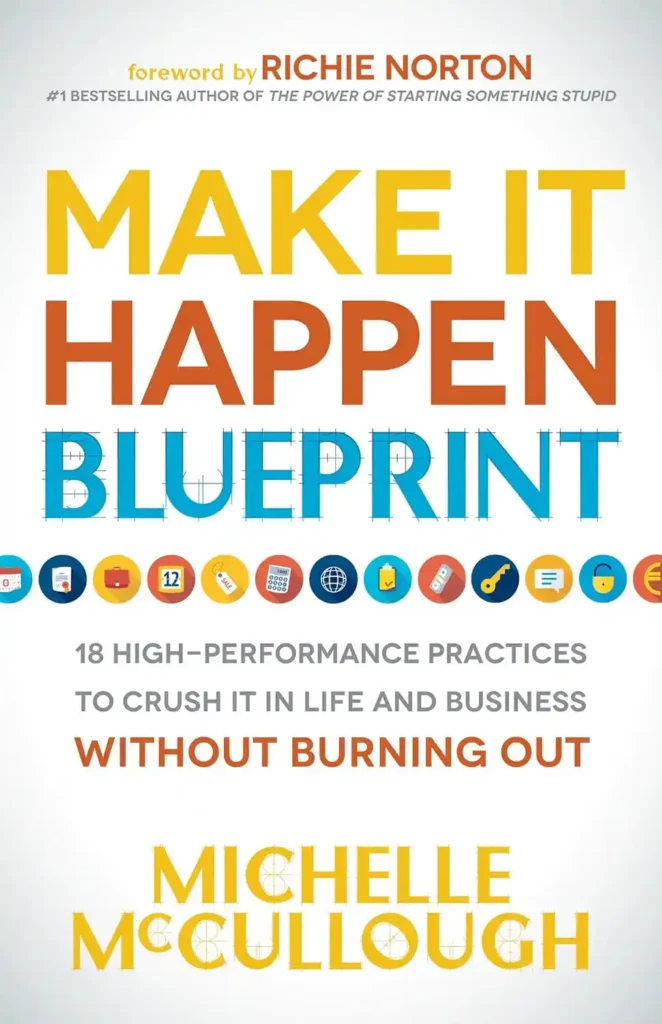
This article is inspired by the chapter on Purpose in Make It Happen Blueprint: 18 High-Performance Practices to Crush It in Life and Business Without Burning Out by Michelle McCullough (Morgan James Publishing, 2017).
Related posts:
 Make It Happen Blueprint: 18 High-Performance Practices to Crush It in Life and Business Without Burning Out (Full Summary & Course)
 The Power Team Pyramid: Who You Need Around You to Reach Big Goals
 How to Raise High-Performing Kids: 6 Anchor Points That Work
 The Life Balance Myth: Why High Performers Choose Priorities Over Balance
 Your Body Is the Vehicle for Your Dreams: 8 Healthy Habits of Successful People