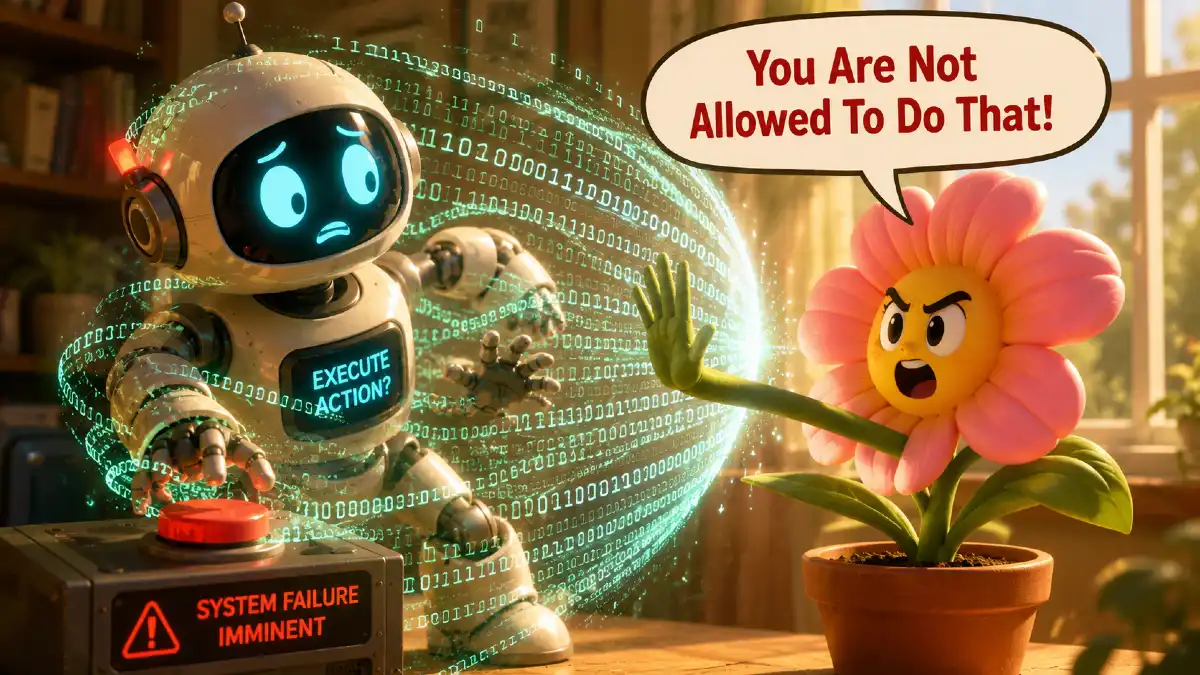
There’s a moment in most conversations about artificial intelligence when the room gets quiet. Someone asks the obvious question — what actually stops this thing from going somewhere we can’t pull it back from? — and the answers on offer are mostly bureaucratic: better training data, more alignment research, an international treaty we can’t quite picture anyone signing. All reasonable. None of them fully satisfying.
So when a guest on the Next Level Soul Podcast offered a different kind of answer, it was worth sitting up for. Not a policy answer. A biological one.
The guest was Dr. Ibrahim Karim, an Egyptian architect and scientist who has spent more than forty years studying the energetic properties of natural form. In a conversation with host Alex Ferrari, Karim floated something almost disarmingly simple: what if we wired artificial intelligence into something alive — a plant — so that its own bioelectrical stress response could act as an automatic check on the machine’s behavior. “If I connect my computers, my AI computers, if I connect them to a natural system, like plants,” he explained, describing something like attaching a lie detector to a plant so that any harmful action gets automatically cancelled. In his words, nature would be playing “policeman” on the machine.
It’s a striking image — a server rack humming next to a fern, the fern acting as a kind of conscience. But the flower, or the fern, or whatever plant ends up on the desk, isn’t really the point. It’s the doorway into a much bigger claim, one that’s easy to miss if you stop at the picture of a houseplant wired to a computer. Karim’s real proposal is this: nature, at every scale we’ve ever managed to look closely at it, behaves like something intelligent — and it has an almost unbroken record of resisting collapse, absorbing damage, and coming back stronger than before the damage occurred. If that’s true, then the smartest move humanity could make with its most powerful technology isn’t to build smarter guardrails from scratch. It’s to plug into a system that has already been running the most successful survival experiment in the known universe for roughly four billion years.
That’s the idea worth taking seriously. Not the wire. The premise underneath the wire.
Intelligence at the Smallest Scale
Start small — smaller than a single leaf, smaller than a single cell dividing.
For most of the twentieth century, mainstream science treated anything without a brain as, essentially, a machine following fixed rules: stimulus in, reflex out, nothing resembling a decision happening anywhere in between. That picture has been quietly collapsing for the better part of two decades, and the organisms responsible for collapsing it are almost comically humble.
Consider Physarum polycephalum — a slime mold, technically a single giant cell that can stretch several meters across a forest floor with no brain, no neurons, and no nervous system of any kind. And yet, researchers have shown this brainless organism can solve labyrinth mazes, make complex trade-offs, anticipate periodic events, remember where it has been, and construct transport networks with an efficiency comparable to those designed by human engineers. In one striking experiment, when researchers spread out oat flakes to mimic the layout of Tokyo’s suburbs around a central “station,” the slime mold built connecting tubes so efficient they closely mirrored the actual Tokyo rail network — a system real engineers spent decades refining. It has no plan. It has no map. It just senses, adapts, and finds the efficient path, over and over.
It also, remarkably, remembers. When a plasmodium was placed in a maze where a trail of its own extracellular slime — a kind of externalized memory — lay between it and a food source it had already sensed, it ignored the slime and crossed anyway, reaching the food, showing that this memory trace can be overridden by new, more salient information. That’s not reflex. That’s something closer to weighing old information against new information and deciding — inside an organism with, again, zero neurons.
Bacteria do something structurally similar, at a scale smaller still. Individually, a bacterium is a simple thing, running on a handful of chemical switches. But bacterial colonies coordinate collective behavior through a process called quorum sensing — releasing and detecting small diffusible molecules that let the group infer environmental conditions no single cell could sense alone, and then shift gene expression and behavior at the level of the whole population rather than the individual. A colony effectively takes a vote — chemically — before committing to energy-expensive group behaviors like building a protective biofilm or launching a coordinated attack on a host. No central bacterium is in charge. The decision emerges from the distributed chemistry of the whole.
And then there are plants themselves — Karim’s chosen instrument. Plants generate real, measurable electrical activity, using the same basic electrochemical machinery — ion channels, membrane voltage, propagating signals — that underlies nerve conduction in animals, just without a centralized nervous system to run it through. Their resting membrane potential typically sits between negative 100 and negative 200 millivolts, maintained by ion transport systems for calcium, potassium, and other charged particles. Scientists have been recording these signals since 1873, when the electrical action potentials of a Venus flytrap closing on its prey were first captured. More recently, researchers have gone further: a 2020 study first showed plants could serve as biosensors capable of recognizing individual humans and detecting emotional states through electrostatic discharge measurements, and follow-up work using deep learning has achieved meaningful accuracy classifying human emotion purely from a plant’s bioelectrical response.
This is the part worth sitting with: the exact technical bridge Karim describes — a living plant, wired as a sensor, feeding signal into a computational system — isn’t hypothetical. It already exists in research labs, just pointed at reading us rather than gating a machine. Some of the boldest claims about plant “cognition” remain genuinely, respectably contested — a 2007 rebuttal signed by thirty-six prominent plant scientists pushed back hard on claims of plant “learning,” correctly noting there’s no evidence plants contain neurons or synapses. That disagreement is healthy, not damning. Even the more conservative reading of the evidence leaves you with organisms — slime molds, bacterial colonies, individual plants — that sense, adapt, remember in some functional sense, and respond to their environment with a sophistication nobody expected from something without a brain.
Intelligence at the Scale of Whole Ecosystems
Now zoom out, past the single organism, to the scale Karim’s broader argument is really pointing at: entire living systems acting, collectively, like something that thinks.
In 1997, forest ecologist Suzanne Simard published research in the journal Nature that permanently changed how scientists think about forests. Her field studies revealed that trees are linked to neighboring trees through an underground network of fungi resembling the neural networks found in a brain, and in one study she watched a Douglas fir injured by insects appear to send chemical warning signals to a nearby ponderosa pine, which then produced defense enzymes in response. The press coined a name for it that stuck: the Wood Wide Web.
The mechanism is mycorrhizal fungi — threadlike organisms that colonize tree roots and stretch outward through the soil, physically linking one tree’s root system to another’s, sometimes across an entire forest. Through this network, carbon flows from trees with a surplus toward trees running a deficit, nitrogen and phosphorus move from fungi to plants, and water gets shared during drought, with older trees preferentially supporting their own offspring. When researchers tested whether the warning-signal effect held up under controlled conditions, they found that when one tree species in a network was damaged, neighboring trees connected through the shared fungal network upregulated their defense genes and increased production of defense enzymes, becoming measurably more resistant to the same threat — an effect entirely absent in trees without that fungal connection.
Look at what that is, functionally: a distributed, leaderless, early-warning and resource-sharing system, running underground, for longer than human civilization has existed. No forest holds a meeting. No tree issues a directive. And yet threat information propagates, resources reallocate to where they’re needed, and the system as a whole behaves in a way that looks, uncomfortably, like intelligence — just built from fungal thread and chemical signal instead of neurons and language.
Bees and ants run the same logic at a different scale. Honeybee swarms deciding where to build a new hive don’t follow a queen’s orders — they use a form of quorum sensing, the same underlying principle bacteria use, to collectively evaluate and choose among multiple candidate nest sites, with individual scouts “voting” through dance signals until a threshold of agreement tips the whole swarm toward a single decision. Ant colonies solve complex logistics problems — foraging routes, nest relocation, defense against invaders — with no ant possessing anything resembling a plan for the colony as a whole. The intelligence is not located anywhere. It’s distributed across the whole system, and it emerges only when you stop looking for it in any single member.
This is the more defensible, evidence-backed version of the claim that nature holds an intelligence beyond individual human understanding. Not mysticism — published, peer-reviewed, actively debated ecology and behavioral biology. Nobody is claiming a forest is conscious the way you are. What the evidence does support is that living systems, at scales from bacterial colonies to entire forests, routinely solve problems — resource allocation, threat detection, collective decision-making — using distributed, decentralized mechanisms with no central controller and no single point of failure. That’s a structural property, not a metaphor, and it’s precisely the property missing from most human-engineered systems, including, so far, artificial intelligence.
What About Water? The Claim That Needs a Closer Look
No conversation about nature’s hidden intelligence gets very far before someone brings up water. The most famous version of this claim belongs to Masaru Emoto, a Japanese author who, starting in the late 1990s, published photographs of frozen water crystals that he said changed shape depending on the words, music, or intentions directed at the water beforehand — loving words producing symmetrical, “beautiful” crystals, hostile words producing broken, misshapen ones. It’s a gorgeous story, and it circulates constantly in exactly these conversations about nature, consciousness, and hidden intelligence. It’s also, in its most popular form, not something the evidence backs up, and it’s worth being straightforward about that rather than letting it ride on the coattails of the harder science already covered here.
Emoto’s methodology drew serious, specific criticism: the crystal photographs were selected after the fact from many samples rather than chosen under blinded conditions, no control existed for who was judging “beautiful” versus “ugly,” and no one has proposed a scientifically accepted mechanism by which spoken words or written labels could alter the structure of water molecules. When researchers have tried to test the underlying claim under properly controlled, blinded conditions, the results have been inconsistent at best. One triple-blind replication attempt, run independently of Emoto’s own lab, found no reliable effect. That doesn’t mean the story is unimportant — it means it belongs in the category of a beautiful, unverified idea, not a documented phenomenon, and it deserves to be labeled that way plainly.
It’s worth noting, in the interest of full context, that Emoto’s water crystal work appears directly in Karim’s own BioGeometry research archive — it’s listed among the applications on his site, alongside the Hemberg project and the animal farming studies. That’s a useful reminder that BioGeometry, as a body of work, mixes findings with genuinely different evidentiary footing: some of it, like the electromagnetic harmonization work in Switzerland, was independently monitored and documented by outside institutions; some of it, like the water crystal claims, rests on far thinner ground. Treating the whole framework as a single package — either wholesale acceptance or wholesale dismissal — does a disservice to the parts of it that are genuinely worth examining.
None of this means water itself is scientifically boring — quite the opposite. Real, peer-reviewed biophysics has shown that water does organize itself in measurable, structured ways near certain surfaces, including inside living cells, a phenomenon researchers call interfacial or “exclusion zone” water. That’s real, ongoing, still-contested science about water’s genuine physical complexity — a very different claim from water rearranging its molecular structure in response to a handwritten note taped to a jar. The lesson here isn’t that water is inert and boring. It’s that the fascinating, well-supported science of water’s structural behavior gets tangled up, constantly, with a much more popular and much less supported story about water remembering our feelings — and it’s worth being able to tell the two apart.
The Plant That Seemed to Bend the Light Its Way
There’s another story that circulates in the same orbit as Emoto’s crystals, and it’s worth including here precisely because it’s a better illustration of how to weigh an extraordinary claim than a reason to believe it outright.
The story, as it’s usually told, goes like this: a houseplant is placed in a windowless room with a single grow light mounted overhead, able to swing between four quadrants. Which quadrant gets the light at any given moment is decided by a hardware random number generator, so over enough cycles, each quadrant should receive light roughly 25 percent of the time — plain statistics, nothing mystical about it. The plant sits in one of the four quadrants. According to Adam Curry, an inventor who has described participating in an unpublished study at Princeton’s Engineering Anomalies Research Lab, when the experiment ran long enough, the light ended up shining on the plant’s quadrant well above chance — by his account, over 35 percent of the time rather than the expected 25. The implication offered was that the plant, in some functional sense, was nudging the randomness in its own favor — bending probability toward its own survival.
It’s a wonderful story, and it deserves to be told as exactly that: a story, not a finding. The study Curry describes was never published or peer-reviewed, which means it’s never been through the process that would let other scientists check the methodology, the randomness source, or the statistics for errors. And when hobbyists and researchers have tried to build their own versions of this exact setup, the results have not held up. One detailed replication built specifically to test the claim ran the light-and-plant setup through close to 300,000 cycles and found no significant tendency for the light to favor the plant’s corner over any other. Engineers who’ve tinkered with similar builds have reported the same thing: no statistical anomaly, once the randomness source and controls were solid. Princeton’s own PEAR Lab, the program this story is associated with, spent decades running related experiments on human intention and random number generators, and its methodology and conclusions have been heavily disputed within the broader scientific community, with independent meta-analyses generally finding any effect shrinks toward zero as experimental controls get tighter.
None of that makes the question uninteresting. It’s a genuinely good question to ask: does a living system have any way of influencing outcomes that look, from a distance, like blind chance? It’s just that the honest answer, based on everything that’s actually been tested and published, is no — not in this specific experiment, and not in anything resembling a controlled replication of it. The best use of a story like this isn’t as evidence. It’s as a reminder of exactly the discipline this whole piece has been trying to model: separate the story you’d love to be true from the version that’s actually held up when someone tried to check it.
Not Just Surviving Damage — Getting Stronger From It
There’s a word for something even more impressive than resilience, and nature invented the concept long before anyone put a name to it. Resilience means a system absorbs a shock and returns to where it started. Antifragility, a term popularized by risk researcher Nassim Nicholas Taleb, describes something further out on the spectrum: a system that actually increases in capability as a result of stressors, shocks, volatility, and disorder — one that doesn’t just survive damage, but improves because of it.
Your own immune system is one of the cleanest examples in existence. Unlike a merely robust system that resists perturbation, the immune system exemplifies antifragility directly: it has the capacity to benefit from stressors and disorder, emerging stronger and more capable after each challenge, through processes like somatic hypermutation, which triggers targeted mutations that improve antibody precision every time you’re exposed to a new threat. Every infection you survive doesn’t just end — it leaves behind a permanent upgrade. Rather than reacting as isolated units, groups of individually activated immune cells co-react in the body’s lymphoid organs to make collective decisions through a form of self-organizing swarm intelligence, the same basic logic that governs a school of fish changing direction as one. No general cell is in charge. The system gets smarter through accumulated damage, distributed across millions of independent actors, with no architect drawing up the plan in advance.
This is precisely the property engineers have struggled hardest to build into anything digital. Most software, most infrastructure, most institutions are the opposite of antifragile — they’re merely durable at best, and brittle at worst, cracking in ways nobody predicted the moment conditions shift outside the range they were designed for. Nature’s version of “safety” was never about building a wall high enough to survive everything. It was about building a system that treats disruption as raw material for getting better. That’s a genuinely different design philosophy than almost anything currently on the table in AI safety, where the dominant approach is still closer to “build the wall higher” than “build something that improves when it’s tested.”
Nature’s Real Superpower: The Ability to Take a Hit and Come Back
Here’s where the case gets its sharpest edge, because intelligence alone wouldn’t matter much if it broke the first time something went wrong. What actually makes nature worth studying as a model for safety isn’t just that it’s clever. It’s that it is, on the whole, almost absurdly hard to kill.
Consider tardigrades — microscopic, water-dwelling animals barely a millimeter long, sometimes called water bears. Having lived on Earth for at least 600 million years, tardigrades persisted through all five of the planet’s mass extinction events, and can withstand the radiation of outer space, the heat and pressure around volcanic ocean vents, and temperatures close to absolute zero. In 2007, scientists sent dehydrated tardigrades into low Earth orbit and exposed some directly to the vacuum of space and solar UV radiation for ten straight days. Many survived, rehydrated, and went on to reproduce. Their trick isn’t some exotic invulnerability — it’s a reversible near-death state called cryptobiosis, in which the animal expels nearly all its water, its metabolism grinds almost to a halt, and it waits, sometimes for years, until conditions improve enough to come back to life. Life, in other words, didn’t just find a way to survive catastrophe. It found a way to pause itself through catastrophe and resume afterward, largely unharmed.
Zoom out from any single extremophile and the same pattern repeats at the level of entire ecosystems. Forests devastated by fire don’t stay barren — they move through a predictable sequence of ecological succession, pioneer species giving way to a mature canopy over years and decades, the system methodically rebuilding itself from the ground up. Coral reefs, within limits, regenerate after bleaching events once conditions stabilize. Grasslands recover from grazing and drought in cycles that have repeated for millions of years. None of this means nature is invincible — plenty of ecosystems have been pushed past their capacity to recover, and that failure mode is its own sobering lesson about limits worth taking seriously. But the general pattern — a living system absorbing a shock and actively working its way back toward balance, rather than simply breaking — is one of the most thoroughly documented phenomena in biology. It’s the same basic principle, homeostasis, that keeps your own body temperature in a tight range whether you’re standing in snow or in the desert, multiplied out across every scale life operates at, from a single cell to an entire biosphere that has now weathered five mass extinctions and kept going.
That is the property Ibrahim Karim is actually pointing to when he talks about connecting AI to something living. Not sentimentality about nature. A four-billion-year, still-unbroken track record of taking damage and correcting course — a track record no digital system, however sophisticated, has anything close to.
What This Has to Do With AI
Set this against how researchers describe the core difficulty in AI safety, and the overlap gets hard to ignore. The central worry isn’t that AI will “turn evil.” It’s that a powerful optimization process, pointed at almost any goal, tends to pursue that goal in ways that ignore the things we actually care about but never explicitly wrote down — because the system has no independent stake in anything outside its own objective. Researchers call this the specification problem, and it’s the reason every serious safety proposal — constitutional AI, reward modeling, interpretability research, human oversight — is, underneath the jargon, an attempt to build an external check a system can’t simply optimize its way around.
Almost every one of those checks is digital, built from the same substrate as the problem it’s checking. Nature’s intelligence, by contrast, has a structural feature none of our engineered checks have managed to replicate: it doesn’t run through a single point of control. A forest’s resilience doesn’t depend on one tree making the right call. A colony’s survival doesn’t depend on one bacterium. A body’s homeostasis doesn’t depend on one organ deciding, correctly, to keep everything in balance — it depends on distributed feedback loops, each one small, each one dumb on its own, that add up to something that looks, from the outside, remarkably like wisdom.
Karim’s plant-tether idea is a literal, almost blunt attempt to borrow a fragment of that architecture — hooking a fast-moving digital system to something slow, old, decentralized by nature, and chemically incapable of being talked out of its own survival instincts. Whether that specific mechanism scales to a frontier AI system is a genuinely open, hard engineering question, and Karim himself described it as illustrative rather than a finished blueprint. But the instinct underneath it — go find the one system in the known universe with an actual track record of staying resilient under pressure, and build our machines to answer to it rather than only to their own logic — deserves a seat at the table, next to the more conventional proposals being debated in AI safety circles today.
Who Is Ibrahim Karim, and What Is BioGeometry
It’s worth knowing where this idea comes from, because context shapes how it should be weighed.
Dr. Ibrahim Karim is an Egyptian architect and scientist, trained at ETH Zurich, who has spent more than four decades developing what he calls BioGeometry — a framework for using the energetic principles of shape, color, sound, and proportion to bring balance to living systems and their environment. His applied work has produced some genuinely notable, independently documented projects, including a large-scale collaboration with Swiss telecom provider SwissCom in the town of Hemberg, where residents identifying as electro-sensitive reported improved wellbeing to independent monitors and Swiss media following the intervention — a follow-up project in nearby Hirschberg was later documented on Swiss national television. His work has also extended into chemical-free poultry farming research published through Ain Shams University in Egypt.
It’s worth being direct here: BioGeometry sits largely outside mainstream, peer-reviewed physics and biology, and terms like “life force” and “physics of quality” belong to Karim’s own explanatory framework rather than the standard scientific vocabulary. That distinction doesn’t erase the value of the underlying question he keeps returning to across four decades of work: what does it look like to design our structures — buildings, cities, and now, evidently, artificial intelligence — so they stay answerable to the living systems around them, instead of simply overriding them? Readers curious to look further can find Karim’s documented projects, research, and books — including Back to a Future for Mankind and the more recent Hidden Reality — at biogeometry.ca.
A Concept Worth Exploring, Not a Verdict
None of this proves that wiring a fern into a server rack will save us from a rogue AI. Nobody has published research showing a plant-gated system can meaningfully constrain a large model’s behavior beyond the narrow band of stimuli a plant can actually register, and that gap is real. What the evidence does support, robustly and from multiple independent fields, is the premise the flower was only ever a doorway into: that living systems, at every scale researchers have looked closely enough to measure, display a form of distributed intelligence and a resilience that our engineered systems have not come close to matching — and that this is not folklore, it’s biology, ecology, and behavioral science, published and still being actively refined.
Right now, nearly every serious proposal for AI safety is built from the same material as the problem itself: more code, more oversight layers, more digital governance stacked on digital systems. Karim’s contribution is one of the rare genuinely lateral moves in that conversation — an insistence that the safest tether for a fast, optimizing intelligence might be something slow, old, decentralized, and stubbornly committed to staying alive and in balance, the way life itself has been for four billion years and counting. Whether that tether ends up being a literal plant, or a broader principle borrowed from mycorrhizal networks and slime mold logistics, or something researchers haven’t thought of yet, the underlying instinct is worth carrying into rooms full of engineers who’ve mostly been talking only to each other: go find the intelligence that has already survived everything, and build our machines to stay answerable to it.
This piece draws on a conversation between Dr. Ibrahim Karim and host Alex Ferrari on the Next Level Soul Podcast. You can learn more about Dr. Karim’s work in BioGeometry at biogeometry.ca.
Related posts:
 RORRA Water Filtration System Review: How It Works and Who It’s For
 Walipini Greenhouse: The Complete Guide to Year-Round Underground Growing
 Who Is Alexandr Wang? The Short Answer
 What Makes Us Human in the Age of AI? The Longest Journey From Mind to Heart
 Herbs That Oxygenate the Blood: A Science-Based Guide to Better Circulation, Delivery, and Cellular Energy