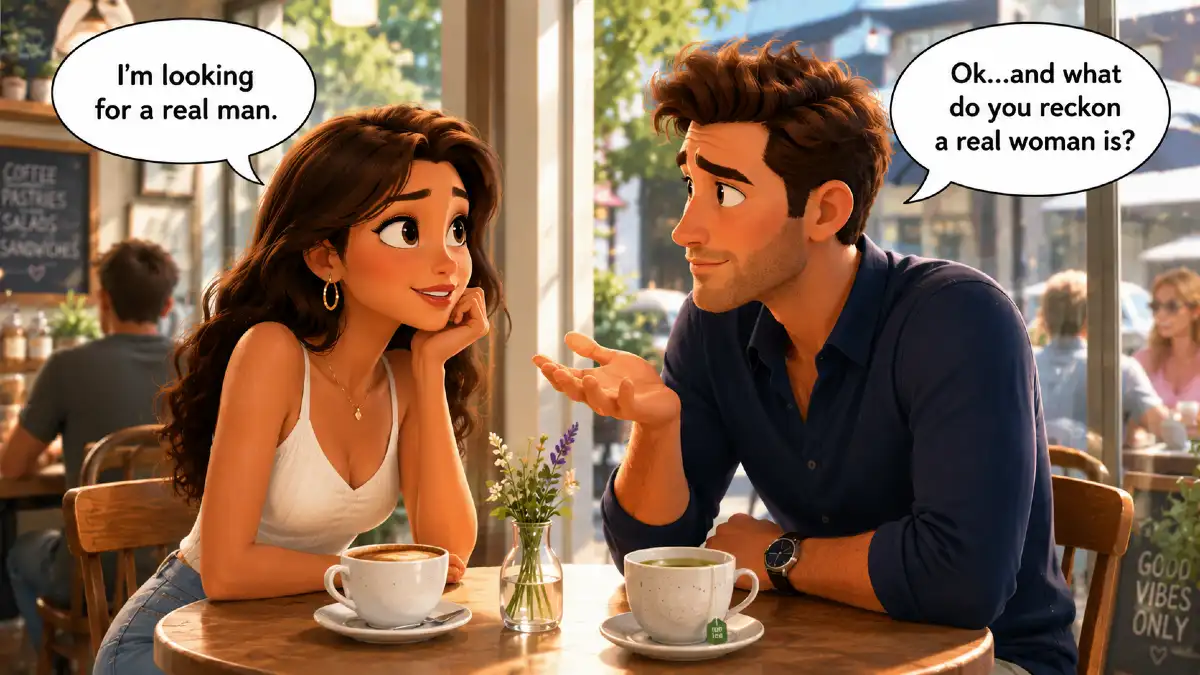
Ask a hundred strangers what a real man looks like, and you’ll get the same answer a hundred times, give or take a few words. He protects. He provides. He keeps his word. He doesn’t hit a woman, even when she hits him. He opens the door, carries the weight, takes the hit so someone else doesn’t have to. You didn’t need a seminar to know this. You absorbed it before you could read, from cartoons and grandfathers and the particular silence that falls on a room when a boy cries too long.
Now ask those same hundred strangers what a real woman looks like.
Watch what happens. The room doesn’t answer in unison anymore. It fractures. Someone says a real woman is independent. Someone else says nurturing. Someone says it’s whatever she wants it to be, that the question itself is the problem, that “real woman” is an outdated cage and good riddance to it. Nobody hesitates over the man question. Everybody hesitates over the woman question. That gap — the instant, unanimous clarity on one side and the shrugging, contested silence on the other — is not an accident of culture. It’s the whole story. And it’s worth sitting with, because it explains more about why men feel quietly exhausted in modern relationships than almost anything else being said about dating today.
This piece is inspired by a short, sharp piece of commentary from creator Jade — @mintyjadex on Instagram — who put her finger on something most relationship content dances around: that men were handed a rulebook for how to treat women, and women were never handed the matching one for how to treat men. What follows takes that observation and pushes further into the asymmetry itself — why one definition calcified into stone while the other stayed liquid, and why society only seems to tolerate the expectation flowing in a single direction.
The Man Who Never Gets to Update His Software
Here’s the strange part. The archetype of the “real man” hasn’t meaningfully moved in generations. Strip away the surface — the haircuts, the jobs, the slang — and the underlying code is identical to what it was in your grandfather’s era. Protect. Provide. Endure in silence. Never hit back. Be the one who absorbs the blow so the people around you don’t have to. You can find this same figure in a 1950s Western, a Marvel film, and a TikTok comment section arguing about “what men are supposed to do,” and he is, structurally, the same man.
Compare that to the “real woman.” She is allowed — encouraged, even — to be defined entirely on her own terms, and to redefine herself as often as she likes. She can be a girlboss or a trad wife, hyper-independent or radically soft, career-first or family-first, and each version gets its own hashtag, its own affirming corner of the internet, its own chorus insisting that this is what real femininity actually means. There is no equivalent permission structure for men. A man who tries to redefine masculinity on his own terms — softer, quieter, less providing, less protecting — isn’t celebrated for authenticity. He’s usually just quietly reclassified as less of a man.
This isn’t a complaint about which version is harder. It’s an observation about which version is allowed to breathe. Femininity today is treated as a spectrum you can walk along and select from. Masculinity is treated as a fixed exam you either pass or fail, and the passing grade hasn’t changed since the exam was first written. This is part of why the conversation around why the man box is tightening rather than loosening keeps resurfacing — because it is tightening, even while the equivalent box for women is being actively, publicly dismantled.
The Double Standard Nobody Wants to Name
Here’s where it gets uncomfortable, and where most articles on this topic quietly change the subject. Women, as a cultural default, are granted something close to an inherent right to define what they expect from men. She can want tall. She can want ambitious. She can want emotionally available but also stoic under pressure. She can want a man who provides but never brings up money, who’s confident but never assertive, who’s a protector but never “controlling.” Nobody polices this list. It’s treated as simply her preference, her prerogative, her right to want what she wants.
Now flip it. Let a man articulate, out loud, a list of qualities he expects from a woman — loyalty, softness, warmth, effort in how she shows up for him — and watch how quickly the conversation shifts from “his preference” to “his problem.” He’s not expressing a standard anymore. He’s exhibiting toxic masculinity. He’s entitled. He’s asking a woman to shrink herself to fit his fragile ego. The exact same cognitive act — a person naming what they want from a partner — gets read as neutral in one direction and suspect in the other.
This is worth being precise about, because it’s easy to overcorrect into either “men have it worse” or “this isn’t real,” and neither is quite true. What’s actually happening is structural, not personal: one gender’s expectations get treated as identity (she just is this way, this is just what she needs) while the other gender’s expectations get treated as ideology (he’s been conditioned by patriarchy, he needs to unlearn this). The content underlying this piece names this exact bind — men were raised on a script written entirely by other people, and now they’re being told the script itself was the problem, without anyone handing them a replacement.
“What Do You Bring to the Table?” — and the Answer Nobody’s Allowed to Give Back
You’ve seen the meme. A woman asks a man, plainly, “what do you bring to the table?” It’s treated as a legitimate, even admirable, filtering question — a woman doing her due diligence, protecting her time, holding a standard. Nobody bats an eye. It’s smart. It’s self-respect.
Now flip the question. Ask a woman what she brings to the table, and watch the entire tone of the internet change. The stock answer, delivered with total confidence, is: I am the table.
Sit with that for a second, because it’s funnier and sadder than either side of the meme wars usually admits. It’s funny because it’s a genuinely clever piece of rhetorical judo — flipping an interrogation into an assertion of inherent worth. It’s sad because it reveals, in five words, exactly the asymmetry this whole article is about. A man is expected to bring something — measurable, external, demonstrable: income, ambition, protection, a plan. A woman, in this framing, doesn’t need to bring anything, because her presence alone is positioned as the value. One side is evaluated on output. The other side is exempted from the question entirely by definitional fiat.
The meme isn’t really an argument. It’s a shield. And it works precisely because nobody wants to be the person who says, out loud, “actually, that’s not an answer, that’s a deflection.” Because saying that gets you labeled bitter, or worse, a misogynist, which is exactly the mechanism described a few paragraphs up: the same question, judged by different rules depending on who’s answering it. It’s the same dynamic explored in what “high value” actually means in modern dating — value has quietly become something men must prove and women are simply assumed to already possess.
Where This Asymmetry Actually Came From
None of this happened by conspiracy. It happened by story. For as long as any of us have been consuming culture, boys have been handed an unbroken chain of instruction on how to treat a woman. Every fairy tale, every action movie, every coming-of-age arc: rescue her, protect her, carry the burden, absorb the hit, never raise a hand even if she raises hers. The lesson was total. It came from fathers, from films, from folklore, from the quiet correction of “don’t hit a girl” repeated to every boy who ever needed reminding.
But girls were never handed the mirror image. There is no equivalent canon of stories where a girl learns, scene by scene, how to be loyal to a man, how to meet his softness with her own, how to notice the weight he’s carrying and lighten it. Princesses are rescued. They are rarely shown rescuing back, in the emotional sense that matters — showing up for a man’s bad day the way he’s expected to show up for hers. Parents don’t teach this half of the equation. Schools don’t teach it. And the broader cultural conversation of the last two decades has spent far more energy telling young women what they’re owed than what they might, in turn, owe.
The result isn’t malice. It’s a gap. An entire generation of women absorbed, without ever consciously choosing to, a story that men are the historical problem and that repair is something done to them, not with them from both sides. Meanwhile an entire generation of men absorbed the opposite story: that a real man gives, endures, and doesn’t ask for reciprocity, because asking makes him needy, and needy is the one unforgivable sin in the modern masculine code. You can watch this exact collision play out article after article on this site — in why nice guys end up resentful over covert contracts they never voiced, in the psychology of why men stop chasing and what happens next, in the quiet epidemic of men who provide everything and receive very little modeling of what it looks like to be met halfway.
The Cost Nobody’s Tallying
Here’s the part that tends to get lost in the noise: this isn’t really a men-versus-women issue. It’s a debt that’s come due, and both sides are paying interest on it. Men are exhausted from performing an unchanging archetype that was never allowed to evolve, while quietly absorbing the message that wanting anything back makes them lesser. Women, meanwhile, are often just as confused as the men in their lives, because nobody ever taught them the vocabulary of feminine contribution either — how to be soft without being a doormat, how to be devoted without disappearing, how to respect a man’s effort instead of treating it as the baseline he owes her for existing.
This is why the piece that inspired this article lands the way it does. It’s not an accusation. It’s closer to a diagnosis: you cannot expect a woman to reciprocate a script she was never handed, any more than you’d expect a man to speak a language he was never taught. The men writing paragraph after paragraph about why modern dating feels so hard aren’t wrong that something is broken. They’re just often aiming the diagnosis at the wrong target — at “women today,” instead of at the asymmetric curriculum both sexes were quietly enrolled in from birth.
And there’s a second cost that rarely gets named: the same women who were never taught reciprocity are, by most honest accounts, not thriving under the current arrangement either. The freedom to define womanhood however she likes hasn’t obviously translated into more contentment — a pattern explored at length in why young women are unhappy despite having more freedom than ever. Total definitional freedom, it turns out, isn’t the same thing as clarity. Sometimes it’s just a more comfortable form of confusion.
Why “It’s Toxic” Became the Universal Off-Switch
It’s worth asking, honestly and without flinching, why male reciprocity requests get treated so differently than female ones. Part of it is history — men have, for most of recorded time, held disproportionate structural power, and there’s a real, defensible instinct to be wary of that power reasserting itself through the back door of “expectations.” That wariness isn’t paranoid; it’s earned.
But wariness curdles into something less honest when it gets applied indiscriminately — when a man simply asking to be treated with warmth, or noticed, or met with the same effort he’s putting in, gets filed under the same heading as actual control or entitlement. The word “toxic” was built to describe genuine harm: manipulation, control, contempt. When it’s stretched to also cover a man quietly wishing his partner would initiate affection once in a while, the word stops doing diagnostic work and starts doing silencing work. It becomes less a description of behavior and more a conversational trump card — the one phrase that ends the discussion before it starts, discussed at length in the men’s guide to handling manipulative phrases in relationships.
The honest version of this conversation has to hold two things at once: men genuinely have, historically, over-defined womanhood in restrictive, harmful ways, and it is genuinely true that a man today asking for basic reciprocity is not automatically doing the same thing. Collapsing those two facts into one accusation is how an entire generation of otherwise decent men ended up afraid to say, out loud, what they actually need from a partner — a pattern this site has traced closely in the hidden crisis of male emotional health and why so many men suffer in silence.
What Reciprocity Would Actually Look Like
None of this is an argument for women abandoning their standards, or for men lowering theirs. It’s an argument for symmetry — for both halves of a relationship being trained in the specific, nameable skill of showing up for the other person, rather than one half being trained exhaustively and the other left to improvise.
What would the missing curriculum actually contain? Probably something like this: noticing effort instead of treating it as background noise. Meeting a man’s provision with warmth instead of quiet entitlement. Understanding that softness genuinely changes how a man shows up far more effectively than demands do. Learning what David Deida calls feminine communication — not as a performance for male approval, but as a real, developed capacity for emotional attunement that a partner can actually feel. None of this requires a woman to become smaller. If anything, it requires the opposite: an active, developed skill set, the same way “being a gentleman” was never passive for men — it was drilled, corrected, and reinforced for two decades before most men ever got into a serious relationship.
And on the other side, the same fairness has to run through the masculine ledger too. If men are going to keep being told to evolve, to grow, to unlearn old patterns — and they should, because nice guy syndrome and covert-contract resentment are real, self-inflicted wounds — then that evolution has to be met with an equally serious evolution on the other side of the table, not a fixed exemption from ever having to change at all.
Clarity Is the Actual Fix
The point of naming a double standard isn’t to win an argument about who’s had it worse. It’s to get to clarity, because clarity is what actually lets two people build something durable. Right now, a huge number of relationships are running on mismatched operating systems: he’s running 1950s software that was never updated, and she’s running whatever version of womanhood felt right to her that particular year, and neither has been given the vocabulary to explain the mismatch to the other without it turning into a fight about who’s the villain of modern dating.
The fix isn’t reverting to an old script, and it isn’t pretending the asymmetry doesn’t exist. It’s building an actual, symmetrical understanding of what synergy between masculine and feminine energy requires — a way of thinking about relationships as complementary systems rather than competing ledgers of who owes whom. Both people learning to love each other well. Both people learning what contribution from the other gender actually looks like, instead of just knowing what they’re owed. That’s the whole argument, stripped of the noise: not that women are the problem, not that men have it worse, but that only one half of the population was ever handed the instructions, and it shows.
Seven Questions Worth Sitting With
These aren’t rhetorical. They’re meant to be sat with — alone, or with a partner, honestly, without reaching for the nearest defensive label the moment one of them stings a little.
1. If you can list, without hesitation, five qualities that make a “real man,” can you list five that make a “real woman” with the same confidence — and would most people agree with your list?
2. Were you ever explicitly taught what it looks like to give to a partner, or were you only ever taught what you deserved to receive?
3. When a man states a clear expectation of his partner, why does that so often get labeled a red flag, while the same act from a woman gets labeled a healthy standard?
4. Is “I am the table” actually an answer to what you bring to a relationship, or is it a well-built deflection that both sexes have simply agreed not to examine too closely?
5. Has the freedom to define womanhood however you like actually made women more fulfilled, or has it just replaced one set of pressures with a quieter, more isolating one?
6. If masculinity is expected to keep evolving in response to legitimate criticism, is femininity being asked to do any of the same work — and if not, why not?
7. What would it cost you, personally, to name what you actually need from a partner out loud, instead of hoping they’ll intuit it — and is that fear the same fear, or a different one, depending on your gender?
Where This Leaves Us
Nobody hesitates when asked what a real man is, because that definition was drilled into all of us with total consistency, generation after generation, until it calcified into something unquestionable. Nobody agrees on what a real woman is, because that definition was left deliberately, almost proudly, unfinished — a canvas instead of a code. Both of those facts are true, and neither one, on its own, is the villain of this story.
The actual villain is the silence in between — the unspoken agreement that men should keep updating themselves indefinitely while women get to keep their definition permanently open, and that pointing this out is itself the toxic act. It isn’t. It’s just honesty, offered in the same spirit Jade offered it in the piece that sparked this one: not as an attack, but as an invitation to actually look at the imbalance instead of flinching away from it. Real change, for both sexes, starts exactly there — with a willingness to ask the uncomfortable question before demanding the comfortable answer.
Related posts:
 When a Strong Woman Gets Soft: Why Her Inner Child Showing Up Is the Rarest Gift to You in a Relationship
 Men, Where Have You Gone? A Male Perspective on the NYT Article
 How to Attract High-Value Women by Mastering Yourself First
 Is Having a Boyfriend Embarrassing Now? The Psychology Behind the Debate
 What Women Want in Dating: The Truth Most Advice Gets Wrong