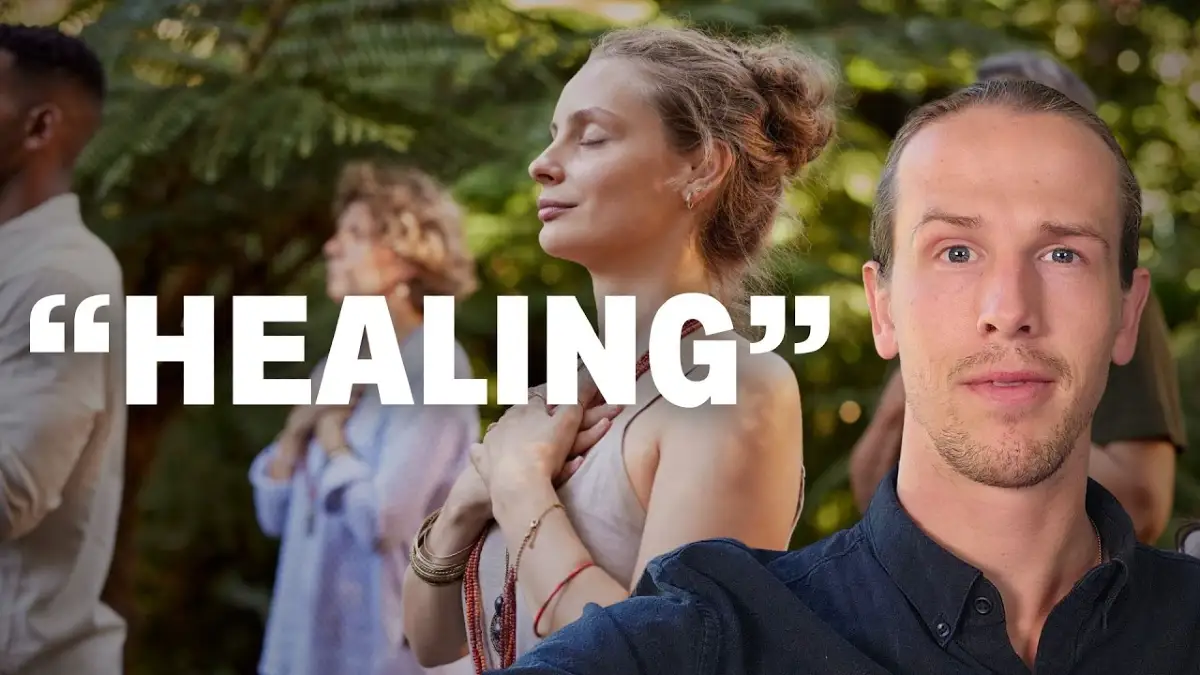
Walk into most conscious community spaces and you’ll find a familiar rhythm. A sharing circle opens the day. Somatic check-ins follow. Then breathwork, then yoga, then a session on attachment theory, then shadow work, then more breathwork. The nervous system is discussed constantly. Processing is the water everyone swims in.
None of this is wrong, exactly. For a lot of people, these spaces have been the first place they ever felt safe enough to open up — to unclench a chest that had been tight for decades, to cry in front of other men without apologizing for it, to finally let their emotional education begin. That matters. It is not nothing.
But there’s a pattern worth naming, one that shows up again and again in communities built around healing: after a while, nothing actually happens. The circle keeps circling. The processing keeps processing. Communities that start out feeling alive slowly calcify into something closer to a support group — well-intentioned, deeply felt, and going nowhere. This isn’t a knock on the people in these rooms. It’s a structural problem, and it points to something specific: a lack of integration with the masculine.
That idea — and the framework behind it — comes from a talk by Alexander Elsden of the ReTribalize Project, a YouTube channel built around building intentional community and helping men (and the communities they’re part of) develop real structure, real accountability, and real forward motion. What follows draws on that talk, expanded and applied to the broader question a lot of men are quietly asking: why do the spaces built to heal us so often fail to build anything at all?
Two Kinds of Work, and the Trap of Choosing One
There’s a relationship between inner work and outer work that almost everyone gets wrong at some point, usually in one particular direction.
When someone wakes up to the fact that the default script — work a job you don’t love, buy things you don’t need, numb out most evenings — isn’t actually working for them, they tend to go looking for something else. They find meditation, or breathwork, or therapy, or psychedelics, or a men’s circle. And a lot of people, once they find that world, make the same mistake: they start prioritizing the inner work entirely over the outer.
It’s an understandable mistake. The inner world feels urgent when you first start paying attention to it. There’s so much to sit with — old wounds, inherited beliefs, a nervous system that’s been on alert since childhood. It’s tempting to believe that if you just process enough, meditate enough, breathe enough, the external life will somehow assemble itself around your newly healed self.
It won’t. Not on its own. A life doesn’t build itself out of insight. At some point the inner work either gets tested against something real in the world, or it stays theoretical — a private, endlessly-refined understanding of yourself that never has to prove anything.
This is where a kind of transformation happens that circles and check-ins can’t produce by themselves: the transformation that comes from committing to something hard, external, and unfinished — and staying with it long enough that it changes you.
Writing a book is one example of a crucible like this. Finishing something that takes years, that gets torn apart by an editor seven drafts in, that has to be written even on the days you’re sick of your own voice — that kind of sustained effort does something to a person’s character that a retreat can’t replicate. The discipline required to sit down for the third day in a row and open the same unfinished page isn’t separate from the “inner work.” It is inner work. It’s just inner work that happens to have an external deadline attached to it, which is precisely what gives it teeth.
The same goes for a long-term committed relationship carried through years of difficulty, or for building and leading a team where people are relying on you and you can’t just process your way out of a conflict — you have to actually resolve it, because the mission depends on it. These are the crucibles. Not the ones you choose because they feel healing. The ones you can’t walk away from without failing at something you said you’d do.
If you want a deeper look at how this plays out over a lifetime — how the demands on a man’s character shift as he ages — the decades-of-a-man’s-life framework is worth reading alongside this. The crucibles change shape, but the principle doesn’t: real transformation tends to arrive disguised as a difficult commitment, not as a breakthrough in a workshop.
Why Commitment Runs Shallow
Here’s the uncomfortable diagnosis: most intentional communities fail, and most conscious communities plateau, for the same two reasons. Commitment runs shallow, and external work is nearly nonexistent.
Compare this to cultures that have actually flourished across history — monastic orders in the medieval period, Bedouin tribes, Native American nations, early Roman society. Whatever their differences, they share one structural trait: each member carried enormous responsibility for the survival and flourishing of the whole. The more responsibility distributed across a community — for the family, for the tribe, for the harvest, for the defense of the group — the higher that culture’s odds of enduring.
There’s a simple reason this works. People carrying real responsibility have less bandwidth for the kind of low-grade dysfunction that eats communities alive — the gossip, the unresolved resentments, the passive-aggressive undercurrents that fill a group with too much free-floating attention and not enough shared load. Busy-with-something-that-matters is one of the most underrated forms of psychological health there is. It’s part of why systems tend to outperform goals over the long run — a system built around ongoing responsibility keeps producing results long after the initial motivation that started it has faded.
This is what integrating the masculine actually means, in practice. Not swagger. Not dominance. A shared, demanding goal that gives a group of people something to strive toward together, and enough structure that everyone’s contribution is legible and needed.
What Happens Without a Goal
When a community lacks a genuine shared goal, it stops being a community in the fullest sense and becomes something more like a support group. Its function shifts entirely to processing. And there’s nothing wrong with a support group — that’s a real and valuable thing to be. But it’s a different animal from a tribe striving toward something, and confusing the two is where a lot of disappointment comes from.
Losing a clear, demanding goal costs a group more than momentum. It costs standards — the shared understanding of how people are expected to show up. It costs direction — a sense of where the group is actually headed, as opposed to where it’s currently sitting. It costs boundaries — clarity about who belongs and why. And it costs order — the basic architecture that lets people trust the space enough to be vulnerable in it in the first place.
These qualities — standards, direction, boundaries, order — are, in the world as it currently exists, almost exclusively found in corporate, military, and athletic communities. That’s worth sitting with. Whatever you think of the corporate world, businesses function as tribes. A sales team that trains together, travels together, and competes together develops a bond that’s every bit as real as anything built in a men’s circle — often more durable, because it was tested against results the whole way through.
None of that is an argument for turning every conscious community into a corporation. It’s an argument for noticing what’s missing and asking why. A lot of people leaving mainstream, achievement-obsessed culture — leaving what they experienced as an exhausting grind — leave the masculine behind along with it, in reaction against the very qualities that made that grind feel oppressive: competition, hierarchy, relentless output. The community they build instead becomes intentionally flat. High on inclusion, high on openness, deeply attuned to the nervous system, rich in relationship dynamics. All genuinely valuable. But if it exists purely in reaction to something, it’s not actually integration — it’s just the pendulum swinging to the opposite pole. Trading one imbalance for its mirror image isn’t growth. It’s overcorrection with better vocabulary.
Real integration looks like both poles held together — structure and softness, striving and safety, standards and warmth — rather than one replacing the other. This is the deeper work available to communities willing to do it: not resisting the old paradigm, but building something that actually contains what both paradigms got right.
Three Centers: Light, Love, and Will
There’s a useful model here for understanding where an individual — or a community — tends to be strong, and where it’s quietly starving.
Think of three centers. The head, which governs light: ideas, wisdom, knowledge, the pursuit of understanding. The heart, which governs love: connection, openness, relational depth. And the gut, which governs will: discipline, execution, the capacity to act.
Self-actualization, in this framing, means bringing forth your purest expression through all three — a strong, clean will; an open heart with relationships that actually flow; and a mind genuinely engaged with wisdom and understanding. Most people are strong in one of these, adequate in a second, and notably weak in the third. Communities follow the same pattern.
Spiritual and conscious communities tend to run hot on love and cool on will. A festival is a good example — it’s saturated with connection, song, sharing, bonding. Sometimes there’s a current of light running through it too, in the philosophical conversations happening at the edges. But will is almost always the weak center. And a community weak in will struggles to build anything at all, no matter how much love is circulating through it.
The mirror image is a startup or a corporate culture — extremely high in will, decent in light, and often close to bankrupt in love. Neither extreme is the goal. The synthesis has to happen inside individual leaders first, and then inside the communities they build. If you already know your center — where you run strong and where you’re avoidant — that’s useful information for choosing what to build next. The self-discipline mini course is a decent place to start if will is the center you’re weakest in, since it breaks the skill down into pieces that are actually trainable rather than treating discipline as a fixed trait you either have or don’t.
The Masculine Bonds Shoulder to Shoulder
There’s an old idea, going back to Plato, that true friendship is a form of striving together — two people, or a group of people, oriented toward the same beautiful, difficult thing, working toward it side by side.
This maps onto something worth noticing about how men tend to bond, which is different from how a lot of processing-heavy spaces are built. The masculine bonds shoulder to shoulder, not face to face. Love-based communities tend to be structured face-to-face — sitting in circles, looking at each other, talking about feelings. Will-based communities tend to be structured shoulder-to-shoulder — working alongside each other, training together, building something with a shared line of sight toward the same horizon.
Neither is wrong. But if a community wants to integrate the will, it can’t just add more circles. It has to build in the other geometry: people standing next to each other, aimed at the same target, doing the actual work of getting there.
This is worth understanding if you’ve ever noticed that your deepest friendships weren’t formed by talking about your feelings, but by training for something, building something, or getting through something difficult side by side. That’s not a character flaw or evidence that you’re avoidant. It’s simply how a lot of male bonding is wired, and there’s real value in designing for it rather than treating it as a lesser form of connection than the face-to-face kind. If you want to go deeper on this specific pattern, attachment styles in male friendship covers why this dynamic shows up so consistently, and what it means for the friendships that actually last into your 40s and 50s.
The Cost of Getting This Wrong
It’s worth spelling out what actually happens, over time, in a community that never resolves this imbalance — because the failure mode is rarely dramatic. It doesn’t usually collapse in a single blowup. It erodes.
The first sign is usually a subtle shift in what the group talks about. Early on, conversation ranges widely — ideas, projects, plans, half-formed ambitions people are excited about. A year or two in, without a shared external goal anchoring things, the conversation narrows. It becomes almost entirely about the group itself: who’s triggered by whom, who feels unseen, who needs to process something from last week’s gathering. The community becomes recursive. It’s a group of people whose main shared project has quietly become discussing the group.
The second sign is turnover that looks like growth but isn’t. New members cycle in, drawn by the openness and warmth, stay for a period of intense connection, and then drift away once the initial catharsis wears off and they realize there’s nothing to actually build toward. The community can look thriving from the outside — full rooms, long waitlists, glowing testimonials about how transformative it was — while quietly failing to retain anyone for the long haul, because there’s no shared mission asking people to stay past the point of emotional payoff.
The third sign, and the most costly one, is that the people with the most to contribute — the ones with the will center already strong, the natural builders and doers — tend to leave first. Not because they don’t value the emotional work. Because a space that has nothing for their will to do eventually feels like being asked to sit still forever. These are often exactly the people a community needs most if it’s ever going to build something lasting, and they’re the ones a will-starved culture loses fastest.
None of this means the emotional work was wasted. It means it was incomplete, and incompleteness compounds over time in a way that’s easy to miss month to month and impossible to miss looking back five years later.
Building the Will-Based Piece
If a community — or a smaller group inside a larger one — wants to actually integrate the will, there are a few concrete questions worth working through, in roughly this order.
What project or business can you build? Every community benefits from having some kind of economic engine at its center, even a modest one. It doesn’t have to be the community’s entire purpose. But an economic engine brings in real resources, creates real stakes, and gives people something outside pure socializing to organize around. A community built entirely around gathering, with no engine generating anything, tends to run on the enthusiasm of whoever’s most excited that month — which is a fragile foundation.
What ideal are you actually striving toward? Not a vague aspiration. A specific ideal you’re trying to embody and are willing to be held accountable to. This is close to what finding your purpose is really asking you to locate — not a feeling, but a target concrete enough that your actions can be measured against it.
Who can meet you in performance and accountability? This is the piece most processing-oriented spaces skip entirely, because performance and accountability sound cold next to words like “safety” and “holding space.” But in masculine spaces, competence matters. Building a will-based community isn’t the same project as building an open, welcoming community — it’s closer to building a team. And a team, almost by definition, has standards for who’s on it and what’s expected of them.
This changes the shape of who you’re looking for, too. Rather than opening the doors wide and inviting everyone to help, it’s usually far more effective to find one, two, or three genuinely committed partners who are willing to put everything into building something specific with you. Small, high-commitment teams consistently outperform large, low-commitment ones when the goal is actually building something rather than gathering people. This is the same logic behind the power team framework — the handful of specific people you need around you to reach an ambitious goal, as opposed to the wider circle of people who are simply glad to know you.
And if you’re not sure what the goal even is yet, the most reliable way to find it is to keep acting on your actual inclinations rather than waiting for a fully-formed vision to arrive. Write the thing you keep wanting to write. Start the project you keep circling back to in your head. Momentum tends to reveal direction faster than reflection does — you find out what you’re building by building something, not by meditating on it until certainty arrives. This is a close cousin of the craftsman mindset, which argues that mastery — and often meaning — tends to follow sustained action rather than precede it.
Why This Matters Beyond the Community Question
It’s worth being honest about why this particular imbalance is so widespread right now, especially among men who’ve consciously stepped outside conventional culture.
A lot of men come to inner work carrying real exhaustion from a system that measured them entirely by output — hours worked, money earned, status accumulated — with almost no attention paid to whether any of it made them into someone worth being. Finding a space that finally asks how you’re actually doing, that lets you feel something other than “fine,” can be enormously relieving. It’s not surprising that men who’ve been starved of emotional permission for years go all-in on spaces that offer it.
But an entire life built around emotional processing, with no corresponding external structure, tends to produce its own kind of stagnation — just a softer, more articulate version of the stagnation it was trying to escape. This is part of what sits underneath the male loneliness epidemic: plenty of men today have more emotional vocabulary than any generation before them, and still feel disconnected, because vocabulary without a shared mission doesn’t actually produce belonging. Belonging tends to be a byproduct of striving together, not a direct target you can process your way toward.
This is also why the men’s group renaissance happening right now matters, and why it’s worth paying attention to which groups are actually working. The ones with staying power tend to combine the emotional openness men are hungry for with something to actually build — a shared project, a physical challenge, a defined mission — rather than offering processing as the entire point. And it’s part of why becoming a regular somewhere — showing up consistently at the same place, among the same people, working toward something specific together over time — tends to build more durable connection than an occasional deep, cathartic circle ever will. Depth without repetition and shared stakes rarely turns into belonging on its own.
There’s also a quieter cost to consider: what all this processing is actually protecting people from. It’s much easier to sit in a circle discussing your relationship to failure than to write the book, start the business, or lead the team where you might genuinely fail in front of people. Inner work, done without any outer test, can become a very sophisticated form of avoidance — a way of feeling like you’re doing the work of transformation without ever risking the thing that would actually transform you. This is worth being honest with yourself about, because the self-help world is full of exactly this trap, something the self-help bookshelf trap covers in more depth — the way consuming more personal development content can start to substitute for actually doing anything with it.
None of this is an argument to abandon inner work, or to disparage the communities that have made it their center. Emotional literacy, nervous system regulation, honest relational work — these are real and valuable, and for a lot of men, learning them for the first time in adulthood has been genuinely life-changing. The point isn’t that these spaces are wrong. It’s that they’re incomplete on their own, the same way a will-based, all-output culture is incomplete on its own. A man, and a community of men, needs all three centers working — light, love, and will — and right now the conscious community world is disproportionately equipped for exactly one of them.
What Integration Actually Looks Like
If you’re part of a community that’s strong in love and light but weak in will, the fix isn’t to abandon what’s working. It’s to add the missing piece deliberately, the way you’d add a missing macronutrient rather than switching diets entirely.
That might mean the group takes on an actual shared project — building something physical, running a real event, launching something with financial stakes attached, not just another gathering. It might mean introducing genuine standards for commitment and follow-through, even if that feels uncomfortable in a space that’s prided itself on being unconditionally welcoming. It might mean deliberately building in shoulder-to-shoulder activities — training together, building together, working together — alongside the face-to-face circles that already exist.
And on an individual level, it means noticing which center you personally avoid, and building toward it on purpose rather than staying in the center that already feels comfortable. If you’re someone who’s spent years in the love and light centers — plenty of inner work, plenty of connection, plenty of understanding — the growth edge is almost certainly the will: picking one demanding thing and finishing it, even when it’s no longer inspiring, even on the day you’re sick of your own voice.
If you’re someone who’s spent years in pure will — building, achieving, executing, with almost no attention paid to your inner world or your relationships — the growth edge runs the other direction, and that’s its own kind of hard work, one plenty of high achievers avoid for the same reason: it requires being bad at something for a while before you’re good at it.
The goal, for a person and for a community, isn’t to pick a side in this. It’s to notice the center that’s been left underdeveloped, and to start deliberately building it — not in reaction to the center you already know, but in genuine addition to it. That’s what integration actually means. Not balance as some vague middle ground, but full development across all three centers, held together at once.
A Practical Starting Point
If any of this resonates and you’re not sure where to start, the honest answer is smaller than it sounds. You don’t need to overhaul an entire community or launch a business next month. You need one demanding, external, unfinished thing — chosen deliberately, not stumbled into — and one or two people willing to be genuinely accountable to you for it.
Start by naming the center you avoid. If it’s the will, pick the smallest version of a real commitment you can make and actually keep: a piece of writing you finish rather than abandon at the first draft, a physical goal with a hard date attached, a project with a deliverable someone else is waiting on. The size of the commitment matters less than its completion. A small thing finished does more for your character than a large thing perpetually in progress.
If it’s love, the equivalent might be showing up consistently in the same room with the same people long enough for real trust to form, rather than seeking the next intense but disposable connection. If it’s light, it might mean committing to genuinely understanding one difficult idea all the way through, rather than sampling a dozen podcasts and calling it wisdom.
Whatever it is, the test is the same one that runs through everything above: does this ask something of you that a conversation alone never could? If the honest answer is no, it’s probably still processing, dressed up as progress. And if the answer is yes, that discomfort is exactly the signal that you’ve finally found the missing center — the one your community, and probably you personally, have been quietly avoiding for a while.
This piece draws on and expands a talk by the ReTribalize Project, whose work focuses on building intentional community grounded in shared purpose, real accountability, and integrated masculine and feminine principles.
Related posts:
 Why Bronze Age Villages Survived When Powerful Empires Fell
 100+ Atomic Habits Quotes by James Clear That Will Change Your Life
 Digital Loneliness: Why We Feel Isolated Online and How to Build Real-World Community
 The Men’s Group Renaissance: The Quiet Movement Saving Men’s Lives
 Understanding Why Men Are Walking Away From Modern Dating and Relationships and The Rise of MGTOW movement