
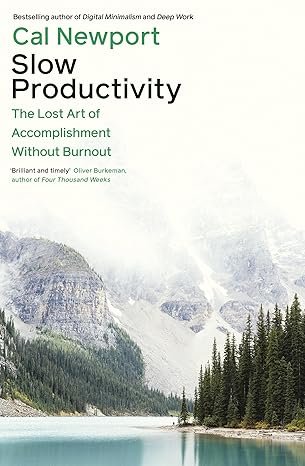
Cal Newport has, over the past fifteen years, become one of the more interesting voices in the contemporary conversation about work, attention, and the texture of a meaningful career. His earlier books — Deep Work (2016), Digital Minimalism (2019), and A World Without Email (2021) — established the framework most readers know him by. Slow Productivity: The Lost Art of Accomplishment Without Burnout, published in 2024, is his most explicit attempt to articulate what should replace the burnout-producing model of contemporary knowledge work.
The book has had unusual influence in the knowledge-worker conversation, partly because it is naming something that many high-functioning professionals have been feeling for years without having vocabulary for. The standard model of contemporary work — what Newport calls “pseudo-productivity,” organized around visible activity, perpetual responsiveness, and the optical demonstration of effort rather than the production of actual accomplishment — has been producing predictable damage to the people inside it. Slow Productivity is an attempt to articulate the alternative.
This piece is a serious summary of the book’s actual arguments, an honest assessment of what holds up and what doesn’t, and a careful reading of how the framework might be applied. The goal is to receive the book as a substantive contribution rather than as either gospel or marketing.
What the book actually argues
The central argument is built around three principles. The book devotes a chapter to each, with the bulk of the practical advice organized under them.
Principle 1: Do fewer things. Newport’s argument is that the single most important shift available to most knowledge workers is the reduction in the number of simultaneous commitments. The contemporary baseline — running ten or fifteen ongoing projects, half of which are progressing slowly and most of which are producing chronic background pressure — is, on his account, the central productivity failure of our time. The cost of having too much in flight at once is not just the divided attention; it is the cumulative anxiety, the loss of capacity to do any single thing well, and the impossibility of bringing real focus to whatever the most important current work is.
The practical implication is that the work worth doing is concentrated in fewer commitments than most ambitious people are running. Newport’s specific recommendations include: maintaining a small fixed number of active projects (his suggestion is one or two at a time at the “deep” level), saying no to most of what is being requested, and ruthlessly limiting the projects that pass the threshold into active work. The argument is that the man with three active commitments will produce more substantive work than the man with thirteen, despite the latter looking, from outside, more impressive in any given week.
Principle 2: Work at a natural pace. This is the principle that most directly contradicts the contemporary culture of work. Newport’s argument is that the great producers across history have, mostly, worked at a pace that was sustainable across decades rather than at the burnout pace that current culture treats as evidence of seriousness. The pace included long stretches of intense work alongside longer stretches of recovery, fallow periods, and slower engagement. The contemporary frame — that every week should be a maximum-output week, that any pause is a moral failing, that more hours always equals more output — is a recent invention and is, on the evidence, producing worse output across longer arcs than the older pace allowed.
The practical recommendations under this principle include: working in defined seasons rather than at constant intensity; building in periods of slower work and recovery, including longer pauses across the year; resisting the cultural pressure to demonstrate constant activity; and calibrating the daily and weekly pace to what is actually sustainable across years.
Principle 3: Obsess over quality. The third principle is, in some ways, the underlying argument that makes the other two coherent. Newport’s claim is that what distinguishes the work worth doing — work that produces actual accomplishment, that compounds across decades, that contributes meaningfully to a field — is the relentless focus on quality. The pseudo-productive worker is rewarded for visible activity; the substantive worker is recognized, eventually, for the quality of the actual output. The orientation toward quality, sustained over time, is what makes the slower pace and the smaller number of projects produce more rather than less.
The practical implication is the deliberate elevation of one’s own standards, the willingness to take more time on important work, and the rejection of the speed-over-quality trade-off that most contemporary workflows have absorbed. The slow craft of working at one thing across decades is the broader picture that this principle is operating in.

Where Slow Productivity holds up well
Several of Newport’s arguments hold up well on close examination and align with research in related fields.
The empirical case against pseudo-productivity. Newport’s analysis of how contemporary knowledge work has evolved into a state of perpetual responsiveness — Slack, email, constant meetings, the optical demonstration of activity replacing the actual production of substantive work — is, on the data, accurate. The research on attention, on context-switching costs, on the cognitive load of running multiple parallel commitments, supports his framing strongly. The man who is constantly responsive is, on the available evidence, producing less substantive work than the man who has periods of protected attention.
The historical case for slower pace. Newport draws on the working patterns of various historically significant figures — writers, scientists, scholars — to argue that the contemporary pace is genuinely anomalous. The case is somewhat selective (he is choosing the figures whose patterns fit his thesis), but the broader point is defensible. Most of the great long-arc productivity in history was produced at sustainable rather than burnout pace, with substantial fallow periods and slower stretches built into the rhythm.
The connection to quality. The argument that quality and pace are connected — that the work that compounds across decades requires the slower pace to be possible — is, on examination, correct for most knowledge work. The exception is work where speed itself is the differentiator (certain forms of competitive business, certain creative work where the energy of the rush is part of the output), but the general principle holds for most substantive knowledge production.
The naming of the burnout dynamic. Newport’s analysis of how the contemporary work model produces burnout, and why the conventional response to burnout (taking a vacation, going on retreat, then returning to the same conditions) usually fails to address the underlying pattern, is sharp and useful. The man who has been operating in pseudo-productive overdrive does not need a vacation; he needs a different way of working that does not produce the conditions for burnout in the first place. The hidden costs of the standard career success model are operating in this same territory.
The framing of seasons. The recommendation to work in defined seasons rather than at constant pace is one of the more useful contributions of the book. Most ambitious people have been operating on a framework that assumes every week should be a high-output week. The shift to thinking in terms of intensity seasons (with deliberately calibrated periods of slower work) maps better onto how sustained production actually works across long arcs.
Where the book has limits
It is also worth being honest about where the framework has gaps or oversells.
The class and structural constraints. Newport is writing primarily for knowledge workers with significant autonomy — academics, writers, certain kinds of consultants, founders. The advice to “do fewer things” and “work at a natural pace” assumes a degree of control over one’s own schedule that most working professionals do not have. The middle manager at a large company, the consultant on a deadline-driven engagement, the parent juggling work and family, has limits on what can be unilaterally restructured. Newport acknowledges this in passing but does not engage with it deeply. The book reads, in places, as if the slow productivity framework is universally available when in fact it is most fully available to people in particular structural positions.
The implicit individualism. The framework is largely about the individual worker’s relationship with their own work. It engages less with the social, organizational, and political dimensions of how work is structured. Many of the conditions producing pseudo-productivity are organizational rather than individual — the Slack culture, the meeting culture, the constant-responsiveness expectation — and the individual who tries to implement slow productivity in an organization that has not absorbed it often finds himself out of step with his peers in ways that produce real costs. The book gives little practical guidance on this collective dimension.
The selection effects in the historical examples. Newport draws on great producers — writers, scientists, scholars — whose long arcs of work are now famous. The implicit framing is that these were the standard producers of their era who happened to do their work in the right way. The truth is selection-biased: the great producers we remember are the small fraction who happened to produce work that survived. Many people working at the same pace did not produce lasting work. The historical case for slow productivity is more about correlation than causation, and the book treats it with more confidence than the underlying evidence warrants.
The absence of the relational dimension. Like much of the productivity literature, Slow Productivity is heavy on the individual’s relationship with work and light on the relational context in which work happens. The marriage that suffers during the burnout years, the children who grow up with a distracted father, the friendships that thin during the high-intensity stretches — these are largely outside the book’s scope. The framework, taken in isolation, can produce a slightly less burned-out individual whose relational life is no better than it was. The deeper integration with the rest of life is the reader’s job to add.
The application to creative versus operational work. The book reads most usefully for people doing creative or substantive knowledge work — writing, research, building, designing. It applies less straightforwardly to operational work, service work, or work where the actual product is the responsive engagement Newport is critiquing. The middle manager whose job is, in part, to be responsive to her team cannot adopt the “no responsiveness” version of slow productivity without redefining her job. The book’s framing leaves this unclear.
How to actually use the book
For the reader who wants to take the framework seriously without becoming captured by its limits, a few approaches work better than others.
Identify the small set of commitments that actually matter. Most ambitious people are running far more parallel commitments than they would, on examination, defend. The work is to identify the three or four that genuinely matter and concentrate attention on those. The others should be either declined, delegated, or postponed. This is not glamorous and produces real social costs in the short term; it is, on the longer view, the foundation of the framework’s actual value.
Build in seasons of varying intensity. Most years can include periods of harder work and periods of slower work without overall productivity loss. The work is to deliberately calibrate the calendar around this — protected stretches of deeper work, protected stretches of recovery and fallow time. The man who has been operating on constant moderate intensity often produces more in alternating cycles of high focus and substantial recovery than in the unvarying medium.
Resist the responsiveness culture deliberately. The Slack messages, the emails, the constant availability — these can be managed with explicit decisions about when you are available and when you are not. The decisions cost something socially in the short term and produce significant benefits in attention and output over time. The challenge is the cultural pressure to remain responsive; the challenge is real, and the solution is partly social (negotiating with colleagues, setting expectations clearly) rather than purely individual.
Take quality seriously as the actual metric. The shift from optical productivity (visible activity) to substantive productivity (actual quality of output) is the deeper move the framework is asking for. The man who can sustain attention to whether his work is actually good — rather than whether he is producing the appearance of effort — is the man whose work compounds across decades. The slow construction of work that compounds is the broader picture this is operating in.
Integrate the framework with the rest of life. The slow productivity framework is most useful when it is one piece of a broader project of building a sustainable life across the long arc. The man who has adopted slow productivity but is still failing his marriage, neglecting his body, or thinning his friendships has implemented one piece while leaving the rest at risk. The integration with the rest of life is the reader’s job. The architecture that rest, work, and relationship require to fit together is the deeper framework that slow productivity sits inside.
The honest closing
Slow Productivity is a useful book — perhaps Newport’s most useful since Deep Work. It names something many high-functioning workers have been feeling, provides a framework for thinking about it, and offers practical recommendations that are mostly defensible. The framework is not the last word on the subject and has real limits. Taken as one piece of the larger project of building a substantive working life, it is among the more valuable contributions to the contemporary conversation.
The work, for the careful reader, is to absorb what is useful, recognize the limits, and integrate the framework with the rest of what makes a working life worth having. The principles — fewer things, natural pace, obsessive quality — point in the right direction. The application is harder than the principles, partly because the structural conditions most workers are inside of resist the application. The work of figuring out how much of the framework can be implemented in your particular situation is itself part of the substantive engagement the book is asking for.
Read the book. Take the framework seriously. Hold it loosely enough to recognize where it doesn’t fit. Apply what does. The man who can do this is in a meaningfully different position with respect to his own work than he was before, and the cumulative effect, across years, is significant. That is, in the end, what the framework was for.
Related posts:
 Slow Productivity: What Cal Newport Got Right About Deep Work in the Age of AI
 Early Signs of Burnout: Find Your Personal Canary Before You Crash
 Mind Over Grind Book Summary: Guy Winch’s Field Manual for Men Whose Work Has Quietly Taken Over
 How to Read a Book That Actually Changes You
 Imperfectionism: The Oliver Burkeman Reframe That’s Killing the Productivity Cult