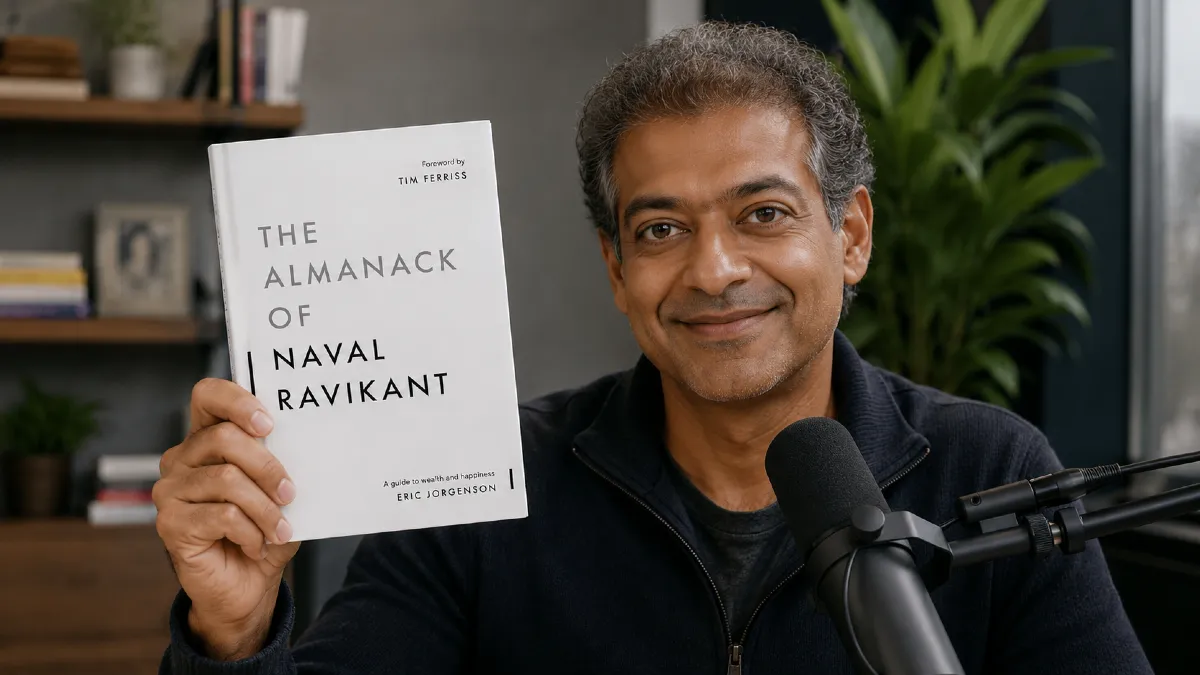
Naval Ravikant is one of the more unusual figures in the contemporary self-improvement landscape. He is, by background, a startup founder and investor — the founder of AngelList, an early backer of Twitter and Uber, somewhere in the upper tier of Silicon Valley wealth. He has spent the last decade or so producing a steady stream of short-form aphorisms on Twitter, podcasts, and interviews, on subjects ranging from wealth creation to philosophy to mental clarity. The Almanack of Naval Ravikant, compiled by Eric Jorgenson and published in 2020, collects much of this material in book form. It has, in the years since, become one of the more reliably-cited works in the contemporary aspirational-male canon.
The Naval material polarizes. To some, he is a near-prophet — the rare voice combining business pragmatism with philosophical depth, the modern-day Stoic with a hedge fund. To others, he is a Silicon Valley packaging of older wisdom, presented in clean tweets that flatter the reader into believing they have understood something they have not. The honest position is closer to the middle. Much of the Naval material is genuinely useful, drawing on Stoic, Buddhist, and Vedantic traditions in ways that are real. Some of it is repackaged in ways that obscure rather than clarify. Most of it deserves a more careful reading than the breathless reposting it usually gets.
What follows is a serious engagement with the Almanack — twenty-five of its ideas, presented in plain form, with honest assessment of what holds up and what does not. The selection is not exhaustive. It is the subset of his work that, on close reading, is most likely to actually change how you live if you take it seriously.
On wealth, work, and the long game
1. Wealth is the thing you would have even when you sleep. This is one of his more useful framings. Wealth, in Naval’s sense, is not the same as money. It is the asset that produces value while you are not actively working — the business that operates, the investment that compounds, the audience that returns, the skill that compounds. Most professional income, however high, is the trading of time for money; it stops when the trading stops. The asset that produces while you sleep is structurally different. This framing changes what you spend your effort building.
2. You will not get rich by renting out your time. A direct consequence of the above. The high-paid lawyer or consultant who is paid for hours worked is, in Naval’s frame, not building wealth; he is producing income that depends entirely on his continued labor. The thing worth building, on this view, is the asset that does not require your ongoing time — equity, leverage, audience, ownership. This is harder than salary work; it is also where the leverage actually lives. The deeper relationship between long-term thinking and wealth operates here.
3. Code and media are the new leverage. Naval distinguishes three kinds of leverage: labor (people working for you), capital (money working for you), and code/media (the new permissionless leverage that requires no boss’s approval to deploy). The argument is that the third category — which costs almost nothing to access, scales infinitely, and produces while you sleep — is the leverage of the modern era. The thoughtful version of this is correct. The cargo-cult version of this is the man who quits his job to “build an audience” with nothing to actually say, and ends up neither wealthy nor satisfied.
4. Specific knowledge is the kind that cannot be taught. Naval’s term for the form of expertise that pays well: the knowledge that is so particular to you, so tied to your unique combination of interests and abilities, that it cannot be replicated by training someone else. Specific knowledge feels more like play than work to the person who has it. The argument is that the work worth doing, the work that produces both meaning and wealth, is the work that draws on this particular form of expertise.
5. Play long-term games with long-term people. One of the more compressed pieces of wisdom in the book. The argument is that almost everything good in life — wealth, relationships, reputation, learning — compounds when sustained across long horizons with consistent counterparties. The short-term mindset, the constant rotation of partners and friends and projects, defeats compounding. This is, on examination, accurate, and most people structurally underrate it.
6. Earn with your mind, not your time. The corollary of the wealth-as-asset framing. The pursuit worth pursuing is the work that scales with thought rather than with hours.
On reading, learning, and the mind
7. Read what you love until you love to read. Naval’s advice on building a reading habit is unusually free of moralizing about which books are important. The point is to find what genuinely engages you and read that, until the act of reading itself becomes pleasurable. Then, gradually, the appetite expands. This is correct and counter to most reading advice, which prescribes the canon and produces readers who quit.
8. The genuine love of reading is one of the largest unfair advantages. Once you can read with appetite, you have access to the accumulated thinking of every serious person who ever lived. The compounding of this across decades is significant. Naval’s claim that this is one of the underrated advantages of educated adult life is, on examination, accurate.
9. Read the original sources. Most secondary writing is a degraded version of what someone else said first. The closer you can get to the source — to the actual Marcus Aurelius, the actual Adam Smith, the actual Darwin — the more useful the encounter. The summary blog post is, mostly, a distillation that loses what was most worth having. Most modern reading is, in fact, summaries of summaries; the recovery of primary reading is its own discipline.
10. Skip what bores you. Permission, contrary to most reading advice, to abandon books that fail to hold attention. Life is finite. Most books are not worth finishing. The discipline is in the appetite, not in the completion.
On happiness, peace, and presence
11. Happiness is the absence of want. Naval’s framing draws on Buddhist and Stoic sources. The argument is that happiness is not produced by acquiring more; it is produced by the relaxation of the desire that has been driving the acquiring. The wealthy person who is still wanting is not happy. The poor person who has stopped wanting can be. This is uncomfortable to those whose lives are organized around getting; it is, on close examination, what most contemplative traditions have been saying for millennia.
12. Desire is a contract you make with yourself to be unhappy until you get what you want. One of his sharper formulations. The desire itself is the painful state; the satisfaction of it is the temporary relief, which is then replaced by the next desire. The path to contentment is not through satisfying every desire but through reducing the number of desires you are running at any given time.
13. Choose what to want carefully. A practical implication of the above. You cannot avoid wanting things; you can choose which wants to admit to your interior. Most of the wants that drive ambitious lives are, on examination, absorbed from culture without conscious selection. The deliberate selection of fewer, more aligned wants produces a less harried interior life. The deeper question of what makes people happy is the territory this is operating in.
14. The three big decisions of a life are where you live, what you do, and who you do it with. Most people optimize the small daily decisions and let these three large ones be made by inertia. Naval’s claim is that the long arc of a life is shaped overwhelmingly by these three, and that deliberately working on them is one of the higher-leverage activities available.
15. The truest mark of a man is how he reacts when things go bad. A near-Stoic observation. The character of a person is visible not when things go well — anyone can be pleasant then — but in the response to difficulty. The implication is that the work of character is the work of building the response to difficulty, not the response to success.
On clarity, ego, and the self
16. Clarity is undervalued and unusually rare. The capacity to see what is actually happening, without the distortions of ego, fear, comparison, and wishful thinking. Most people, most of the time, are looking at a heavily edited version of reality. The man who has developed clarity — through meditation, honest self-examination, deliberate effort to see clearly — has an advantage that compounds.
17. The mind is best treated as a tool, not as a master. Naval draws on Vedantic philosophy here. The constant interior commentary that most people identify as “themselves” is, on this view, a tool that has gotten out of hand — running endlessly, producing low-quality output, mistaking its activity for the person. The work is to use the mind when it is useful and let it rest when it is not.
18. Meditation is doing nothing. Against the techniques-and-protocols framing of contemporary meditation. Naval’s argument is that the practice is simpler than most teaching suggests — to sit, to do nothing, to allow whatever happens to happen, without attempting to manage the experience. The simplicity, in practice, is harder than the elaborate technique versions, because there is nothing to perform.
19. Anger is the punishment you give yourself for someone else’s mistake. A direct restatement of older Stoic material. The argument is that the emotional reaction is yours, not theirs; the cost of carrying it is yours; the choice to put it down is also yours. This is one of the harder pieces to actually live, even when intellectually accepted.
20. The ego protects itself by projecting its assumptions onto the world. The man inside his ego does not see the world; he sees his ego’s defenses against the world. The work of getting past this, partial as it ever is, is one of the slower projects of an adult life. The work of self-acceptance that allows the ego to relax is part of what this points toward.
On habits, decisions, and the texture of a life
21. The two largest decisions in life are the ones nobody warns you about: who you marry, and who you befriend. A consequence of the long-term-games framing. The compounding of relationships across decades makes the early decisions disproportionately consequential. Most people make them on autopilot. The deliberate construction is one of the higher-value uses of attention available in early adulthood.
22. Habits are the compound interest of self-improvement. Naval shares with James Clear and others the recognition that most of the variance in long-term outcomes comes from the slow accumulation of small daily actions, repeated across years. The dramatic single event is overrated; the slow compounding is underrated.
23. The first rule of any game is to keep playing. Survival, in any long endeavor, is most of the work. The man who is still in the game at fifty has, by virtue of having survived, access to opportunities the burned-out thirty-five-year-old has lost. This applies to careers, relationships, health, and most other domains.
24. Avoid people who play status games. They lose to people who play wealth games. Naval’s argument is that status is zero-sum — your gain is someone else’s loss — while wealth is positive-sum, in the sense that production creates value that did not previously exist. The implication is that the time spent on status maneuvers is time taken from the work that could compound. This is partially true; the more honest version is that status games are unavoidable in social life but the work worth doing is mostly in the production rather than in the positioning.
25. You are not going to remember any of this anyway. Live accordingly. The final note, and one of the more honest. The accumulated experience of a life is mostly forgotten. The peak moments and the difficult moments persist; the texture of an ordinary Tuesday afternoon is mostly gone within months. The implication is to weight current experience by what will be the experience of having it now, rather than by what the future memory of it will be — because most of what is happening will not be remembered regardless. The question of how to find peace in a busy life operates in this territory.
What the Almanack gets wrong
It is worth being honest about the limits of the material, because the breathless reception tends to obscure them.
The first limit is the genre constraint. Aphorisms are a particular form. They are most useful for compressed insight that can be unpacked across long meditation. They are least useful as substitute for the actual unpacking. A tweet-length version of Stoicism is not Stoicism; it is a pointer toward Stoicism. The reader who treats the Almanack as the destination rather than the trailhead is shortchanging both the material and himself.
The second limit is the Silicon Valley framing. The wealth and leverage material is shaped by a specific milieu — venture capital, startups, early-internet equity outcomes — that is not, in fact, available to most readers. The implication that anyone can build “code and media leverage” sufficient to escape salaried work is, on examination, a survivor-biased generalization from outliers. Most people who attempt this fail. The honest framing would include this.
The third limit is the implicit politics. The Naval material includes a fairly libertarian assumption about individual sovereignty, the limitation of social obligation, and the primacy of personal optimization. These are positions, not facts. They are not always named as positions. The reader absorbs them as part of the wisdom package without examining them.
The fourth limit is the absence of the relational. Naval’s material is heavy on individual flourishing — the mind, the work, the wealth — and light on what makes a life relationally substantive. The marriages, the friendships, the families that produce most of the actual texture of a meaningful life appear thinly. This is one of the larger gaps in the genre Naval represents, and it is worth noting.
How to actually use this
Most of the Naval material is worth reading slowly, with the willingness to disagree where the material does not hold up to your own honest examination. The aphorisms that hit, take seriously and let work on you for months. The ones that do not, skip without guilt.
A few specific moves that have worked for readers who took the material seriously:
Pick three of the twenty-five ideas above that, on your honest reading, are pointing at work you have actually been avoiding. Spend a year on those three. Do not move on until they have, in some real way, become part of how you operate. The accumulated effect of three Naval ideas, taken seriously, will outpace the effect of fifty taken superficially.
Read the original sources Naval draws on rather than only Naval’s distillations. Marcus Aurelius. The Bhagavad Gita. The Tao Te Ching. The actual Stoics. The encounter with the primary material thickens the engagement and corrects for the compression losses in the aphorism form.
Notice when the material is being used to flatter you. Aphorisms have a particular property: they tend to confirm to the reader whatever the reader already half-believed. The work is to read for what the material is asking of you, not for what it is confirming about your current self. The slow building of practical wisdom across an adult life is what the material is, at its best, pointing toward. The shortcuts are illusions.
The Almanack is, on the most honest reading, neither prophecy nor packaging. It is one thoughtful person’s compressed reflection on the questions most worth considering. Read this way, it is worth your time. Read as breathless gospel, it is most of what is wrong with the contemporary self-improvement genre. The choice between the two readings is, every paragraph, yours to make.
Related posts:
 Sahil Bloom’s Wealth Score: Measure All Five Types of Wealth
 How to Apply Sahil Bloom’s Five Types of Wealth Framework
 Work-Life Balance for Entrepreneurs Through Integrated Wealth
 How to Create Wealth as a Man: 9 Powerful Strategies for Financial Freedom
 How to Read a Book That Actually Changes You