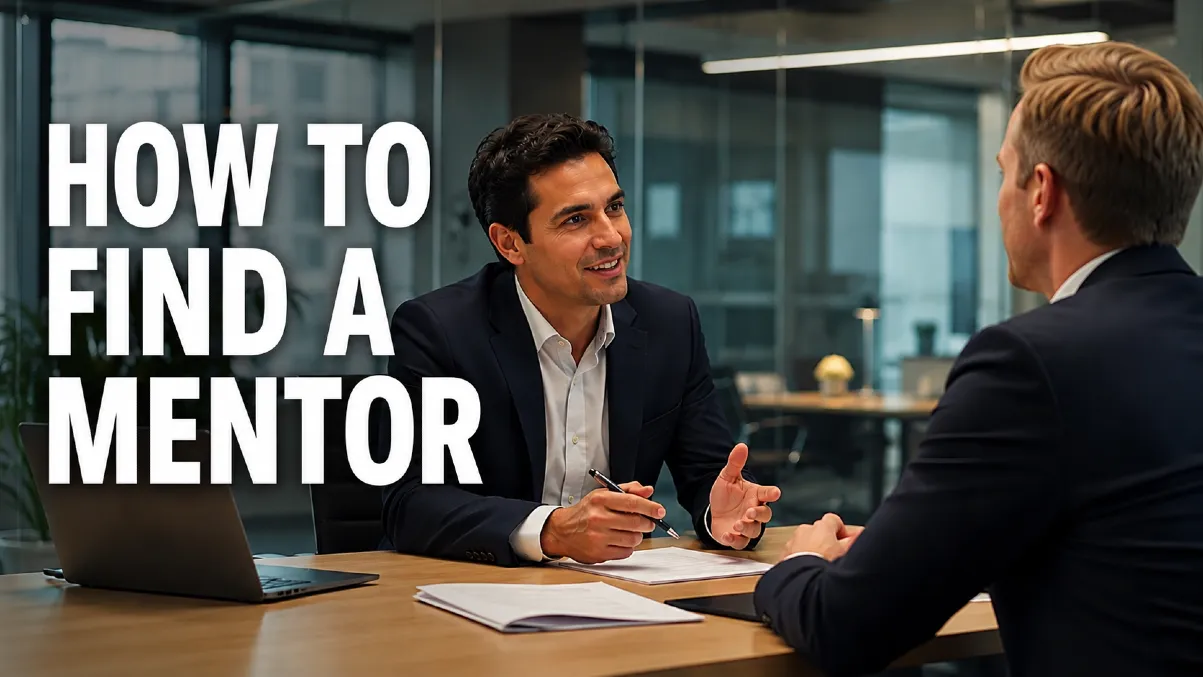
Most men know a good mentor would change their trajectory, and most never go looking for one. The research is more interesting than the usual sales pitch: the average effect is modest, but a mentor you pursue yourself and genuinely connect with does far more for you than one a company assigns. What follows covers what the studies show, why men hold back, and how to find and approach an older man who has already walked the road you’re on.
How to find a mentor as a man: the short answer
To find a mentor as a man, identify someone roughly five to fifteen years further along a path you actually want to walk, make one small and specific request (a single question, a single conversation, never “will you be my mentor?”), act on his advice and report back, and keep showing up. Done well, the relationship becomes a mentorship without either of you formally naming it. Everything below explains why that sequence works, what the research says about it, and where most men go wrong.
What the research actually says about having a mentor
The mentorship literature is large, consistent in direction, and more modest in size than the usual sales pitch admits. Two major meta-analyses (statistical reviews that pool dozens of studies) tell the same story. In 2004, Allen and colleagues, writing in the Journal of Applied Psychology, found that mentored people tended to enjoy better compensation, more promotions and greater career satisfaction than people without mentors, though the effect sizes for objective outcomes such as pay were small. Four years later Eby and colleagues pooled youth, academic and workplace mentoring and found favorable results across behavioral, attitudinal, health-related, relational, motivational and career measures—again with generally small effects.
Small on average is not the same as small for you. An average blends tightly bonded relationships with indifferent ones, and the evidence in the next section suggests that the quality of the bond, far more than the mere presence of a mentor, drives the benefit.
The survey data is easier to feel. In the 2019 CNBC/SurveyMonkey Workplace Happiness Survey of 7,940 U.S. workers, 91 percent of people with a mentor were satisfied with their jobs, and satisfaction fell by double digits among those without one. Workers with mentors were likelier to feel their colleagues valued their work (89 percent versus 75), to say they were well paid (79 versus 69), and to rate their chances of advancing as good or excellent (71 versus 47). Only a quarter of the mentored had considered quitting in the previous three months; among the unmentored it was more than four in ten. The pattern held for men: 88 percent of white men aged 18 to 34 with a mentor were satisfied at work, against 66 percent of those without, and the survey’s authors noted that the benefit appeared in every demographic cut they examined, with the largest payoff for workers under 45.
These are correlations, of course. A man who is thriving may simply be likelier to attract a mentor, and no survey can fully untangle the two. But the direction is consistent, and the entrepreneurial evidence points the same way: a UPS Store survey cited by the U.S. Small Business Administration found that 70 percent of mentored small businesses survived beyond five years, double the rate of businesses without a mentor. Nor is the arrangement one-sided. A 2013 meta-analysis in the Journal of Vocational Behavior found that people who provide mentoring report benefits of their own, including to career success, organizational commitment and job performance, which matters because it means a mentor is not doing you a charity.
And still the gap persists. An Olivet Nazarene University survey reported by Forbes in 2019 found that 76 percent of people considered mentors important while only 37 percent had one; CNBC’s figure for workers with a mentor at work was closer to half, a difference that mostly reflects how each survey defined the word. Men were slightly less likely than women to have one in the CNBC data (48 percent versus 54 percent). Whatever number you prefer, a great many people who believe in mentorship are going without it.
Why the mentor you pursue beats the mentor you’re assigned
The most useful finding in this literature may be the least advertised: how a mentorship begins matters. Ragins and Cotton (1999, Journal of Applied Psychology) studied 257 men and 352 women and found that people with informal mentors, the kind who emerge naturally, rated their mentors as more effective and earned more than people with formal, assigned mentors. Protégés with informal mentors also fared better than people with no mentor, while the researchers found no significant difference between the unmentored and the formally mentored.
A follow-up by Ragins, Cotton and Miller (2000, Academy of Management Journal), covering 1,162 employees, sharpened the point: satisfaction with the relationship shaped work attitudes more strongly than whether a mentor existed at all, formal or informal. CNBC’s analysts reached a similar conclusion from their data, observing that simply being assigned a mentor is unlikely to make much difference to how people feel about work.
The practical reading is plain. Collecting a mentor like a credential does little; building a relationship that both of you value does a great deal. Corporate programs are fine as far as they go, but a man who waits for the system to hand him an older guide is outsourcing something he can do himself, and the version he builds on his own tends to be the version that works. It also helps to treat the search as part of a larger skill: the ability to build a network worth drawing on is what puts the right older men within reach in the first place.
What a good mentor actually gives you
Information is cheap; anyone with a phone can find the standard advice on negotiating a raise or starting a business. What a good mentor supplies is scarcer, and it arrives in four forms.
The first is compressed pattern recognition. A man who has spent decades in a field has watched certain situations unfold many times, so he can often tell a younger man in thirty seconds what would otherwise take five years and a painful failure to learn. Books, courses and content can’t fully substitute for this, because the mentor is reading your particular situation rather than reciting generic principles.
The second is calibration. Young men are routinely miscalibrated about what matters, what is normal, which problems are real and which will pass, and how good their own work actually is. A mentor tells you the thing you’re panicking about is ordinary, that the thing you’re ignoring is serious, that the project you consider mediocre is strong (or that the one you’re proud of has a specific flaw). He also hands over the unwritten rules of getting ahead that no onboarding document mentions. Self-calibration is close to impossible, since the instrument doing the measuring is the one that’s off.
The third is sponsorship, which is worth separating from advice. Herminia Ibarra, Nancy Carter and Christine Silva drew the line in a 2010 Harvard Business Review article: mentoring means feedback and guidance, while sponsorship means active advocacy by someone with influence. A sponsor makes introductions, vouches for you in rooms you aren’t in, and puts your name forward. It often grows out of a mentoring relationship once the older man has seen your work and trusts your follow-through, which is one more reason to report back (more on that below).
The fourth is belief. Sometimes the most valuable thing a mentor offers is confidence in you before you have it yourself, and the effect is real even if the surveys barely capture it, much as expectations quietly shape performance in classrooms and workplaces alike. “You’re further along than you think,” coming from a man whose judgment you trust, can be the input that lets you take the risk or persist through the difficult middle. Ask any man who has had a good mentor whether it mattered, and he will tell you it did.
Why most men never ask
If the benefits are real, why do so few men pursue them? The reasons are specific, and naming them is half the work of getting past them.
The first is the fear of imposing. Many young men treat a request for guidance as a favor that costs an older man his time and offers nothing back. Help-seeking research suggests the fear is miscalibrated: in studies by Flynn and Lake (2008), people underestimated by as much as 50 percent how likely others were to agree to a direct request for help, largely because they focused on the effort of saying yes and overlooked the social cost of saying no. As Flynn put it, “People are more willing to help than you think.” Add the mentor-side benefits above, and the imposition looks smaller still. Asking for help cleanly, without manipulation or apology, is a skill; it can be practiced.
The second is the absence of obvious channels. A century ago, mentorship flowed through apprenticeships, trades, family businesses, fraternal organizations, churches, the military and long tenures at a single company. Many of those structures have thinned, and their loss compounds the isolation many men report, a theme explored in more depth in the data on male loneliness. The man of 2026 has to be more deliberate than his grandfather was, because the channels no longer deliver a mentor automatically.
The third is a misunderstanding of what to ask for. Many men picture a ceremony (“Will you be my mentor?”) and the formality makes the ask awkward and the relationship stilted. In practice the best mentorships rarely begin that way. They begin with a specific question, a small ask, a single conversation that goes well and is repeated. The man who asks for a mentor outright often gets a polite deflection; the one who asks a sharp question and follows up thoughtfully may find himself a year later in a mentorship nobody formally proposed.
The fourth is pride. Some men resist guidance because accepting it feels like admitting inadequacy, and the research says the fear runs backwards. Brooks, Gino and Schweitzer (2015, Management Science) found that people avoid seeking advice for fear of looking incompetent, yet advice-seekers were in fact judged more competent, especially when the task was difficult and the person asked was an expert. Putting a hard question to the right person reads as intelligence. A man’s worth was never conditional on already having the answers; refusing guidance simply makes every lesson more expensive, paid for in years and failures. The willingness to empty your cup and learn again is one of the quieter forms of strength.
Where to find a mentor, and who to look for
Start with who. The best mentor is rarely the most famous person you can reach. Look for someone roughly five to fifteen years ahead of you (a rule of thumb, not a research finding) on a path you actually want, and accessible enough that a relationship is realistic. The vice president who stood where you stand a decade ago is a better candidate than the CEO; proximity and relevance matter more than altitude. If a man controls your performance review, honesty gets harder on both sides, so lean toward someone outside your direct reporting line.
Then where. Start on warm ground: past bosses and colleagues, alumni associations, professional bodies, industry meetups. Founders can look to SCORE, which the SBA describes as the nation’s largest network of volunteer business mentors. Local clubs, trade guilds, congregations and men’s groups put you in a room with older men on a regular basis, and becoming a familiar face in the same place does more of the work than people expect, because familiarity lowers the cost of the first conversation for both sides. LinkedIn is useful for warm, specific outreach. If you’re wondering how to find a mentor near you, the answer is usually a recurring room rather than a search bar.
How to ask someone to be your mentor
Don’t open with “will you be my mentor?” Open with one specific question that he is uniquely placed to answer and that shows you’ve done your homework: “I’m facing this decision, and I noticed you handled something similar—could I ask you two questions about how you thought it through?” It is small, easy to say yes to, and the seed from which real mentorship grows.
Prepare. Come with sharp questions (learning to ask better questions is worth practicing in its own right), listen more than you talk, and respect the clock. Then do the thing most mentees skip: act on what he suggested and report back on what happened. Reporting back tells him his input mattered, which is exactly the fulfillment mentors are after, and it converts a pleasant conversation into a relationship.
Frequency matters too. In SCORE’s data on small-business owners, reported in 2018, 30 percent of those with a single mentoring interaction reported business growth, rising to 43 percent among those with five or more. One coffee is a conversation; a pattern of conversations is a mentorship.
Let it flow both ways. You probably have things he values: fluency with new tools, a fresh read on a market or a culture, energy, appreciation that is specific rather than generic. Offer them (the logic behind reverse mentorship is that older men are often glad to learn too). Helping others is a career strategy in its own right, as the Canvas Strategy shows, and the habit of becoming someone established people want to invest in is part of building your professional reputation.
If he says no, or goes quiet, assume it’s about his calendar rather than your worth. Thank him and approach the next person on your list. The cost of trying is a handful of thoughtful emails.
Cultivate more than one mentor. The idea of a single man guiding your entire life is mostly mythology; the well-mentored man usually has several lighter relationships, one for the craft, one for the politics of his industry, one for marriage and family, one simply for an older man’s character he admires. Think of it as a small power team rather than a guru.
And start mentoring someone yourself, even early. A 25-year-old has something to offer a 20-year-old, and teaching sharpens your own thinking and makes you a better mentee. If you want to study how much of a life’s work runs through relationships, Andrew Bustamante, who turned CIA tradecraft into a framework for everyday life, and Jesse Itzler, whose business strategies lean heavily on people, are both worth examining. For a wider look at what separates useful guidance from noise, there is a full breakdown of mentorship advice that actually works.
The deeper function: what the studies can’t measure
Beyond the career mechanics, mentorship does something older than any survey. In many traditional cultures the passage from boy to man ran through older men: the father, the uncle, the elder, the master craftsman. Stories have always known it; the mentor is a fixture of the hero’s journey for a reason. The young man was not expected to work it out alone.
Modern life has dismantled much of that infrastructure, and a generation of young men now assembles its idea of manhood from content made by strangers, with no older man who actually knows them looking on. The crisis of modern masculinity is, in part though not only, a crisis of missing mentors.
The surveys capture salary, satisfaction and survival rates. They can’t capture what a steady older man’s attention does to a younger man’s sense of who he is becoming, or the other direction of the exchange: an older man who, after decades of building, gets to pass something on, which is legacy in its most direct form. Seen this way, finding a mentor is less a career tactic than a small repair to something culture used to provide.
What to do this month
If you don’t have a mentor, the move is concrete and the timeline is now. List three people five to fifteen years ahead of you on a path you respect, and pick the most accessible. Send a specific, researched, easy-to-answer question. If the exchange goes well, follow up, report back on what his advice produced, and ask another. The relationship will either develop or it won’t; if it doesn’t, move to the next name. The potential return, in compressed experience, calibration, sponsorship and belief, is among the highest available to a man in his twenties and beyond.
Most men will read this and do nothing. The few who act will, a decade on, be hard to catch, and some of them won’t connect the difference to a single email sent to an older man who said yes.
The path you’re on has been walked. Someone ahead of you knows where the holes are. Go find him.
Ask. More of them will say yes than you expect.
Frequently asked questions about finding a mentor
How do you ask someone to be your mentor?
Skip the formal request at first. Ask one specific, well-researched question about a situation he has already navigated, then act on his advice and report back. If the relationship deepens you can name it later, though many of the best are never named. Research on help-seeking suggests he is more likely to say yes than you expect.
Does a mentor have to be older than you?
No. What matters is that he is further along a path you want and willing to be candid. Five to fifteen years ahead is a practical rule of thumb rather than a research finding. An older man brings the advantage of having watched whole cycles of a career, a business or a marriage, but a peer a few steps ahead can also be a valuable guide.
Where can men find a mentor outside of work?
Look for recurring rooms: men’s groups, professional or trade associations, alumni networks, clubs, congregations, volunteer organizations, and programs such as SCORE for founders. Show up consistently, because familiarity makes the first conversation easier. LinkedIn and online communities can start an introduction, but relationships deepen through repeated, specific contact.
What is the difference between a mentor and a sponsor?
A mentor offers advice, feedback and perspective; a sponsor uses his influence on your behalf by recommending you, introducing you and putting your name forward. Ibarra, Carter and Silva drew this distinction in Harvard Business Review in 2010. Sponsorship often grows out of a mentoring relationship once trust and a track record exist.
Is having a mentor really worth the effort?
On average the measured effects are modest (Allen et al., 2004; Eby et al., 2008), but workers with mentors report higher satisfaction, a stronger sense of being valued and better perceived chances of advancing (CNBC/SurveyMonkey, 2019), and relationship quality matters more than simply having a mentor (Ragins et al., 2000). The cost of trying is low; the upside is high if the relationship is real.
Sources and further reading
Allen, T. D., et al. (2004). Career benefits associated with mentoring for protégés: A meta-analysis. Journal of Applied Psychology, 89(1), 127–136. PubMed
Eby, L. T., et al. (2008). A multidisciplinary meta-analysis comparing mentored and non-mentored individuals. Journal of Vocational Behavior. Record
Ragins, B. R., & Cotton, J. L. (1999). Mentor functions and outcomes: A comparison of men and women in formal and informal mentoring relationships. Journal of Applied Psychology, 84(4), 529–550. DOI
Ragins, B. R., Cotton, J. L., & Miller, J. S. (2000). Marginal mentoring: The effects of type of mentor, quality of relationship, and program design on work and career attitudes. Academy of Management Journal, 43, 1177–1194. DOI
Flynn, F. J., & Lake, V. (2008). If you need help, just ask: Underestimating compliance with direct requests for help. Journal of Personality and Social Psychology. Stanford GSB
Brooks, A. W., Gino, F., & Schweitzer, M. E. (2015). Smart people ask for (my) advice: Seeking advice boosts perceptions of competence. Management Science, 61(6), 1421–1435. DOI
Ibarra, H., Carter, N. M., & Silva, C. (2010). Why men still get more promotions than women. Harvard Business Review. Author’s copy
Wronski, L., & Cohen, J. (2019). Nine in 10 workers who have a career mentor say they are happy in their jobs. CNBC/SurveyMonkey Workplace Happiness Survey. CNBC
U.S. Small Business Administration (2019). Mentoring: the missing link to small business growth and survival. SBA
Related posts:
 Why the Hero’s Journey Requires a Mentor No Man Can Replace
 Reverse Mentorship: What Younger People Are Teaching Older Men
 Male Loneliness Epidemic: What the Data Actually Shows (and What to Do About It)
 63% of Young Men Are Single. The Real Reasons Aren’t What You Were Told.
 The Marathon Continues: What Nipsey Hussle Taught Us About Ownership, Brotherhood, Legacy and Being a Man