Unlock Your Power by Poppy Delbridge argues that most capable people don’t lack motivation; they hit an invisible internal ceiling, which she calls the Limit, and a seven-step process can lift it. The surprise is that her fix isn’t more effort but less force: safety first, then desire, then action. This summary walks through the Limit, the Invisible Mind Patterns that guard it, all Seven Keys from Desire to Done, her Rapid Tapping toolkit, and an honest look at where the science holds and where it stretches.
It’s 10:40 on a Wednesday night and you’ve just closed the biggest deal of your year. The email came through at six. You told your partner, she hugged you, you opened a beer. Now you’re alone at the kitchen counter, and instead of feeling the win you’re scrolling through other people’s lives, already drafting tomorrow’s to-do list in your head. Somewhere under the relief is a flat, faintly anxious hum, as though good news were something to be managed rather than enjoyed.
Nothing is wrong, exactly. You’re capable. People ask you for advice. But you’re tired in a way that sleep doesn’t fix, and every time life starts to open up, something in you quietly closes.
That moment is where Poppy Delbridge’s book begins.
What Is Unlock Your Power About?
Unlock Your Power is a self-development book by Poppy Delbridge (HQ, HarperCollins, 2026) that explains why capable people stall at an internal ceiling she calls the Limit, and offers a seven-step framework, the Seven Keys, to work with that ceiling instead of fighting it. The keys are Desire, Discover, Decide, Debunk, Ditch, Do and Done.
The book’s tagline sums up its method: spot the pattern, shift the power. Its central claim is blunt. As Delbridge puts it, “You don’t have a motivation problem. You have a pattern problem.” In her telling, the habits of thought, feeling and body response that once kept you safe now keep you capped, and no amount of willpower overrides a nervous system that has decided growth is dangerous.
What makes the book distinctive in a crowded genre is the order of operations. Most success books start with goals and action. Delbridge starts with safety, then desire, and leaves action for the sixth of seven steps. Her argument is that pushing from a dysregulated system simply recreates the same results at a higher cost.
Who Is Poppy Delbridge?
Poppy Delbridge built her first career in British television, rising through development roles to become a creative executive at Warner Bros. By her own account, she was named one of the most powerful women in the industry in her mid-twenties. In 2010, mid-career and outwardly successful, she was taken to hospital with symptoms of extreme stress. Over the following year her marriage ended, she left her job and became a single, breadwinning parent.
That collapse became the origin of her work. She retrained across several mind-body and energy-based disciplines, founded the Rapid Tapping method and an accompanying app, and now advises leaders and creatives on mindset and performance. She is a global ambassador for the mental health charity Mind. Unlock Your Power follows her earlier book, Tapping In, and is built on her coaching programme, Pivot Into Power.
It’s worth saying plainly who the book is written for. Delbridge speaks most often to high-achieving women, and her examples reflect that. The patterns she describes, though, are not gendered: the pushing, the people-pleasing, the quiet terror of slowing down. Men tend to recognise them faster than they’d like.
The Big Idea: The Limit
The Limit is Delbridge’s name for the point at which going further no longer feels safe. It isn’t the edge of your ability. It’s a set point, a kind of internal thermostat, that your system draws around how much success, visibility, love or ease it can tolerate.
She lists the signs with uncomfortable accuracy: losing momentum just as things go well, doubting yourself after a breakthrough, talking yourself out of desires that once felt alive, and feeling strangely anxious when life becomes calmer. Crucially, she refuses to call this self-sabotage in the dramatic sense. It’s self-protection. At some point you learned what level of success or expression didn’t risk rejection, and your system remembered.
That framing will feel familiar to anyone who has read about the upper limit problem, and it maps closely onto what many people experience as a fear of success. It also echoes a point made in this magazine before: that self-sabotage is often a form of protection, not a character flaw.
When you meet the Limit, Delbridge says, you have three options. Shrink back and stay safe but stuck. Ignore the signal, push harder and stay the same. Or meet the Limit differently and pivot into what she calls a quieter kind of power. The whole book is an argument for the third.
Invisible Mind Patterns: The Guards at the Gate
If the Limit is the ceiling, Invisible Mind Patterns, or IMPs, are what hold it in place. Delbridge defines them as habits of thought, emotional responses and body reactions that run beneath your conscious intentions. They were shaped by upbringing, school, culture, gender expectations and relationships. And because they’ve been running for so long, they sound exactly like you.
They rarely announce themselves as problems. They sound like logic, caution or humility: be realistic, don’t get too big, who do you think you are. She introduces a cast of archetypes to make them easier to catch: the Prover, who equates worth with productivity; the Pleaser, who trades truth for peace; the Doubter, who waits to be perfect; the Controller, who carries more than is his; and the Diminisher, who plays small to avoid judgement. Later she adds the Super-Pusher, the Over-Giver, the Hider and the Procrastinator.
Her method for dealing with them is refreshingly light. You don’t interrogate an IMP for twenty years or shame it into submission. You notice it, name it and decline to take direction from it. That instinct has some research behind it. When UCLA psychologist Matthew Lieberman and his colleagues scanned people’s brains in 2007, simply putting a feeling into words reduced activity in the amygdala, the brain’s alarm centre. Naming a pattern, in other words, is not a trivial first step; it’s where your grip on it begins. The full map of the patterns, and how to catch your own, is in the guide to how to identify limiting beliefs.
The Three Layers of the Mind
Delbridge builds her framework on three layers of mind. The conscious mind plans, decides and makes lists; she calls it brilliant at organising your day and terrible at changing your life on its own. The subconscious stores habits, emotional memories and safety responses; its job, she says, is to keep you safe and the same. And the superconscious is her term for the layer of insight, intuition and creative possibility that opens when the system feels regulated and safe.
IMPs, in her model, live in what she calls the Lag: the gap between knowing something and actually living it. They thrive when energy dips, when the nervous system is fried, or when you’re in transition.
The first two layers line up well with mainstream psychology’s picture of deliberate versus automatic processing. The third is where Delbridge’s spiritual language enters, and readers will take it in different ways; for a grounded, practical treatment of the first two, see how to reprogram your subconscious mind.
The Frequency Scale and the “I’m Fine” Trap
One of the book’s most useful tools is the Frequency Scale, a self-rating from +10 to –10. At the top is what she calls connected frequency: aligned, expansive, clear. At the bottom is contracted frequency: survival, shutdown, overload. And in the middle, from about –3 to +6, is coping frequency, where she believes most capable people live.
Coping frequency is the “I’m fine” zone. You’re productive, you’re doing the right things, and life works on paper. But your spark has been traded for safety. Delbridge’s phrase for it is pancake energy, and she’s right that fine is a sneaky kind of stuck. If that sounds like your last few months, the article on why you can feel empty when your life is good takes that zone apart.
Her advice for each band is practical. Down at the bottom: regulate first, don’t plan, don’t fix, don’t push. In the middle: interrupt autopilot with one small, bold act. At the top: protect the state. And at any point, ask the most useful question in the book: what’s one tiny thing I could do to move up even one point?
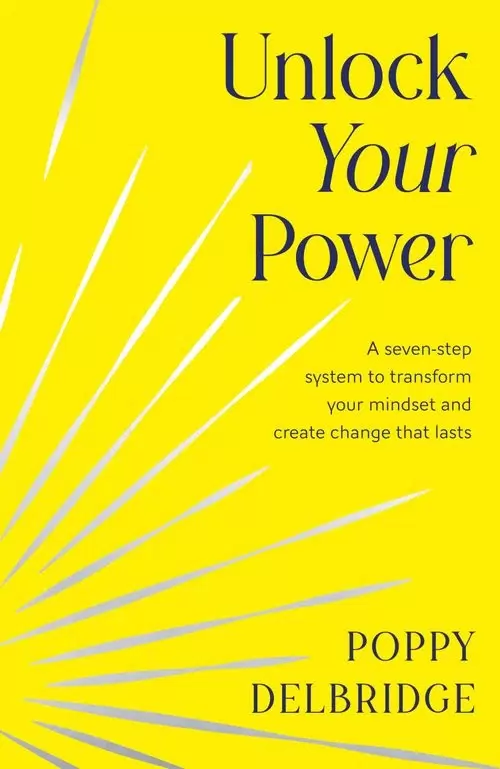
Unlock Your Power – The Seven Keys, One by One
The heart of the book is a seven-step sequence. Delbridge is clear that you can dip into any key at any time, but the first pass works best in order.
Desire: get honest about what you actually want
The first key asks what you’d want if you weren’t being realistic, sensible or polite. Delbridge argues that most people don’t lose their desires; they dim them, regulating themselves down to the expectations of an older version of themselves. Her tools include a desire diagram, a seven-day spoken experiment, and a warning about the double-negative trap: listing what you don’t want (“not stressed, not broke”) keeps your attention on exactly that. The practical version of this key lives in how to figure out what you want in life.
Discover: see the patterns running the show
The second key is honest diagnosis. You locate yourself on the Frequency Scale, check whether a desire is truly yours or borrowed, and ask “why” seven times until the real motive surfaces. Her Seven Whys borrows from the Five Whys technique developed at Toyota, with tapping added to keep the body calm while you dig.
Decide: choose as if it’s already done
Indecision, in Delbridge’s view, isn’t a flaw; it’s a protective pattern she calls energetic limbo. The Decide key asks you to commit before you feel ready, because readiness is a result of deciding, not a prerequisite. Her favourite tool is the diary decision: put the desire in your calendar with a date, then hold the plan loosely. More on this in how to stop being indecisive.
Debunk: break up with old stories
Debunk is where you question the beliefs holding your Limit in place. Delbridge borrows a comedian’s trick: treat the inner critic like a heckler and have a comeback line ready. She teaches a two-part method she calls underuse and overwrite: starve the old thought of attention, and feed a new one with repetition and feeling. She also introduces four Gremlins, deeper fears of failure, judgement, not being enough and, tellingly, success. The working version is in how to stop negative self-talk.
Ditch: release what drains you
The Ditch key is about subtraction. Delbridge’s sharpest line here is that we don’t manifest what we want, we manifest what we tolerate; read it as a statement about attention and standards rather than mysticism, and it lands hard. She also names cover habits, the busywork that looks like progress but protects you from real change: rewriting the bio instead of sending the pitch, organising cables and calling it alignment. That idea gets its own treatment in productive procrastination.
Do: aligned action, inner and outer
Only now does action arrive, and even here it comes in two parts. The Inner Do is mental rehearsal: running the meeting, the speech or the hard conversation in your mind until it feels familiar. The Outer Do is one visible, regulated action taken from that state. Delbridge contrasts push energy, which chases, checks and grinds, with pull energy, which works deeply, then rests. She also names the Easy-Genius IMP, the belief that if something comes easily it doesn’t count. For men who measure themselves by output, the article on self-worth tied to productivity unpacks that pattern.
Done: live from the finished state
The final key is what Delbridge calls Done Energy: the practice of feeling an outcome as complete before it arrives. Her single ritual combines grounding, her 3As (acknowledge, accept, affirm), a vivid Future Memory and tapping, sealed with the words “It is Done.” She frames Done not as a finish line but as a state you return to whenever you dip.
Her Toolkit: Rapid Tapping, the 3As and the Butterfly Tap
Running through every chapter is Delbridge’s own method, Rapid Tapping. It draws on Emotional Freedom Techniques (EFT): you tap lightly on points on the face, collarbone and head while naming what you feel. Her version wraps that in a three-step script she calls the 3As: acknowledge the feeling, accept it as current conditioning rather than identity, and affirm a new possibility. She pairs it with the Butterfly Tap, an arms-crossed, left-right tapping borrowed from trauma therapy, and with simple practices like a hand on the chest, a long exhale, softening the jaw.
How well does tapping hold up? A 2025 systematic review of seven randomised trials found that EFT reduced anxiety compared with no treatment, and performed similarly to breathing exercises and relaxation, but the authors warned that small samples and unblinded designs prevent firm conclusions. That’s a fair summary: promising, low-risk, and probably working at least partly through attention, exposure and calm breathing. The full picture is in does tapping work, and the wider set of body-first tools is in how to regulate your nervous system.
Done Energy: Feeling It Before It Arrives
Done Energy is the book’s most distinctive idea and its most debatable. Delbridge’s claim is that the feeling can come first: instead of “I’ll feel good when I get what I want,” you practise feeling it now, and your system stops bracing for disappointment. She ties this to the creative rehearsal she used in television development, where ideas had to be imagined vividly before they could exist.
Here the research adds an important caution. The psychologist Gabriele Oettingen has spent decades studying positive fantasies, and her lab found that people who vividly imagined a desired future often felt less energised afterwards and achieved less, as if the fantasy had already paid out the reward. What works better, in her studies, is pairing the positive image with the obstacle in the way and a concrete plan.
That doesn’t sink Delbridge’s idea; it sharpens it. Her own version of Done Energy includes rehearsing the process (speaking slowly, handling the hard question) and taking one visible action straight afterwards, which is much closer to what research supports than pure daydreaming. The article on whether visualization works sets out how to use it so it fuels effort instead of replacing it.
Where the Science Holds and Where It Stretches
Delbridge describes herself as a self-confessed nerd for ancient wisdom and cutting-edge science, and the book blends both freely. It’s fair to separate the two.
Much of the practical core is well supported: naming emotions, slowing the exhale, mental rehearsal, writing down plans, reducing what drains you, and treating habits as trainable. Her emphasis on safety before stretch echoes how anxiety and performance actually interact.
Some claims go further than the evidence. The book leans on quantum physics (entanglement, the observer effect) as a model for how desires take shape; physicists don’t support applying particle behaviour to personal outcomes in that way, so these passages are best read as metaphor. Her nervous-system language draws on polyvagal theory, which is popular with therapists but contested by many physiologists. The idea that the brain can’t tell the difference between imagined and real experience is an overstatement; imagined and real experience overlap in the brain, which is why rehearsal helps, but they’re not identical.
The book also uses the language of manifesting, frequency and the Universe throughout. Delbridge is explicit that she’s offering her own spiritual framework and invites readers to use whatever language fits. Read as metaphor, much of it translates cleanly into psychology: attention shapes what you notice, expectation shapes how you act, and action shapes what happens. Read as literal mechanics, it promises more than any of us can control. The most useful posture is to take the practices seriously and hold the cosmology lightly.
What Men Can Take From a Book Written Mostly for Women
The book’s examples are mostly women: the high-flying lawyer, the over-giving mother, the leader who won’t take up space. It would be easy for a man to put it down. That would be a mistake.
The pattern at the centre of the book, pushing harder as the only response to a ceiling, is arguably more entrenched in men. Many of us were taught that force is strength and rest is weakness, and that a problem you can’t out-work is a problem with you.
Delbridge cites a striking piece of research from the University of Virginia. In 2014, psychologist Timothy Wilson and his colleagues asked people to sit alone with their thoughts for fifteen minutes, with a button that delivered a mild electric shock. Sixty-seven per cent of the men pressed it at least once, compared with a quarter of the women. Stillness, for many men, feels more threatening than pain. That’s not a verdict on men’s character; it’s a sign of how rarely we practise being with ourselves.
What Delbridge offers is a different model of power, which she calls quieter and more altruistic: the ability to stay steady, choose deliberately and act from calm rather than threat. That’s not softness. It’s the kind of grounded strength that lets a man lead his family, his team and himself without burning out. Her push-versus-pull distinction, in particular, is worth more to most ambitious men than another productivity system. It also fits naturally beside the idea of effortless success through inner and outer intention, and with the honest work of self-acceptance without seeking validation.
Who Should Read Unlock Your Power?
The book will suit you if you’re functioning well and feeling capped: busy, successful on paper, and quietly sure there’s more. It will suit you if you’ve tried pure discipline and found it brittle. And it will suit you if you want practical tools you can use in two minutes before a meeting, not a forty-day retreat.
It will frustrate you if you want peer-reviewed rigour on every page, or if spiritual language makes you close the cover. Delbridge’s voice is playful, warm and unapologetically enthusiastic; she writes about goats called Bob and Teddy Ruxpin as readily as about the amygdala.
The best way to read it is the way she suggests: pick one area of your life, run it through the Seven Keys, and keep only what works. That’s also the best way to read any self-help book, as the case against the self-help bookshelf trap makes clear.
Power Without Pushing
The most valuable thing in Unlock Your Power isn’t any single tool. It’s the permission to stop treating your own resistance as an enemy. The tightening you feel when life gets good isn’t proof that you’re weak or undeserving. It’s an old safety system doing its job, and it can be taught a new one.
You’ve already shown you can push. Most capable men have proved that many times over. The harder skill, and the one this book is really about, is learning to expand without bracing: to want openly, decide cleanly, drop what drains you and act from steadiness rather than threat.
Tonight, before you write tomorrow’s list, put a hand on your chest, take one long breath out, and rate where you are from –10 to +10. Then pick the smallest thing that would move you up a single point, and do it.
What would change if you stopped fighting the part of you that’s trying to keep you safe, and started showing it that bigger is safe too?
What Unlocking Your Power Looks Like in Your Life: 7 Questions
Answer each question twice: once in a single breath, without thinking, and once slowly, after you’ve let the first answer sit. The gap between the two is usually where the useful information is.
- Think of the last time something genuinely good happened to you: what did you do in the following hour, and did it look more like celebrating or bracing?
- Which of Delbridge’s Invisible Mind Patterns (the Prover, the Pleaser, the Doubter, the Controller, the Diminisher) has protected you most, and what has it quietly cost you in the process?
- Take one slow breath in and a longer breath out, then picture saying your biggest desire aloud to someone you respect: does your breathing stay easy, catch, or shorten?
- Where on the Frequency Scale from –10 to +10 have you spent most of the last month, and what would one point higher look like on an ordinary Tuesday?
- Which part of your life is already more than enough (a person, a skill, a habit), even though your list-making mind keeps treating it as unfinished?
- If millions of capable men are quietly stuck at the same invisible ceiling, what tool, group or practice doesn’t exist yet that would help them notice it before burnout does?
- Picture yourself a year from now, living one notch above your current Limit: what is that man doing differently every morning, and what do you sense he’d tell you to stop?
If reading this has stirred up more than restlessness (persistent low mood, exhaustion that won’t lift, or a sense that you can’t cope), please speak to your GP or a counsellor. Tools like these sit well alongside professional support, not in place of it.
Your Next Seven Days With the Seven Keys: 5 Questions
Small, repeated doses beat one big push, so these build a practice ladder for the week ahead.
- Where and when will you do your first two-minute check-in (one breath, one Frequency Scale score, one small move), and what will you stop doing in that slot to make room for it?
- Which single key (Desire, Discover, Decide, Debunk, Ditch, Do or Done) feels most uncomfortable right now, and what is the smallest exercise from it you’ll try before Sunday?
- Who is one person you’ll tell about the experiment, so it’s not just a private promise you can quietly break?
- Before the weekend, which three men do you know who are also “fine but capped” will you ask what would actually help them, and what one-page sketch of an idea could you show them?
- When the old pattern shows up midweek and you skip a day, what sentence will you say to yourself to start again without turning it into evidence against you?
A key only works if you turn it, and it only has to turn a little to open the door.
Frequently Asked Questions About Unlock Your Power by Poppy Delbridge
What is Unlock Your Power by Poppy Delbridge about?
Unlock Your Power (HQ, HarperCollins, 2026) explains why capable people stall at an internal ceiling Delbridge calls the Limit, a nervous-system set point that makes growth feel unsafe. She argues the ceiling is guarded by Invisible Mind Patterns, and offers a seven-step framework, the Seven Keys, to lift it through safety, honest desire, clear decisions, releasing what drains you and calm, aligned action.
What are the Seven Keys in Unlock Your Power?
The Seven Keys are Desire, Discover, Decide, Debunk, Ditch, Do and Done. Desire clarifies what you truly want; Discover spots the patterns holding you back; Decide commits you; Debunk questions old beliefs; Ditch removes what drains your energy; Do takes aligned inner and outer action; and Done is the practice of feeling an outcome as complete. Delbridge says they can be used in order or individually.
What are IMPs in Poppy Delbridge’s book?
IMPs, or Invisible Mind Patterns, are Delbridge’s term for automatic habits of thought, emotion and body response that run beneath conscious intention and keep you at your Limit. They sound like your own voice, often disguised as logic or caution. She describes archetypes including the Prover, Pleaser, Doubter, Controller and Diminisher, and teaches readers to notice and name them rather than fight them.
What is Done Energy?
Done Energy is Delbridge’s term for an internal state in which a desired outcome feels already complete, so the body stops bracing for failure. She builds it through a short ritual of breathing, her 3As, a vivid Future Memory and tapping. Research on positive fantasies suggests pairing it with honest planning and immediate action, which her method’s process rehearsal and “Outer Do” step already encourage.
What is Rapid Tapping?
Rapid Tapping is Poppy Delbridge’s own method, drawing on Emotional Freedom Techniques. You tap lightly on points such as the eyebrows, under the eyes, chin and collarbones while acknowledging a feeling, accepting it and affirming a new possibility. Studies of EFT show promising reductions in anxiety, though the trials are small and it’s unclear whether tapping itself, or the calm focus around it, does the work.
Is Unlock Your Power worth reading for men?
Yes, if you’re capable but capped and willing to read past examples aimed mostly at women and a spiritual vocabulary you may not share. The core patterns it describes, such as pushing harder, people-pleasing and fearing stillness, are common in ambitious men. Its practical tools, including naming patterns, slowing the exhale, mental rehearsal and cutting what drains you, are quick, low-risk and largely supported by research.
References
- Delbridge, P. (2026). Unlock your power. HQ, HarperCollins Publishers.
- Choi, S. H., Sung, S.-H., & Lee, G. (2025). Emotional Freedom Techniques for anxiety disorders: A systematic review. Healthcare, 13(17), 2180.
- Kappes, H. B., & Oettingen, G. (2011). Positive fantasies about idealized futures sap energy. Journal of Experimental Social Psychology, 47(4), 719–729.
- Lieberman, M. D., Eisenberger, N. I., Crockett, M. J., Tom, S. M., Pfeifer, J. H., & Way, B. M. (2007). Putting feelings into words: Affect labeling disrupts amygdala activity in response to affective stimuli. Psychological Science, 18(5), 421–428.
- Wilson, T. D., Reinhard, D. A., Westgate, E. C., Gilbert, D. T., Ellerbeck, N., Hahn, C., Brown, C. L., & Shaked, A. (2014). Just think: The challenges of the disengaged mind. Science, 345(6192), 75–77.
Related posts:
 What Makes Some People Powerful? The Seven Attributes You Need to Develop
 25 Essential Lessons from Jeffrey Pfeffer’s Power: Key Takeaways That Will Transform Your Career
 Modern Dating Isn’t Broken. It’s a Crisis of Trust. Here’s the Difference.
 Love Is a Skill, Not a Feeling: The Seven Skills of Lasting Love
 15 Unspoken Rules That Quietly Separate Men Who Get Ahead From Men Who Stay Stuck