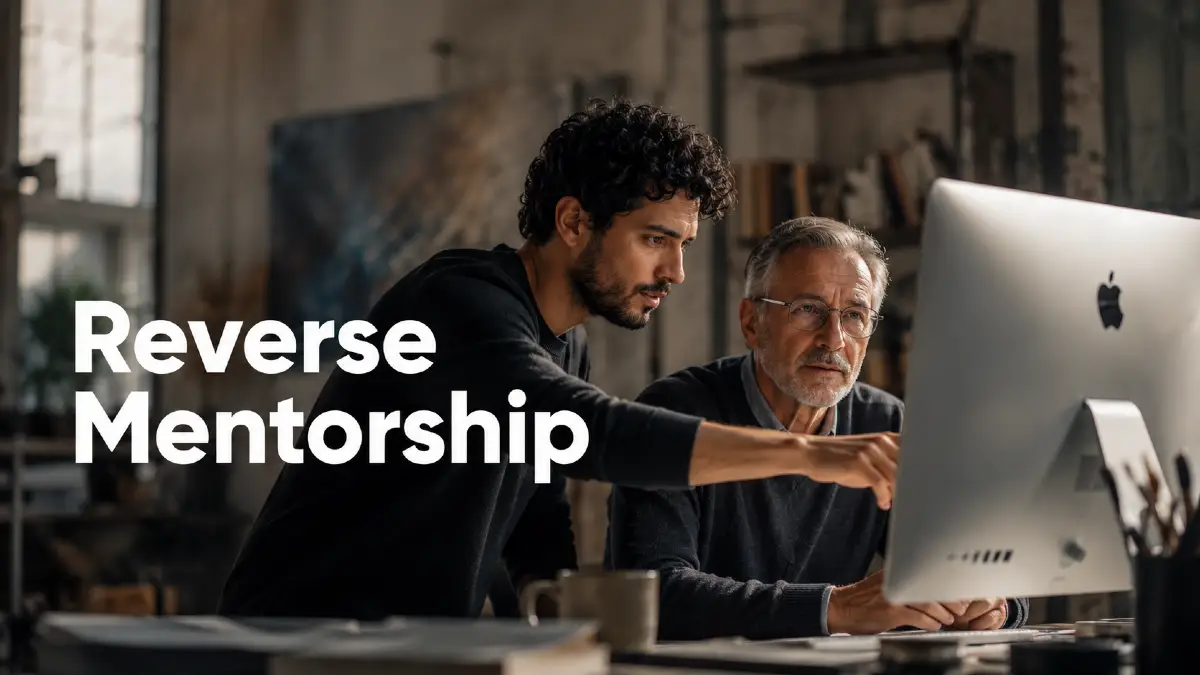
The traditional model of mentorship runs one direction: the older, more experienced person guides the younger, less experienced one. Wisdom flows downhill, from age to youth. This model is ancient, valuable, and — as the data on mentorship makes clear — enormously beneficial for the younger party.
But a quieter pattern has emerged over the past several years that inverts the flow, and the men who have embraced it are discovering benefits that the traditional model cannot provide. It is called reverse mentorship: the deliberate practice of an older person being mentored by a younger one, typically on domains where the younger person has genuine advantage — technology, cultural fluency, emerging tools, shifting social norms, and increasingly, the emotional and relational vocabulary that younger generations have developed more fully than their elders.
Reverse mentorship began in the corporate world. Companies paired senior executives with junior employees so the executives could understand emerging technologies, younger consumer behavior, and cultural shifts they were too removed from to grasp. The practice has since spread well beyond the corporate context into a general principle: the older man who deliberately positions himself as a student of younger people gains access to capabilities, perspectives, and growth that the man who only ever teaches never accesses.
For a generation of men entering middle age in a period of unprecedented technological and cultural change, reverse mentorship is not a soft nicety. It is a survival skill, a humility practice, and one of the more powerful antidotes to the rigidity and isolation that tend to set in as men age.
Why this matters now specifically
Reverse mentorship has always had some value, but several features of the current moment have made it unusually important.
The pace of technological change has accelerated past the point where experience confers automatic advantage. For most of history, the older person knew more about how the world worked because the world changed slowly enough that accumulated experience stayed relevant. That assumption has broken. A 25-year-old in 2026 has a more intuitive grasp of AI tools, of the platforms where culture now happens, of the shifting norms of communication, than a 55-year-old with thirty more years of general experience. On these specific and increasingly important domains, the flow of useful knowledge has reversed.
Artificial intelligence has made this especially acute. The men who will thrive in the AI-transformed economy are the men fluent in using these tools, and fluency is currently concentrated among younger users who adopted them without the friction that experienced professionals bring to new tools. The older man who refuses to learn AI from people younger than him is choosing obsolescence. The older man who humbly positions himself as a student of younger, more fluent users gains a capability that will define the next phase of his career. Learning how AI can make us more human rather than less is, increasingly, something the young are teaching the old.
The cultural and emotional vocabulary has also shifted in ways that favor younger generations. Younger men, raised in a period of more open discussion of mental health, emotional expression, and relational dynamics, often have a more developed vocabulary for these domains than their fathers’ generation. The older man who learns this vocabulary from younger people gains access to parts of his own emotional life that his generation was not given the tools to articulate. This is a genuine and underappreciated form of reverse mentorship.
What reverse mentorship actually transfers
The specific things that flow from younger to older in a good reverse-mentorship relationship are worth naming, because they are different from what flows in the traditional direction.
Technological fluency. This is the most obvious and most commonly cited benefit. The younger person teaches the older one how to actually use the tools that are reshaping work and life — AI systems, new software, the platforms where business and culture now happen. This is not just about keeping up. It is about the older man retaining his economic relevance and his ability to participate in a rapidly changing world. Lifelong learning used to mean reading more books. Increasingly it means being willing to be taught by people younger than you.
Cultural awareness. The younger person provides a window into how the world is actually shifting — what younger consumers want, how communication norms are evolving, what is changing in the broader culture. For the older man in business, this awareness is directly valuable. For the older man as a father, it is essential — understanding the world his children are growing up in requires input from people closer to that world than he is.
Fresh perspective on stale assumptions. The older man accumulates not just wisdom but also calcified assumptions — beliefs about how things work that were true when he formed them and may no longer be. The younger person, unburdened by these assumptions, frequently sees possibilities the older man has stopped seeing. The reverse-mentorship relationship surfaces these calcified assumptions and challenges them, keeping the older man’s thinking more flexible than it would otherwise be.
Emotional and relational vocabulary. This is the least discussed and possibly most valuable transfer. Younger generations have developed more explicit frameworks for discussing emotion, relationship, mental health, and inner life than their elders were given. The older man who learns this vocabulary — often from his own adult children, sometimes from younger colleagues or friends — gains tools for understanding his own inner life that his generation’s silence denied him. Many men in their 50s and 60s report that their adult children taught them more about emotional honesty than they learned in the preceding five decades.
The humility practice itself. Beyond the specific content transferred, the act of being mentored by someone younger is itself developmentally valuable for the older man. It is a deliberate practice of humility, of remaining a student, of refusing the rigidity that age tends to produce. The man who can be taught by people younger than him stays mentally young in a way the man who has stopped learning does not. The Nun Study and related research on cognitive reserve suggests that this kind of continued learning and mental flexibility is protective against cognitive decline. Staying a student may literally keep the brain healthier.
Why older men resist it
The benefits are clear, but the practice runs against deep instincts, and naming the resistance is necessary to overcome it.
The status threat. Being taught by someone younger inverts the natural status hierarchy, and many men experience this as threatening. The older man is supposed to be the one who knows. Admitting that a younger person knows things he doesn’t — and deliberately positioning himself as their student — requires setting aside a status concern that runs deep. The men who can do this are demonstrating a security that the men who can’t are lacking.
The competence identity. Many men have built their identity around competence and expertise. Being a beginner again — fumbling with a tool a 24-year-old uses effortlessly — is uncomfortable precisely because it threatens the competence identity. The willingness to be incompetent in front of someone younger, in service of becoming competent, is a specific kind of strength that not all men have developed.
The generational dismissiveness. Older generations have always been somewhat dismissive of younger ones — the kids today, with their soft values and their phones and their lack of resilience. This dismissiveness, whatever truth it contains, blinds the older man to what the younger generation actually knows that he doesn’t. The man who has decided that younger people have nothing to teach him has guaranteed that he will learn nothing from them, which in a rapidly changing world is an expensive decision.
The fear of irrelevance. Paradoxically, the men who most fear becoming irrelevant are often the men most resistant to reverse mentorship, because engaging with it requires admitting how much they don’t know. The defensive move is to dismiss the new tools and norms as fads, to insist that the old ways are better, to refuse to learn. This defense guarantees the irrelevance it fears. The men who stay relevant are the ones secure enough to keep learning, including from people half their age.
How to actually do this
For the older man who wants the benefits of reverse mentorship, the practice is learnable.
Identify your blind spots honestly. Where has the world moved past your competence? AI tools? Emerging platforms? The cultural world your kids inhabit? The emotional vocabulary you were never taught? Honest assessment of where younger people genuinely know more than you is the starting point. Most older men have several such domains. Naming them without defensiveness is the first move.
Find younger people worth learning from and ask. Just as with traditional mentorship, the ask is specific and small. “I’m trying to actually understand how to use these AI tools and I keep bouncing off them — could you show me how you use them?” The younger person, flattered to be asked and pleased to teach, almost always says yes. The relationship grows from specific, repeated exchanges.
Practice genuine humility. This is not performed humility, where the older man pretends to learn while secretly believing he knows better. It is genuine studentship — actually treating the younger person as the teacher in their domain of competence, actually trying their methods, actually changing your behavior based on what they teach. The younger person can tell the difference, and so can you. The genuine version produces the benefits. The performed version produces nothing.
Offer the traditional direction in return. The best cross-generational relationships flow both ways. While the younger person teaches the older one about tools and culture, the older one offers what he genuinely has — perspective, calibration, experience, the patterns that only time reveals. This reciprocity makes the relationship rich rather than transactional. The young teach the new; the old teach the enduring. Both grow. Good mentorship in either direction is fundamentally a relationship of mutual respect, not a one-way transfer.
Let your own children teach you. For fathers, the most powerful reverse mentorship is often available at home. Adult children, and even teenage ones, have access to a world the father can only partially see. The father who can position himself, at times, as a student of his own children — about technology, about culture, about emotional honesty — deepens the relationship and learns things he could not learn otherwise. This requires setting aside the parental authority reflex in specific domains, which is hard, and which the best fathers learn to do.
What this looks like across a working life
The value of reverse mentorship is easiest to see when you trace it across the arc of a man’s career rather than treating it as a single relationship. In his twenties, a man is overwhelmingly a receiver of traditional mentorship — he knows little, the people ahead of him know much, and the flow of wisdom is almost entirely downhill. In his thirties, the picture begins to balance: he has accumulated genuine expertise in some domains while younger entrants are arriving with fluency in tools and norms he is already starting to lag on. By his forties and fifties, if he is paying attention, he is simultaneously a traditional mentor to those behind him and a reverse-mentee to those same younger people in the domains where they lead.
The man who manages all three flows at once — guiding the young in his areas of mastery, learning from them in theirs, and still seeking out his own elders in the domains where wisdom only comes with more years than he has — is operating with a kind of intellectual humility that keeps him sharp and relevant for decades longer than his rigid peers. He is never the smartest person in the room about everything, and he has stopped needing to be. He extracts what each person around him knows that he doesn’t, regardless of their age, and contributes what he knows that they don’t, regardless of their seniority. This posture is rare, and the men who hold it tend to be the ones who remain genuinely valuable into their sixties and seventies while their contemporaries calcify.
There is also a compounding effect worth naming. The older man who is known to be genuinely open to learning from younger people becomes someone younger people want to be around. They bring him their knowledge freely because he receives it well and reciprocates with his own. This creates a flow of fresh information, emerging trends, and new perspectives that keeps the older man’s thinking current in a way no amount of solitary study could achieve. The rigid older man, by contrast, finds that younger people stop offering him anything, because he has made it clear he isn’t interested in what they know. He cuts himself off from the very input he most needs, and the isolation accelerates his decline. Lifelong learning in practice means staying the kind of person that others, including younger others, want to teach.
The deeper reframe
Underneath the practical benefits, reverse mentorship reflects a truth about wisdom that the traditional model obscures. Wisdom is not simply a function of age. It is domain-specific. The older man knows more about some things — the enduring patterns of human nature, the long arc of a career, the consequences that only reveal themselves over decades. The younger person knows more about other things — the tools of the present moment, the shape of the emerging future, the vocabulary the culture has only recently developed. The wise older man is not the one who insists on his superiority across all domains. He is the one who knows which domains are his and which are not, and who remains a student in the domains that are not.
This is itself a form of wisdom that the rigid older man lacks. The capacity to learn from anyone, regardless of age, is a marker of genuine maturity rather than its opposite. The men who age best — who stay relevant, mentally sharp, connected to the changing world, and close to their children — are almost universally men who never stopped being students. They take the traditional mentor role seriously, guiding those behind them. And they take the reverse-mentor role seriously too, learning from those who know what they don’t.
The man who only ever teaches becomes rigid, isolated, and gradually obsolete. The man who can both teach and be taught — who guides the young in the domains of his mastery and learns from them in the domains of theirs — stays alive in a way the purely-teaching man does not. Lifelong learning is not just reading more. It is staying humble enough to be taught, by anyone, at any age, including by people who are decades younger and who know things you do not.
The world is changing faster than experience alone can track. The older man who insists that age confers complete authority is choosing a slow obsolescence. The older man who stays a student — who lets the young teach him the new while he teaches them the enduring — keeps growing until the end. Reverse mentorship is how he does it. The first step is the hardest: admitting, to someone younger than you, that there is something they can teach you. Most men can’t do it.
The ones who can are the ones who stay sharp, relevant, and connected for the rest of their lives.
Related posts:
 The Mentor Multiplier: How to Find a Mentor as a Man (and Why Most Never Ask)
 Understanding Why Men Are Walking Away From Modern Dating and Relationships and The Rise of MGTOW movement
 Carbon Diet Coach: The Science-Based Macro Tracking App Created by Dr. Layne Norton That’s Revolutionizing Nutrition Coaching
 Student Mindset for Lifelong Learning: Stay Sharp for Life
 Mentorship Tips That Actually Work (And Why Most Advice Fails)