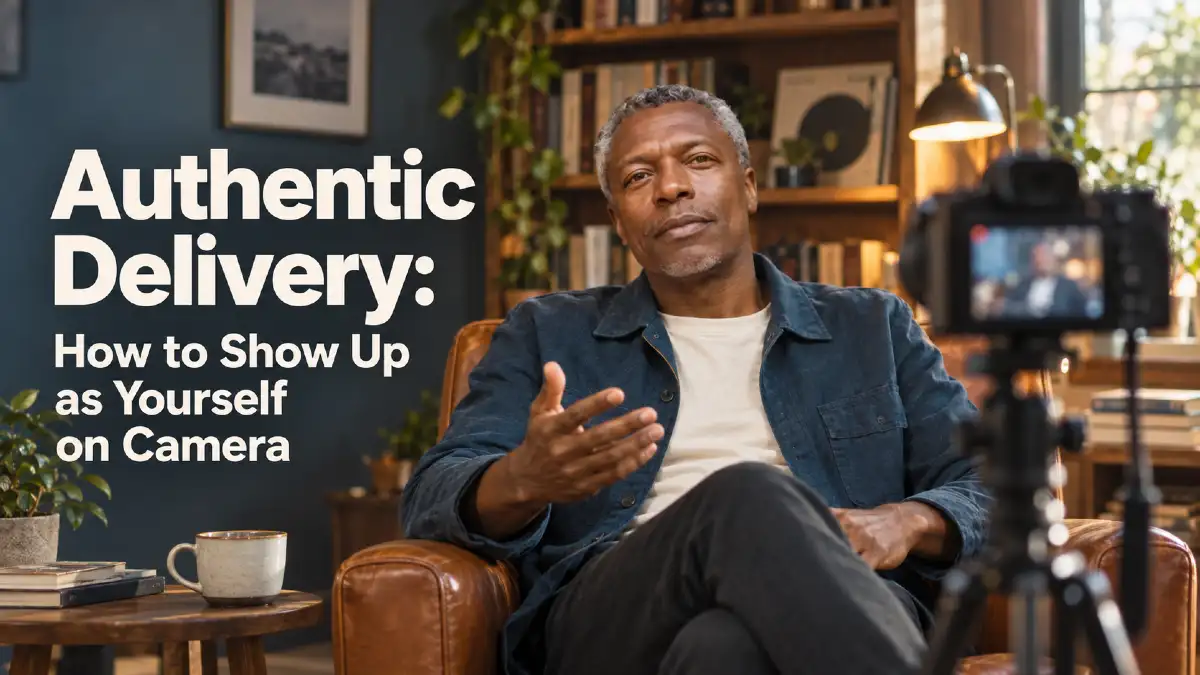
Most advice about on-camera presence focuses on what you should add. More energy. More animation. Bigger gestures. A heightened version of yourself that fills the frame with presence and personality.
Caleb Ralston’s advice goes in the opposite direction entirely. And it is more useful precisely because of that.
In his personal brand course, Ralston argues that good delivery — the kind that builds audiences, earns trust, and makes people feel genuinely connected to the creator they are watching — is not about performance. It is about subtraction. It is about systematically removing everything that makes you feel unlike yourself when a camera is pointed at you.
“Delivery is not about becoming someone else or building this caricature version of yourself,” he says. “Delivery is about removing all the things that keep you from being fully you.”
The Problem with Performing: Why Content Creation Culture Rewards the Wrong Thing
The content creation industry has, perhaps inadvertently, created an aesthetic of exaggerated presence. The upbeat host. The over-enunciated delivery. The carefully modulated enthusiasm that never dips, never hesitates, never shows the texture of a real human having a real thought in real time.
Ralston traces this partly to old production advice — the instruction to “turn up times ten” because it reads differently on camera. There is a kernel of truth in that. Energy does translate differently through a lens. But the culture around that advice has mutated into something more distorting: the idea that you need to be a brighter, bigger, more polished version of yourself to build an audience — a pressure that only sharpens every time a platform quietly rewrites what its algorithm rewards and creators scramble to keep up.
The result is creators who burn out building a character rather than a brand. Who feel increasingly distant from what they are putting out. Who, as Ralston puts it, would not send their own videos to the people in their lives whose opinions they actually care about.
That is not just a psychological problem. It is a practical one. If you cannot sustain the performance, you will not sustain the content. And if you cannot sustain the content, you will not build the brand.
The Real Variable in Good Delivery: What Actually Builds a Personal Brand
Ralston points to something that gets lost in the conversation about charisma and presence: the clearest predictor of good delivery is how well you understand what you are trying to say.
When you genuinely understand an idea — when you have lived with it, tested it, turned it over in your mind enough times that it belongs to you — you can communicate it in multiple ways, to multiple audiences, in multiple contexts. That flexibility is closer to what some creators describe as learning to talk on camera in your own voice than it is to memorizing a script — the words change scenario to scenario, but the understanding underneath stays the same. Ralston’s test: if you can explain a concept clearly to three different people in three completely different scenarios, you understand it well enough to teach it in your content.
When the understanding is not there — when you are reaching for words, padding with filler, retreating into vagueness — it shows. And it shows regardless of how good your setup is, how bright your ring light is, or how much energy you bring to the opening of the video.
This reframes the work. The work is not to become a better performer. The work is to understand your material deeply enough that the performance becomes irrelevant. Usefulness, communicated clearly, is what builds an audience. Not charisma. Not production value. Usefulness.
The Game Tape Review: A Content Creator’s Self-Evaluation Method
Ralston uses an analogy from sport to describe how he improves his communication over time: the quarterback who watches game tape on Monday morning, frame by frame, to understand what worked and what did not on Sunday.
He does this with his own content — watching back podcast appearances and videos not to evaluate his production quality, but to observe his communication. Where did he find the clearest path to the idea? Where did he spiral into unnecessary detail? Where did he answer a question too slowly, when thirty seconds less would have served the audience better?
He specifically identifies something he works on: he is a verbal processor, someone who thinks out loud and sometimes takes longer than necessary to arrive at the point. The game tape review helps him see where those loops occurred — and then he practices saying the same thing more directly. It’s the same instinct behind honestly asking whether your content is actually helping the people watching it, or just performing for them — the review only works if you’re willing to look at the footage without flinching.
The implication for anyone building a personal brand is that delivery is not a fixed attribute. It is a skill you can develop through honest self-observation, not through critique from others or by copying a style you have observed in creators you admire.
Authenticity Is Not a Soft Concept — It’s a Personal Brand Strategy
There is a tendency to treat authenticity in personal branding as a fuzzy, feel-good value — something you are supposed to pursue because it sounds virtuous. Ralston treats it as a survival strategy. The same logic holds outside of content creation, too: showing up as your real professional self at work carries the same trust dividend it does on camera.
Being authentic on camera is sustainable. Being a constructed character is not. The moment you step into a room with someone who watches your content and you are not who they expect, you have a trust problem. And the content creator space is small enough, and human beings are perceptive enough, that the gap between your on-camera persona and your actual self tends to surface eventually.
More practically: if who you are being on camera is someone you do not actually like being, you will eventually stop. The energy required to maintain a persona you did not create is enormous. The energy required to simply show up as yourself — curious, uncertain sometimes, direct in your opinions, specific in your experience — is something that can be sustained indefinitely.
Ralston made this point from his own first year of brand-building. He is introverted. He is uncomfortable being filmed in public. He is a verbal processor who sometimes circles before landing. And his content has performed, by his own admission, beyond what he could have predicted.
Because none of those things disqualify him. They make him human. And human is, as it turns out, the rarest and most sustainable thing you can be on camera in an era when AI-generated content is proliferating and audiences are quietly starving for proof that a real person is on the other side of the screen.
The Two-Part Test for On-Camera Authenticity
For anyone asking whether their current delivery style is working for them, Ralston offers an implicit two-part test.
First: do you enjoy the process of creating this content, or does it consistently feel like a performance you are maintaining? If it feels like effort in the wrong direction — not the good effort of doing hard, meaningful work, but the draining effort of being someone you are not — that is a signal, and often one of the same quiet patterns that hold people back well beyond the camera.
Second: does the person on screen feel, to you, like someone you would actually want to have a conversation with? Not a flawless version of yourself. Not a character. Just: is this person present, clear, genuine, and someone you could imagine sitting with for an hour?
If the answer to both is yes, you are building something sustainable. If not, the work is not on your production quality. It is on reducing the distance between who you are and who you are being.
FAQs:
Q: How do I become more natural on camera? A: Focus on deeply understanding what you are trying to communicate rather than how you are presenting it. Clarity of thought produces natural delivery more reliably than any technique.
Q: Do I need to be charismatic to build a personal brand? A: No. Caleb Ralston argues that usefulness, communicated clearly, builds audiences more reliably than charisma. Even monotone delivery works if the content is genuinely valuable — a pattern that shows up consistently in where platform trends are actually heading each year.
Q: What is a Game Tape Review in content creation? A: Watching back your own recorded content — videos, podcast appearances — not to evaluate production quality, but to observe your communication patterns and identify where clarity could improve.
Q: How do I stop feeling awkward on camera? A: Ralston suggests focusing on someone specific you are making the content for — a real person with the real problem you are solving — rather than performing for an abstract audience.
Q: Is it okay to show vulnerability or uncertainty in content? A: Yes. Real humans are uncertain sometimes. Showing the texture of genuine thought — including uncertainty — tends to build more trust than false confidence.
Related posts:
 Roberto Blake on AI, Shorts, and the New Rules of YouTube Growth in 2026
 The YouTube Algorithm Update: What Creators Need to Know About the 2026 Gemini Update
 DJI Osmo Pocket 3 vs Pocket 4: The Complete Comparison (Is the Upgrade Worth It?)
 The Ordeal Is the Hero’s Journey Stage Everything Else Was Building Toward
 Is Your Content Helping or Harming? A Creator’s Guide to Honest Self-Evaluation