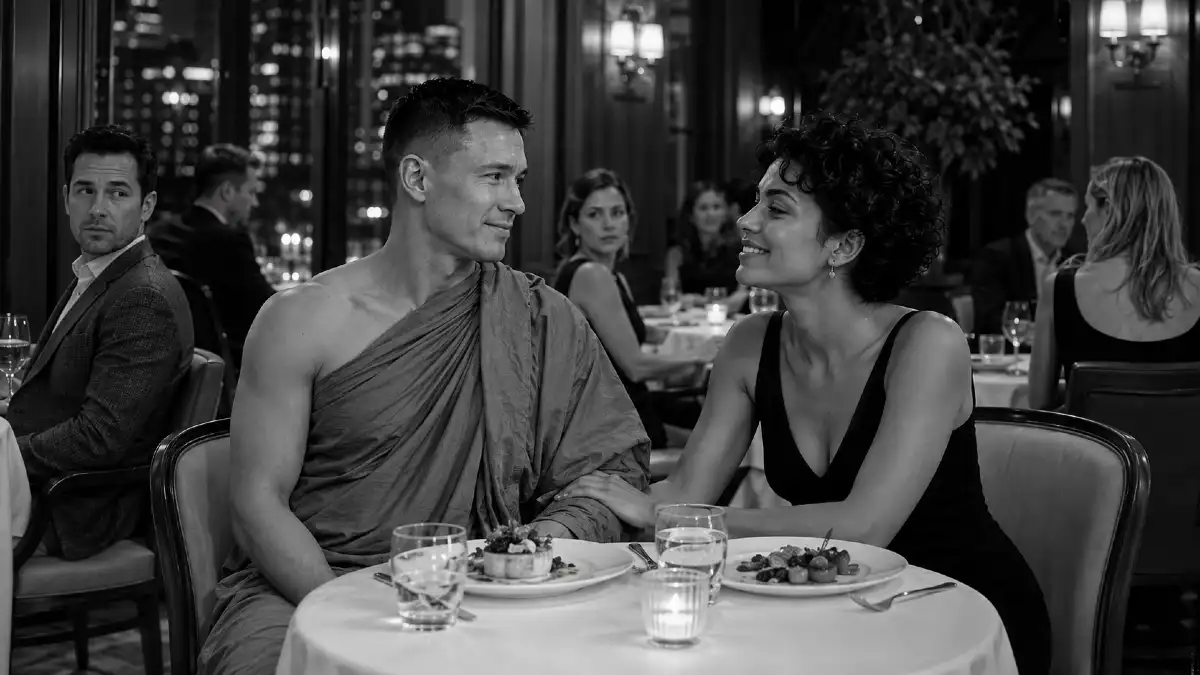
What you do after monk mode decides whether it worked: the gains last when you plan the exit as carefully as the entry, bring things back one at a time, and turn your monk mode rules into habits you own. Most men treat the last day as a finish line, and the first night out as a reward they’ve earned, which is exactly where the trouble starts. Below are the reasons the exit is the riskiest part of monk mode, a 14-day re-entry protocol, what to keep out for good, and how to lock in what you built.
Day 61. You’ve done it. Sixty days without alcohol, without the apps, without the late nights and the takeaway. You wrote every morning. You trained five days a week. You read eleven books. On Friday a friend texts, you’re out of the monastery, pint tonight? and you think, why not. You’ve earned one.
One becomes three. Saturday you reinstall Instagram, just to catch up. Sunday the run doesn’t happen because you’re tired. By Wednesday you’re scrolling in bed at one in the morning, and by the end of the third week you’re living a version of your old life with a faint memory of the man who did sixty clean days, and a quiet, nagging suspicion that he wasn’t really you.
If any of that sounds familiar, the man who did sixty days was you, and he still is. Nothing about the slide means the discipline was fake. It means nobody told you that the exit needs a plan of its own.
What Should You Do After Monk Mode?
After monk mode, you should run a deliberate re-entry phase of about two weeks: hold your routine for the first few days, decide in advance what comes back and in what form, reintroduce one thing at a time while watching its effect, and re-label the habits you want to keep as part of who you are, not as temporary rules.
The reason this matters is simple. Monk mode is a period of deliberate restriction, a set stretch in which you cut the things that drain your attention and energy so you can rebuild focus, health and work. The restriction is the easy part to design. Ending it is where most of the value is either banked or lost, and almost every guide on the subject stops at the door.
If you’re still planning your first one, start with the honest guide to monk mode for men, which covers the tiers, what to cut and what to add. This article picks up where that one ends.
Why Coming Out of Monk Mode Is Where It Usually Goes Wrong
During monk mode, your relationship with the things you cut changes. That’s the point. But the change cuts both ways, and the second half catches men off guard.
Anna Lembke, a psychiatrist at Stanford and author of Dopamine Nation, describes the brain’s reward system as a balance. Every hit of pleasure is followed by a dip in the other direction, and with repeated exposure the brain leans further into that dip, so you need more of the thing just to feel normal. Her prescription is a break, typically around thirty days, from whatever you’ve been leaning on. The first stretch tends to feel worse before it feels better; after a couple of weeks, many people find ordinary pleasures start to register again.
A good monk mode does something similar. After sixty days, a walk, a decent meal and a long conversation feel richer than they did. That’s real progress. It also means that when the old inputs come back, they hit harder than you remember. The beer, the feed, the late-night game arrive with full force on a system that’s no longer used to them, and the pull to go back for more is strong.
That’s not a character flaw. It’s what a recalibrated system does when it’s flooded, and the same adaptability that makes the pull strong is what lets you rewire your brain in the first place. Lembke’s book is careful to frame these responses as how brains work, not as a verdict on the person, and the same applies here. You’re not weak for feeling the pull. You’d be unprepared if you didn’t plan for it.
What this means in practice is that the end of monk mode is not a return to neutral. It’s a high-risk window, and you go into it either with a plan or without one.
The One-Beer Problem: How a Small Lapse Becomes a Full Relapse
The most dangerous moment after monk mode isn’t the first drink or the first scroll. It’s the story you tell yourself immediately afterwards.
The psychologist G. Alan Marlatt, whose relapse prevention model shaped modern addiction treatment, drew a sharp line between a lapse and a relapse. A lapse is a single slip. A relapse is a full return to the old pattern. What moves a man from one to the other, in Marlatt’s model, is what he concludes about the slip. If he reads it as proof of something permanent about himself — I’ve got no willpower, I’ve blown it, I might as well — the slip tends to snowball. (Whether willpower is really a limited resource is itself more open than that inner voice assumes.) If he reads it as a one-off, tied to a specific situation he can handle differently, it tends to stay a slip. Marlatt called the first reaction the abstinence violation effect.
Later research has complicated the details. In one closely tracked study of people quitting smoking, the guilt and self-blame after a first lapse didn’t predict relapse the way the model expected. What did predict a faster next lapse was falling confidence after repeated slips. Either way, the practical lesson holds: a slip that dents your belief that you can handle this is the one that starts the slide.
For a man coming out of monk mode, that’s the whole game. You will lapse. Plan for it rather than pretending you won’t. When it happens, the job is to call it what it is — one night, one decision, information — and get back on the protocol the next morning. All-or-nothing thinking is what turns one beer into three weeks.
This is also why being kind to yourself after a slip isn’t softness. Self-compassion that keeps your standards is one of the most practical tools you have, because a man who isn’t busy punishing himself has the energy to get back up.
The Four Principles of Monk Mode Re-Entry
Everything in the protocol below rests on four principles. Learn these and you can adapt the details to your own life.
Treat the exit as part of the discipline
Monk mode isn’t a switch that flips from on to off. It has an entry, a middle and an exit, and the exit deserves the same seriousness as the first day. In practice that means a defined re-entry window of about two weeks, written into the calendar before monk mode even begins. The man who plans the exit before he enters is the one who keeps what he built; it’s delayed gratification applied to the finish line itself.
Decide in advance what comes back
Nothing returns by default. Every item you cut gets a decision: stays out, comes back in a different form, or comes back slowly under observation. This isn’t just good sense. Research on what psychologists call implementation intentions, specific plans in the form if this happens, then I’ll do that, has found them to be among the more reliable tools for following through. When Peter Gollwitzer and Paschal Sheeran pooled 94 studies, these simple when-where-how plans had a medium-to-large effect on whether people actually reached their goals. Deciding in advance is how you take the decision out of the moment, when the pull is strongest.
Use a gradient, not a flood
Bring things back one at a time, with a few days between each, so you can see what each one actually does to your sleep, your mood, your training and your work. If everything returns on the same weekend, you’ll have no idea which input knocked you off course. A gradient turns re-entry into an experiment you can learn from.
Lock in the gains before the exit window opens
The habits that served you during monk mode need to stop being monk mode rules and start being how my life works before the restrictions lift. Otherwise, when monk mode ends, they end with it. More on how to do that below.
The 14-Day Monk Mode Re-Entry Protocol
This is a template, not a commandment. Adjust the timing to the length and intensity of your monk mode, but keep the order.
Days 1–3: Hold
Change nothing. Keep the same wake time, training, work blocks and restrictions you’ve been running. Use these three days to write your re-entry plan: every item you cut, what happens to it, when, and how you’ll judge whether it’s working. The urge to celebrate on day one is strong. Holding for 72 hours proves to yourself that the end of monk mode is your decision, not a release valve.
Days 4–6: The first, lowest-risk reintroduction
Bring back one thing, starting with whatever has the weakest hold on you. For one man that’s two beers at home with a close friend, not a night out. For another it’s one film on a Saturday. Afterwards, write three lines: how it felt, what it did to your sleep, and whether you wanted more the next day.
Days 7–10: A second category, in a new form
Add one item from a different category, in a form that’s harder to binge. If it’s social media, use it in a browser on a computer, with a daily time limit, instead of reinstalling the apps on your phone. If it’s gaming, set a session length before you start. The form matters as much as the thing, which is why Lembke’s idea of putting physical, time-based and category-based limits on what you return to is so useful here.
Days 11–14: The stress test
Deliberately add one demanding event: a big night out, a travel day, a weekend away from your routine. Then watch how quickly you return to baseline. A man who’s back on his morning routine, and his sleep, within a day or two has built something durable. A man who takes a week to recover has learned which parts still need scaffolding.
Day 15 onwards: Steady state
The restrictions are over. What remains is a set of choices you’ve tested and own. You’re not on monk mode, and you’re not off it. You’re living the life it was meant to build.
What to Keep Out, What to Change, What to Bring Back Slowly
Every man’s list will be different, but most items fall into three groups.
Some things are usually worth leaving out for good. For many men that includes the social media apps they couldn’t use without losing hours, the third and fourth drinking nights of the week, the constant news refresh, and television as background noise. If you didn’t miss something during sixty days, that’s information. You don’t owe it a comeback. If the feed was the hardest thing to cut, the bigger picture of how the attention economy is designed to hold you will make the decision easier.
Some things should come back in a different form. Social life, food, entertainment and dating are part of a full life, and cutting them permanently isn’t discipline; it’s withdrawal. The question is which form serves you. Dinner with two friends instead of a crowded bar. Good food you cook rather than delivery at midnight. A series you choose to watch instead of the autoplay queue. Men who ran monk mode with others in their lives already know this, and the principles in monk mode without isolation apply just as much on the way out.
And some things should only come back slowly, under observation, or not at all. Anything that felt compulsive before monk mode belongs here: alcohol, dating apps, gaming, betting, pornography and the foods you used to eat on autopilot. These are the inputs most likely to run the flood rather than the gradient. With some of them, the honest answer after sixty days may be that they don’t come back. That’s not failure. That’s what the experiment was for. If alcohol is on the list, the reframe that makes quitting drinking easier is worth reading before you decide, and if betting is, look closely at how sports betting hooks young men.
Lock In the Gains: Turning Monk Mode Rules Into Who You Are
The most important move happens before the exit, and it’s mostly invisible.
During monk mode, your habits are held up by rules. No phone before nine. Train five days. Write for an hour. Rules work well inside a set period. The problem is that rules have an end date, and when it arrives, everything they were holding up tends to fall with them.
James Clear, in Atomic Habits, argues for anchoring habits to identity instead: not I’m on a no-phone-before-nine rule, but I’m someone who doesn’t start the day on his phone. The rule ends when monk mode ends. The identity doesn’t. In the last week of monk mode, write down every habit you want to keep and rewrite each one as a sentence about who you are. I’m a man who writes for an hour every morning. I’m someone who trains. I go to bed before eleven.
Then keep doing them, because identity follows evidence. It’s the same mechanism behind rebuilding your self-image: you become who you repeatedly show yourself to be. The good news here comes from Phillippa Lally and her colleagues at University College London, who followed people building new daily habits and found it took an average of 66 days for a behaviour to become close to automatic, with a wide range from 18 days to an estimated 254. A sixty-day monk mode gets you close to that point for many habits, but not past it for all of them. That’s exactly why the re-entry window matters: it’s when your new habits are nearly automatic but not quite safe.
The same study holds a second piece of good news, and it connects back to the one-beer problem. Missing a single day had little effect on the habit forming. Only frequent misses really set people back. So a bad night after monk mode doesn’t erase sixty days. Missing the next morning, and the one after that, is what does.
This is also where the idea that how you do anything is how you do everything becomes practical. The small daily choices after monk mode are the ones that decide which man you’ll be in three months. And it’s why building systems instead of chasing goals suits re-entry so well: a system survives the end of a challenge in a way a goal doesn’t.
Common Mistakes When Coming Out of Monk Mode
Most failed exits make one of the same five mistakes.
The first is treating day one as a celebration. The night you finish is the night your reward system is most primed and your plan least developed. Save the celebration for day fifteen, when it’s a choice rather than a release.
The second is reinstalling everything at once. Apps you deleted are designed to pull you back in, and reinstalling them all on day one guarantees the flood. If you’ve felt what your digital life does to real-world connection, you already know why. Bring one back, in its least sticky form, and see.
The third is walking straight back into the old setting. The same bar, the same group chat, the same evenings on the same sofa carry cues that trigger the old pattern. You don’t have to drop those people, but you can change where and how you see them, at least for the first few weeks.
The fourth is skipping the identity work. Men who do sixty disciplined days and never rewrite their habits as identity often find the habits leave with the rules.
The fifth is not scheduling what comes next. Monk mode tends to work best as a recurring practice rather than a one-time heroic effort, closer to continuous improvement than to a single test of will. Many men find a few focused periods a year, of a month or more each, easier to sustain than one punishing stretch. If you have a partner and children, running monk mode with a family needs its own planning, and the re-entry is a natural moment to agree the next one together.
When Re-Entry Needs More Than a Protocol
A plan like this works for the ordinary pulls of modern life: the feed, the extra drinks, the late nights. It’s not built for addiction.
If what you cut during monk mode was something you’d struggled to control for years — alcohol, gambling, pornography, drugs — and the first contact after monk mode sends you straight back into it, that’s not a protocol problem. It’s a signal to get proper support. Lembke herself warns that people who are physically dependent on alcohol or certain drugs should not stop abruptly without medical help, because withdrawal can be dangerous. The same caution applies to restarting after a break. Tolerance can drop while you’re not using, so going straight back to your old amount carries real risk; with some drugs, including opioids, that risk is overdose.
Asking for help here is a strong move, not a soft one. Tell one person you trust. If it feels bigger than that, a doctor, a counsellor or a dedicated support service is the right next call. And if you’re not ready for that, learning how to ask for help is a good first step, as is finding a group of men working on the same thing; there’s a reason men’s groups are having a quiet renaissance.
You’re capable of a great deal of discipline; sixty days proved that. Being capable doesn’t mean doing it alone.
The Exit Is Part of the Discipline
Monk mode gets all the attention: the cold showers, the deleted apps, the clean streak. But the streak was never the point. The point was to become a man who doesn’t need the streak.
That happens after the restrictions lift, in the ordinary week when nobody is counting. It happens when you choose two beers instead of six, a browser instead of the app, bed at eleven on a Saturday because that’s simply who you are now. Each of those choices is small. Together they decide whether sixty days of work turn into a life or into a memory.
You’ve already done the hard part. You know you can hold a line for two months, and you’ve felt how physical discipline builds mental strength. Now you get to find out which of those lines are worth keeping for good, and you get to decide.
So before your next monk mode ends, ask yourself: what kind of man do I want to be on day sixty-one, when nobody is keeping score?
Questions for the Man Who Just Finished Monk Mode
Read these like an auditor reviewing your last sixty days: no praise, no punishment, just what the evidence shows.
- Look back at the last time a challenge or streak ended: what did you do in the first 72 hours, and what does that tell you about this exit?
- Which slip are you most likely to make in the next two weeks, and what would you say to a friend who made it the morning after?
- Compare your sleep in the last week of monk mode with your sleep the week before it began: which change are you least willing to give back?
- Which item from your cut list does something in you already know shouldn’t return, even before you’ve tested it?
- Finish this without editing: “The habit I’m calling a monk mode rule that is really just who I am now is…”
- You know the day-61 slide from the inside; what would a re-entry tool or practice look like if it were built by someone who had lived it, for every man ending a challenge?
- If the man you were on day sixty could leave a note for the man you’ll be on day ninety, what would it say?
The Re-Entry If-Then Plan: 5 Questions to Protect What You Built
Each answer is a plan in the form when this happens, I’ll do that. Write them down before your last day of monk mode.
- Write it as: “When monk mode ends on ___, I will hold my routine until ___ and write my re-entry plan on ___.”
- Which one thing will you reintroduce first, in which form and on which day, and what will you check the next morning to judge it?
- Which app, setting or habit will you keep out for good, starting today, and what will you put in the space it leaves?
- Before the 14 days are up, which five men who’ve done a challenge like this will you ask about their exit, and what rough re-entry plan could you show them?
- When you slip, and you will, who will you tell, and what sentence will you say before getting back on the plan next morning and letting the slip be one night?
Monk mode was the training camp. The exit is the season.
Frequently Asked Questions About Life After Monk Mode
How long should you wait to reintroduce things after monk mode?
Hold your routine for at least the first two or three days, then bring back one thing at a time with a few days between each. A re-entry phase of about two weeks lets you see how each input affects your sleep, mood and training. Reintroducing everything on the first weekend makes it impossible to tell what knocked you off course.
Why do I binge after monk mode?
After a long break, old pleasures can hit harder than you remember. Psychiatrist Anna Lembke describes how the brain’s reward balance resets during abstinence, so returning inputs feel unusually strong. Add the all-or-nothing thinking that turns one slip into “I’ve blown it”, and a single night can snowball. A planned, gradual exit and a calm response to slips prevent most binges.
Does one bad day after monk mode undo the progress?
No. In Phillippa Lally’s research at University College London on how habits form, missing a single day had little effect on building the habit; only frequent misses set people back. What matters is getting back on track the next morning. The danger isn’t the slip itself, but treating it as proof you’ve failed and abandoning the routine.
How do you keep monk mode habits for good?
Rewrite each habit you want to keep as part of your identity rather than a rule, and keep doing it through the re-entry phase. James Clear’s Atomic Habits argues that identity-based habits outlast rule-based ones. Research suggests habits take an average of about 66 days to become automatic, so the weeks after monk mode are when they’re most fragile.
What should you not bring back after monk mode?
Anything you didn’t miss during monk mode, and anything that felt compulsive before it, deserves careful thought before it returns. For many men that means certain social media apps, extra drinking nights, constant news checking and background TV. Things like social life, good food and entertainment usually come back in a healthier form rather than being cut forever.
How often should you do monk mode?
Many men find monk mode works best as a recurring practice, a few focused periods a year of a month or more each, rather than a single extreme stretch. Each round is easier when you’ve planned a proper exit for the last one. If you have a partner or children, agree the timing together so the discipline doesn’t come at the cost of the people you love.
References
- Clear, J. (2018). Atomic habits: An easy & proven way to build good habits & break bad ones. Avery.
- Gollwitzer, P. M., & Sheeran, P. (2006). Implementation intentions and goal achievement: A meta-analysis of effects and processes. Advances in Experimental Social Psychology, 38, 69–119.
- Kirchner, T. R., Shiffman, S., & Wileyto, E. P. (2012). Relapse dynamics during smoking cessation: Recurrent abstinence violation effects and lapse-relapse progression. Journal of Abnormal Psychology, 121(1), 187–197.
- Lally, P., van Jaarsveld, C. H. M., Potts, H. W. W., & Wardle, J. (2010). How are habits formed: Modelling habit formation in the real world. European Journal of Social Psychology, 40(6), 998–1009.
- Lembke, A. (2021). Dopamine nation: Finding balance in the age of indulgence. Dutton.
- Marlatt, G. A., & Gordon, J. R. (Eds.). (1985). Relapse prevention: Maintenance strategies in the treatment of addictive behaviors. Guilford Press.
Related posts:
 Monk Mode for Men: The Honest Guide That Actually Works (Without Turning You Into a Hermit)
 Monk Mode With a Family: How Married Men Actually Make It Work
 Monk Mode Without Isolation: Discipline That Doesn’t Cost You Friends
 The Man Box Is Tightening, Not Loosening — What the 2026 Data Actually Shows
 The Men’s Group Renaissance: The Quiet Movement Saving Men’s Lives