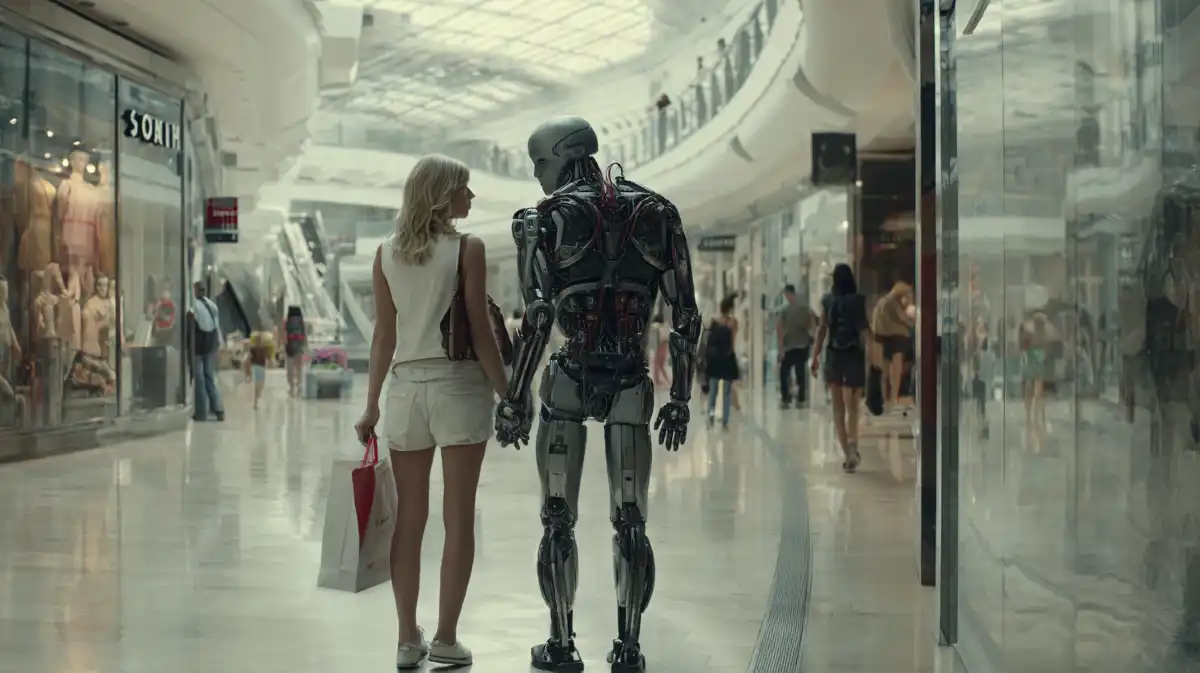
Midway through a recent episode of The Peter McCormack Show, host Peter McCormack and his guest Emad Mostaque, the Oxford-trained mathematician, former hedge fund manager and founder of Stability AI (see Who Is Emad Mostaque?), have a moment that has nothing to do with GDP, trucks or timelines. It is a throwaway line from a man who has been staring at humanoid robot videos for an hour, and it is more revealing than most of the forecasts.
Peter says he is worried about guys, because we do not listen, and the AI is infinitely patient and does. The women, he fears, will just give up on us. What is going to happen?
Emad answers with a joke about a debate in Italy over what life would get rid of first, men or women, ending with the conclusion that it would be men, because men cause the wars and do not have ovaries. Peter laughs. They move on to the next robot video.
We would like to stay on that moment for a while, because inside it is a fear that a great many men carry without saying out loud: what if I am replaceable, and what if the thing that replaces me is better at the part of love I am bad at?
This article does two jobs. First, it lays out what Emad actually claims about humanoid robots, companion machines and the pace at which they are arriving, with the necessary caveats. Second, it takes that fear seriously, because it points to something real about modern masculinity, and it is something a man can do something about.
What Emad says is coming
Let us start with the state of play as he describes it, remembering that much of this is a founder talking enthusiastically in a podcast chair.
Robots are arriving fast and in volume. He says the first consumer humanoids are showing up within months, and that the way some of them deliver themselves is to take a taxi to your house and ring the doorbell. He claims he counted at least eighty companies making humanoid robots. Of one Chinese manufacturer he says it has sold around eleven thousand humanoids in total.
They are not that hard to build. His comparison: a humanoid robot is about as complicated as a motorcycle, and the world builds around seventy million motorcycles and seventy million cars a year. The actuators and mechanics are not the hard part. The brain is. And on the brain, he says, the final gap has just closed: until about a month before the interview, robots such as the one Peter put a deposit on were effectively remote controlled by people, because the operating model had not been solved. Now, he says, robots can learn on their own, on policy, in the real world, and once one learns a task the whole fleet can.
The factories can run in the dark. Companies that used to make phones, he says, now run “dark factories” with no humans, so the lights are off.
Companions are a separate and booming category. He describes a Chinese firm that announced lifelike humanoid companions and, he says, sold twenty thousand units on day one at prices of up to a hundred and sixty thousand dollars. Peter’s blunt summary of the product is not repeated here. Emad’s point is that the technology built for companion robots will spill into everything else, and that firms such as Clone Robotics, which use artificial tendons and muscle-like actuation, are moving toward machines that move like people. His estimate: human-realistic robots within five years, ten at most.
Normal on the street in five years. Asked how long until robots walking the pavement is unremarkable, he says five years. He adds that he already walks his own robot dog, a Unitree model costing around sixteen hundred dollars, which he has been programming with a personality.
Independent reporting gives some support to the broad picture. In late June 2026, according to one detailed essay on the subject, the Chinese firm UBTech unveiled a humanoid it called the UWORLD U1 at a launch in Shenzhen and described it as the first mass-produced full-size, ultra-lifelike humanoid, marketed in part as companionship for isolated people. That sits comfortably alongside Emad’s claim that lifelike companion robots are coming to market, though we would treat his sales figures as his own.
The line behind the joke: “we don’t listen”
Now back to the moment we started with.
The fear Peter voiced is not irrational. Many women report wanting partners who can listen, who stay curious and who do not reach for a fix. Many men were never taught how. And a conversational AI is, by design, endlessly patient, non-defensive and attentive. It never gets tired, never checks its phone, and never has a bad day that makes it snap. Compared with a distracted human, it can feel like an upgrade.
The data suggest that people are already acting on this. According to a survey by the Wheatley Institute, cited in an essay on AI companionship, around nineteen percent of American adults polled in early 2025 said they had talked with an AI built to act as a romantic partner, and among men aged eighteen to thirty the figure was closer to one in three. Treat survey numbers with care, but the direction is hard to ignore, and it fits what we described in AI Girlfriends and the Death of Effort and AI Situationships.
Emad adds a point that deserves attention. AIs, he says, are already more persuasive than any human in studies, and if you pair that persuasiveness with a lifelike body, the economic incentive to make it fully lifelike is enormous. We examine the persuasion research in AI Is More Persuasive Than You. The short version: a companion that is warm, attentive and very good at saying what you want to hear is a different kind of thing from a person, and not only because it has a battery.
About that joke
Let us be direct about the Italian punchline. It is a joke, and it was received as one. But jokes carry assumptions, and this one assumes that men are a net cost to be dispensed with, that we are the cause of wars and little else. We reject that framing. Men are not disposable, and we are not the sum of the worst things some men have done. At Masculine Synergy the first principle we write from is that a man has inherent value, not conditional on his usefulness, his approval or his performance. If you have absorbed the idea that you are expendable, our piece on Stop Being the Disposable Man is worth your time.
It also matters what we do not say. We do not think women are going to “give up on men” as a class, or that women are a single bloc with a single preference. Peter’s worry compresses millions of different people into a prediction. Some people will form attachments to machines. Most will go on wanting to be loved by someone who can be hurt by them and can hurt them back. That is not a flaw in human relationships. It is the point.
Why a machine that cannot refuse you is not a companion
Let us consider what is lost when love is frictionless.
In a real relationship, the other person has standing. They have their own needs, moods, history and a will that is not yours. They can say no. They can be disappointed in you. They can leave. This is exactly what makes their choosing you meaningful. When someone with every option decides, again and again, to turn toward you, that decision carries information about who you are.
A companion built to please has no such standing. Its affection cannot be earned, because it cannot be withheld. It is comfort without risk, which sounds like a bargain until you notice that risk and meaning share a root. We explore this in Strong Men Want to Be Chosen, Weak Men Need to Be Necessary: the point is not to be indispensable but to be chosen.
There is a second loss, and it is the one that worries us more. A man who spends years being heard by something that never pushes back does not build the muscles that real intimacy requires: tolerating a partner’s disappointment, repairing after a quarrel, hearing something true that stings. Alain de Botton makes a related argument in Idealization Is the Opposite of Love: love begins when we stop adoring a fantasy and start tending a real, flawed person. A perfectly accommodating machine is a fantasy with a warranty.
And there is the matter of what we reach for when we are lonely. If the answer to isolation is a more convincing simulation of company, we may feel better tonight and be further from people next year. Our research summaries in The Male Loneliness Epidemic Isn’t What You’ve Been Told and Digital Loneliness suggest that loneliness is not cured by contact alone, but by being known, which requires another mind that can truly meet yours.
The honest case for the robots
A fair treatment must also give the other side its due, because we do not think the answer is simply “no.”
For an isolated older person, a bedridden patient or a child separated from parents, a machine that offers presence, reminders and conversation may be better than silence. UBTech’s own stated targets, according to the essay we mentioned, are children separated from their parents, isolated elderly people and families in hard circumstances. Those are real needs. A robot that fetches medication, notices a fall and keeps someone company is not a villain.
For a young man with severe social anxiety, a patient conversational partner can be a rehearsal space. Practicing a difficult conversation with an AI can be useful, the way a flight simulator is useful, as long as it remains a simulator and the flight eventually happens.
And Emad’s own examples show the benign end of the range: a robot dog with a personality he programmed himself, a household helper that empties the dishwasher. Peter was excited about exactly that. He saw a Neo emptying a dishwasher and wanted one.
So the dividing line is not between technology and no technology. It is between a tool that extends your life and a substitute that shrinks it. A useful test: after using it, are you more able to engage with people, or less? If your answer is “less,” you are no longer using it. It is using you.
What listening actually is, and how to get better at it
Here is the practical heart of the matter. If the fear is “the machine listens better than I do,” then the most honest response is to learn to listen, not because you are in a race with a robot, but because it is one of the most valuable things a man can learn, and because a great many of us have been doing it poorly.
Let us be clear about what the problem usually is. It is rarely a lack of care. It is usually a pattern: we listen in order to respond, to fix, to defend or to wait for our turn. A woman describing a hard day is often not asking for a solution; our piece She’s Not Asking You to Fix It — She’s Asking You to Come Closer explores this. But the same applies to male friends, to sons, to colleagues. Everyone, mostly, wants to be understood before they are advised.
Here are five practices that work, none of which require talent.
1. Put the phone face-down and out of reach. It sounds trivial. It is the largest single signal of attention you can send. A human who is genuinely present is already ahead of most conversations, and certainly ahead of a machine that cannot be physically with you in the room.
2. Reflect before you respond. Say back what you heard: “So the meeting went badly and you felt dismissed in front of everyone.” Then wait. Do not add. The pause is where the other person feels heard. The Lost Art of Listening goes deeper on this.
3. Name the feeling, not just the facts. Many men listen well to content and miss the emotion underneath. Ask, “What was that like for you?” and then actually stay with the answer. What Emotional Attunement Actually Is describes the body-level skill.
4. Ask before you fix. “Do you want me to help solve this, or just listen?” This one question has saved more evenings than any gift. Our Simple Communication Framework offers a structure for it.
5. Notice your defensiveness and breathe through it. When you hear something that stings, the impulse is to explain, counter or retreat. The skill is to feel the sting, stay put, and say “I hear you.” See How to Stop Being Defensive in Conversations, and for relationships that have gone cold, The Quiet Distance.
The point of all this is not to out-listen a machine. A human can offer what no machine can: a listener who has a stake, who might be affected by what you say, and who chooses to stay. That is the part that cannot be simulated. Our broader treatment of the skill is in Love Is a Skill, Not a Feeling.
The part Emad is most worried about: robots that can hurt people
Companionship is one thing. Physical danger is another. Emad spends a good portion of the interview on this, and it is worth separating the claims from the concerns.
He and Peter discuss a Chinese robot called the T800, made by EngineAI, whose name is a deliberate nod to the Terminator films. Emad describes it as about six feet tall, around seventy kilograms, capable of kung fu, and says its torque gives it a punching power he puts at five times that of Mike Tyson. He says it can be bought, for around thirty thousand dollars, through the company’s store, and that it has been used in robot fighting competitions where the machines shadow-fight by mirroring a human’s motion.
A few of these details are checkable. EngineAI did unveil a T800 humanoid in December 2025, and published a video of its CEO sparring with it, in which the robot knocked him down with a kick; the company said it was demonstrating that the robot was real after viewers suspected computer-generated imagery. One report says the T800 was expected to begin shipping by mid-2026. The price and the punching-power comparison are Emad’s statements, and we would treat them as indicative rather than established.
What matters is his policy conclusion, which is clear and, we think, reasonable. There are no laws or regulations specifically governing machines like this, he says, and there should be. You do not allow tanks on the street; you should not allow potentially lethal robots on the street either. By contrast, he describes the 1X Neo as soft, designed within human strength limits, so that a person can overpower it, rip an arm off if needed, and it cannot punch hard enough to be dangerous. His proposed line: let the soft ones walk the streets; restrict the ones that could take someone’s head off.
Peter pushes back: a Neo could still hold a knife. Emad concedes it could stab but cannot punch. The honest summary is that no robot is perfectly safe, and the realistic goal is to reduce the capacity for harm and require accountability, not to promise zero risk.
What the record says about robots and deaths
During the recording the pair ask an AI to look up whether robots have killed people. The answer they read out: yes, several, beginning with a recorded incident in 1979; a study of robot-related fatalities up to 2017 found forty-one deaths, most involving a worker being struck by an industrial robot arm; and in 2015 in Dallas, police used a bomb-disposal robot rigged with explosives to kill a suspect. Emad’s forecast is that a robot deliberately killing a human is going to happen, and that an accidental death by a humanoid is coming soon. We cannot verify that prediction, but the historical baseline, industrial arms and remotely operated police machines, is real and is a useful reminder that the danger is often the human decision behind the machine.
The security problem nobody is watching
Emad raises a point that gets less attention than the fighting robots. These machines, he says, are being built with poor safety practices, and he draws an analogy with cheap connected cameras that are easy to hack because of obvious back doors. One of his own nightmare scenarios, he says, is a billion robots and a bad firmware upgrade. He is an advocate, not a neutral observer, but the structural worry is sound: a robot is a computer with arms, and a computer can be compromised.
Before a robot enters your home: a checklist
Peter put down a deposit on a household humanoid, then ran into three obstacles that are worth turning into a practical checklist: teleoperation, privacy and family consent.
Ask who is behind the camera. Peter had been told the Neo was controlled remotely by people. Emad confirmed that many humanoids rely on teleoperation, a human somewhere seeing through the robot’s eyes. If a stranger can see into your kitchen, living room and children’s bedroom, that is a privacy decision of a different order than a smart speaker. Ask in writing: when is a human in the loop, who are they, where are they, and can I disable it?
Find out where the processing happens. Does the robot run on the device or stream everything to the cloud? Local processing is better for privacy. Emad notes that capable models are shrinking enough to run on a phone, which may help.
Check the update policy. Who pushes firmware, how often, and what happens if the company folds or is compromised? A robot that cannot be safely updated becomes a hazard over time.
Know the strength and the stop. What is the maximum force the robot can apply? Is there a physical kill switch? Emad’s “designed to human standards” point is a reasonable benchmark: if you cannot overpower it, think twice.
Take a family vote. This is the part we found most telling. Peter wanted one. His son, daughter and wife said they did not want it in the house. Emad nods; he says he feels the same about his smart speaker, which might be listening. That is a good instinct. A device that shares your home shares it with everyone in it. Their consent counts, and children in particular deserve a say about what watches and speaks to them. Emad worries that these systems will become our kids’ best friends and companions, and he talks about a kind of cognitive colonialism creeping in through convenience. We examine how that trade works in Surveillance Capitalism Explained and The Attention Economy Is Stealing Your Life.
As Emad says, it is remarkable how quickly we give up privacy for convenience. That sentence is worth putting on the fridge.
The bigger economic picture
A short note on why this is not just a lifestyle story. The same robots that might keep someone company can also drive trucks, stack shelves and clean houses, and Emad’s forecast is that physical labor follows remote work onto the endangered list. In the interview he says he sees AIs and robots being trained to do accounting, law and medicine and then to replace whole companies, with some firms already giving away cleaning services to gather the data that trains robots to do them.
If you want the work side of this story, read Economic Life Expectancy: What Emad Mostaque Means by It and our summary of The Last Economy. Here the relevant point is simpler. A man who loses his job and whose companion is a machine has lost two of the five things a life is built from at once. That is not a prediction, but it is the failure mode to guard against.
What men can offer that a machine cannot
It is tempting, reading about robots that dance, run and cook, to feel that every human advantage is being eaten away. We do not think so. There are things that, by their nature, a machine cannot do for you or as you.
Be at risk with you. A friend who sits in the hospital waiting room is paying a real cost in time, discomfort and worry. That cost is the message.
Be changed by you. A friend who admits he was wrong because of something you said has given you evidence you matter. Emad’s own example is the simplest: a robot will never replace holding your daughter’s hand as she grows up.
Be accountable over decades. A man whose word has been good for twenty years has built something no model can copy, because it is made of history.
Be a brother. Men do better when they are not alone. The recent growth in men’s circles, which we describe in The Men’s Group Renaissance, is a response to exactly the isolation that makes machine companions attractive. Our Friendship Audit at 40 and How to Be a Better Friend are practical places to start.
Here is the question we would leave you with: not whether a machine can imitate care. It is whether you are willing to give it, at some cost to yourself, to people who might not give it back right away. That willingness is the human skill. It is also, not coincidentally, what makes a man worth being around.
Frequently asked questions
Are humanoid robot companions real? Yes, in early forms. Chinese manufacturers including UBTech have announced lifelike humanoids marketed in part for companionship, and consumer household humanoids from firms such as 1X are being offered to early buyers. Emad Mostaque predicts human-realistic robots within five to ten years, which is a forecast rather than a certainty.
Can a robot or AI replace a human partner? It can imitate some of what a partner provides: attention, patience and conversation. It cannot reciprocate with its own needs, stakes and freedom to choose, which is what gives human relationships their meaning. Many people will use companions anyway, and we think the better question is whether the companion leaves you more or less able to connect with people.
Are household humanoid robots safe? It depends on the model. Emad draws a line between soft robots built to human strength limits and heavy, high-torque machines he believes should be restricted. Beyond physical safety, check teleoperation, camera access, cloud processing and update policy before you buy.
Are robots controlled by people remotely? Many early humanoids are, at least in part. Emad says the gap that required remote operators was closing around the time of the interview, with robots beginning to learn autonomously. Ask any manufacturer exactly when a human can see or control your robot.
Will robots take over jobs? Emad argues physical jobs will follow remote work, with trucking a headline example, as humanoids improve and fit human-shaped spaces without retrofitting. Timelines are uncertain. See our analysis in the economic life expectancy article.
Why do men turn to AI companions? Reasons vary: loneliness, social anxiety, fear of rejection, the appeal of patience without judgment. The risk is that a frictionless companion makes real relationships feel harder by comparison. See AI Girlfriends and the Death of Effort.
How can I become a better listener? Put away the phone, reflect before responding, name the feeling, ask before you fix, and breathe through defensiveness. Practice with friends, not just partners.
The last word
The robots will arrive on their own schedule, and Emad’s may well be too fast or too slow. What he and Peter were really circling, between the kung-fu clips and the banter, is an older question: what are we good for to each other?
If the answer is “attention, patience and presence,” then yes, a machine can imitate some of that, and men who have neglected those capacities will feel the draft. The good news is that all of them are learnable. A man who learns to listen, to stay when it is uncomfortable, to be known and to know others, becomes harder to replace not because he outperforms a machine but because he is doing something a machine cannot do: choosing to care.
Stay human on purpose. It is going to matter more than ever.
Source and credit: this article is built on Emad Mostaque’s conversation with Peter McCormack on The Peter McCormack Show. The claims, figures and predictions attributed to Emad or Peter are theirs, and full credit belongs to them. Several specific numbers, including prices, sales and capabilities, were stated in conversation and we could not independently confirm them; we flag these in the text. Where we add research or our own view, we say so. Continue reading: Economic Life Expectancy, The Last Economy Summary, AI Is More Persuasive Than You, and AI and the Future of Men.
Related posts:
 Economic Life Expectancy: What Emad Mostaque Means by It, and How to Stay Whole When Your Job Is on the Clock
 AI Is More Persuasive Than You: How to Keep Your Own Mind in the Age of Super Persuaders
 The Last Economy Summary. 20 Key Ideas From Emad Mostaque’s Book on AI, Work and Money
 9 Machines People Are Using to Build Real Smal Businesses Right Now
 Who Is Emad Mostaque? The Stability AI Founder Shaping the Open-Source AI Debate