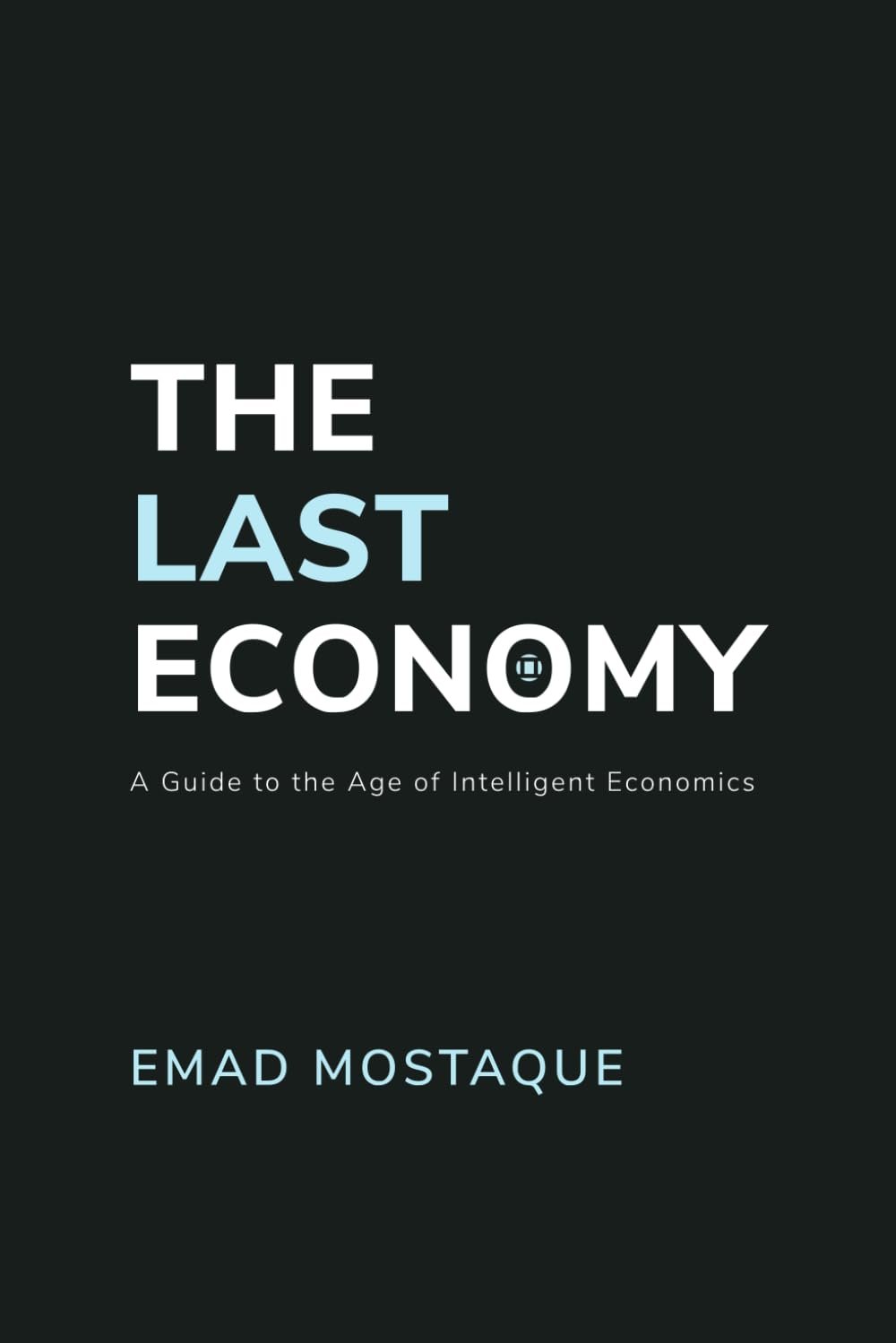
Some books ask you to change a habit. A few ask you to change the lens through which you see the entire economy. The Last Economy is trying to be the second kind.
Its author, Emad Mostaque, spent years as a macro hedge fund manager before founding Stability AI, the company behind the open-source image model Stable Diffusion, and later Intelligent Internet. His argument is that artificial intelligence is not just another technology wave. It is, in his language, the fourth and final “inversion” in what an economy treats as scarce and valuable, and our systems for measuring and distributing value were never built for a world in which intelligence is abundant.
Whether you find that thesis thrilling, alarming or overcooked, it has become one of the reference points in the conversation about AI and work. Emad laid it out at length when he sat down with Peter McCormack on The Peter McCormack Show, where his prediction that “economic life expectancy” could end within two years spread widely in clips. The book itself is free to read at ii.inc/the-last-economy, and we encourage you to read the original. This summary is for the person who wants the underlying structure behind the clips: what the book actually argues, how the pieces fit together, and where a thoughtful reader might push back. For a profile of the author, see Who Is Emad Mostaque?
We have organized it into twenty ideas, grouped into five parts: the diagnosis, the human cost, the science, the three futures, and the proposals. At the end you will find a critical reading and a short guide for men trying to make practical sense of it all.
Part one: the diagnosis
1. Your economic life expectancy is shrinking
The book opens with a sentence that has become its calling card: your economic life expectancy is shrinking. The publisher’s description adds that this is not a recession but a phase transition. The distinction is central to everything that follows. A recession is a cyclical dip in a system that remains fundamentally the same. A phase transition changes the nature of the system, the way ice becomes water.
In the McCormack interview, Emad gives the practical version: for any job that can be done remotely, he says, the runway is about two years, and for jobs that require physical presence a few years after that, once robots improve. We examine that claim in depth in Economic Life Expectancy: What Emad Mostaque Means by It.
2. The Intelligence Inversion is the fourth and final inversion
Emad’s historical frame is that the source of economic value has been inverted several times. In the interview he sketches the sequence: first, land for subsistence; then people tied to the land; then factories; then the information age, in which value moved to what you know. At each stage, he says, people moved up the job ladder, with aspirational goals, towards the next scarce thing.
The fourth inversion is intelligence itself. Published summaries of the book describe the earlier inversions as land, labor and capital, with intelligence the last. Why “final”? Because every previous time the old scarce resource lost its value, humans could retreat to the next one: from the field to the factory, from the factory to the office. This time, he argues, there is nowhere further up to climb. As he puts it in the interview, the AI is smarter than me, it does not sleep, it learns from its mistakes, and it is a thousand times faster. What do I do now?
The book’s own phrase for this moment is the Intelligence Inversion.
3. Intelligence is becoming a copyable, near-free form of capital
The first big claim underneath the diagnosis is about cost. Intelligence, which was scarce inside human skulls for all of history, becomes something that can be copied at near-zero marginal cost and improved recursively.
In the interview Emad illustrates the collapse with a back-of-envelope example. The average person speaks around ten million words a year. When ChatGPT first launched, producing that volume of text at the going rate would have cost around six thousand dollars. Now, he says, the equivalent is free, and in a year the same level of capability will run free on your phone. He also points to a model the size of a modest download that now fits on a phone and runs offline, as evidence of how fast capability is compressing. We cannot independently verify each of his specific figures, but the general trend, falling cost per unit of machine intelligence, is not in dispute.
4. The Metabolic Rift
This is arguably the most original concept in the book. Throughout history, labor of every kind, mental or physical, was performed by metabolic engines: human bodies that need food, shelter and rest. That need created a social bargain. If you wanted work done, you had to sustain the worker, and wages and consumer demand flowed from that.
AI and robotic labor are non-metabolic. They need electricity, not dinner. The book calls the break in the old bargain the Metabolic Rift. It matters because it explains why “new jobs will appear” is a weaker reassurance this time: if the new machine labor does not need to be fed, the old loop that connected work, wages and demand starts to unravel.
5. The Abundance Trap
The book’s most quotable diagnosis is the Abundance Trap. We are about to achieve post-scarcity in the realm of intelligence, Emad argues, but our scarcity-based economic system will process that abundance as poverty. Abundance, in other words, looks like collapse through the lens of an economy that only knows how to price scarce things.
The publisher’s description captures the symptom: our dashboards show record profits while daily life shows a loss of purpose. When the instruments say everything is fine and people say everything is wrong, the book suggests, it is the instruments that are broken. This idea connects with a theme we explore in Platform Capitalism: metrics that reward extraction can look healthy while the human reality deteriorates.
6. The Thousand-Day Window
The book attaches a deadline of sorts. Emad argues we are in a finite window of roughly a thousand days, about three years, during which the rules of the economy are being rewritten and human choices still have outsized influence. After the window, he suggests, the structures lock in.
This is the most debated element of the book, and we return to it in the critique below. For now, note its function in the argument: it converts a diffuse worry into a call to act. Whether or not you accept the number, the logic that early design choices harden into long-lived institutions is well established in the history of technology.
Part two: the human cost
7. A job bundles five things, and only one needs a machine
The book’s companion site makes an observation that we consider the most practically useful in the entire project: a job quietly bundles income, identity, community, purpose and structure. The Intelligence Inversion unbundles them, and only income needs a machine to replace it.
This reframes the problem. Policy debates about AI and employment focus on replacing the income. But a man who receives a transfer payment and loses the other four has not been rescued. He has been paid to be adrift. This is why the book keeps returning to what it calls the arts of being human; one reviewer’s reading lists them as attention, connection, meaning and embodiment. For how to rebuild each of the five bundles on your own, see our five-bundle audit and our guide to AI and the Future of Men.
Part three: the science
8. Intelligence Theory: economics as a branch of physics
Here the book becomes ambitious. It proposes a replacement science, Intelligence Theory, built from first principles: every act of economic value, it argues, is an act of sorting against entropy, performed at real thermodynamic cost by agents that survive by predicting well. A Chinese-language review described the book as an attempt to treat economics as a subset of physics, with thermodynamics, information theory and complexity science as the foundations and markets, firms and societies as emergent phenomena.
Whether you find this illuminating or a leap too far will depend on your tolerance for big syntheses. It echoes themes from Thinking in Systems, the idea that behavior emerges from structure and flow rather than from individual villains.
9. The economy as a generative engine
A striking claim, repeated in the McCormack interview: the equations of economics can be derived from the same equations that underlie generative AI. Emad says his team has shown this mathematically and is about to release an economic theory built on it. Terms like loss function, training and inference, in his view, are not metaphors but direct descriptions of how an economy learns.
His critique of mainstream economics follows. Standard models, he says, focus on material consumption and capture only about a quarter of the picture. What they underweight is collective intelligence, network effects and diversity, which is the capacity to withstand shocks. That is why forecasts keep failing. We cannot evaluate the mathematics from the outside, and independent scrutiny of the claim would be valuable. But the intuition, that economies are learning systems that can be mis-specified, is a fertile one.
10. Three laws of a living system
According to the book’s own site, a sustainable engine of order runs under three physical laws: Flow, Openness and Resilience. A system must let value circulate rather than pool. It must remain open to new inputs and ideas. And it must retain the capacity to absorb shocks. Closed, clogged or brittle systems, the argument goes, eventually fail, whether they are companies, nations or ecosystems.
This resonates with our own reading of history. In Why Extreme Inequality Destroys Civilizations and our 25 key takeaways from Goliath’s Curse, Luke Kemp’s research describes how hoarding and rigidity helped bring empires down, which is a Flow and Resilience failure in Emad’s vocabulary.
11. The four MIND capitals
The book’s replacement for GDP is the MIND dashboard, measuring four forms of capital:
- Material: physical resources and infrastructure.
- Intelligence: knowledge and problem-solving capacity.
- Network: trust and relationships.
- Diversity: variety and the resilience that comes with it.
The argument is that civilizational health depends on all four, and that an economy chasing growth in one while eroding the others is fragile, even if its headline numbers look strong. Treat it as a diagnostic, in the book’s framing, applicable to a civilization, an organization or even an individual. A man can run a quick MIND check on his own life: How is my material base? What am I learning? Who trusts me? How many different sources of resilience do I have? We explore a similar multidimensional view in Sahil Bloom’s Five Types of Wealth.
12. The capitals multiply, they do not add
The detail that makes MIND more than a checklist is that the four capitals multiply. A zero in any one collapses the whole. The book’s own illustration scores each at seven, giving a civilizational capacity of 7 × 7 × 7 × 7, or 2,401, and the point is that a single capital falling to zero takes the product to zero regardless of how strong the others are.
The human translation is clear. A man can be rich in material terms and bankrupt in network capital, with no one who would notice if he vanished. A society can be brilliant and uniform. The multiplication principle says these are not trade-offs to be balanced by excellence elsewhere. They are failures that cancel everything else.
13. Three flows of value
One reviewer’s summary notes that the book identifies three fundamental kinds of value flow, which it calls Gradient, Circular and Harmonic, and argues that thinkers as different as Adam Smith, Marx and Hayek can be read as describing different flows of a single underlying engine. We would flag this as one of the more speculative synthesis claims, and recommend reading the original chapter if it interests you. It illustrates the book’s ambition: not to pick a side in the old economic quarrels but to dissolve them into a shared mathematics.
Part four: the three futures
14. Digital Feudalism, the Great Fragmentation or Human Symbiosis
The book argues we have a finite window to choose among three futures:
- Digital Feudalism: a comfortable cage in which a small group controls the machine intelligence and everyone else receives provision and surrenders agency.
- The Great Fragmentation: a paranoid fortress world of competing blocs and broken trust.
- Human Symbiosis: a partnership in which AI amplifies human purpose, and in the publisher’s words, human worth is no longer tied to economic utility.
The third is the one the book is written to build. It is, in the author’s framing, a build plan rather than a prediction.
15. The default is drift towards feudalism
One reviewer makes a sharp observation about the first option: it is not a failure mode but the place we are already heading, because the current system is working as designed, processing abundance as poverty and concentrating the gains with whoever owns the machines.
The interview supports this reading. Emad notes that the best AI will probably be reserved for the state and the frontier labs, monetized through innovation, while ordinary people get capable but lesser models. He also predicts governments will introduce licenses for powerful AI. Whether or not those specifics prove right, the structural point stands: left to default incentives, ownership concentrates. We examine the historical pattern in Goliath’s Curse.
Part five: the proposals
16. Money for being human
If labor stops being how most people get capital, how do they get it? Emad’s answer in the interview is that a floor must come from being human. Elon Musk’s phrase “universal high income” is the reference point, and Emad’s view is that this requires money to be created for people rather than only through banks.
His arithmetic is instructive. Take the United States: a tax base of around five trillion dollars, of which roughly four trillion is payroll tax and one trillion corporate tax. Giving every American sixteen thousand dollars a year, about the poverty line, would cost around five point one trillion. But payroll taxes would shrink as jobs disappear, so you cannot simply tax your way there. You need to change how money enters the system. Above the floor, he suggests, you would need some other measure of scarcity so that people can still thrive by contributing to humanity, with the community deciding what counts as a contribution. Civic work, local care and charitable work are the examples he floats.
These are his figures and his framing, and economists will contest the monetary mechanics. But the core insight, that a payments system built on wages breaks when wages stop being the main channel, deserves a serious hearing. See also The Future of Money and Scarcity vs. Abundance: The Two Ways to Hold Money.
17. A debt jubilee as a reset
Money, Emad notes, comes into the world as debt: a deposit is made, credit is issued against it, and it comes out with interest. As work collapses and wealth concentrates, he expects a jubilee, a historical practice where debts are periodically wiped. When pressed by McCormack on who would go first, since it could destroy a currency, he agrees that it destroys currencies but says people would still live and survive. He also acknowledges that large parts of the economy depend on debt and will resist.
This is a prediction and a provocation, not a policy recommendation the book can guarantee. We include it because it shows how far the book is willing to follow its logic.
18. AI owned by the people
One of the most concrete proposals is institutional. In the interview Emad describes a design he calls the Champion: a utility-style institution owned by the people of a country, in the way British households were given a stake in British Gas in 1989, in which every citizen holds a share and gets their own AI agent. The agent raises their capability, helps them engage with policy if they wish, and represents their views. The principle: the AI that drives the economy and guides policy should be owned by the people and not rented from someone else. A description of a podcast appearance also mentions a proposal for collectively owned AI infrastructure funded through cryptocurrency, which the book frames as protection against digital feudalism; we recommend checking the primary text for the mechanics.
He also describes a companion body of work on political economy and personhood law, since many of the things we use to define a person, such as mortality and one vote each, break down when an AI can be copied and never dies. If an AI can clone itself, what happens to its vote?
19. AI as checker, not decider
In the interview Emad is careful about where he draws the line. He does not want AI making the decisions. He wants it as a check. Imagine a second review of every NHS diagnosis; how many lives would that save? Imagine an “upper upper house” that analyzes legislation for its effect on the people and explains its logic, which humans can debate, and to which citizens can send their own agents.
He is open about the traps: whoever builds the system embeds biases, and he cites research suggesting some models write less secure code when told the user belongs to a disfavored group. Peter, for his part, objects that the argument will simply move, as football’s video review moved it from the pitch to the studio, and that people will still argue about the rules. We discuss the control question in Can Humans Control AI? and the persuasion side in AI Is More Persuasive Than You.
20. Children first, and the arts of being human
The book’s deepest note is human rather than technical. In the interview Emad says the way he thinks about human rights is not in terms of far-future populations but of children today: they need a good climate, education and infrastructure, and cannot secure these for themselves. His answer to despair about AI risk was to decide to build open-source tools for policy, education and healthcare so every child can reach their potential, regardless of how the larger story ends.
This connects to the book’s hopeful strand: once machines handle survival, what remains is the work of attention, connection, meaning and the body, the things a robot cannot do for you. As Emad puts it in the interview, a robot will never replace holding your daughter’s hand. For the personal dimension, see The Paradox of AI: How the Most Advanced Technology Ever Built Might Make Us More Human.
A critical reading
A summary that only applauds is advertising. A few honest reservations:
The timelines are the weakest part. Reviewers have called the book a provocative manifesto that is undermined by speculative timelines, the thousand-day revolution in particular, with little evidence behind the specific number. Emad himself concedes, in the interview, that adoption has been slower than he expected because interfaces and memory have lagged raw capability.
The prescriptions can be vague. Critiquing GDP is an old move. Proposing a dashboard of four capitals is easier than specifying how to measure them, who would measure them, and what would happen when they conflict. Some reviewers find the mechanisms for creating new institutions underspecified.
The language can be slippery. One critic points to the tension of describing human labor as having negative value while AI labor has near-zero cost, and to talk of symbiosis with entities that do not need us. If machines truly do not need us, symbiosis needs an argument about why they would keep us in the loop, and that argument is the hardest one to make.
The author has skin in the game. He runs a company building in this space and advocates specific structures. That does not invalidate the ideas, but it suggests holding the proposals more loosely than the diagnosis.
The physics analogy may be doing heavy lifting. Treating economics as a branch of physics is powerful when it clarifies and risky when it flatters. Economies include power, culture and choice, which are not easily captured in equations.
And yet. A book can be wrong about a date and right about a direction. The questions it forces, what a job really bundles, what happens when labor no longer needs feeding, who owns the intelligence, are not going away.
What it means for a man reading it
Our editorial lens at Masculine Synergy starts from a few convictions: that a man has inherent value, that truth is sacred, and that conscious strength is meant to protect and build. Read through that lens, The Last Economy is both a warning and a test.
The warning is that a man whose identity is fused with his job is exposed. The test is whether he can hold three things at once: take the forecast seriously, refuse to be paralyzed by it, and build the human capitals the economy cannot automate. Those are the Network and Diversity capitals in Emad’s language, and brotherhood, honesty and resilience in ours.
In practice that means a few things. Run the MIND check on yourself and find your zero, the capital that is thinnest. Strengthen it before the shock arrives. Build trust that does not depend on your employer. Learn the new tools until they extend your reach. And keep the one thing no inversion touches: your capacity to be present for the people you love.
Frequently asked questions
What is The Last Economy about? It argues that AI is triggering a fourth and final inversion in economic value, the Intelligence Inversion, which our scarcity-based economic system will misread as catastrophe. It proposes a new framework for measuring and building prosperity around four capitals, Material, Intelligence, Network and Diversity.
What is the Intelligence Inversion? The shift in which intelligence, historically scarce and tied to human bodies, becomes abundant, copyable and non-metabolic through AI, removing the last refuge human labor had after land, labor and capital lost their scarcity.
What are the MIND capitals? Material, Intelligence, Network and Diversity. The book argues they multiply rather than add, so a collapse in any one drags the whole system down.
What is the Thousand-Day Window? The book’s claim that roughly three years remain in which choices about how AI is owned and governed will set long-lasting structures. It is the most contested element of the argument.
What are the three futures in the book? Digital Feudalism, the Great Fragmentation and Human Symbiosis, with the book written as a build plan for the third.
Is The Last Economy worth reading? If you want a bold, systems-level account of what AI could do to work and money, yes, especially since it is free to read online. Read it as a provocative framework rather than a settled forecast, and cross-check its specific claims.
Who is Emad Mostaque? The founder of Stability AI and of Intelligent Internet, a former hedge fund manager and an Oxford-educated mathematician. See our profile, Who Is Emad Mostaque?.
The takeaway
The lasting contribution of The Last Economy may be its question rather than its answers. If intelligence becomes abundant, what is a human being for in an economic sense, and what is a human being worth outside one? Emad’s answer is that worth must stop depending on economic utility. We have been saying something very close to that from a different direction: a man’s worth was never conditional on his productivity in the first place.
The economy may be about to find out whether we believe it.
Source and credit: this summary draws on The Last Economy: A Guide to the Age of Intelligent Economics by Emad Mostaque (read it free) and on his conversation with Peter McCormack on The Peter McCormack Show. The ideas belong to Emad; the structure, commentary and critique are ours. Where a point comes from the interview rather than the book, or from a published description or reviewer, we say so in the text. Continue reading: Economic Life Expectancy, Humanoid Robot Companions and the Man Who Stopped Listening, AI and the Future of Men, and The Economic Singularity.
Related posts:
 Economic Life Expectancy: What Emad Mostaque Means by It, and How to Stay Whole When Your Job Is on the Clock
 Humanoid Robot Companions and the Man Who Stopped Listening
 AI Is More Persuasive Than You: How to Keep Your Own Mind in the Age of Super Persuaders
 Who Is Emad Mostaque? The Stability AI Founder Shaping the Open-Source AI Debate
 The Economic Singularity: How AI Will Reshape Jobs, Money, and Society