There’s a particular kind of quiet humiliation in watching your phone die on schedule.
Not because it broke. Because it was engineered to feel broken — the battery a little slower, the updates a little heavier, the whole thing nudging you, gently but relentlessly, toward the upgrade page. You didn’t choose to want a new phone. Wanting it was installed in you, the way a virus installs itself in a system it was never invited into.
Most men never stop to notice this. They just pay the bill, trade in the old device, and feel a small flush of dopamine when the new box arrives — then forget the feeling by Thursday. It’s such a normal transaction that questioning it feels almost paranoid. But if you’ve read anything on this site about personal responsibility or what “enough” actually means, you already know where this is going: the things you own quietly train you. A phone designed to be disposable teaches you, over years, to treat your own commitments — to people, to work, to yourself — the same way. Replaceable. Upgradeable. Never quite worth repairing.
There’s a small Dutch company that built its entire existence around refusing that arrangement. It’s called Fairphone, and it makes, by a wide margin, the most repairable, most transparently sourced, most deliberately unfinished-feeling smartphone on the market. That last part is a compliment. This article is a complete look at what Fairphone is, how it actually holds up, who it’s genuinely for, and — underneath all of that — why the decision to buy one is a small but real test of character.
What Is Fairphone, Actually?
Fairphone is a Dutch electronics company, headquartered in Amsterdam, that designs and sells smartphones (and now headphones) built around three commitments most manufacturers treat as PR footnotes: the phone should be repairable by its owner, the materials inside it should be sourced without funding armed conflict or child labor, and the device should be supported with software updates for close to a decade, not two years.
It was founded in January 2013 by Bas van Abel, along with Tessa Wernink and Miquel Ballester Salvà. Van Abel wasn’t a phone executive. He was a designer who’d spent time in the Democratic Republic of Congo working on a campaign about conflict minerals — the tin, tantalum, tungsten, and gold that finance armed militias and are mined, often by hand, in some of the most dangerous conditions on earth, before ending up inside the device in your pocket. He came home from that trip and, according to people who worked with him, couldn’t look at a smartphone the same way again.
The story that’s followed him ever since — and it’s worth knowing, because it says everything about the company’s DNA — is that he once got so angry at being unable to open his son’s broken Nintendo DS to fix it that he smashed the thing in frustration. Out of that came his now-famous line: “If you can’t open it, you don’t own it.”
That sentence is the whole company in eight words. It’s also, if you sit with it, a decent one-line definition of ownership in general — of a relationship, a piece of work, a version of yourself. If you can’t get inside it, examine it, and fix what’s wrong, you don’t really possess it. It possesses you.
Fairphone launched its first device in 2013 after a crowdfunding campaign that aimed for 5,000 pre-orders and got roughly 25,000, raising more than €7.5 million from people who’d never held the product. There have since been six generations of the phone (the Fairphone 2, 3, 4, 5, and now the Fairphone 6, also called the Fairphone Gen. 6), each one incrementally closer to being both a genuinely good phone and a genuinely ethical one — two goals that, for most of the company’s life, were in tension with each other.
A Short History: From Awareness Campaign to Actual Company
It’s worth slowing down on the origin story, because most “ethical brand” narratives get compressed into a single marketing sentence, and Fairphone’s is more interesting than that.
The project didn’t start as a company at all. In 2010, three Dutch organizations — Waag Society, ActionAid Netherlands, and a small design collective called Schrijf-Schrijf — launched Fairphone as an awareness campaign, not a product. The goal was simply to educate people about conflict minerals: the tin, tantalum, tungsten, and gold (often shortened to “3TGs” in supply-chain literature) mined under brutal conditions in the eastern Democratic Republic of Congo, where profits routinely fund the armed groups responsible for one of the deadliest conflicts since World War II. Van Abel led investigative trips into mining regions and spent two years trying to get the electronics industry to simply be transparent about where its raw materials came from.
It didn’t work. Nobody wanted to talk. So in 2013, the campaign did something unusual for an advocacy project — it stopped asking politely and built the thing itself. Fairphone B.V. was incorporated in Amsterdam by van Abel, Tessa Wernink, and industrial designer Miquel Ballester Salvà. Rather than pitch investors, they ran a pre-order crowdfunding campaign with a modest goal of 5,000 units. They got roughly 25,000 orders and more than €7.5 million in commitments within a month — proof, in the clearest possible terms, that there was real appetite for a phone that told the truth about itself.
Since then, the company has released six generations of phone — the Fairphone 1 through 6 — plus a line of wireless earbuds, the Fairbuds, launched in 2024, which apply the same repair-first philosophy to a product category almost nobody else bothers to make serviceable at all. By 2025, Fairphone had sold more than 700,000 devices, posted around €55 million in annual revenue, and become one of the relatively small number of companies to hold certified B Corporation status while still operating as a for-profit business — meaning it’s independently verified against social and environmental performance standards, not just self-declared.
Van Abel stepped down as CEO in 2018, moving to a non-executive board role, and has spoken candidly since about the burnout that came with building something out of pure conviction. “It’s the kind of company that pulls you in completely,” he said. “It demands everything.” That honesty is, again, on-brand — a founder unwilling to perform invincibility for the sake of the story is a pretty good sign the rest of the company isn’t performing either.
The Problem Fairphone Exists to Solve
To understand why Fairphone matters, you have to understand the two systems it’s quietly rebelling against. Neither one is really about phones. Both are about how modern commerce is designed to work against you.
1. Planned Obsolescence Is Not a Conspiracy Theory — It’s a Business Model
“Planned obsolescence” sounds like something you’d hear from a guy wearing a tinfoil hat. It isn’t. It’s a documented, named, studied practice: designing products to fail, become incompatible, or feel outdated well before they actually stop functioning, in order to drive repeat purchases.
The mechanics are almost embarrassingly simple once you see them. Batteries glued into the chassis with adhesive that requires a solvent to remove — cheap to manufacture, expensive and risky to repair, so most people just don’t. Software updates that quietly slow older hardware down. Spare parts that either don’t exist or cost nearly as much as the device itself. None of it is illegal, most of it isn’t even hidden — it’s just normalized to the point that nobody questions it.
Apple settled a lawsuit in 2020 over exactly this — deliberately throttling the performance of older iPhones — for $500 million. That’s not a rumor. That’s a legal outcome.
The result, at scale, is staggering. The world generated a record 62 million metric tons of electronic waste in 2022 alone — an 82% jump from 2010 — and only about 22% of it was properly recycled. The rest was landfilled, incinerated, or shipped through informal channels that expose the poorest people on earth to lead, mercury, and cadmium so the rest of us can get a slightly thinner phone every eighteen months.
The average smartphone lasts around 2.7 years before being replaced. Fairphone’s own devices average roughly 5.5 years in the hands of a single owner — over double — and are often used far longer than that once you account for people who buy them secondhand or upgrade individual components instead of the whole unit.
That gap — 2.7 years versus 5.5 — is not a minor efficiency statistic. It’s the difference between a device that respects your time and money and one that’s quietly designed to waste both.
2. The Right to Repair Movement Is Catching Up
Fairphone didn’t wait for regulation. But regulation is finally catching up to Fairphone.
The EU’s Right to Repair directive is set to be fully implemented across member states by July 31, 2026, requiring manufacturers to make devices easier to disassemble, sell spare parts at “reasonable” prices, and stop blocking third-party repairs. France has had an anti-obsolescence law and a public repairability index since 2015 — and the Fairphone 5 sat near the top of that index with a 9.3 out of 10 rating. In the United States, seven states have already passed Right to Repair legislation, with bills introduced in all fifty.
In other words: the law is slowly, grudgingly, being rewritten to match what Fairphone was already doing more than a decade early. That’s not luck. That’s what happens when a company builds around a principle instead of a quarterly earnings target.
If any of this sounds familiar, it should — it’s the same pattern we’ve written about in what enshittification actually is and Amazon’s monopoly trap: platforms and products get worse for you on purpose, once the company is confident you won’t leave. A phone you can’t open is just the physical version of that same trap.
How Fairphone Actually Works: Modular by Design
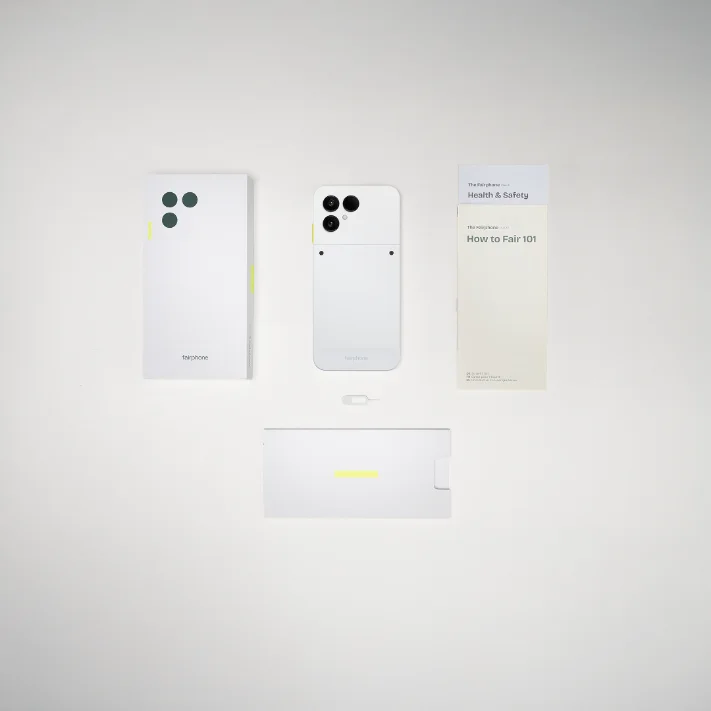
Open the back of a Fairphone — with a fingernail or a coin, not a heat gun and a prayer, the way you’d need to on most flagship phones — and you’ll find something that looks almost old-fashioned: distinct, labeled, individually replaceable modules. The battery. The camera module. The USB-C charging port. The screen. Each one is designed to be swapped out by an average person with a small screwdriver (which, notably, Fairphone includes in the box) and a YouTube tutorial, not a certified technician in a back room.
That single design decision changes the entire economics of ownership. A cracked screen, historically the single most common reason people replace an otherwise functional phone, becomes a €70–€100 part swap instead of a €600 replacement decision. A dying battery — the second most common failure point in any smartphone after two or three years — is a five-minute fix instead of a reason to buy new.
Fairphone backs this with software support that dramatically outpaces the industry: the Fairphone 6 ships with a promise of seven major Android version upgrades and eight years of security patches, alongside a standard two-year warranty extendable, often at no cost, to five years. For comparison, most Android manufacturers offer three to four years of major updates, and budget and mid-range phones frequently offer far less.
This is the part that tends to get lost in spec-sheet comparisons but matters more than almost anything else: a phone’s real lifespan is set less by its hardware and more by how long the company is willing to keep supporting the software running on it. You can have the sturdiest chassis in the world, but if the manufacturer stops patching security holes after three years, the “repairable” phone becomes a liability anyway. Fairphone’s commitment here is the actual product. The hardware is just the delivery mechanism.
Where the Materials Actually Come From
The repairability gets most of the headlines. The sourcing is arguably the more radical part.
Fairphone was the first smartphone company to attempt to map — and intervene in — its entire supply chain, from conflict-free mineral sourcing in the Democratic Republic of Congo to worker well-being programs at its manufacturing partners in China. Van Abel went on to found the Fair Cobalt Alliance specifically to address the “blood battery” problem: cobalt mining, often involving child labor and extremely dangerous conditions, that powers most of the world’s lithium-ion batteries with almost no transparency about where the raw material came from.
The Fairphone 5 contained over 70% fair or recycled materials, including Fairtrade gold and 100% post-consumer recycled plastic in the back cover. The company also runs an e-waste-neutral program, committing to collect and responsibly recycle a comparable amount of electronic waste for every phone it sells, regardless of brand.
To Fairphone’s credit, it has never claimed to be perfect, and it doesn’t pretend otherwise. Van Abel has said plainly that the company isn’t conflict-free, waste-free, or emission-free — yet. What it does instead is publish the imperfect parts of its own supply chain, openly, rather than hiding them behind a glossy sustainability page. That honesty is unusual enough in this industry to be, in its own quiet way, the most impressive feature on the spec sheet.
The Fairphone 6: What You Actually Get
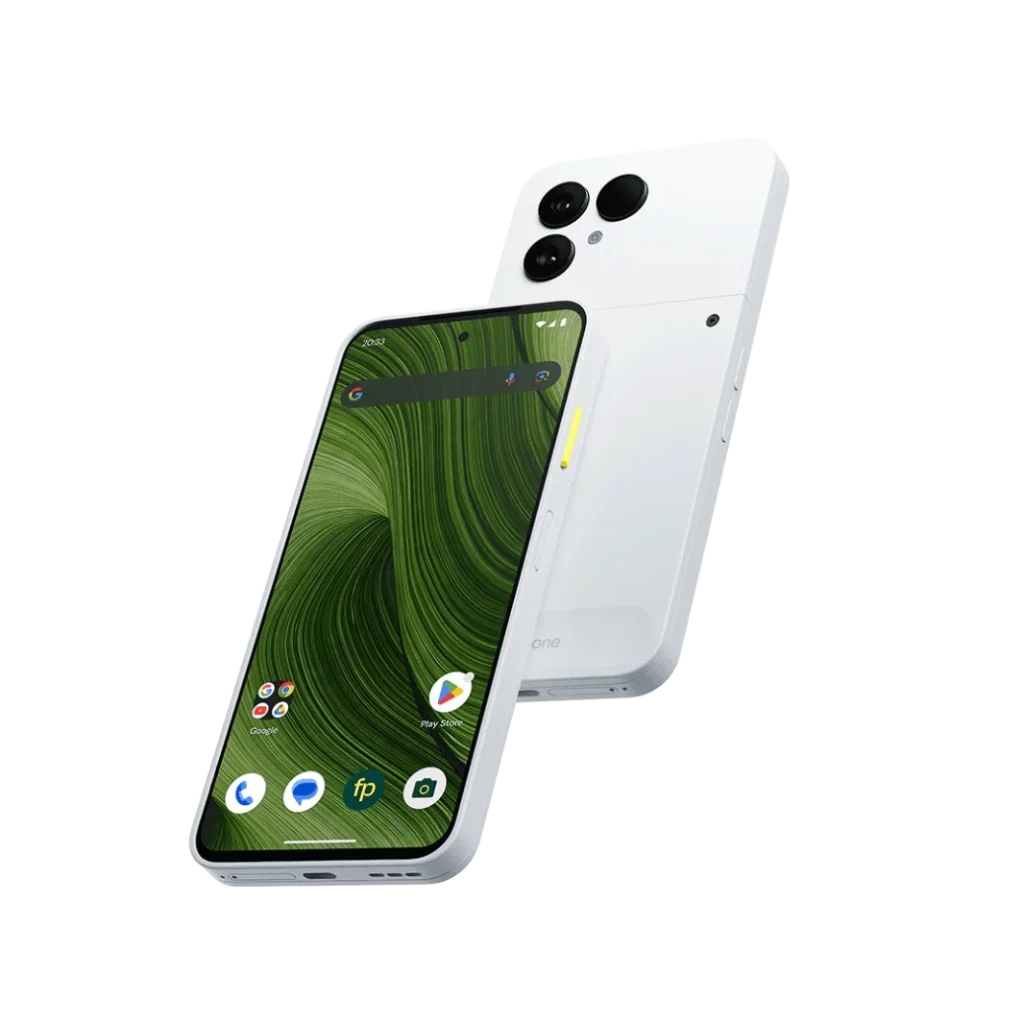
Specs age fast, but as of the current generation, here’s what the Fairphone 6 (also called Fairphone Gen. 6) puts on the table:
- Chipset: Qualcomm Snapdragon 7s Gen 3
- Battery: 4,415 mAh, with 30W fast charging
- Display: A 90Hz OLED panel, sharper and brighter than the previous generation
- Cameras: A dual rear system including a genuinely strong portrait camera, alongside a wider primary sensor that trades some raw sharpness for repairability
- Modular accessory system: An expanded ecosystem of swappable modules and cases, including options for card storage and finger loops
- Software support: Seven major OS upgrades, eight years of security patches
- Repair kit: Ships with the tools needed to open and service the device yourself
Independent reviewers have converged on a consistent verdict, and it’s worth taking seriously precisely because it isn’t a marketing summary — it’s a pattern across outlets that have no financial stake in Fairphone’s mission. TechRadar called it a “new high watermark for the eco-friendly phone” and a “must-buy for environmentally-minded people,” while noting it’s bulkier than flagship competitors and its overall camera performance lags behind category leaders. Expert Reviews landed in a similar place: strong recommendation for eco-conscious buyers, honest caveat that some components don’t feel quite built to outlast the phone’s own eight-year software promise. Longtime independent reviewer Dedoimedo, writing without any brand relationship, called it “a capable and interesting mid-range device” and specifically praised the repair philosophy as “commendable” — while noting the phone still runs stock Android, with all the tracking and account requirements that implies, unless you opt for a de-Googled version.
None of these are five-star raves. That’s the point, and it’s actually reassuring. A company built around imperfect honesty produces a phone that gets reviewed the same way — as good, meaningfully different, occasionally frustrating, and worth it on its own terms rather than by pretending to beat Apple and Samsung at their own game.
The honest trade-offs:
- It’s bulkier and heavier than most flagships, because modularity requires physical seams and connectors that a sealed, glued phone doesn’t need.
- The camera system, while genuinely good for portraits, doesn’t match the computational photography of a Pixel or an iPhone in low light or fast motion.
- It runs on a mid-range chipset, not a flagship one — meaning it’s fast enough for daily use, messaging, browsing, and most apps, but not built for heavy gaming or the most demanding workloads.
- It costs more upfront than a comparable mid-range phone from a mainstream brand, because ethical sourcing and modular engineering aren’t cheap to build.
What the Fair Cobalt Alliance Actually Does
One detail that separates Fairphone from companies that simply publish a “sustainability report” once a year: van Abel didn’t stop at sourcing better materials for his own product. In 2020, he helped found the Fair Cobalt Alliance, a multi-stakeholder initiative aimed specifically at the “blood battery” problem — the fact that most of the world’s cobalt, essential for lithium-ion batteries in everything from phones to electric cars, comes from artisanal mines in the DRC where child labor and life-threatening working conditions have been extensively documented by human rights organizations.
The Alliance doesn’t just avoid the problem by sourcing elsewhere and calling it solved — that approach, pulling out entirely, tends to leave the miners who depend on that income worse off, not better. Instead, it works to formalize artisanal mining sites, improve safety standards, and eliminate child labor from the sites Fairphone and partner companies actually source from, treating the region as something to invest in fixing rather than a liability to route around. It’s a slower, harder, less photogenic approach than a clean marketing claim of “conflict-free,” and Fairphone has been transparent that its supply chain still isn’t perfect. But building the fix instead of just avoiding the headline is, again, the pattern that shows up everywhere in this company’s history.
What Actual Owners Say — Including the Complaints
It would be dishonest to present only the polished review-outlet consensus and skip what real owners say once the review unit goes back and they’re living with the phone on their own dime. Owner reviews on Fairphone’s own site and independent forums surface a consistent, useful pattern: strong overall satisfaction with day-to-day performance, battery life, and build quality, alongside a handful of recurring gripes — occasional UI bugs like a notification drawer that sticks, intermittent Wi-Fi reconnection issues, a chunkier-than-expected optional case, and default media volume set uncomfortably loud out of the box. None of these are dealbreakers; all of them are the kind of small-but-real friction you’d expect from a company with a fraction of Samsung’s or Apple’s QA budget.
The more serious complaints tend to cluster around fulfillment, not the product itself — customers reporting multi-week delays between payment and dispatch during high-demand periods after a new model launch. If you’re ordering, build in patience for shipping the same way you would with any smaller manufacturer scaling production; it’s a real friction point worth knowing about going in, not a reason to avoid the phone once it arrives.
On community forums like GSMArena, you’ll also find the expected contingent of specs-focused critics arguing the battery capacity or dimensions lag behind flagship competitors gram-for-gram and milliamp-for-milliamp. They’re not wrong on the numbers. They’re just optimizing for a different value than the one Fairphone is selling.
Who a Fairphone Is Actually For
This isn’t a phone for everyone, and Fairphone doesn’t pretend it is. It’s worth being direct about who benefits and who doesn’t, the same way we’d tell you the truth about any product review on this site — see our honest look at the Ridge Wallet or the DJI Osmo Pocket comparison for the same kind of unsentimental breakdown.
It’s a strong fit if you:
- Keep your phones for four-plus years anyway and resent being pushed off that timeline
- Genuinely care where the materials in your electronics come from, not as a talking point but as a practice
- Want a device you can service yourself instead of depending entirely on a manufacturer’s goodwill
- Are building a life around intentional consumption — the same instinct behind Japandi design or a well-considered durable cookware set — where fewer, better things replace a constant churn of upgrades
It’s probably not for you if:
- You need top-tier camera performance or flagship gaming power
- You want the thinnest, lightest device on the market
- You’re not willing to pay a premium for ethics and repairability over raw spec-per-dollar value
That’s not a weakness in the product. It’s the product being honest about its priorities — which, frankly, is more than most manufacturers manage.
Fairphone vs. the Alternatives
It helps to see Fairphone next to its usual competition, not to declare a winner, but to be clear-eyed about what you’re actually trading.
Fairphone vs. iPhone or Samsung flagship: You’re trading raw performance, camera sophistication, and resale-brand-recognition for repairability, transparency, and a materially longer functional lifespan. The flagship will out-perform it in almost every measurable spec. It will also, by design, be harder and more expensive to keep alive past year three.
Fairphone vs. a budget Android phone: Here Fairphone wins clearly on longevity and ethics, at a higher price point. A €150 budget phone might match the Fairphone 6’s day-one performance, but it typically gets one or two years of software support and is essentially unrepairable — glued shut, with parts that aren’t sold separately. You’re not comparing like for like; you’re comparing a disposable product to a durable one that happens to cost more upfront and less over time.
Fairphone vs. buying secondhand/refurbished from a mainstream brand: This is the most legitimate alternative, and it’s worth naming honestly. A refurbished iPhone or Samsung device, kept for years and repaired through third-party shops where legally possible, achieves some of the same longevity goals at a lower price. What it doesn’t give you is the supply-chain transparency or the manufacturer-backed repair ecosystem. If your priority is purely economic and environmental (less e-waste, lower cost), a well-maintained refurbished flagship is a defensible choice. If your priority includes the ethics of extraction and labor — where the cobalt and gold actually came from — Fairphone remains in a category mostly by itself.
The Part That Actually Matters: What This Has to Do With Being a Man
Here’s where this stops being a phone review.
There’s a reason we’re covering a smartphone on a site about masculine development, and it isn’t because Fairphone sponsored anything — it didn’t. It’s because the instinct behind buying (or refusing to buy) a device like this touches something we come back to constantly on this site: the difference between a man who’s steered by convenience and a man who’s steered by conviction.
Most consumption decisions are frictionless on purpose. The old phone breaks, or just feels slow, and the new one is one tap away, financed over twenty-four months so it barely registers as a decision at all. That frictionlessness isn’t an accident — it’s engineered, the same way casinos remove clocks from the floor. You’re not meant to notice you’re choosing. You’re meant to just keep moving.
A Fairphone reintroduces friction on purpose. You have to think about it. You have to accept a heavier device, a less flashy camera, a higher price, in exchange for something the market has trained you to stop valuing: the ability to actually own the thing you paid for, and the knowledge that the person who mined the materials inside it wasn’t a child working for a militia.
That’s not really a phone decision. That’s the same decision that shows up everywhere else in a man’s life — in whether he takes responsibility for the mess he’s in instead of trading it in for a new version of himself every few years, in whether he practices self-discipline when the easy option is one tap away, in whether he understands that money spent well buys time, not just things. Buying a phone you can actually open and fix is a small, almost trivial way of practicing the same muscle you need for the much bigger stuff: staying with something instead of discarding it the moment it becomes inconvenient.
There’s also something here about digital minimalism worth sitting with. A lot of the discipline we talk about around Monk Mode, reclaiming your time from the attention economy, or digital loneliness assumes the phone itself is neutral — that the problem is only how you use it. Fairphone quietly challenges that assumption. It suggests the object itself carries values, whether you notice them or not: values about disposability, about opacity, about how much say you get over the things you own. Choosing a phone built on repair instead of replacement is one way of aligning the object in your pocket with the discipline you’re trying to build in the rest of your life.
None of this makes Fairphone a moral obligation. Plenty of thoughtful, responsible men will read all of the above and still buy the flagship, for entirely legitimate reasons — performance needs, budget, brand ecosystem, resale value. That’s fine. The point was never “buy this specific phone.” The point is noticing that you have a choice at all, and that the default option was designed to make you forget you had one.
The Fairbuds: The Same Philosophy, Applied to Earbuds
Fairphone’s 2024 move into wireless earbuds, the Fairbuds, is worth a mention on its own, because it’s a useful test of whether “repairable and ethical” was ever really about phones specifically, or whether it’s a design philosophy the company is willing to apply anywhere it operates. True wireless earbuds are, category-wide, among the most disposable pieces of consumer electronics ever made — sealed shut, with non-replaceable batteries that degrade within eighteen to twenty-four months, at which point the entire unit is landfill. Fairphone’s answer was to build the Fairbuds with a user-replaceable battery, a first for the category, alongside the same fair-material sourcing commitments used in the phones. It’s a smaller product with a smaller cultural footprint than the phone line, but it’s a meaningful signal: this isn’t a single flagship gimmick built to earn press coverage. It’s an operating principle the company keeps reapplying as it grows into new categories, which is exactly what you’d want to see from a business you’re trusting with a decade-long relationship instead of a one-time purchase.
What Critics Get Wrong About Fairphone
It’s worth directly addressing the most common dismissal, because it’s repeated often enough to feel like consensus even though it doesn’t hold up under scrutiny: the idea that Fairphone is a “nice idea, bad product” — a phone you buy to feel good about yourself and tolerate rather than one you’d actually choose on the merits.
That critique made real sense as recently as the Fairphone 3 and 4 generations, when the compromises were sharper: noticeably weaker chipsets, cameras that struggled in anything but good light, and a design language that looked more like a rugged industrial tool than a phone you’d want to be seen using. The Fairphone 6 is a different conversation. Independent reviewers with no ethical mandate to praise it — outlets that review a hundred phones a year and owe Fairphone nothing — are landing on genuine recommendations, not consolation prizes. TechRadar’s framing, that it’s “a solid Android phone that stands out in a few departments and lags behind the competition in others,” is a description that could honestly apply to plenty of mainstream mid-range phones that never have to defend their existence on ethical grounds. The gap between “ethical alternative” and “genuinely competitive device” has closed faster than most critics have bothered to update their opinion.
The second common critique — that ethical sourcing is impossible to verify and therefore meaningless to claim — has more substance to it, and Fairphone doesn’t fully escape it. Supply chains are long, opaque by nature, and genuinely difficult to audit end-to-end, even for a company built specifically to try. But the honest response isn’t “so no claim is worth anything.” It’s noticing the difference between a company that publishes its imperfect audit results publicly, invites scrutiny, and keeps working the problem, versus one that says nothing at all and hopes you don’t ask. Fairphone is unambiguously the former. That’s not the same as perfect. It’s meaningfully different from every major competitor’s approach, which is closer to silence.
A Buyer’s Framework, If You’re Actually Considering One
If this has you leaning toward trying one, here’s a grounded way to think it through — the same way we’d walk through any considered purchase, like the reasoning in our RORRA water filtration review or the Momentous supplements breakdown.
Ask yourself three questions:
- How long do I actually keep phones? If the honest answer is “eighteen months, whenever the new one drops,” Fairphone’s core value proposition — a longer functional life — won’t land the way it’s designed to. This phone rewards patience.
- Do I care enough about the sourcing story to accept a camera and chipset that are merely good instead of best-in-class? If yes, the trade is worth it. If the camera is non-negotiable for your work or creative output, be honest about that instead of talking yourself into a phone that will quietly frustrate you.
- Am I willing to actually use the repairability, or is it a feature I’ll admire without ever touching? The value of a modular phone compounds the moment you replace your first battery or screen yourself, at a fraction of the replacement cost. If you’ll just pay a shop to do it anyway, you still get the ethics and longevity — you just won’t feel the full weight of “if you can’t open it, you don’t own it.”
If you land on yes, yes, and either answer to the third — buy direct from Fairphone, register the extended warranty immediately, and actually keep the included screwdriver somewhere you’ll find it in three years. That last part sounds like a joke. It isn’t. The entire philosophy only works if you engage with it.
Frequently Asked Questions
Is Fairphone actually more sustainable, or is this greenwashing? By the available evidence, it’s substantively different from most sustainability marketing. Fairphone publishes supply-chain detail most competitors keep private, uses independently audited fair-trade and recycled materials at meaningfully higher percentages than the industry average, and backs its longevity claims with actual repair-part availability and multi-year update commitments — not just a claim on a box. It isn’t perfect, and the company says so itself, which is part of what separates it from typical greenwashing.
Is a Fairphone as good as a Samsung or iPhone flagship? Not on raw performance, camera sophistication, or resale-brand recognition — reviewers are consistent on this. It’s a well-built mid-range device with an unusually strong software-support commitment and a repair philosophy no mainstream flagship offers.
How much does it cost to repair? Individual modules — battery, screen, camera, charging port — are sold directly through Fairphone and typically run from roughly €30 for a battery to €80–100 for a screen, a fraction of full-device replacement cost, and designed to be installed with basic tools in minutes.
Is Fairphone available in the United States? Availability has historically been limited to Western and Central Europe, though the company has been expanding, including a de-Googled, carrier-locked configuration sold through a partner in the US market. Check current availability directly with Fairphone before ordering, since this changes as the company grows.
Does buying a Fairphone actually reduce e-waste? Individually, yes, in a measurable way — a device kept for 5.5 years instead of 2.7 roughly halves your personal contribution to the replacement cycle, and the company’s e-waste-neutral collection program offsets additional waste beyond your own device. At an industry level, meaningful change requires the kind of regulatory shift the EU’s Right to Repair directive represents — but individual choices are what create the market pressure that makes regulation possible in the first place.
The Real Takeaway
A phone is a small thing to build an entire argument around. But small things are usually where character actually lives — not in the big, cinematic decisions, but in the quiet, repeated, unglamorous ones nobody’s watching you make. Whether you fix what’s broken or throw it away. Whether you know where the things in your life actually came from. Whether you’re willing to pay a little more, and accept a little less shine, in exchange for something that holds together with integrity.
Fairphone isn’t going to make you a better man. No product will. But the instinct behind choosing it — patience over convenience, transparency over polish, ownership over disposability — is the same instinct this entire site is built to strengthen. If you want to practice it somewhere lower-stakes than a relationship or a career, your pocket is as good a place as any to start.
Related posts:
 Hume Band Review: Does This Stress-Tracking Wearable Actually Work?
 10 Most Popular Gifts for Men in 2026 (That He’ll Actually Use)
 DJI Osmo Pocket 3 vs Pocket 4: The Complete Comparison (Is the Upgrade Worth It?)
 How to Talk on Camera: The Art of Yapping and Why It Might Change Your Career
 Alexandr Wang’s Story: From MIT Dropout to Meta AI Chief