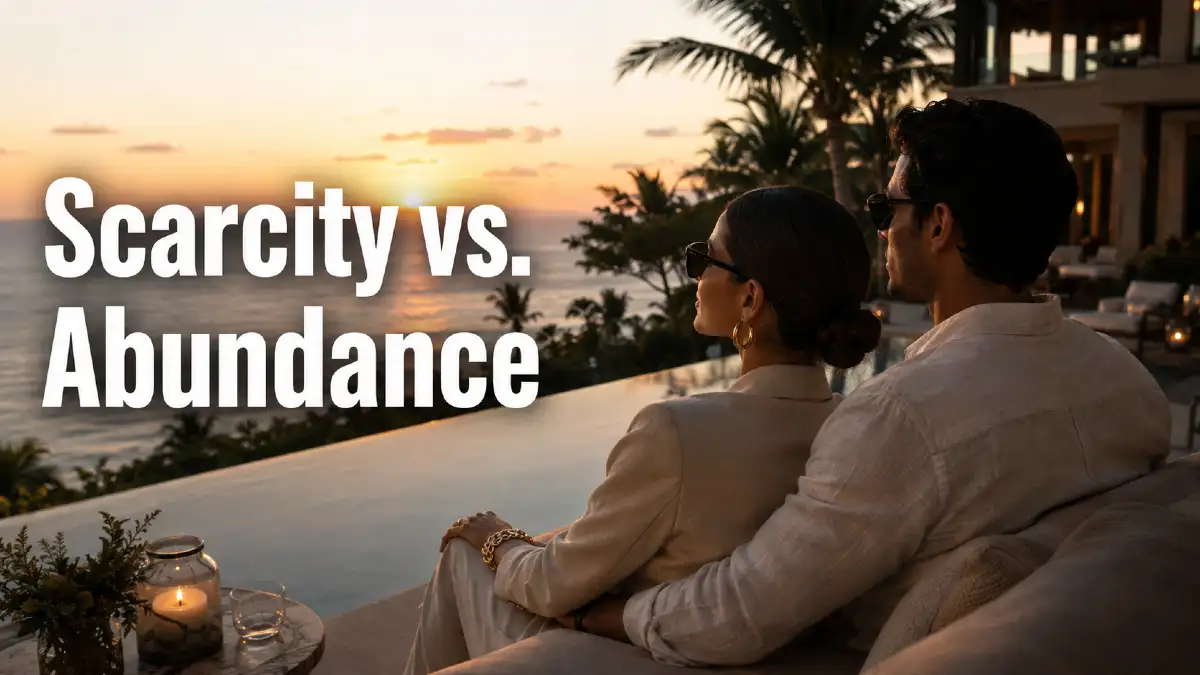
Two people have the exact same amount in the bank. One lies awake calculating worst-case scenarios, feels a jolt of fear with every expense, and is convinced it could all vanish at any moment. The other sleeps fine, spends and gives without panic, and carries a quiet sense that they’ll be okay. The number is identical. The difference is entirely in the mind — and it has a name: scarcity versus abundance.
Ken Honda describes this in Happy Money: The Japanese Art of Making Peace with Your Money using a simple image — a lake and a flow. Scarcity is the fear that there’s never enough and never will be; abundance is the felt sense that you have enough, that more can come, that you’re not desperate. He’s clear that this is largely independent of your actual wealth: plenty of people with real estate and trust funds still operate from a deep “myth of scarcity,” while others with far less live in genuine abundance. The mindset isn’t a readout of your balance — it’s a lens you bring, and it shapes both how money feels and, often, how much of it flows your way.
Scarcity isn’t about how much you have
The most counterintuitive part is that scarcity and abundance barely track your actual finances. We assume rich people feel abundant and people with less feel scarce, but Honda’s observation — and common experience — says otherwise. Scarcity is a fear state, and fear states don’t respond to evidence. Give a scarcity-minded person more money and the fear simply finds a new worst-case to fixate on; now there’s more to lose. The lack lives in the nervous system, not the account.
This is why “just earn more” so rarely cures money anxiety, and it’s the same insight behind why getting more money doesn’t stop the worrying. Scarcity is usually rooted in your money blueprint — an early experience that taught your system the world is unsafe and resources can disappear. Until that fear is addressed directly, no amount of accumulation reaches it. Abundance, conversely, is a felt sufficiency that some people carry at almost any income, because it’s a relationship with security, not a balance.
Where real security actually comes from
Honda offers a redefinition of security that cuts against everything the scarcity mind believes. True security, he argues, does not lie in how much money you have — it lies in who you know and trust. The scarcity mind is certain that safety is a number: enough in the bank, enough saved, enough hoarded against catastrophe. But that number keeps moving, and the people chasing it hardest are often the most anxious of all, because no balance ever silences a fear that was never really about balances.
Honda points instead to relationships and trust as the deeper reserve. The person surrounded by people who would show up for them in a crisis is, in a real sense, more secure than the isolated person with a larger account, because life’s genuine emergencies are met by people as much as by money. This reframes abundance entirely: it’s not just felt sufficiency about cash, it’s a felt sufficiency about your whole web of support. One concrete way Honda suggests proving abundance to yourself is to give a little away — donating even a small amount signals to your own mind that you have more than enough to share, which is the precise opposite of the scarcity reflex to clutch. You can’t simultaneously believe you’re running out and freely give some away, which is exactly why the small act of giving quietly rewires the fear.
How each mindset shapes behavior — and outcomes
The two lenses don’t just feel different; they produce different behavior, which produces different results, which loops back to confirm the lens.
Scarcity makes you grip. You hoard out of fear, struggle to spend or give, make anxious and short-sighted decisions, and often can’t take the calculated risks that build wealth because every risk feels like potential ruin. It also contracts you — generosity feels dangerous, opportunity feels threatening. Ironically, the fear of not having enough often keeps people from the very moves that would create more.
Abundance lets you operate from security rather than panic. You can spend and give freely (within reason), make calm long-term decisions, take sensible risks, and let money flow without clenching. This open, non-desperate state tends to attract more — partly because you’re making better decisions, partly because desperation repels opportunity while calm confidence draws it. Honda ties abundance to having “enough in reserve” emotionally, not just financially — the inner sense of sufficiency that changes how you act. It’s also why comparison is so corrosive: measuring against others manufactures scarcity out of plenty.
How to shift from scarcity to abundance
Moving the lens, not just the number:
Recognize scarcity as a feeling, not a fact. When the “never enough” panic hits, label it: this is a fear state, not an accurate readout of my situation. That separation alone loosens its grip and lets you check the actual facts, which are usually less dire than the fear claims.
Count what you already have. Scarcity fixates on lack; the direct antidote is noticing sufficiency. Honda even counts his trustworthy friends as a form of wealth. Regularly inventory what you do have — money, skills, relationships, resourcefulness — through a gratitude practice. Abundance grows from attention to enough.
Make one decision from abundance. Practice acting from sufficiency in small ways — a modest act of generosity, a reasonable purchase without guilt, a sensible risk — proving to your nervous system that letting money move doesn’t lead to ruin. Behavior teaches the feeling.
Address the root fear. Since scarcity is usually an old wound, lasting change means tending that fear directly — examining the blueprint and building trust — not just affirming abundance over a fear you haven’t faced.
Why “more” never becomes “enough”
Honda has a sharp analogy for why scarcity is a mindset rather than a measurement. Think about body weight: plenty of people say they’d like to lose a few pounds, and only rarely does someone wish to gain — but occasionally you meet a person who feels genuinely good in their own skin, just as they are. Money runs the same way, except the “feels good as they are” person is even rarer. Almost everyone says they want more; Honda says he’s met essentially no one who felt they had too much. The wanting is nearly universal and nearly bottomless.
That near-universal hunger is the giveaway that “more” was never going to deliver “enough,” because enough isn’t a quantity you reach — it’s a relationship with what you have. The person at peace with their body isn’t necessarily the lightest; the person at peace with money isn’t necessarily the richest. Both have simply stopped running the scarcity program and arrived at sufficiency from the inside. Honda’s warning attaches here too: the people who chase “more” most desperately tend to suffer the most stress and often fail hardest, precisely because the hunger driving them can’t be satisfied by acquisition. Abundance begins the moment you stop measuring and start appreciating.
The bottom line
You can have very little and live in abundance, or have a great deal and live in scarcity, because the two are mindsets, not balances. Scarcity is a fear state that grips, contracts, and sabotages — and that more money won’t cure, because it was never about the money. Abundance is a felt sufficiency that lets you hold money with an open hand, make calm decisions, and let it flow.
The work isn’t only to accumulate more; it’s to shift the lens — to address the fear, count what’s already there, and practice acting from enough. Do that, and you can feel rich long before any number says you should, which turns out to be the only kind of rich that actually feels like anything. For the full picture, see our complete Happy Money summary, and the trust that abundance ultimately rests on — trust the flow of money.
This article draws on the ideas in Ken Honda’s Happy Money*, recommended for anyone who has enough on paper but never feels like it.*