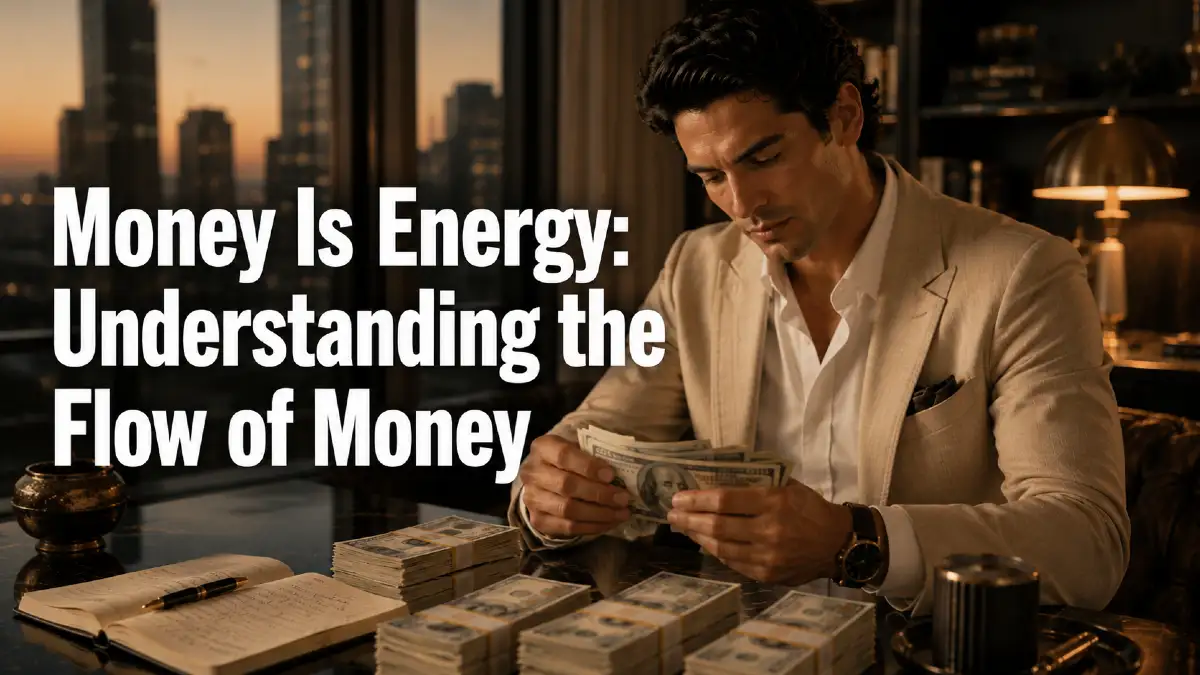
Notice the word we use for money: currency. It shares a root with “current” — something that flows. That’s not a coincidence, and it points to a way of seeing money that changes how it feels to earn, spend, and hold it. Most of us picture money as a static pile to accumulate and guard. Ken Honda invites a different picture: money as something that moves, like water or electricity — a current passing through your hands rather than a stash sitting in them.
In Happy Money: The Japanese Art of Making Peace with Your Money, Honda asks you to see money as energy flowing all around, mostly between people. When you buy something, money doesn’t really vanish — it flows to someone else, who uses it, who passes it on. You’re a point in a vast, constant circulation. You can hold the “energy” language as loose metaphor; the useful shift is real and psychological: relating to money as flow rather than as a hoard transforms your emotional experience of spending, earning, and having. Hoarders grip a current and create stagnation; people at peace with money let it move through them with ease.
Flow vs. stagnation
The hoarding mindset treats every dollar leaving as a loss — a little death, a subtraction from your pile. So spending hurts, generosity feels dangerous, and the goal becomes damming up as much as possible. The flow mindset sees money as moving energy: it comes in, it goes out, and both are natural parts of a healthy circulation. Spending isn’t loss — it’s money flowing onward to do its work elsewhere, often coming back around in time.
This isn’t an argument against saving (saving wisely is part of a healthy flow, not a violation of it). It’s about the emotion you attach to money’s movement. When you grip every dollar in fear, you create a kind of stagnation — anxious, contracted, joyless — even if your accounts look fine. When you let money flow with ease, both in and out, the whole relationship relaxes. Honda’s image is that hoarded money “cries” while circulated money “smiles.” Underneath the poetry: a clenched, fearful relationship with money feels bad regardless of the amount, while an open, trusting one feels good. This is the heart of the whole Happy Money idea.
Spending as participation, not loss
Reframing spending is where this gets practical. When you pay for something — a meal, a service, a gift — you’re not losing money; you’re participating in a flow, sending value to someone who provided value to you. Done with resentment (“I hate paying for this”), it’s Unhappy Money, and it sours every transaction. Done with appreciation (“I’m glad this exists and glad I can pay for it”), the very same payment becomes a positive exchange that feels good on both ends.
This is why two people can spend the identical amount and have completely different experiences of it. The flow mindset lets you pay bills, support others, and buy what you need without the contraction of loss — because you understand you’re a channel money moves through, not a vault it’s trapped in. And a channel that flows freely tends to have more moving through it than one that’s clenched shut. The receiving side of this flow — often the harder side — gets its own treatment in why receiving money is so hard.
Practical ways to start the flow
Honda doesn’t leave “flow” as an abstraction — he offers concrete, almost playful ways to get money moving with good energy, and they’re revealing precisely because they’re so small. Donate a little to a cause you care about (even a dollar tells your own mind you have more than enough). Buy gifts for friends — he keeps a whole closet of them at home and says when his family shops, they mostly shop for others. Buy from a real person you like rather than always defaulting to the cheapest online option, because doing so keeps someone you like in business and keeps you both in the flow.
Two of his suggestions genuinely surprise people. First: when you give or lend, give a little extra — if someone asks to borrow a pen, hand them a notebook too; if you’re hiring someone, offer slightly more than they asked. People tend to ask for less than they need out of the shame of “not having,” so giving extra turns anxious, reluctant energy into something warm. Second, and stranger: sometimes pay more than you’re billed, just to show appreciation. Honda does this and delights in the reaction — most people have never in their lives received more than they asked for. These aren’t financial strategies; they’re ways of practicing an open, generous relationship with money’s movement, the felt opposite of the clenched fist. The receiving side of this same flow gets its own treatment in why receiving money is so hard.
How to shift into a flow relationship with money
Moving from hoarding to flow:
Reframe spending as circulation. When money goes out, practice seeing it as flowing onward to do good elsewhere, not disappearing into a void. This single reframe takes the sting out of necessary spending and the guilt out of generosity.
Pay with appreciation, not resentment. Try silently appreciating what you’re paying for as you pay — the meal, the electricity, the work someone did. Resentful payment is Unhappy Money; appreciative payment keeps the flow clean and feels markedly better.
Don’t clench in fear. Notice when you’re gripping money out of anxiety rather than handling it wisely. Wise management and fearful hoarding look similar from outside but feel completely different inside — and the fear is the part that poisons your relationship with money. Releasing the clench is the work of trusting the flow.
Let it move in both directions. A healthy flow includes both earning/receiving and spending/giving, each done with ease. Blocked on either side — unable to receive, or unable to let go — creates stagnation. Aim for graceful movement both ways.
Keeping the flow human
Honda makes a point about where you let money flow that’s easy to overlook in a one-click world. Whenever possible, he suggests, buy from a real person you actually like — the local shop, the diner, the vendor you know — even when you could shave a little off the price online. When you do, you’re keeping someone you like in business, keeping them in their flow, and keeping a human relationship alive inside the transaction. He worries, reasonably, that if we route everything through the cheapest invisible option, the mom-and-pop shops that give a neighborhood its life quietly disappear.
His deeper observation is that physical shops still exist precisely because people don’t only want the lowest price — we want to see things, be inspired, and be around other people and good energy. Money, in this light, isn’t just a number moving between accounts; it’s a thread connecting you to actual humans. Spending it with that awareness — choosing, sometimes, the slightly costlier path that keeps a person you value afloat — is the flow mindset made concrete. It treats your spending as participation in a community, not just a search for the best deal, and it tends to feel markedly better on both ends of the exchange.
The bottom line
Money behaves a lot like a current, and your relationship with it depends enormously on whether you treat it as a flow to participate in or a pile to defend. The defender lives in contraction — every outflow a loss, every dollar gripped in fear — and feels poor no matter the balance. The participant lets money move through them with appreciation and ease, and feels rich in a way that doesn’t depend on the number.
You’re a point in a vast circulation of value. Relate to money as the flowing current it is, and the whole thing — earning, spending, having — gets lighter. For the full picture, see our complete Happy Money summary, and the mindset that makes flow possible — scarcity vs. abundance.
This article draws on the ideas in Ken Honda’s Happy Money*, interpreted as a lens for your emotional relationship with money.