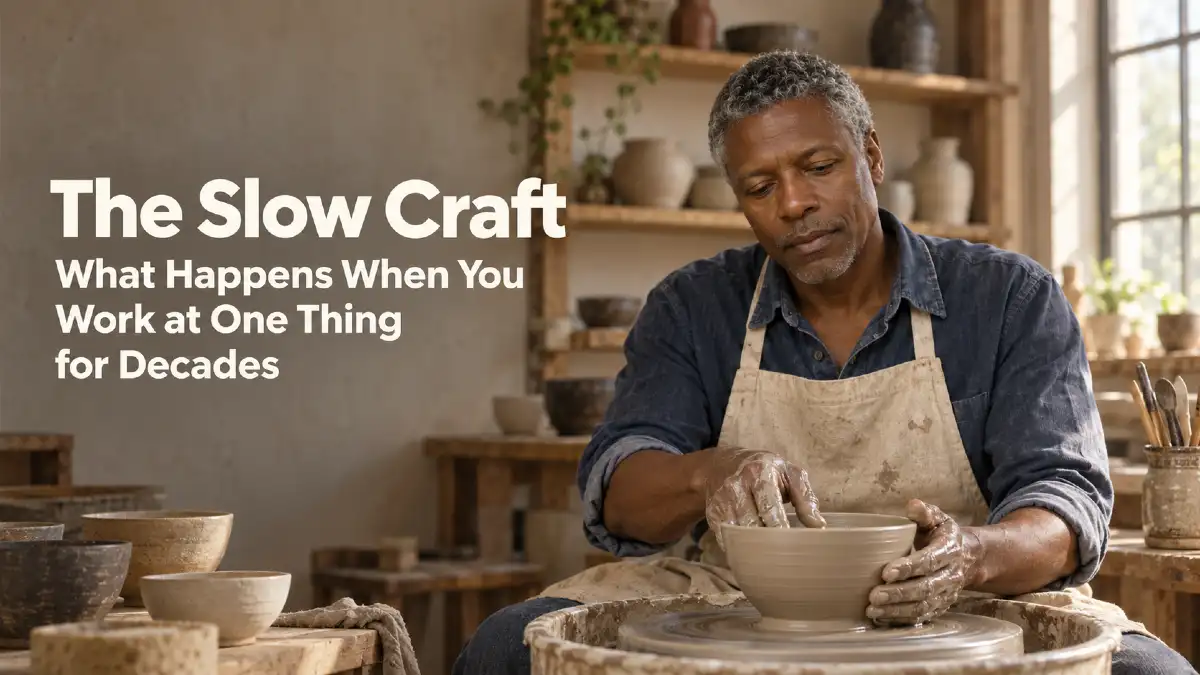
There is a category of human achievement that the contemporary culture has been busy making invisible. It is the achievement of the man who has spent thirty or forty years on the same craft — the cabinetmaker who has been making furniture in the same shop since he was twenty-five, the surgeon who has been operating on the same kind of hearts for four decades, the writer who has been working in the same form for most of his adult life, the farmer who has been working the same land across two generations. These men are not, mostly, famous. They are not on the lists of people whose accomplishments contemporary media celebrate. They are not what the success literature is pointing toward. They are also, on close examination, doing something that the more visible forms of contemporary achievement cannot reproduce.
The phenomenon has many names. Some traditions call it mastery. Some call it craft. Some call it the long apprenticeship. In its religious and contemplative versions it is sometimes called the way, in the sense of a path that is the same as the destination. What unites the names is the recognition that something different happens when a human being stays with one thing long enough for the something to become inseparable from him — and that the something cannot be produced any other way.
This piece is for the man who has been considering whether to commit to one thing for the long arc, or who has been on the path long enough to wonder whether the commitment is worth it, or who has been hopping between projects and is beginning to suspect that the hopping itself is part of why nothing has gone deep. The slow craft is not for everyone and not available in every field. Where it is available and where someone undertakes it, it produces a particular shape of life that, on examination, most other shapes do not match.
What the slow craft actually is
To understand the phenomenon, it helps to distinguish it from things that look like it but aren’t.
The slow craft is not the same as a long career. A man can have a career spanning forty years and produce, in the relevant sense, almost nothing of substance — moving through roles, accumulating titles, optimizing his position without ever going deep into the actual work. The slow craft involves sustained attention to a specific body of practice, not just sustained presence in an industry. Many long careers are not slow crafts.
The slow craft is not the same as expertise. Expertise can be acquired in five to ten years of focused work in a domain. After ten thousand hours of deliberate practice, a person becomes expert. The slow craft begins, in some sense, after expertise has been reached. The expert has learned the rules; the master of a craft has lived in the rules long enough that the rules have become part of how he sees, and the work he does after that point is qualitatively different from the work expertise alone produces. Most experts are not, in the relevant sense, on the slow craft path.
The slow craft is not the same as productivity. The contemporary discourse on work is heavily focused on output — how much can be produced per unit time, how to optimize the production, how to scale the contribution. The slow craft is, in its actual operation, often quite slow in this sense. The cabinetmaker who has been doing his work for thirty-five years may produce fewer pieces per year than a young craftsman with more energy and less attention to the depth of each piece. The output measure misses what is actually happening in the work.
What the slow craft actually is, on careful examination, is a relationship with a specific practice that has been sustained long enough that the practice has become the medium through which the practitioner thinks. The cabinetmaker no longer makes decisions about woodworking; the woodworking has, in some sense, become how he sees the world. The surgeon does not consciously apply techniques; the techniques have become how his hands and eyes and judgment operate. The writer does not assemble sentences from learned rules; the rules have become how language presents itself to him. The work has, in some real sense, transformed the worker.
This is what the older traditions were pointing at when they talked about mastery in the strong sense. Not the technical skill, which can be acquired in a decade. The deeper integration of the person and the work, which takes decades of sustained engagement and which produces something the contemporary culture has mostly stopped recognizing. The slow building of the kind of practical wisdom that sustained attention produces is part of what the path actually involves.
Why it has become rare
The slow craft has not always been rare. In many earlier cultural arrangements, the path was something like the default. Most people who learned a trade did so in their teens and twenties and continued in it for the rest of their working lives. The accumulated time on the same body of practice was the normal pattern. The contemporary arrangement, where a typical professional may have four or five career changes over a working life, is historically unusual.
The reasons for the contemporary shift are worth being honest about, because they are not all bad and not all good.
Economic mobility has increased. People can move between fields in ways that earlier generations could not. This is, on balance, a good thing — the constraint that once forced people to stay in a specific trade has loosened, and people now have options earlier generations did not have. The cost has been that the slow craft path has lost some of its structural support; staying in one thing now requires more deliberate choice, against more available alternatives.
The culture has been busy elevating change as a virtue. Reinvention, pivoting, exploring multiple careers — these have been framed as positive in the contemporary discourse, often without acknowledgment of what they cost. The man who has had four different careers is presented as more interesting than the man who has had one. The implicit framing is that staying in one thing reflects lack of ambition or imagination. This is, on examination, sometimes true and often false. The man who has stayed in one thing for thirty years is, sometimes, the man who never had options; he is also, sometimes, the man who saw what the depth was worth and chose to pursue it against the noise of available alternatives.
The economic returns to switching have, for many fields, exceeded the returns to depth. In many contemporary white-collar industries, the way to advance is to change companies every few years. The internal promotion ladders have slowed. The man who stays at one company for two decades is often paid less and given less responsibility than the man who has switched four times. The economic incentives have been quietly pushing against the slow craft pattern in much of the modern economy.
Algorithmic visibility has shifted attention toward what is newer. The contemporary attention economy is biased toward novelty. The thirty-year master of a craft is largely invisible online; the new entrant with a Twitter account is highly visible. The dynamic produces a particular kind of distortion in what younger workers see as worth pursuing. They see, mostly, the visible work; the invisible work, which is what mastery actually consists of, is mostly outside their field of view.
The genuine difficulty of sustaining commitment. The slow craft is hard. The middle years — once you have learned the basic skills but before the deeper integration has occurred — are often the least satisfying. The work feels repetitive, the visible progress slows, the question of whether to give up arises regularly. The cultural environment that does not value the path provides no support for getting through these middle years. Many people who would have completed the path in an earlier arrangement quit somewhere in their thirties or forties, partly because there is no surrounding culture to remind them what the path is producing in the meantime.
What the path actually feels like from inside
For the man considering whether to commit to the slow craft, or for the man who is on the path and uncertain whether to continue, it helps to be honest about what the experience actually feels like across the different stages.
The early years are mostly invisible. In the first three to five years of serious engagement with any craft, you are learning the basic vocabulary. The work is mostly imitation, application of received techniques, and the gradual acquisition of the specific motor and cognitive patterns the work requires. The output is, mostly, derivative. The feeling from inside is often one of inadequacy — you can see what the masters in the field are doing, and your own work is so far short of it that the gap is painful. This is normal and not, in the relevant sense, evidence that you should not be on this path.
The middle years involve a particular kind of darkness. Somewhere between years seven and fifteen, depending on the field, most practitioners hit a period where the early progress has slowed, the easier improvements have been made, and the deeper work has not yet begun to pay off. The output is technically competent but lacks the distinctive quality that the older masters produce. The work feels, often, like grinding. The question of whether to continue is, for most people, most acute in this period. Many people quit here. Those who continue have, on average, made the choice for the slow craft over the available alternatives in a way that the path will, eventually, vindicate. The middle darkness is not a sign that the path is wrong; it is a feature of the path itself.
Somewhere in the fifteen-to-twenty-year range, something shifts. This is where the integration begins to occur. The techniques that you learned consciously begin to operate automatically. The judgments that you used to have to reason out begin to arise as immediate perception. The work itself begins to feel different — less like applying skills to material, more like the material and the skills and you being in some kind of conversation that produces the work. This shift is hard to describe to anyone who has not gone through it; it is also unmistakable to those who have. The phenomenon is real, replicable across fields, and produces a kind of quality in the work that earlier stages cannot.
The later decades are where the deepest work becomes possible. After twenty or twenty-five years on the path, the practitioner has access to a kind of working that the earlier years could not have produced. The work draws on accumulated material that no shorter engagement could have built. The seeing is different. The judgment is different. The output, when it is at its best, has a quality that distinguishes it from competent professional work in ways that are hard to specify but easy to recognize.
This is the territory the older traditions were pointing at. The decades-long arc produces something that no shorter path can. The man who has spent forty years on his craft, if he is one of the men who actually went deep rather than just persisted in proximity to the work, is in possession of something rare and not commercially replicable. The slow craft, when it succeeds, produces the man it does. The broader question of how to find peace in the texture of a sustained life is part of what this kind of long engagement makes possible.
What it requires
The path is real and accessible to most people in most fields. It is also not easy, and the requirements are worth being honest about.
It requires a field that rewards depth. Some fields produce more depth at the long end of the arc than others. Crafts with deep accumulated tradition — carpentry, surgery, certain forms of writing, certain musical practices, certain scientific specialties — tend to produce more in the deep years than fields where the basic problem changes every few years. The man considering the path should think honestly about whether his field is one where the depth pays off. Not all fields are.
It requires commitment in the middle years. The middle darkness is where most paths end. The man who can sustain the commitment through the period when the work is not visibly improving has, on average, made the choice that the path actually requires. This is not glamorous. It is the slow accumulation of decisions, week after week, year after year, to keep showing up for work that is not, in the moment, particularly rewarding. The deeper capacity for persistence that this requires, and how to build it, is doing most of the work here.
It requires the willingness to do work that is not legible to the broader culture. The slow craft, by its nature, produces results that are not, mostly, visible in the contemporary attention economy. The master who has been doing his work for thirty years does not have a podcast, does not have a personal brand, does not appear in the visible economy of attention. The man on the path has to be willing to be largely invisible to the broader culture. For some people this is fine; for others, the desire for visibility pulls them off the path before the deep work has had time to develop. The broader question of what makes work meaningful when the visible rewards are slow operates particularly visibly here.
It requires being able to evaluate your own work without external validation. Because the broader culture is not, mostly, capable of recognizing what is happening in the long arc of a craft, the man on the path has to develop his own internal sense of whether the work is improving. This is, on examination, one of the harder skills. The man who depends on others to tell him whether his work is good will be misled, because most people cannot see what he is doing. The man who can hold his own internal standard, and revise it slowly as his understanding deepens, can keep the work moving in directions that the external feedback cannot point to.
It requires accepting the trade-offs. The slow craft makes certain other lives unavailable. The constant exposure to multiple fields that produces the dabbler’s breadth is not, mostly, compatible with the depth. The maximum financial return is often available through more switching than the depth-path allows. The breadth of social engagement that comes with multiple careers is not available to the man who has been in one field for decades. These are real trade-offs and the man who chooses the slow craft is, in some sense, choosing the costs that come with it. The question is not whether the trade-offs exist but whether what the path produces is worth what it costs.
The honest closing
The slow craft is not for everyone, not available in every field, and not the only way to produce a meaningful working life. For the man for whom it is available and to whom it appeals, it is a path that produces something the more visible forms of contemporary achievement cannot reproduce — a particular kind of integration between the person and the work, a quality in the work that no shorter engagement can match, and a shape of later life that has a depth most other shapes do not have.
The decision to commit to the path is, in some sense, a wager — a bet that the deep work will, eventually, be worth what the years of less-visible accumulation cost. The wager pays off, in most cases, for those who can stay with it through the middle darkness. It does not pay off for those who quit at year eleven, year thirteen, year fifteen, before the integration has had time to develop. The middle years are where most paths end. The decision to continue through them, even without the external evidence that the path is working, is what distinguishes the men who eventually do the deep work from those who don’t.
The contemporary culture is not, mostly, going to provide the support that the path needs. The visibility, the validation, the surrounding social structures that would have once made the path easier — these have mostly thinned. The man who undertakes the slow craft today is, mostly, doing so against the cultural current. The work of sustaining the commitment in this environment is, itself, part of what the path requires.
The masters who emerged from the older arrangements — the men who had spent forty years on their craft and produced work in their later years that the younger years could not have produced — are mostly gone now, or going. The question is whether anyone, in the present arrangement, is willing to undertake the long commitment that produces this kind of work. The slow craft is, in some sense, available to be undertaken by anyone who is willing to do it. The man who chooses to undertake it is, by the simple fact of doing so, doing something that the broader culture has been busy making rare. This is part of what makes the work, when it is eventually done, valuable in ways the visible market cannot price. The decision, like much that matters, is yours to make. The clock, gently, has already started.
Related posts:
 Cal Newport’s Slow Productivity: Book Summary and Honest Reading
 Slow Productivity: What Cal Newport Got Right About Deep Work in the Age of AI
 The Craftsman Mindset: Why Mastery Beats Passion
 The Marathon Continues: What Nipsey Hussle Taught Us About Ownership, Brotherhood, Legacy and Being a Man
 Why Loving Your Work Can Be Dangerous (And What to Do About It)