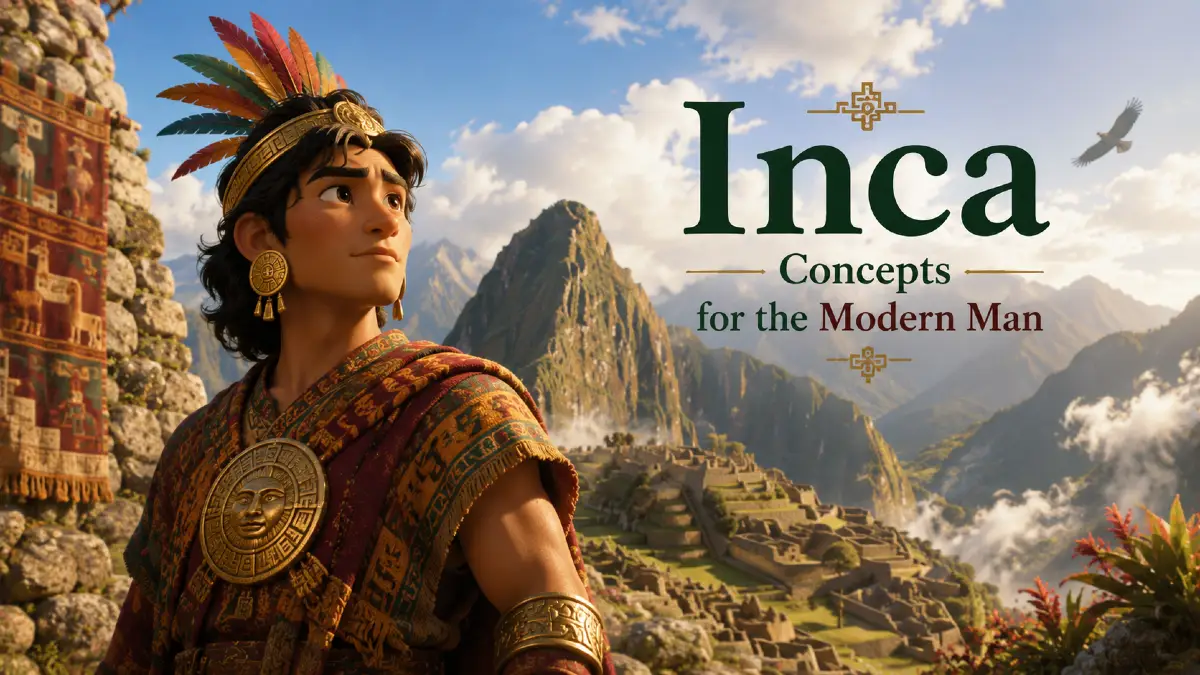
Before the Spanish arrived, the Andes were home to one of the most administratively sophisticated civilizations in human history—and one of the least understood masculine wisdom traditions. The Inca world built an empire of ten million people across mountains, deserts, and jungle, held together not by religion alone but by a coherent system of ethical concepts every man was expected to live by. Seven of those concepts, from ayni to llank’ay, still speak with unusual clarity to the modern man trying to live well in 2026.
The Inca Empire—Tawantinsuyu, the Land of Four Quarters—was not, as the colonial narrative often suggested, a primitive theocratic state. It was a meticulously organized civilization that fed millions, built thousands of miles of road across vertical terrain, ran a planned economy without writing or money, and produced a body of ethical thought as refined as anything contemporaneous in Eurasia. Most of the English-speaking world has never encountered it, because the conquest destroyed most of the textual record and what remained was filtered through Spanish missionary lenses.
What survived—in oral tradition, in Quechua linguistic memory, in the recorded testimony of Andean chroniclers like Felipe Guaman Poma de Ayala and Garcilaso de la Vega, and in the living practice of Andean communities today—is a system of concepts most modern men have never heard of, but which name dimensions of masculine life with surprising precision. Reciprocity as a daily ethical practice. Work as sacred. Wisdom as something integrated into the hands, not just the mind. The complementarity of opposites as the architecture of mature judgment.
This article makes no claim to speak for living Andean peoples, who continue to develop and practice these concepts in their own contexts. It is a respectful translation of seven core ideas from the Inca tradition, anchored where possible in scholarly and indigenous sources, and offered to the modern man as part of a serious wisdom-traditions conversation. Most Western masculine writing has overlooked the Andes entirely. That oversight has been the modern man’s loss.
What follows are seven of the most useful Inca concepts for the modern man, drawn from the ethical and philosophical inheritance of the Quechua-speaking civilizations of the Andes.
A Note on the Hatun Runa
The framing figure of this piece is the hatun runa—a Quechua term meaning roughly the great person or the full human. In the Inca social and ethical world, becoming a hatun runa was the developmental goal of a man’s life. Not merely an adult. Not merely a productive member of society. A full human: someone who had integrated wisdom, work, love, and reciprocity into a coherent way of being, and who carried his place in the larger weave of community and cosmos with the visible weight that responsibility deserves.
The hatun runa is the Andean parallel to the mensch, the vir, the junzi, the omoluabi. The concepts below are the path toward becoming one.
1. Ama Suwa, Ama Llulla, Ama Qhilla — The Three Laws
The Inca ethical system rested on a triad that every Andean child still learns today: Ama suwa, ama llulla, ama qhilla—do not steal, do not lie, do not be lazy. The three appear simple. They are not. The Inca tradition treated them as the irreducible ethical floor of a real man’s life, and the failure to honor any one of them disqualified a man from being considered a full participant in the community.
What makes the triad striking is its precision. Ama suwa—the prohibition against stealing—was understood broadly. To steal another man’s time, his reputation, his credit for work he had done, his attention under false pretenses, was all stealing. Ama llulla—the prohibition against lying—extended to small social lies, performance lies, lies of omission, and self-deception. Ama qhilla—the prohibition against laziness—was perhaps the most radical: in the Inca worldview, idleness when others were working was a form of theft, because it offloaded one’s share of labor onto others.
For the modern man, the triad is a structural diagnostic. He can audit his own life by it in five minutes. Where am I taking what is not mine—time, attention, credit, ease? Where am I shading truth—socially, professionally, with myself? Where am I idle while others around me carry the load? Most men, honestly applying the triad for a week, find more violations than they want to admit. That is the value of the standard. It is so simple that it cannot be argued with, and so demanding that it never stops sharpening the man who takes it seriously.
2. Munay — Love as Active Will
Munay is the Quechua concept that integrates two things English keeps separate: love and willpower. In the Andean tradition, munay is the felt energy that drives a man to do what matters—not abstract feeling, not romantic sentiment, but the active force in the chest that aligns desire with sustained action. A man with strong munay loves deliberately. He chooses to care. He pours energy into what he has decided is worth energy.
This integration matters because the modern Western framework usually separates these. Love is one thing—emotional, often passive. Will is another—muscular, often loveless. The Andean insight is that real love without will is sentimentality, and real will without love is brutality. Munay is what happens when the two are welded together.
For the modern man, the practical translation is sharp. The relationships that matter—with partner, with children, with community, with one’s own self-development—do not survive on emotion alone. They require munay: chosen, sustained, energetic devotion that does not wait to be moved by mood. The man who develops his munay can decide to love well, and then act on the decision through every condition the day produces. The man without it is, regardless of how much he feels, mostly inert.
The Quechua wisdom is clear: love that does not move the hands is not yet munay. The hands are the test.
3. Yachay — Wisdom Integrated Into the Body
Yachay is the Quechua word for wisdom, but the concept refuses the Western academic split between knowing-about and knowing-how. In the Andean tradition, yachay is wisdom that has been worked into the body and hands through practice—not just retained in the head. A man does not have yachay because he has read about something. He has yachay because he can do it, do it well, under varied conditions, and know in his hands when something is right or wrong.
The Andean masters traditionally taught that yachay requires three things to develop. Long apprenticeship under someone who already has it. Patient, repeated practice with the elements—fire, water, earth, air. And reflection that integrates what the hands have learned with what the mind can articulate. The yachaq, the wise person, is recognized not by what he says but by what his presence and conduct demonstrate.
For the modern man, yachay is a structural challenge to the information-as-knowledge framework that dominates contemporary self-improvement. Reading about meditation is not yachay. Watching videos about woodworking is not yachay. Subscribing to newsletters about discipline is not yachay. The man with yachay has done the thing he claims to know, for years, with his actual hands, under real conditions, until the knowing has soaked into how he moves. There is no shortcut. There never has been.
Pick one thing the modern man actually wants to know in this deep sense. Spend a decade on it. That is the Andean path to yachay, and there is no other.
4. Llank’ay — Work as Sacred Practice
The third leg of the classical Andean ethical tripod—alongside munay and yachay—is llank’ay: work, labor, sustained physical and mental effort. The Inca tradition treated llank’ay not as a necessary evil but as one of the three ways a man fulfills his humanity. Work was sacred. Done badly, dishonestly, or for selfish ends, it was a corruption. Done well, with skill and integrity and contribution to the community, it was a form of devotion.
This framing changes the entire posture of a man toward his daily effort. The modern Western frame treats work mostly as a means to other ends—income, status, retirement. The Andean frame treats the work itself as a primary site of meaning. A man at his bench, his desk, his field, his shop, doing his work well, is not biding time until he can do something more important. He is, in that moment, doing something important.
The practical implication is unmistakable. Bring full attention to the actual task. Do it well even when no one is watching. Refuse the half-effort that has become culturally normal. The Andean tradition records that a community could tell the quality of a man’s character by the quality of his llank’ay over time. Slipshod work was understood as a moral signal, not just an aesthetic one.
For the modern man, llank’ay is the antidote to phoning it in. There is no neutral work. Every task either embodies your character or corrodes it.
5. Ayni — Reciprocity as the Architecture of Relationship
If the Inca tradition has a single foundational concept, it is ayni—reciprocity. Ayni is the principle that every relationship—between humans, between human and earth, between giver and receiver—must rest on balanced, sustained, mutual exchange. The Andean phrase that captures it is kunan q’an, paqarin ñuqa—today you, tomorrow me. What flows must flow back. What is received must be returned. A man who only takes, or only gives, is in ayni terms broken.
This is more demanding than Western “reciprocity” usually suggests. Ayni is not transactional balance-sheet keeping. It is the felt obligation, embedded into daily life, that what circulates between humans is the substance of community itself. The Inca empire’s economic and social structure—the minka (collective labor for shared good), the mit’a (rotating service obligation)—was built on ayni as its operating principle.
For the modern man, ayni is the structural critique of the transactional life. Most modern relationships, including many friendships, drift toward asymmetry: one person gives, the other consumes; one initiates, the other receives. Over time, asymmetry corrodes the bond. Ayni demands the constant, slightly uncomfortable practice of attending to balance. Have I given what I received? Have I returned what was offered? Have I been the one carrying the relationship, or the one being carried, for too long?
A man whose relationships are in ayni walks lighter. Nothing is owed in either direction. The web is alive.
6. Yanantin — The Complementarity of Opposites
Yanantin is one of the most distinctive Andean philosophical concepts and one of the most useful for the modern man’s interior life. The word names the recognition that apparent opposites are actually complementary halves of a single whole, and that maturity consists in holding both rather than choosing one. Day and night, male and female, sun and moon, strength and softness, action and stillness, individual and community—each pair is not a battle but a yanantin, a pair that needs each other to be complete.
The Andean intuition is that immature thinking treats opposites as enemies. Mature thinking treats them as partners. A man who refuses his softness in the name of strength is, by yanantin logic, weakened. A man who refuses his ambition in the name of contentment is, by yanantin logic, half-formed. The work of maturity is to integrate the second half into the first, not to choose between them.
This concept addresses one of the defining failures of contemporary masculinity discourse, which is its tendency to polarize. The “alpha” framework requires denial of softness. The “soft male” framework requires denial of capacity for hardness. Both halves are necessary, the yanantin says, and a man who has only one is operating with half his equipment.
The practical move is concrete. Where in your life have you exiled one half of a pair you actually need? Where is the discarded half hiding, demanding to be reintegrated? Most men, asking the question honestly, can name three places before lunch. That is the diagnosis. Yanantin is the path back to wholeness.
7. Sumak Kawsay — The Good Living
The final concept on this list is the integrating one. Sumak kawsay in Quechua (also suma qamaña in Aymara) is usually translated as good living or the good life, and in recent decades it has become an organizing principle in Andean constitutional and ecological thought. But its roots are far older, and its meaning runs deeper than any single translation.
Sumak kawsay is the recognition that a good life is not a maximized life. It is not the life of maximum acquisition, maximum experience, maximum status. It is a life in balance—balance between work and rest, between giving and receiving, between human and earth, between self and community. The Andean vision is that a man living in sumak kawsay has enough, knows he has enough, and refuses the cultural pressure to be perpetually optimizing for more.
For the modern man, this concept is one of the sharpest correctives the article offers. The contemporary masculine economy is built on optimization—more output, more money, more fitness, more status, more growth. Sumak kawsay does not deny any of these as such. It denies that the unbounded pursuit of them constitutes a good life. The hatun runa, by Andean measure, is not the man with the most. He is the man with the right amount, lived well, in balance with everything around him.
The practical question is simple and unbearable. What in your life are you accumulating past the point of sumak kawsay—past the point where more is actually making things worse? Naming the answer is the first step. Acting on it is the work of years.
Where the Modern Man Can Actually Begin
Seven concepts is more than any man can absorb at once. The Andean approach has always been patient. A reasonable on-ramp looks like this.
Begin with the Three Laws. For one month, audit your life daily against ama suwa, ama llulla, ama qhilla. Where am I taking what is not mine? Where am I lying, even small? Where am I idle while others work? No need to fix anything yet. Just see clearly.
Add llank’ay. Choose the task you are most tempted to half-do and commit to doing it fully, every time, for a season. Notice what changes when one area of your work is done with full attention.
Then layer in ayni. Audit one important relationship. Has reciprocity been honored? If not, what needs to flow back? Begin to return what is owed. Begin to ask for what is owed to you.
The rest will follow. Munay grows as you love deliberately. Yachay deepens as you stay with your craft. Yanantin reveals the halves you have been exiling. Sumak kawsay becomes the felt result of all the other concepts working together over years.
Living the Way of the Hatun Runa
The seven concepts above were never independent items on a checklist. The Inca tradition treated them as facets of a single integrated way of being. The Three Laws were the floor. Munay, yachay, and llank’ay were the active substance of a developing man. Ayni was the relational architecture. Yanantin was the mature judgment underneath it all. Sumak kawsay was the felt quality of a life lived in alignment with the whole.
The modern man does not need to convert to anything Andean to take this tradition seriously. He needs only to recognize that one of the most refined ethical systems in human history was developed not in Athens or Beijing or Jerusalem but in the high mountains of South America, and that its core concepts have been preserved by Andean peoples through five centuries of catastrophe. They are still alive. They still work. And they still point toward the hatun runa—the full human, the complete man—that Andean wisdom has always insisted any man can become if he is willing to do the work.
The path is open. It has always been open. The seven concepts above are seven of the most useful tools the Andes have produced for walking it.
Related posts:
 The Way of the Omoluabi: 7 African Philosophy Concepts for the Modern Man
 The Way of the Lugal: 7 Mesopotamian Virtue Concepts for the Modern Man
 Why Bronze Age Villages Survived When Powerful Empires Fell
 The Way of the Bogatyr: 7 Slavic Philosophy Concepts for the Modern Man
 How Moral Awakenings Spark Social Change: The Psychology Behind Sudden Ethical Insight