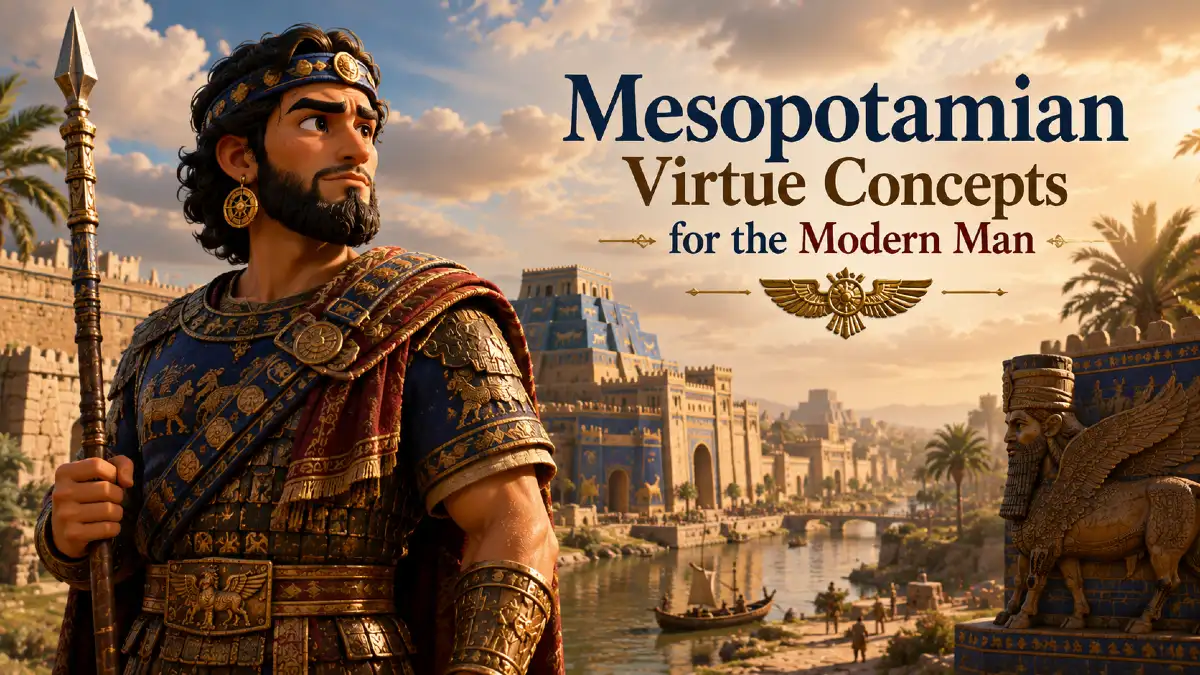
Mesopotamia gave the world its first cities, first writing, first laws, first epic poem, and—less famously—its first sustained masculine wisdom tradition. Five thousand years ago, in the cuneiform tablets of Sumer, Akkad, and Babylon, scribes recorded a body of advice on how a man should live that is, in places, indistinguishable from the best contemporary insight. The Epic of Gilgamesh alone is one of the most psychologically penetrating works of masculine literature ever produced. Seven Mesopotamian concepts, drawn from this oldest of recorded inheritances, still speak with unsettling precision to the modern man.
The civilizations of Mesopotamia—Sumer, Akkad, Babylon, Assyria—occupy a strange position in the modern imagination. Most educated men have a vague sense that something important happened there. Cities. Writing. Hammurabi’s code. The Tower of Babel. The Epic of Gilgamesh. But the wisdom tradition itself—the body of ethical thought these civilizations developed across three thousand years—is almost entirely invisible. Western masculine writing draws extensively from Greek, Roman, Christian, and increasingly Eastern sources. Mesopotamia, the deepest tap root underneath all of them, is mostly skipped.
This is a loss. The Mesopotamian record contains some of the oldest sustained reflection on the masculine condition that human beings have ever recorded. The Instructions of Shuruppak—a Sumerian text from roughly 2600 BCE—is, by some scholarly accounts, the oldest extant work of literature on earth, and it consists almost entirely of a father’s practical advice to his son. The Counsels of Wisdom, the Dialogue of Pessimism, Ludlul Bēl Nēmeqi (the Babylonian Job), and above all the Epic of Gilgamesh form a coherent inheritance of masculine reflection that the modern man can still read, with the right framing, as if it were addressed to him.
This article makes no claim to scholarly comprehensiveness. It is a translation, for a general masculine audience, of seven core concepts from the Mesopotamian wisdom inheritance—drawn from the surviving cuneiform record, the Gilgamesh epic, the wisdom literature, and the conceptual world the texts emerged from. Most modern men have never encountered any of this. The encounter changes how a man reads everything that came after.
What follows are seven of the most useful Mesopotamian concepts for the modern man, anchored in the world’s oldest documented masculine wisdom tradition.
A Note on the Lugal
The framing figure of this piece is the lugal (𒈗)—a Sumerian word literally meaning big man or great man, used to designate kings, rulers, and figures of significant standing. The lugal was the Mesopotamian masculine ideal: the man whose stature in the community was earned, whose word carried weight, whose decisions shaped the lives of those around him. The most famous lugal in the Mesopotamian imagination was Gilgamesh, the semi-divine king of Uruk whose epic remains, after four thousand years, one of the most useful masculine texts ever written.
The lugal is the Mesopotamian parallel to the mensch, vir, junzi, omoluabi. Becoming one was understood as the work of a man’s life. The concepts below are the toolkit the world’s first civilization produced for that work.
1. ME (𒈨) — The Civilizing Ordinances
The first of the Mesopotamian concepts for the modern man is also the oldest and most strange. Me (pronounced may) was the Sumerian word for the divine ordinances—the underlying patterns, institutions, and arts that made civilization possible. Kingship was a me. Truth was a me. Writing was a me. Music was a me. Each me was understood as a kind of divine technology, granted to humanity by the gods, that allowed civilized life to exist at all.
The Sumerian intuition was that civilization is not a default condition. It is a fragile achievement, held in place by the persistent practice of specific patterns. Take away the me—through war, neglect, or moral collapse—and the result is not freedom. It is chaos. The lugal’s central task was to uphold the me—to keep the civilizing structures functioning in his time.
For the modern man, the concept is a sharp corrective to the contemporary assumption that civilization is automatic. The Sumerians knew it wasn’t. They watched cities rise and collapse. They knew that the structures their grandfathers built could be lost in a single generation of inattention. The lugal who failed to uphold the me was, in Sumerian eyes, not just personally flawed. He was complicit in the unraveling.
The modern equivalent is the recognition that family, community, craft, and culture all rest on practices someone has to keep alive. The man who maintains the me of his life—the rituals that hold his family together, the standards of his work, the institutions he serves, the inherited wisdom he transmits—is performing a quiet but essential masculine function. The me does not maintain itself. Someone has to.
2. Namlulu — The Project of Becoming Human
Namlulu is the Sumerian word usually translated as humanity or humanness—but the word names something more specific than English captures. Nam-lú-ulu₃: the state of being a person, the project of being human. In the Sumerian conceptual world, being human was not a default. It was a developmental achievement. A man was born with the potential for namlulu. Whether he ever actualized it depended on what he did with his life.
The Gilgamesh epic is, at its core, a meditation on namlulu. Gilgamesh begins the poem as a half-divine king whose excess of force is destroying his own city. He is not, in any meaningful sense, human yet. The epic traces his slow movement toward namlulu through friendship with Enkidu, the death of his friend, the futile quest for immortality, and finally the hard-won acceptance of mortality and the return to his city as a different kind of king. By the end of the poem, Gilgamesh has become human—and the achievement is treated as far more important than the kingship he started with.
For the modern man, namlulu reframes the entire developmental question. The work is not to optimize. It is not to win. It is not to accumulate. It is to actually become human—to grow into the full capacity for the experience, responsibility, and presence that a developed human life requires. Most men are still potential. The Mesopotamian tradition is honest about this in a way few traditions have been since. Becoming human is hard. Most men never finish the job. The ones who do are the only ones who have, in any meaningful sense, lived.
The practical question is the one Gilgamesh had to answer. What is the part of you that is not yet human—the place where you still operate as raw force, ego, appetite, or fear? The work of namlulu is the slow conversion of that material into something more developed.
3. Kittu u Mēšaru — Truth Bound to Justice
In the Akkadian royal vocabulary, kittu (truth, fidelity) and mēšaru (justice, righteousness) were almost always paired. The phrase kittu u mēšaru—truth and justice—appears throughout the inscriptions of Mesopotamian kings, who understood their primary task as upholding the linked discipline of seeing truthfully and acting justly. Hammurabi’s famous code is, in its prologue, framed as the king’s commitment to kittu u mēšaru: to make truth and justice prevail in the land.
The pairing matters. The Mesopotamians understood that truth without justice is just analysis—and justice without truth is just force. Real masculine integrity requires both: the willingness to see what is actually happening, and the willingness to act on what is seen, even when the action is costly.
For the modern man, the pairing is a sharper standard than either virtue alone. He can see truthfully and do nothing. He can act forcefully on a falsehood. Neither is enough. The Mesopotamian frame demands both—the clear sight of kittu welded to the responsible action of mēšaru. The man who has only one half is not yet what the tradition was looking for.
The practical question is daily. Where in your life are you seeing the truth but not acting on it? And where are you acting strongly on something you have not yet seen clearly? The man who can answer both questions honestly, and adjust accordingly, is operating in kittu u mēšaru. That posture, sustained, is one of the most powerful masculine stances any tradition has ever produced.
4. The Gilgamesh–Enkidu Bond — Friendship as Transformation
The central relationship in Mesopotamia’s greatest text is not romantic. It is the bond between Gilgamesh and Enkidu—the wild man sent by the gods to be his equal, his companion, and eventually his transformative loss. The Mesopotamian tradition treats this kind of friendship—a deep, equal, transformative bond between men—as one of the highest goods available in a human life, and one of the primary engines of a man’s development.
What makes the Gilgamesh-Enkidu bond instructive is its substance. They were not buddies. They were not networking contacts. They fought side by side. They challenged each other. They mourned together. They made each other better. When Enkidu dies, Gilgamesh is shattered—and the shattering is what eventually makes him human. The Mesopotamian insight is that no man develops fully without the friendship of another man who knows him deeply enough to actually shape him.
For the modern man, this is one of the most urgent concepts in the article. The contemporary male friendship crisis is well-documented: shallow connections, declining numbers of close friends, men reporting they have no one to call in a crisis. The Mesopotamian tradition would consider this not just sad but developmentally disastrous. Without the deep friendship, the second half of namlulu cannot happen. The man stays half-formed.
The practical move is to identify whether you have, currently, an Enkidu. A man who knows you. Who challenges you. Who has been with you through real things. If the honest answer is no, the construction of that bond may be the most important masculine project available to you. The Mesopotamians were right four thousand years ago. The need has not changed.
5. Šimtu — Personal Destiny and Its Acceptance
Šimtu is the Akkadian word for personal fate or destiny—the specific shape of a man’s life, the particular conditions he was given, the limits and gifts that define his individual situation. The Mesopotamian tradition was unusually direct about šimtu: every man has one, no man chooses it, and a developed man learns to live well within his šimtu rather than constantly resisting it.
This is not fatalism. The Mesopotamian sources are full of men acting decisively, building, ruling, achieving. But underneath the action runs a recognition that some things cannot be changed: the era a man was born into, the family he came from, the body he inherited, the mortality that awaits him. The mark of a wise man, in the Mesopotamian view, is the ability to act with full energy within the conditions of his šimtu while accepting what cannot be moved.
For the modern man, šimtu is a corrective to the contemporary fantasy that anything is possible if you just want it enough. Some things are not possible for you. Some doors are closed because of when you were born, where, into what. The Mesopotamian frame says: this is not the tragedy. The tragedy is spending your life resenting the closed doors instead of working seriously through the open ones. Šimtu is the discipline of looking at your actual situation, accepting what is given, and then acting with everything you have within the actual conditions you face.
A famous line from the Gilgamesh epic captures it: the life that you seek, you will not find. Mortality cannot be escaped. The wise man accepts his šimtu, and turns his energy to what can be built within it. That is the Mesopotamian answer to the modern obsession with unlimited possibility.
6. Šubat Libbi — The Peace of the Heart
Šubat libbi is an Akkadian phrase meaning literally the dwelling place of the heart, often used to refer to inner peace—the settled, composed state of a man whose interior is at rest. The Mesopotamian texts treat šubat libbi as one of the rarer and more valuable achievements of a developed life. The lugal who has šubat libbi is governed differently than the man whose interior is chaotic. His decisions flow from a stable center.
This is striking because Mesopotamia was not a peaceful civilization. The texts emerged from a world of constant war, plague, political upheaval, and personal loss. Šubat libbi was not the absence of external difficulty. It was the inner achievement of composure despite external difficulty. The man with šubat libbi had done internal work serious enough that his peace was not contingent on conditions.
For the modern man, šubat libbi is the slow target of every meaningful spiritual or contemplative practice. It is not happiness. It is not optimism. It is something quieter and deeper: the settled interior of a man who has accepted his šimtu, made his peace with what cannot be changed, and developed enough character that the day’s events no longer destabilize his center.
The practice is patient. Daily silence. Honest self-knowledge. Acceptance of what is. Slow, deliberate building of the kind of internal life that can no longer be easily disturbed. Over years, the result is exactly what the Akkadian phrase names: a heart that has finally found its dwelling place.
7. The Wisdom-Through-Suffering Tradition — Ludlul Bēl Nēmeqi
The final concept on this list is not a single word but a literary inheritance. Ludlul Bēl Nēmeqi—I Will Praise the Lord of Wisdom, sometimes called the Babylonian Job—is an Akkadian poem about a man who loses everything, suffers without apparent reason, and finally arrives at a deeper wisdom than any he had access to before the suffering began. The poem is part of a broader Mesopotamian wisdom tradition that takes the redemptive value of suffering with full seriousness.
The Mesopotamian insight is that there is a kind of masculine wisdom that cannot be acquired any other way than through real, hard, prolonged suffering. The man who has never lost, never been broken, never been forced to question what he assumed was solid, has not yet been opened to the deepest layer of what wisdom requires. The Gilgamesh epic dramatizes this: only after Enkidu’s death, only after the failed quest for immortality, does Gilgamesh become wise.
For the modern man, this is a hard but useful concept. The contemporary instinct is to optimize suffering away—through medication, distraction, comfort, performance. The Mesopotamian tradition does not romanticize suffering, but it refuses to treat it as merely an obstacle to be eliminated. Some doors only open after a man has been broken open. Some forms of wisdom are only available on the other side of real loss.
The practice, if there is one, is to stop running. When suffering arrives—and it will—do not aestheticize it, do not perform it, do not flee from it. Carry it. Stay with it. Let it do the work it has come to do. The man on the other side will be different. That difference is the wisdom Ludlul Bēl Nēmeqi was trying to describe four thousand years ago.
Where the Modern Man Can Actually Begin
Seven concepts is more than a man can carry at once. The Mesopotamian wisdom tradition was patient. A reasonable on-ramp looks like this.
Begin with namlulu. Name, honestly, the part of you that is not yet human—the place where raw force, appetite, fear, or ego is still in charge. Don’t try to fix it yet. Just see it clearly. The seeing is the first move.
Add the Gilgamesh-Enkidu test. Ask whether you currently have a real masculine friendship—a man who knows you, challenges you, has been with you through real things. If the answer is no, this is the project to begin. Find or build it. Nothing else matters as much.
Then practice šimtu. Identify three conditions in your life that you have been resenting or fighting that are not actually changeable. Accept them. Redirect that energy toward what is open. Notice the strange relief.
The rest will follow. Me surfaces as the practices you decide to uphold. Kittu u mēšaru sharpens as you align seeing with action. Šubat libbi slowly arrives as the interior work continues. The wisdom-through-suffering tradition is what you carry with you when difficulty inevitably comes.
Living the Way of the Lugal
The seven concepts above are the oldest sustained masculine wisdom on record. They come from a civilization most modern men know nothing about, written in a language no one has spoken for two thousand years, preserved on clay tablets buried under Iraqi soil. And yet, read carefully, they speak with the clarity of something written last week. The reason is simple. The masculine condition has not changed as much as the modern conversation suggests. The questions the Mesopotamians were asking are still the questions. They simply had longer to think about them.
The modern man does not need to be Sumerian, Akkadian, or Babylonian to take this inheritance seriously. He needs only to recognize that the oldest documented wisdom tradition on the planet has been quietly available all along, waiting for any man willing to read it. Open Gilgamesh. Read the Instructions of Shuruppak. Sit with Ludlul Bēl Nēmeqi. The voices are old. The teaching is current.
The lugal is not a relic. He is the great man—the developed, civilized, fully human ruler of his own life—toward whom four thousand years of Mesopotamian thought has been pointing. The seven concepts above are the tools the world’s first civilization produced for the work of becoming one.
Related posts:
 Masculine Leadership in Relationships Without Control
 The Way of the Vir: 7 Roman Virtues for the Modern Man
 How to Attract Women Without Chasing or Performing
 Ryan Holiday’s “Wisdom Takes Work”: Why Philosophy Only Matters When It’s Practiced
 How to Attract High-Value Women by Mastering Yourself First